


Most Nigerian traders are set up to fail before they place their first trade.

Olumide Adeyemi
Пионер трейдинга в Западной Африке ·  Nigeria
☕ 11 мин чтения
Что вы узнаете:
- 1The Regulatory Maze: CBN, SEC, and You
- 2Understanding the Naira: The Real Cost of Trading
- 3Choosing a Broker in Nigeria: The Practical Reality
- 4Trading Strategies That Work (In This Volatility)
- 5Common Pitfalls (And How to Avoid Them)
- 6The Future: SEC Regulation and What's Next
- 7Your Action Plan (Starting Today)
Most Nigerian traders are set up to fail before they place their first trade. They're chasing quick Naira profits in a market that's designed to take their money. I've seen it for over a decade. The truth is, the Nigerian forex market isn't just about charts and pips; it's a psychological and regulatory minefield where the rules change while you're in a trade. This guide won't sugarcoat it. I'll show you exactly how the market works, why most traders lose, and what you need to do differently to have a real shot.
If you think you're just trading EUR/USD, think again. You're trading in a system where the government is actively trying to stop the Naira from collapsing. That changes everything.
The Central Bank of Nigeria (CBN) is the main player. For years, they ran a fragmented system with multiple exchange rates. That created a paradise for arbitrage but hell for regular people trying to get dollars. In 2023, they unified the market under the Nigerian Foreign Exchange Market (NFEM), adopting a 'willing buyer, willing seller' model. In theory, this means market forces set the rate. In practice, the CBN still intervenes heavily to manage volatility.
Here's where it gets personal for you. The Investments and Securities Act (ISA) 2025 changed the game for retail traders. Before this, online forex trading platforms operated in a grey area. Now, it's illegal to operate one without registering with the Securities and Exchange Commission (SEC). This is huge. It means the SEC is finally stepping in to regulate the brokers you and I use.

Warning: Don't assume your favorite international broker is SEC-regulated. Most aren't yet. You're likely trading with a broker regulated offshore (like Seychelles or Cyprus). The new law aims to change that, but enforcement takes time. Always check a broker's regulatory status in their Exness review or XM review before depositing.
The CBN also launched the Nigerian FX Code in 2025. It's a set of rules for banks and authorized dealers, not directly for you, but it affects the liquidity and pricing that eventually trickles down to your trading platform. The goal is 'transparency.' My experience? More rules often mean wider spreads during volatile Naira news events.
What This Means for Your Trades
Every major CBN announcement - interest rate decisions, BDC policy changes, reserve figures - creates instant volatility. I learned this the hard way in 2022. I was in a short USD/NGN position (betting the Naira would strengthen) when the CBN announced a new BDC policy. The spread widened from 50 pips to over 300 pips in seconds. My stop-loss was triggered at a horrific price, turning a small planned loss into a account-damaging one. The market didn't care about my technical analysis. It cared about the CBN.
Your job is to know the calendar. The CBN Monetary Policy Committee meetings are more important for Naira pairs than any Non-Farm Payroll report. Trade around them, not through them.

💡 Совет Уинстона
Your first profit target should always be to move your stop-loss to breakeven. Protecting capital is job one. Profits are a secondary benefit.
Let's talk numbers, because sentiment doesn't pay losses. The Naira's story is one of brutal depreciation.
Look at this move: from roughly N400/$1 in early 2023 to N1,700/$1 by late 2024. That's a 325% move. For context, a major forex pair like EUR/USD might move 10-15% in a year. This isn't normal forex volatility; this is a currency in crisis.
| Period | Approx. Rate (NGN/$) | Depreciation |
|---|---|---|
| Early 2023 | 400 | - |
| Late 2024 | 1,700 | ~325% |
| CBN Projection for 2026 | 1,400 | (A hoped-for stabilization) |
What does this mean for you?
- Your Deposit Erodes in Naira Terms: You deposit 100,000 NGN when the rate is 1,000/$1. That's $100 in your trading account. If the Naira weakens to 1,500/$1 and your account value stays at $100, it's now worth 150,000 NGN. That looks like a 50% profit in Naira, but it's a phantom gain. You didn't trade well; the floor just fell out of your local currency. Conversely, if the Naira strengthens, your dollar-denominated account loses Naira value.
- Broker Costs Are in Dollars: Your spreads, commissions, and swap fees are charged in the currency of your account (usually USD). When the Naira weakens, these costs become more expensive in your local currency. That tiny 0.6 pip spread on EUR/USD adds up faster than you think.
- Inflation is Your Silent Enemy: Inflation hit over 32% in late 2024. Even if you make a 10% return in dollars in a year, you're still losing purchasing power in Nigeria if inflation is higher. Your trading isn't happening in a vacuum.

Example: You want to buy a laptop that costs $1,000.
- In Jan 2023 (NGN 450/$): You need 450,000 NGN.
- In Jan 2025 (NGN 1,500/$): You need 1,500,000 NGN. To afford the same laptop, your trading returns need to outpace the Naira's collapse against the dollar, not just the market you're trading.
The CBN is fighting this with high interest rates (they peaked at 27.5%) to attract foreign capital and support the Naira. As a trader, high interest rates in Nigeria mean higher swap fees for holding Naira positions overnight, which can eat into a swing trading strategy.
“The Naira's volatility isn't a trading opportunity for beginners; it's a financial woodchipper.”
Forget the fancy ads. Choosing a broker here is about survival, not bonuses. Based on the data and my own experience, here’s the breakdown.
Minimum Deposits: They're low for a reason - to get you in the door. You can start with $1 or $10. My blunt advice? Don't. Starting with a tiny amount teaches bad habits. You'll over-use because 'it's only $10.' Start with an amount you'd genuinely hate to lose, enough to force you to use proper position size calculator discipline. For most, that's at least $200-500.
Spreads & Commissions: This is your true cost of doing business. ECN accounts with raw spreads (0.0 pips on majors) plus a commission are often cheaper for active traders. Commission-free accounts have the cost baked into a wider spread. You need to do the math.
- Example: On a commission-free account with a 1.5 pip spread for EUR/USD, you pay $15 on a standard lot ($10 per pip x 1.5 pips).
- On a raw spread account with 0.1 pip spread + $7 commission round turn, you pay $8 total ($1 spread cost + $7 commission).
The raw spread account is cheaper. Brokers like IC Markets and Pepperstone are known for this model.
use: Up to 1:2000 is advertised. This is a weapon that will blow up your account if you're not trained. Nigerian markets are volatile. High use on volatile assets is a recipe for a margin call. I never use more than 1:50 on major forex pairs, and even that's aggressive for a beginner.
Deposits & Withdrawals: This is the daily hassle. Bank transfers can take days and attract bank charges. E-wallets like Opay or Paga are faster. Some brokers offer direct NGN accounts, which simplify things but lock you into the broker's conversion rate. Always check withdrawal times and fees in reviews before you sign up.
The classic strategies from textbooks often fail here. You need to adapt.
Forget Buy-and-Hold on Naira Pairs: You don't 'invest' in USD/NGN. You trade the volatility spikes around CBN news, liquidity crunches (often month-ends when businesses need dollars), and official vs. parallel market gaps. This is pure news and sentiment trading. I use very tight stop-losses and only risk 0.5% of my account on these trades because the slippage can be monstrous.
Major Pairs (EUR/USD, GBP/USD) Are Your Sanctuary: These are your core trading instruments. The liquidity is deep, spreads are tight, and the moves are more technical. You can actually apply RSI indicator divergences or MACD indicator crossovers with some reliability. This is where you build your consistent edge. The Naira's drama is just background noise for these pairs.
Gold (XAU/USD) is a Popular Hedge: When Nigerians lose faith in the Naira (and sometimes the dollar), they flock to gold. XAU/USD often sees bullish momentum during Naira crises. It's not a perfect correlation, but it's a useful sentiment gauge.
Scalping is Risky But Possible: Scalping requires ultra-low latency and tight spreads. If you have a stable, fast internet connection and are using a top-tier broker with local servers, it's possible on major pairs. Avoid scalping Naira pairs - the spread will kill you.

Pro Tip: Your most important tool isn't an indicator; it's an economic calendar. Mark every CBN MPC meeting date, FX reserve publication date, and inflation data release. Do not have open Naira-related positions during these events. Period.
💡 Совет Уинстона
If you feel a strong emotional urge to 'double down' on a losing Naira trade, close your chart and take a walk. You're about to pay a very expensive tuition fee to the market.
“Your edge in Nigeria isn't predicting the CBN; it's managing risk while everyone else is panicking.”
I've made these mistakes so you don't have to.
Pitfall 1: Trading Based on Patriotism or Anger. 'The Naira is too weak, it must bounce back!' That's not analysis; it's hope. I watched the Naira go from 800 to 1200, thought 'surely it can't go higher,' and shorted it. It went to 1700. I was mathematically wrong and emotionally wiped out. Trade the chart in front of you, not your opinion of what the currency should be worth.
Pitfall 2: Chasing Parallel Market Rates. You see the dollar selling for 1800 in the parallel market and your broker's USD/NGN is at 1600. You think you've found free money. It's a trap. The broker's rate is based on the formal market (NFEM). You cannot arbitrage this as a retail trader. The spread between the two is a risk premium, not a guaranteed profit.
Pitfall 3: Ignoring the True Cost of a Pip. A pip for USD/NGN is worth a different amount than a pip for EUR/USD. If you trade both with the same lot size, you're risking vastly different amounts. You must calculate your position size for each pair, every time.
Pitfall 4: Underestimating Internet and Power Issues. Your generator kicks off during a trade, or your data gets choppy. By the time you're back online, your stop-loss has been hit and the price has recovered. It's infuriating. Have a backup: a power bank for your router, a mobile data hotspot ready to go. Treat your trading setup like life support.
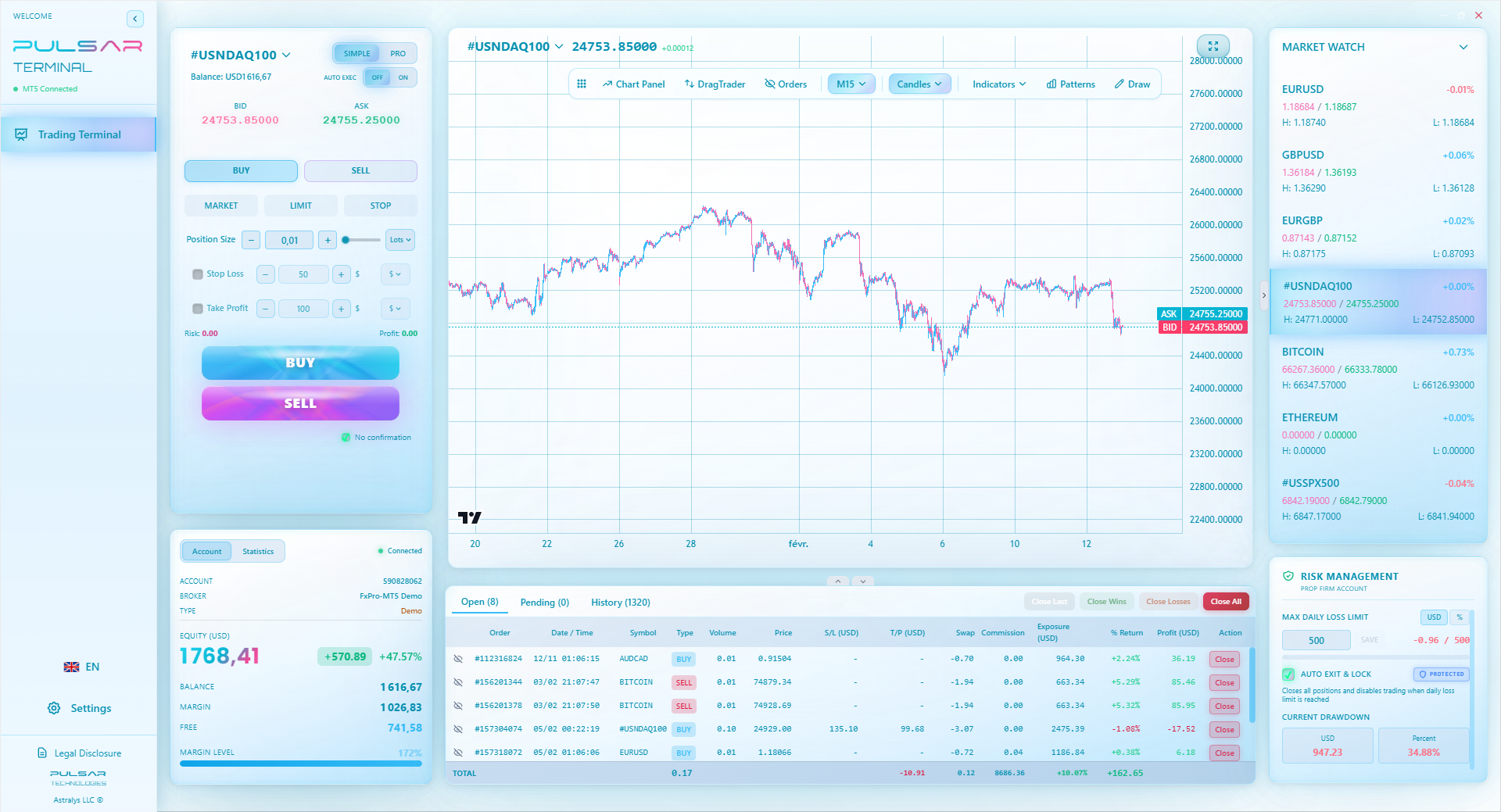
Managing multiple trades and stop-losses during Naira volatility is chaotic, which is why tools like Pulsar Terminal that automate partial closures and breakeven moves directly on MT5 are essential for Nigerian traders.
Pulsar Terminal
Универсальный инструмент для MT5: drag-and-drop ордера, мульти-TP/SL, трейлинг-стоп, грид-трейдинг, Volume Profile и защита для проп-фирм. Используется 1000+ трейдерами ежедневно.
The ISA 2025 is the biggest shift on the horizon. The SEC is now mandated to regulate 'virtual and digital asset exchanges and other market venues.' This will likely mean:
- Licensing for Platforms: Local and international brokers serving Nigerians may need SEC approval. This could improve fund safety but may also restrict broker choice.
- Capital Requirements: Brokers may need to hold more capital locally, which could increase costs that get passed to you.
- Dispute Resolution: You might finally have a clear local path for complaints, instead of dealing with offshore regulators.
It won't happen overnight. There will be a transition period. Use this time to get your house in order. Trade with reputable, well-established international brokers who are most likely to comply with new regulations. The cowboy days of completely unregulated platforms are numbered.
The CBN's goal is to stabilize the NFEM rate, rebuild reserves (they're targeting over $51 billion), and let the market find a 'true' price. For you, this means the insane volatility of 2023-2024 might moderate. Trading might become more about economics and less about panic. That's a better environment for developing a real skill.
Your edge in the future won't be guessing the next CBN move; it will be mastering technical execution and risk management while everyone else is still distracted by the noise.
💡 Совет Уинстона
Track your trades in Naira, not just dollars. A 5% dollar gain is meaningless if the Naira depreciated 20% in the same period. Know your real return.
“Starting with a $1 account teaches you how to lose, not how to trade.”
- Education First, Money Second: Spend three months on a demo account. Not one week. Three months. Go through a full market cycle. Practice during CBN news events.
- Pick One Major Pair: Master EUR/USD. Understand its daily range, its typical reaction to news. Don't touch USD/NGN until you are consistently profitable on the majors for at least 6 months.
- Choose a Regulated Broker: Pick one from a detailed review. Compare their spread structures on the pair you'll trade and their NGN deposit/withdrawal process.
- Write a Trading Plan: It must include your risk per trade (I recommend 1% max), your daily loss limit, the setups you'll take, and the news events you'll avoid. Then follow it like a robot.
- Start Small, Scale Slowly: Fund your live account with an amount you can afford to lose. Your goal for the first year is not to get rich. It's to not blow up. If you end the year with your initial capital intact, you're in the top 20% of traders. Seriously.
The Nigerian forex market is tough, but it's not impossible. The volatility that destroys the unprepared can be harnessed by the disciplined. Stop looking for the secret. Start managing your risk. That's the only edge that matters here.
FAQ
Q1Is forex trading legal in Nigeria?
Yes, forex trading is legal. However, the regulatory landscape is changing. The Central Bank of Nigeria (CBN) regulates the underlying foreign exchange market. Crucially, the Investments and Securities Act (ISA) 2025 now requires online forex trading platforms to register with the Securities and Exchange Commission (SEC). You, as an individual trader, are legal, but you must ensure you use reputable services.
Q2What is the best broker for forex trading in Nigeria?
There's no single 'best' broker. It depends on your needs. Look for brokers with strong international regulation (like ASIC, FCA, CySEC), competitive spreads on the pairs you trade, and reliable deposit/withdrawal methods for Naira. Brokers like Pepperstone, IC Markets, and Exness are popular among experienced Nigerian traders for their tight spreads and platform reliability. Always read an independent Pepperstone review or similar to get the full picture.
Q3Why is the Naira so volatile?
The Naira faces structural issues: high demand for dollars for imports, lower oil export revenue (a major dollar earner), and historical market fragmentation. The CBN's efforts to unify rates and clear FX backlogs create short-term volatility as the market searches for a new equilibrium. For traders, this means USD/NGN is extremely news-driven and risky.
Q4How much money do I need to start forex trading in Nigeria?
Technically, you can start with as little as $1 with some brokers. Practically, this is a terrible idea. A micro-account encourages reckless over-leveraging. To trade properly with sensible position sizing and survive inevitable losses, a starting capital of at least $500 is more realistic. This allows you to risk 1% ($5) per trade, which is a standard risk management rule.
Q5Can I trade forex with my Nigerian bank?
No, Nigerian commercial banks (like Zenith, GTB) are not retail forex brokers. They are Authorized Dealers in the CBN's formal market for large transactions. You cannot open a leveraged trading account with them to speculate on currency pairs. You must use a dedicated online forex broker.
Q6How do I withdraw my profits in Naira?
Your broker will convert your dollar-denominated profits to Naira upon withdrawal. You typically request a withdrawal to your bank account or e-wallet (like Opay). The broker uses their own exchange rate, which is usually close to the formal market (NFEM) rate, not the parallel market rate. Processing times vary from a few hours to several business days.
Q7What is the difference between the official rate and the black-market rate?
The official rate is set in the Nigerian Foreign Exchange Market (NFEM) where banks and large institutions trade, governed by CBN rules. The black-market (parallel) rate is determined by street demand and supply, often reflecting a premium due to dollar scarcity in the formal system. The gap between them represents market distortion and risk. Your broker uses a rate aligned with the official market.
Урок проф. Уинстона
Ключевые выводы:
- ✓Risk max 1% per trade on Naira pairs
- ✓Trade majors (EUR/USD) 90% of the time
- ✓Avoid trading 1 hour before/after CBN news
- ✓Calculate position size for every single trade
Насколько полезна эта статья?
Нажмите на звезду
Еженедельные торговые инсайты
Бесплатный еженедельный анализ и стратегии. Без спама.
Об авторе
Olumide Adeyemi
Пионер трейдинга в Западной Африке
Один из самых активных преподавателей форекс-трейдинга в Нигерии. 8 лет торгового опыта из Лагоса. Специализируется на стратегиях с малым капиталом и челленджах проп-фирм для африканских трейдеров.
Комментарии
Предупреждение о рисках
Торговля финансовыми инструментами сопряжена со значительным риском и может не подходить всем инвесторам. Прошлые результаты не гарантируют будущих доходов. Данный контент носит исключительно образовательный характер и не является инвестиционной рекомендацией. Всегда проводите собственное исследование перед торговлей.
Вам также может понравиться

Cara Trading Forex Sukses: 7 Prinsip dari Trader Profesional
Cara trading forex sukses dengan 7 prinsip trader pro: manajemen modal, disiplin, journal trading, backtest. Data nyata, bukan janji profit palsu.
Jam Trading Forex Terbaik untuk Trader Indonesia: Panduan Lengkap dengan Tabel Waktu
Panduan jam trading forex untuk trader Indonesia. Tabel 4 sesi dunia, jam emas 20:00-00:00, sesi mana yang harus dihindari. Data akurat + tips dari trader berpengalaman.
Top 5 Sàn Forex Uy Tín Nhất 2026: Review Jujur dari Trader Indonesia
Top 5 sàn forex uy tín 2026 untuk trader Indonesia. Review jujur: spread, deposit, withdraw, dukungan lokal. Exness, XM, IC Markets & lebih.
Скачать Pulsar Terminal
Все эти калькуляторы встроены в Pulsar Terminal с данными в реальном времени с вашего счёта MT5.
Скачать Pulsar Terminal