


Let's cut through the hype.

James Mitchell
Старший аналитик по трейдингу
☕ 11 мин чтения
Что вы узнаете:
- 1What Exactly Is a "No Evaluation" Prop Firm?
- 2The Real Costs and The Fine Print That Gets You
- 3The Murky U.S. Regulatory Gray Area
- 4Who Should Actually Consider One? (Spoiler: It's a Short List)
- 5No-Eval vs. Traditional Prop Firm: A Side-by-Side Breakdown
- 6Red Flags and How to Vet a Firm (If You're Still Going For It)
- 7My Final Verdict and Realistic Alternatives
Let's cut through the hype. The promise of a no evaluation prop firm sounds like a trader's dream: skip the grueling challenge, get funded capital immediately, and start making real money. It's a fantasy sold hard on social media. But here's the controversial truth: for 95% of traders, it's a faster, more expensive way to lose. I've traded with them, and I've seen the fine print that bites. This isn't about gatekeeping; it's about cold, hard reality. I'm going to show you exactly how these firms work, why their rules are often stricter than a prison warden's, and whether they're even legal in the current regulatory mess.
Forget the two-step challenge, the profit target phase, the whole drawn-out audition. A no evaluation prop firm (sometimes called instant funding or direct funding) says, "Here's the capital, start trading." You pay a fee, and in theory, you get immediate access to a simulated account with a large balance that mirrors a live account.
The core appeal is obvious: speed and accessibility. If you're an experienced trader with a proven strategy, why jump through hoops for months? The problem is, the firm hasn't vetted you. They have no idea if you're a disciplined pro or a gambler with a hot streak. To compensate for that massive risk, they build a fortress of rules around their capital. The trade-off is simple: you skip the test, but you trade in a much smaller cage.
It's crucial to understand that most of these firms, evaluation or not, are not putting your trades into the live market initially. You're trading in a simulated environment. Your profits and losses are tracked, and if you're successful and follow all their rules, they may allocate real capital to you or pay you out from their own funds. This structure is why they've largely flown under the radar of regulators like the SEC and CFTC - they're not handling client investment funds in the traditional sense. They're providing a performance-based service.

💡 Совет Уинстона
A firm that's afraid to show you its full rulebook before you pay is a firm that plans to use those rules against you. Transparency is non-negotiable.
“You're trading speed for security, flexibility, and often, a fair shot.”
This is where the dream meets the spreadsheet. That upfront fee? It's not just an entry ticket; it's your skin in the game, and it's usually higher than a standard challenge fee. I've seen fees ranging from $500 for a $10,000 account to over $2,000 for $100,000. They justify it by saying they're taking on more risk by not evaluating you.
The Profit Split Illusion
They'll advertise "Up to 90% profit split!" Sounds great. But that "up to" is doing heavy lifting. You might start at 50/50 and have to hit certain milestones to scale up. Even at 90%, remember they're taking a cut for providing... what, exactly? Capital you can't withdraw and a set of restrictive rules. Compare that to simply growing your own account where you keep 100%.
The Rulebook Designed to Protect Them
This is the killer. Without an evaluation to prove you can manage risk, they impose draconian limits.
- Daily Loss Limits: Often a tiny 3-5% of your account's starting balance. Have one bad trade in the morning? You're done for the day. No chance to recover. This alone can wreck most swing trading strategies.
- Maximum Drawdown: Usually a strict 5-10%, calculated from your starting balance or peak equity, whichever is higher. This is a trailing stop on your entire account.
- Trading Restrictions: Banned from holding trades over weekends, news trading, or trading certain instruments. Your strategy might be invalid from day one.

Warning: That "maximum drawdown" is almost always a hard stop. If your floating losses plus closed losses hit that number, your account is terminated instantly. No warning, no margin call. Game over, fee gone.
I learned this the hard way early on. I funded a $25k no-eval account, paid a $750 fee. My strategy was solid, but I got caught in a GBP/USD spike during London open. My floating loss hit 4.9%, just shy of the 5% max drawdown. I was sweating, but I knew the trade would come back. Then, a tiny, unrelated position in gold moved against me by 0.2%. The combined drawdown ticked to 5.01%. The platform closed everything. Account liquidated. $750 and two weeks of work gone in a microsecond because of a formula. That's the reality.
“The daily loss limit isn't a challenge; it's a guillotine hanging over you every single session.”
Let's be blunt: the regulatory status of these firms is a confusing mess. Most operate in a space that's neither fully legal nor explicitly illegal. They've exploited a gap.
Traditional retail forex and CFD brokers are regulated by the CFTC and NFA. They have capital requirements, client fund segregation rules, and strict reporting. Most retail prop firms avoid this by not taking client deposits for trading. You pay a "fee for an evaluation service" or for "access to a simulated account with payout potential." Your fee isn't a trading deposit; it's a service charge. Your trades aren't initially in the live market. This clever structuring has kept the SEC and CFTC at arm's length, but the walls are closing in.
In 2024, the SEC tried to broaden the definition of a "dealer," which could have forced many prop firms to register. That push got tangled in courts, but the intent is clear: regulators are looking. The CFTC is also sniffing around, likely to classify these firms as Commodity Trading Advisors (CTAs), requiring registration and transparency.
The biggest shake-up? 2024 saw between 80-100 prop firms shut down. MetaQuotes (maker of MT4/MT5) pulled support from many, and regulatory pressure increased. The survivors, including some big names, are now scrambling to partner with regulated US entities to offer services here. The industry is consolidating and formalizing fast. By 2026, I expect mandatory licensing and real capital requirements. The cowboy days are ending.
What does this mean for you? If you join a no evaluation prop firm today, you're dealing with an entity in a legal transition. Your contract is everything. There's no government backstop if they decide not to pay you or if they go bankrupt. Your only recourse is whatever arbitration clause they wrote.
“The daily loss limit isn't a challenge; it's a guillotine hanging over you every single session.”
After all that doom and gloom, is there anyone these make sense for? Maybe. A very specific type of trader.
- The Hyper-Disciplined Scalper: If your strategy involves taking 5-10 pips per trade, never holding positions for long, and you have the emotional control of a robot, the daily loss limit might not faze you. You're in and out before major drawdowns can occur.
- The Proven Professional Needing a Quick Boost: You have years of verified track record, but your personal capital is tied up. You need a larger pool to trade with right now for a specific opportunity. You can treat the fee as a cost of doing business and are confident you can navigate the rules.
- The Trader Who Chokes on Evaluations: Some talented traders just psych themselves out during challenges. The pressure of the profit target ruins their execution. If you genuinely trade better without that specific pressure, and you understand the alternative rules, it could be an option.
For everyone else - especially beginners or traders without a statistically proven, rule-based strategy - this is a terrible idea. You're paying a premium to be thrown into a high-stakes game with tighter rules. You'd be better off using that fee money in a real broker account with sensible position sizing and learning to manage your own risk.
💡 Совет Уинстона
If your strategy can't survive a 3% daily loss limit, it's not the firm for you. That rule isn't a challenge; it's a fundamental incompatibility. Don't try to fit a square peg in a round hole.
“If you can't pass a two-phase challenge, you have no business trading a six-figure simulated account.”
Let's make the choice crystal clear. Here’s what you’re really deciding between.
| Feature | No Evaluation Prop Firm | Traditional Evaluation Prop Firm |
|---|---|---|
| Time to Funding | Immediate (after fee) | 1 week to several months |
| Upfront Cost | Higher fee (often non-refundable) | Lower challenge fee (sometimes refundable) |
| Primary Risk | Stricter daily & overall drawdown limits | Hitting profit targets without breaking rules |
| Best For | Instant access, very short-term strategies | Building a track record, more strategic freedom |
| Psychological Pressure | Pressure to not hit daily loss limit | Pressure to hit profit target in phase |
| Industry Stability | High risk in current regulatory shift | More established model, but still evolving |

Pro Tip: If you have a strategy that requires holding trades for days or weathering volatility, the traditional evaluation route is almost certainly better. The daily loss limit on a no-eval account will strangle your strategy. The evaluation profit target is a one-time hurdle; the daily loss limit is a guillotine hanging over you every single session.
The math often works against no-eval firms. The average trader spends over $4,200 trying to pass challenges. That's a lot. But with a no-eval firm, you're risking a similar chunk on a single account with tighter rules. The pass rate for challenges is abysmal (around 3-10%), but the survival rate on no-eval accounts? I'd bet it's even lower, they just don't publish that data.
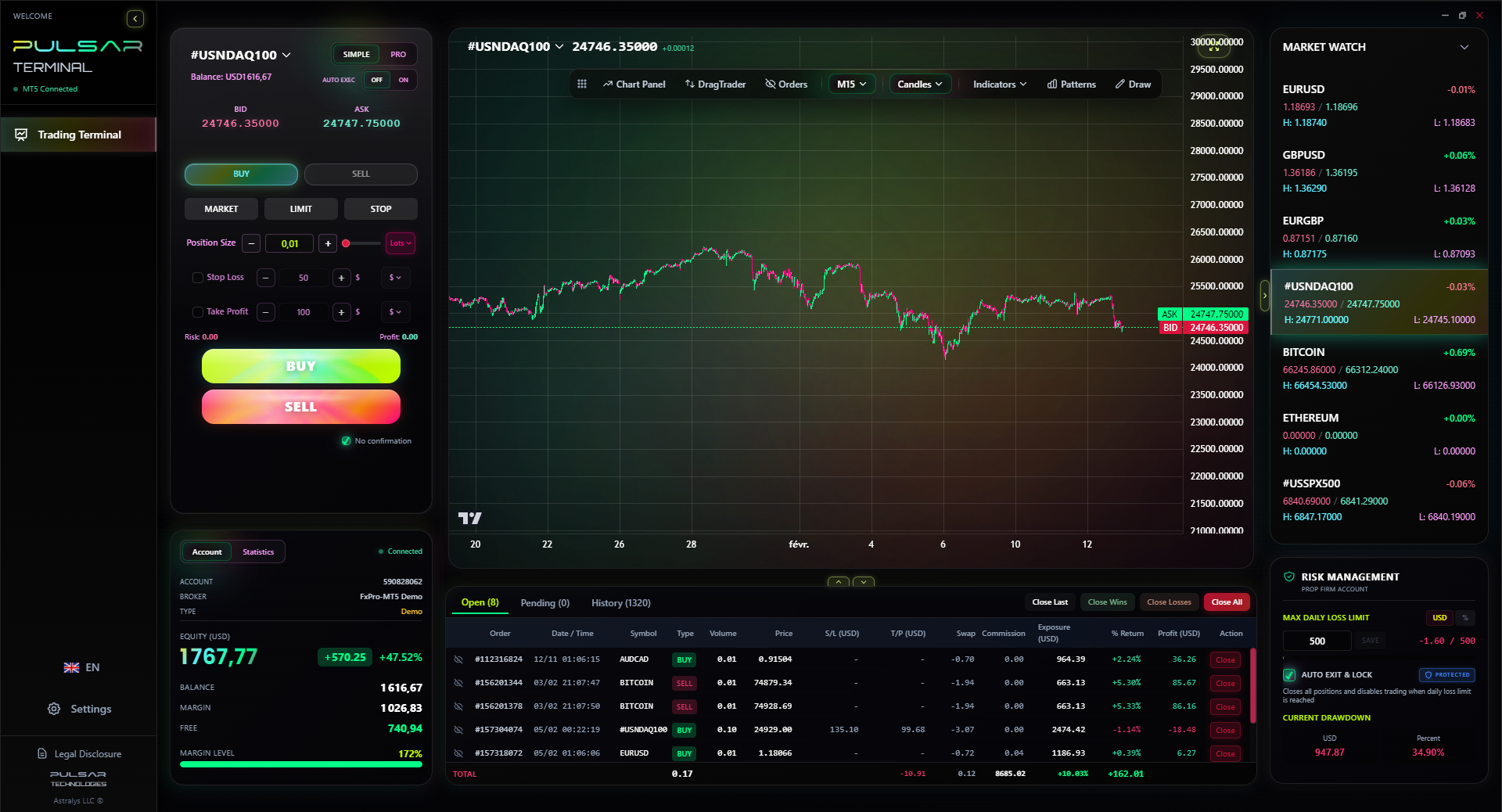
Managing the complex, multi-level risk rules of a prop firm account is stressful; Pulsar Terminal automates daily loss limits, trailing stops, and breakeven orders directly on your MT5 chart, so you can focus on trading instead of babysitting rules.
Pulsar Terminal
Универсальный инструмент для MT5: drag-and-drop ордера, мульти-TP/SL, трейлинг-стоп, грид-трейдинг, Volume Profile и защита для проп-фирм. Используется 1000+ трейдерами ежедневно.
“If you can't pass a two-phase challenge, you have no business trading a six-figure simulated account.”
Alright, you've read the warnings and you're still interested. Your head, your money. If you're going to do this, you need to be a detective.
Major Red Flags:
- No clear, written rules: If their Terms of Service are vague about drawdown calculations or profit splits, run.
- Overly generous promises: "100% profit share from day one!" "No rules!" This is fantasy land. A real firm protects its capital.
- Poor or slow customer support: Test them before you pay. Ask a detailed question about drawdown calculation. If they take days to respond or give a canned answer, imagine trying to get a payout from them.
- No third-party verification: Look for user reviews on independent sites, not just testimonials on their page.
- Pressure to use specific signal services or "coaches": This is a common scam. The firm gets a kickback while you blow up.
Due Diligence Checklist:
- Read the entire contract. Yes, all of it. How is drawdown calculated? From balance or equity? Is it trailing? What are the exact daily limits?
- Check payout proof. Can they provide evidence of recent payouts to US traders? Not screenshots, but real evidence.
- Understand the platform. Is it a stable platform like MT5 or cTrader, or some proprietary web platform that might freeze?
- Contact support. Gauge their professionalism and knowledge.
- Start small. If they offer multiple account sizes, take the smallest one. Treat the fee as tuition. Prove you can navigate their system before scaling up.
Remember, firms like Exness, XM, or Pepperstone are regulated brokers. You give them money, you trade it. The relationship is clear. With a prop firm, you're paying for the opportunity to earn a share of simulated profits. It's a fundamentally different - and riskier - agreement.
💡 Совет Уинстона
The best indicator of a prop firm's legitimacy isn't its slick website, but its payout speed and consistency. Search for independent withdrawal proofs from the last 30 days.
“The allure of skipping the line is powerful. But in trading, there are very few legitimate shortcuts.”
So, are no evaluation prop firms a complete scam? Not always. Some are legitimate businesses offering a high-risk, high-cost financial product. But for the vast majority of US traders, they are a poor choice.
You're trading speed for security, flexibility, and often, a fair shot. The regulatory uncertainty adds a layer of risk that your hard-earned profits might not be there tomorrow if the firm gets shut down or changes its rules.
Here are better paths to trading with more capital:
- Pass a Traditional Challenge: It's a filter for a reason. If you can't pass a two-phase challenge with sensible rules, you have no business trading a six-figure simulated account. Use the challenge to improve your discipline. The structure can be a good teacher.
- Grow Your Own Account Slowly: This is the old-school way, and it's still the best. Take that $500-$2000 fee and deposit it into a reputable broker. Use strict risk management (1-2% per trade). Compound your gains. You keep 100% of the profits, you have no arbitrary rules, and your capital is real. Tools like a good position size calculator are your best friend here.
- Seek Private Capital or a Mentor: If you have a verified track record, look for angel investors or trading groups. The terms will be negotiated, not dictated by a one-size-fits-all contract.
- Master a Smaller Account First: Can you consistently grow a $1,000 account to $1,100? If not, what makes you think you can handle $100,000? The psychology is different, but the percentage gains are the same.
The allure of skipping the line is powerful. I get it. But in trading, there are very few legitimate shortcuts. The process of evaluation, of proving your consistency, of building your own capital - that's not a barrier to your success. It's the foundation of it. A no evaluation prop firm offers to build your house on someone else's shaky land, with their blueprints. I'd rather dig my own foundation, even if it takes longer.
FAQ
Q1Are no evaluation prop firms legal in the United States?
It's a gray area. Most operate by charging a fee for a simulated trading service, not by taking client deposits for live trading, which allows them to sidestep direct SEC/CFTC broker regulations. However, increased scrutiny and potential new rules around "dealer" definitions mean their legal status is unstable and could change.
Q2What's the biggest risk with a no evaluation prop firm?
The strict, often hidden, risk management rules. The daily loss limit (e.g., 3-5%) is a silent account killer. One bad morning can lock you out for the day, and a combined drawdown from multiple positions can liquidate your account instantly without warning, forfeiting your entire fee.
Q3Can I actually withdraw my profits from a no evaluation prop firm?
If you follow all their rules to the letter and reach a payout threshold, yes, in theory. However, your payout comes from the firm's capital, not from live market profits. You must ensure the firm has a clear, documented payout history and process before trusting them with a large fee.
Q4How do the profit splits compare to traditional prop firms?
They often start lower (e.g., 50/50) and scale up with performance milestones. While they may advertise "up to 90%," you likely won't start there. Traditional firms often offer a consistent 70-80% split from your first payout after passing the challenge.
Q5Is the trading capital in a no-eval account real?
Almost never at the start. You are trading in a simulated (demo) environment. The firm uses your performance to decide whether to risk its own real capital on you or to pay you out from its operating funds. This simulation is central to their regulatory positioning.
Q6What's a better alternative for a beginner trader?
Use the money you'd spend on a prop firm fee ($500+) to fund a small live account with a regulated broker. Trade micro lots. Your goal isn't to get rich quick but to learn real risk management and build a consistent track record with your own capital. It's slower, but you keep all profits and learn useful lessons.
Q7Why did so many prop firms shut down in 2024?
A combination of factors: MetaQuotes (MT4/5) reducing support, increased regulatory scrutiny, and market saturation. An estimated 80-100 firms closed. This signals industry consolidation, pushing towards more formal, potentially regulated operations, which could change the landscape significantly by 2026.
Урок проф. Уинстона
Ключевые выводы:
- ✓Daily loss limits of 3-5% will strangle most strategies.
- ✓Upfront fees are higher and often non-refundable.
- ✓You operate in a severe regulatory gray area.
- ✓Industry consolidation means choose your firm carefully.
- ✓Growing your own capital is slower but you keep 100%.
Насколько полезна эта статья?
Нажмите на звезду
Еженедельные торговые инсайты
Бесплатный еженедельный анализ и стратегии. Без спама.
Об авторе
James Mitchell
Старший аналитик по трейдингу
Базируется в Нью-Йорке, более 9 лет опыта торговли. Работает с основными USD-парами, проп-фирмами и регулированием в США.
Комментарии
Предупреждение о рисках
Торговля финансовыми инструментами сопряжена со значительным риском и может не подходить всем инвесторам. Прошлые результаты не гарантируют будущих доходов. Данный контент носит исключительно образовательный характер и не является инвестиционной рекомендацией. Всегда проводите собственное исследование перед торговлей.
Вам также может понравиться

Cara Trading Forex Sukses: 7 Prinsip dari Trader Profesional
Cara trading forex sukses dengan 7 prinsip trader pro: manajemen modal, disiplin, journal trading, backtest. Data nyata, bukan janji profit palsu.
Jam Trading Forex Terbaik untuk Trader Indonesia: Panduan Lengkap dengan Tabel Waktu
Panduan jam trading forex untuk trader Indonesia. Tabel 4 sesi dunia, jam emas 20:00-00:00, sesi mana yang harus dihindari. Data akurat + tips dari trader berpengalaman.
Top 5 Sàn Forex Uy Tín Nhất 2026: Review Jujur dari Trader Indonesia
Top 5 sàn forex uy tín 2026 untuk trader Indonesia. Review jujur: spread, deposit, withdraw, dukungan lokal. Exness, XM, IC Markets & lebih.
Скачать Pulsar Terminal
Все эти калькуляторы встроены в Pulsar Terminal с данными в реальном времени с вашего счёта MT5.
Скачать Pulsar Terminal