


So you're looking for an online trading platform in Nigeria? Good move.

Olumide Adeyemi
Пионер трейдинга в Западной Африке ·  Nigeria
☕ 9 мин чтения
Что вы узнаете:
So you're looking for an online trading platform in Nigeria? Good move. The market's exploding, but it's also a jungle out there. Between new SEC rules, funding headaches, and a sea of brokers promising the world, it's easy to get lost or, worse, scammed. I've traded here for over a decade, made my share of costly mistakes, and figured out what actually works. This isn't about hype; it's a straight-talking guide to getting you set up on a platform that won't vanish with your money.
First things first: is this even legal? Absolutely. But the rules have changed, and you need to understand them to protect yourself. The big news is the Investments and Securities Act (ISA) 2025. This law, signed in March 2025, is a game-changer. It explicitly outlaws unregistered operations of digital asset exchanges and online FX trading platforms. The Securities and Exchange Commission (SEC) now has the power to regulate this space properly.
What does this mean for you? It means you should only use platforms that are either:
- Internationally regulated by a top-tier authority (like CySEC, FCA, ASIC, or FSCA).
- Registered locally with the SEC as a "Digital Sub-broker."
For a company to get that local SEC license, they need a ₦10 million paid-up capital and a fidelity insurance bond. This is a good thing - it adds a layer of protection for you. The Central Bank of Nigeria (CBN) also plays a role by controlling forex flows, which is why funding your account can be tricky (more on that later).

Warning: Trading on an unregulated platform is now explicitly illegal under ISA 2025. If a platform isn't transparent about its regulation, run. I learned this the hard way early on with a "broker" that offered unbelievable bonuses; getting my withdrawal processed was a months-long nightmare.
And yes, you have to pay tax. Profits from trading are subject to a 10% Capital Gains Tax, payable to the FIRS. Keep a clean record of your trades.
“The advertised price isn't always the real price. You need to look at the spread and any commissions.”
With over 50 mobile trading apps now in Nigeria, choice is not the problem. Finding the right one is. Don't just download the one with the flashiest ads. You need to check under the hood.
Regulation is Non-Negotiable
This is your safety net. I only trade with brokers regulated by reputable bodies outside Nigeria, as they typically offer better technology and tighter spreads. My go-to list includes brokers like IC Markets (ASIC regulated), Pepperstone (ASIC, FCA), and Exness (CySEC, FSCA). These guys have been around and handle Nigerian clients smoothly.
The Real Cost of Trading: Spreads & Commissions
The advertised price isn't always the real price. You need to look at the spread (the difference between buy and sell price) and any commissions.
| Pair | Average Spread (Pips) | Notes |
|---|---|---|
| EUR/USD | 0.6 - 1.0 | The benchmark. Under 1.0 is decent. |
| GBP/USD | 0.9 - 1.3 | More volatile, often wider spreads. |
| USD/NGN | 50 - 200+ | Huge spread. Not ideal for scalping. |
A "pip" is your basic unit of movement. If you're not clear, our pip definition breaks it down. I got burned on a seemingly cheap platform that had "zero spread" but charged a $7 round-turn commission per lot. On a scalping strategy where I'm in and out 10 times a day, that murdered my profits. Always calculate the total cost.

Pro Tip: Open a demo account first. Test the execution speed during volatile news events (like US Non-Farm Payrolls). A platform that freezes or gives you terrible slippage isn't worth it, no matter how cheap it is.

💡 Совет Уинстона
A platform is just a tool. A master carpenter doesn't blame his hammer for a crooked nail. Spend 10x more time learning price action than learning a platform's buttons.
“Funding is where theory meets reality. The CBN's restrictions mean you have to get creative.”
This is where theory meets reality. The CBN's restrictions mean you can't just use your Naira debit card to fund an international broker with $1,000. You have to get creative.
The Two Main Paths:
- Domiciliary Account: This is your USD, GBP, or EUR account with a Nigerian bank. It's the most straightforward way. You transfer funds from it to your broker via international wire. It's secure, but banks charge hefty fees (around $25-50 per transfer), and processing can take 2-5 business days.
- E-Wallets (The Trader's Favorite): This is how most serious traders I know do it. You fund a global e-wallet like Neteller or Skrill using your domiciliary account or a peer-to-peer (P2P) service. Then, you transfer from the e-wallet to your broker instantly and with lower fees. Some brokers even accept direct deposits from these wallets.
Cryptocurrency Funding: Given the CBN's stance on crypto, some platforms and traders use USDT (Tether) as a funding method. It's fast and bypasses traditional banking. However, you're exposed to crypto volatility during the transfer window, and you must ensure your broker accepts crypto deposits.
The Cost: Don't forget the hidden costs. Payment gateways like Flutterwave charge up to 4.8% for international transactions. That's $48 on a $1,000 deposit gone before you even place a trade. Always factor this into your position size calculator.
I made the mistake of funding a small account with a card, paying a 3% fee, only to blow the account in a week. Those fees significantly cut into your risk capital.
“Funding is where theory meets reality. The CBN's restrictions mean you have to get creative.”
MetaTrader 4 (MT4) and MetaTrader 5 (MT5) are the undisputed kings in Nigeria. Why? Familiarity, stability, and a massive library of custom indicators and Expert Advisors (EAs). If a broker doesn't offer MT4/5, I'm skeptical.
But the standard MT5 interface is pretty basic. To trade professionally, you need better tools. This is where companion apps come in.
Essential Tools You'll Grow To Need:
- Advanced Order Management: Placing a trade with multiple take-profit levels or a trailing stop should be simple. Dragging and dropping these on a chart is a huge time-saver.
- Trade Journaling: You must review your trades. A platform that helps you track your win rate, average profit/loss, and performance by session is useful.
- Market Profile & Volume Analysis: Understanding where the market is finding value is key for swing trading. Tools like Volume Profile show you where big money is trading.
For example, trading Gold (XAU/USD) without understanding key volume nodes is like driving blind. My XAU/USD guide talks about this, but you need the platform tools to see it on your chart.

Example: Let's say you're in a EUR/USD trade. With advanced tools, you can set: Take Profit 1 at +50 pips (close 50% of position), Take Profit 2 at +100 pips (close 30%), and let the final 20% run with a trailing stop. Manually managing this on basic MT5 is clunky and error-prone.
💡 Совет Уинстона
The first feature you should master on any platform is the 'Close All' button. Knowing how to exit everything, instantly, when you're wrong is a survival skill.
“Your first line of defense is your own due diligence. Check the broker's regulatory number on the regulator's website.”
Nigeria's booming market is a magnet for scammers. Here are the red flags I've learned to spot:
- Guaranteed Profits: Anyone promising you weekly returns of 20% or more is lying. Trading is hard. Period.
- Unregulated "Investment Hubs": Groups that ask you to send money to a "master trader" or a pooled account. Your money should only ever go to your own account at a regulated broker.
- Bonuses That Sound Too Good: Be wary of massive sign-up bonuses with withdrawal restrictions. A legitimate broker like XM or others might offer a small welcome bonus, but it's never the main attraction.
- Pressure to Deposit More: If you're losing and a "account manager" calls you to deposit more to "average down" and recover losses, it's a classic scam tactic. A real broker won't call you with trading advice.
Your first line of defense is your own due diligence. Check the broker's regulatory number on the regulator's website (e.g., the ASIC register). Read independent reviews. And start small. Fund your account with an amount you can afford to lose completely while you test withdrawals. I deposit $100 first and immediately request a $50 withdrawal. If it comes through in a reasonable time, I gain confidence.
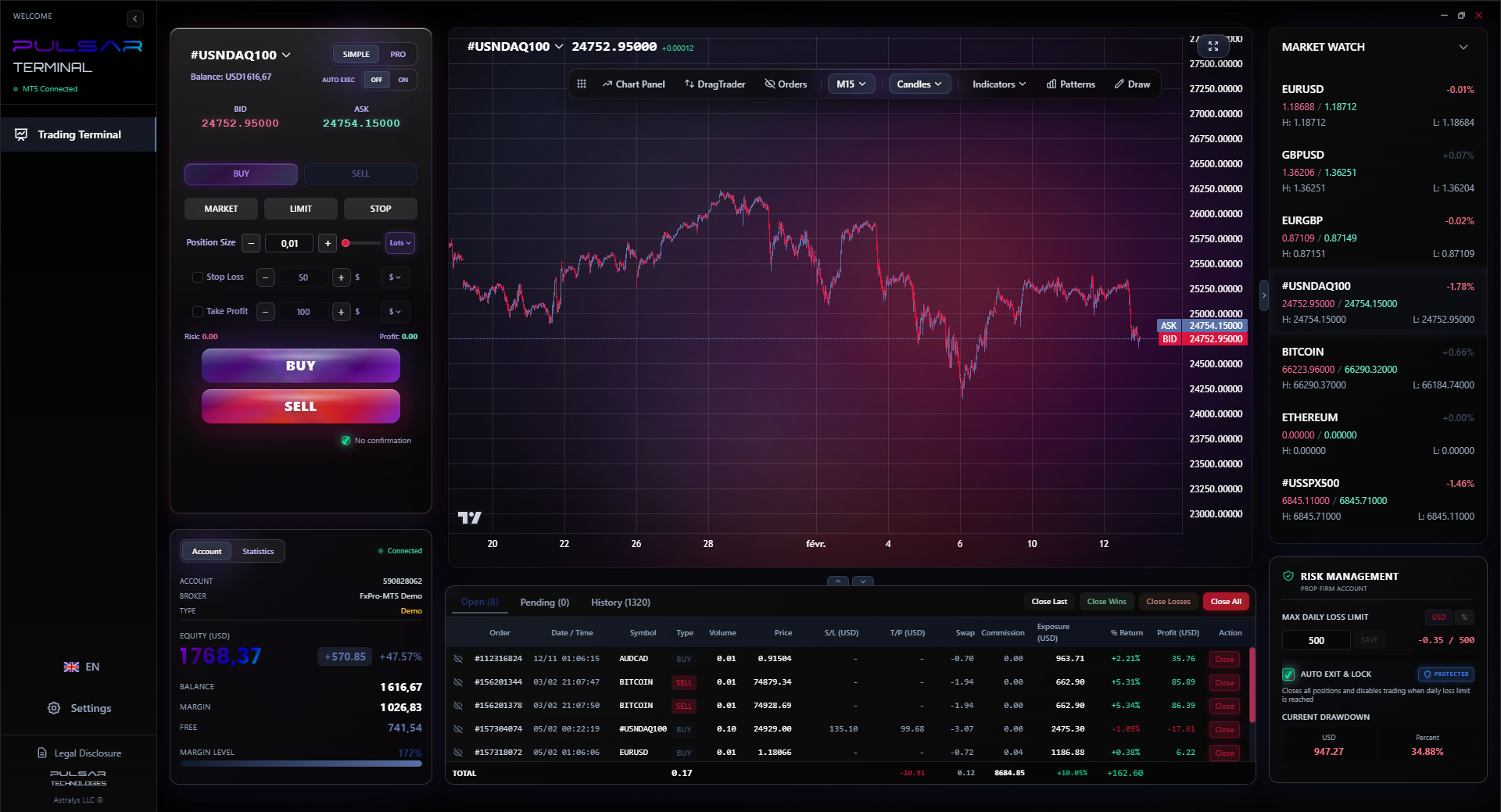
Managing complex trades with multiple take-profits and a trailing stop is clunky on basic MT5, but Pulsar Terminal lets you drag-and-drop these orders directly onto your chart for precise, automated control.
Pulsar Terminal
Универсальный инструмент для MT5: drag-and-drop ордера, мульти-TP/SL, трейлинг-стоп, грид-трейдинг, Volume Profile и защита для проп-фирм. Используется 1000+ трейдерами ежедневно.
“Your first line of defense is your own due diligence. Check the broker's regulatory number on the regulator's website.”
Alright, let's get personal. What does a 12-year Nigerian trader actually use?
My Primary Broker: I split my capital between IC Markets and Pepperstone. Why? IC Markets has raw spreads and fantastic execution for my EA, and Pepperstone has a great research suite. I fund both via Skrill from my domiciliary account.
My Biggest Platform Mistake: In 2019, I was seduced by a platform with built-in social trading. I copied a "top trader" with a 80% win rate. I put $2,000 into it. What they didn't show was his risk-reward ratio. He was taking 5-pip profits and 50-pip losses. His account was slowly bleeding out, and so was mine. I lost $800 in two weeks before I realized the flaw. The platform's design hid the critical data. Now, I rely on my own analysis using the MACD indicator and RSI for confluence, not someone else's hype.
A Trade Example: Last month on EUR/USD, I saw a clear divergence on the 4-hour chart. Price made a new high, but the RSI made a lower high. I entered a short at 1.0885. I used a 50-pip stop loss and set two take-profits: TP1 at 1.0835 (50% position closed) and TP2 at 1.0785. I moved my stop to breakeven after TP1 was hit. TP2 was eventually reached for a total gain of about 100 pips on half my position. Managing this trade cleanly required tools beyond basic MT5.
💡 Совет Уинстона
If you wouldn't be comfortable explaining your platform's fee structure to a skeptical friend, you shouldn't be trading on it. Opacity is the enemy of profit.
“Your goal for the first 3-6 months is not to get rich. It's to not blow up your account while you learn.”
Don't try to do everything at once. Here's a step-by-step plan:
- Education First: Before you deposit a kobo, learn the basics. Understand what a spread is, what a margin call means, and how to calculate your position size. Our position size calculator is a free tool for this.
- Choose 2-3 Regulated Brokers: From the list discussed. Don't just pick one.
- Open Demo Accounts: Open a demo with each. Trade for at least two weeks. Test everything: placing orders, modifying them, the feel of the platform.
- Test Funding & Withdrawal: Pick your preferred broker. Deposit the minimum possible amount (maybe $50). Then, immediately request a withdrawal of $25. This tests the entire process. If it works smoothly, you're good.
- Start Microscopically: When you go live, trade the smallest position size possible (0.01 lots). Your goal for the first 3-6 months is not to get rich. It's to not blow up your account while you learn.
The Nigerian market is full of opportunity, with daily FX turnover hitting $8.6 billion. But the ones who last are the careful, disciplined, and well-equipped. Choose your online trading platform in Nigeria like you'd choose a business partner - with scrutiny, patience, and a clear eye on the long game.
FAQ
Q1What is the best online trading platform for beginners in Nigeria?
There's no single 'best,' but look for a platform that offers a strong demo account, educational resources, and low minimum deposit. Brokers like XM or Exness are often beginner-friendly. The real key is using the demo to learn the platform itself before risking real money.
Q2Can I trade forex legally in Nigeria?
Yes, forex trading is completely legal. The key is to use a platform that is regulated, either internationally by bodies like CySEC or FSCA, or locally registered with the SEC under the new ISA 2025 law. Trading on unregulated platforms is now illegal.
Q3How do I fund my trading account from Nigeria?
The two main methods are: 1) Using a domiciliary account for an international bank transfer (secure but slow/expensive), or 2) Using an e-wallet like Skrill or Neteller. You fund the e-wallet via your domiciliary account or P2P, then transfer to your broker instantly with lower fees.
Q4What is the minimum amount needed to start trading?
You can start with as little as $10-$50 on some brokers. However, I strongly advise against it. With such a small amount, proper risk management is nearly impossible. A more realistic starter amount that allows you to trade 0.01-lot sizes comfortably is $200-$500.
Q5Are there platforms that allow Naira deposits?
Yes, some locally registered SEC platforms may accept Naira deposits directly. However, be aware that trading global markets like EUR/USD will still involve currency conversion, and your spreads on USD/NGN pairs will be very wide. Most traders prefer international brokers for better conditions on major pairs.
Q6How are my trading profits taxed?
Trading profits are subject to Capital Gains Tax in Nigeria. The current rate is 10%. You are responsible for declaring this income and paying the tax to the Federal Inland Revenue Service (FIRS). Keep detailed records of all your trades for tax purposes.
Урок проф. Уинстона
Ключевые выводы:
- ✓Regulation is your non-negotiable safety net under ISA 2025.
- ✓Calculate total cost: spread + commission + funding fees.
- ✓Test withdrawals with a small deposit first.
- ✓Master the 'Close All' function before any fancy indicator.
Насколько полезна эта статья?
Нажмите на звезду
Еженедельные торговые инсайты
Бесплатный еженедельный анализ и стратегии. Без спама.
Об авторе
Olumide Adeyemi
Пионер трейдинга в Западной Африке
Один из самых активных преподавателей форекс-трейдинга в Нигерии. 8 лет торгового опыта из Лагоса. Специализируется на стратегиях с малым капиталом и челленджах проп-фирм для африканских трейдеров.
Комментарии
Предупреждение о рисках
Торговля финансовыми инструментами сопряжена со значительным риском и может не подходить всем инвесторам. Прошлые результаты не гарантируют будущих доходов. Данный контент носит исключительно образовательный характер и не является инвестиционной рекомендацией. Всегда проводите собственное исследование перед торговлей.
Вам также может понравиться

Cara Trading Forex Sukses: 7 Prinsip dari Trader Profesional
Cara trading forex sukses dengan 7 prinsip trader pro: manajemen modal, disiplin, journal trading, backtest. Data nyata, bukan janji profit palsu.
Jam Trading Forex Terbaik untuk Trader Indonesia: Panduan Lengkap dengan Tabel Waktu
Panduan jam trading forex untuk trader Indonesia. Tabel 4 sesi dunia, jam emas 20:00-00:00, sesi mana yang harus dihindari. Data akurat + tips dari trader berpengalaman.
Top 5 Sàn Forex Uy Tín Nhất 2026: Review Jujur dari Trader Indonesia
Top 5 sàn forex uy tín 2026 untuk trader Indonesia. Review jujur: spread, deposit, withdraw, dukungan lokal. Exness, XM, IC Markets & lebih.
Скачать Pulsar Terminal
Все эти калькуляторы встроены в Pulsar Terminal с данными в реальном времени с вашего счёта MT5.
Скачать Pulsar Terminal