


I remember my first big options loss like it was yesterday.

Rajesh Sharma
Старший форекс-аналитик ·  India
India
☕ 11 мин чтения
Что вы узнаете:
- 1Getting the Basics Right: Calls, Puts, and the Indian Context
- 2Your First Steps: Simple Strategies to Practice
- 3Controlling Risk: The Power of Spread Strategies
- 4Beyond the Price: Understanding Greeks and Volatility
- 5Picking Your Tools: Brokers and Hindi Resources
- 6The Pitfalls: Mistakes I Made So You Don't Have To
- 7Building Your Trading Routine
I remember my first big options loss like it was yesterday. It was 2021, and I sold a Nifty 18,500 Call option, thinking the market couldn't possibly go higher. I collected a premium of ₹120 per lot. Two days later, a massive rally took Nifty to 18,800. My paper loss ballooned to ₹9,000 per lot, and I got a dreaded margin call notification. I had to close the position at a ₹7,200 loss. I didn't understand the risk, the Greeks, or the new SEBI rules. That painful lesson cost me real money, but it taught me that options aren't a lottery ticket. They're a tool, and you need the right manual. This guide is that manual, written for you, the Hindi-speaking trader navigating today's market.
Before we talk strategies, let's get our foundation solid. In the simplest Hindi terms, a 'Call Option' is a satte ka patta that gives you the right to BUY something at a fixed price. A 'Put Option' is the right to SELL something at a fixed price. You're not buying the share itself; you're buying a contract based on it.
Here's the critical part for India: the rules have changed dramatically. SEBI isn't playing around anymore. As of April 2026, if you sell an option (which is riskier), your broker must keep 50% of your margin as cash. No more funding your entire portfolio with pledged shares. Also, if you buy an option, you pay 100% of the premium upfront. No free use.

Warning: A SEBI study showed 9 out of 10 F&O traders lose money. The average loser loses way more than the average winner makes. Don't be a statistic. Start small.
The lot sizes are bigger now too. To curb speculation, the minimum contract value for Nifty and Bank Nifty options is between ₹15-20 lakhs. This means one lot of Nifty options can easily represent over ₹15 lakhs in underlying value. Your profit or loss is calculated on that notional value, even though your margin or premium is much smaller. It's a game of use, and use cuts both ways.
Key Terms You Must Know
- Premium (Prashasti): The price you pay to buy an option, or the money you receive to sell one. This is your main P&L as a buyer.
- Strike Price (Strike Mulya): The fixed price at which you can buy (Call) or sell (Put) the underlying asset.
- Expiry (Samapti Tithi): The day the option contract ceases to exist. With SEBI's new rules, only one weekly expiry (for Nifty) remains. Most action is in monthly expiries.
- In-the-Money (ITM): A Call option where the market price is above the strike, or a Put where it's below. It has intrinsic value.
- Out-of-the-Money (OTM): The opposite. No intrinsic value, only time value. Most retail traders gamble on cheap OTM options, which is a major reason for losses.

💡 Совет Уинстона
The market doesn't care about your opinion. Trade what you see on the chart, not what you feel in your gut. A clear chart pattern is worth a thousand hunches.
“Options aren't a lottery ticket. They're a tool, and you need the right manual.”
Start here. Paper trade these for at least a month before using real money. I use a position size calculator for every single trade, no exceptions.
1. Long Call (Bullish View) This is straightforward. You buy a Call option expecting the market to rise.
- Max Risk: Limited to the premium you pay.
- Max Reward: Technically unlimited.
- The Catch: Time is your enemy. The market needs to move in your direction, and move quickly, before expiry. That premium you paid? It decays every day.
My Experience: In Jan 2023, I bought a Bank Nifty 42,000 Call for a ₹180 premium. Bank Nifty was at 41,800. I bought 1 lot (15 shares). Total cost: ₹2,700 (180*15). The index moved to 42,400 in three days. The premium rose to ₹420. I sold for a profit of ₹3,600 ( (420-180)*15 ). A 133% return. Sounds great, right? I've had five similar trades that expired worthless. The wins don't always cover the losses.
2. Long Put (Bearish View) The mirror image. You buy a Put expecting the market to fall.
3. Covered Call (For Stock Holders) This is for if you already own shares, say 100 shares of Reliance. You sell a Call option against those shares. You collect the premium as extra income. If the stock stays below the strike, you keep the premium and the shares. If it rockets above, your shares get 'called away' at the strike price. Your profit is capped.

Pro Tip: When buying options, most beginners go for the cheapest, far Out-of-The-Money options. They're a sucker's bet. The probability of them expiring worthless is huge. Instead, look at At-The-Money or slightly In-The-Money options. You pay more, but your odds are better.
“The silent killer for option buyers isn't being wrong on direction; it's the relentless tick of time decay.”
This is where real options trading begins. Spreads involve buying one option and selling another of the same type (Call or Put) to limit both risk and reward. They're perfect for India's volatile markets and higher margin rules.
Bull Call Spread (Cost Defined, Bullish) You buy one Call option at a lower strike and sell another Call at a higher strike of the same expiry.
- Why it works: The premium you receive from selling the higher Call reduces the cost of buying the lower one. Your net risk (max loss) is the net premium paid. Your max profit is capped at the difference between the strikes, minus your net cost.
- Margin: Lower than naked selling. Might be around ₹30,000-₹50,000 for a Nifty spread.
Example: Nifty at 22,000.
- Buy 22,100 Call for ₹120.
- Sell 22,200 Call for ₹70. Net Debit (Cost) = ₹50 (120 - 70). Max Loss = ₹50 * 50 (lot size) = ₹2,500. Max Profit = (100 point difference - 50 net cost) * 50 = ₹2,500. You've defined your risk-reward perfectly. This is a disciplined approach.
Bear Put Spread (Cost Defined, Bearish) The Put version of the above. You buy a higher strike Put and sell a lower strike Put.
Iron Condor (For Range-Bound Markets) This is an advanced spread for when you think Nifty will stay in a range. It involves both a Bull Call Spread and a Bear Put Spread. Your profit is the net premium collected. Your risk is limited to the width of the spreads minus the premium. It's a great swing trading strategy for sideways markets, but it requires careful monitoring. Platforms like Sensibull have great builders for these.
“The silent killer for option buyers isn't being wrong on direction; it's the relentless tick of time decay.”
If you just look at the price chart, you're missing half the picture. Options have their own dynamics, called the 'Greeks'.
- Delta (Δ): Measures how much the option's price moves for a ₹1 move in the underlying. A Call with a Delta of 0.60 will move roughly ₹0.60 for every ₹1 Nifty moves.
- Theta (Θ): Time decay. This is the silent killer for option buyers. It tells you how much value the option loses each day. As expiry approaches, Theta decay accelerates dramatically. I learned this the hard way holding options over a weekend.
- Vega (V): Sensitivity to volatility. If the market expects big swings (like around Budget or RBI policy), option premiums get more expensive due to higher Implied Volatility (IV). Selling options when IV is high can be profitable.
- Gamma (Γ): The rate of change of Delta. It's highest for At-The-Money options and causes rapid P&L swings near expiry.

Example: Let's say you buy a Nifty Call with 7 days to expiry for ₹100. Its Theta might be -₹5. This means, all else equal, the option will be worth ₹95 tomorrow, ₹90 the next day, just from time passing. The market needs to move up just for you to break even.
This is where tools like Pulsar Terminal, which can integrate advanced analytics, become valuable for visualizing these risks on your MT5 chart. Understanding IV is crucial. In India, IV often spikes during earnings season or global events. Buying options after an IV spike is expensive; selling options (via spreads) when IV is high can give you an edge. I use the RSI indicator and MACD indicator on the underlying chart for direction, but I check the option's IV and Greeks before placing any order.
💡 Совет Уинстона
Your first loss is often your smallest loss. The moment a trade goes against your thesis, have the discipline to exit. Protecting capital is job number one.
“Your broker's platform is your battlefield. Choose one that doesn't fight you.”
Your broker's platform is your battlefield. You need one that's reliable, fairly priced, and suits your style.
For most Indian traders starting out:
- Zerodha: Their Kite platform is clean and reliable. Their 'Varsity' module has fantastic educational content (in English, but the concepts are universal). Flat ₹20/executed order for F&O.
- Upstox: Very similar to Zerodha, with a strong mobile app. Another great discount broker.
- Dhan: Their 'Options Trader' platform is built specifically for us. It simplifies building multi-leg strategies like spreads and Iron Condors. Highly recommended if you want to move beyond simple buys and sells.
For analytics:
- Sensibull: This is a game-changer (free and paid plans). It connects to your Zerodha/Upstox/Angel One account. You can visualize payoff graphs for any strategy before you place it, check Greeks in real-time, and see probability calculations. It's the best way to learn.
Hindi Content: The landscape is growing. Search for "Option Greeks in Hindi" or "Bull Call Spread in Hindi" on YouTube. Several educators break down concepts in simple Hindi. Platforms like Upsurge.club offer structured courses. My advice? Use the Hindi videos to grasp the concept, but always cross-reference with the official exchange documents and your broker's contract notes. Don't follow any "sure shot" tipster.
Regarding international brokers like IC Markets review or Pepperstone review, remember: SEBI rules prevent Indian residents from trading derivatives like Nifty options on international platforms. You can only trade those on Indian exchanges (NSE, BSE).
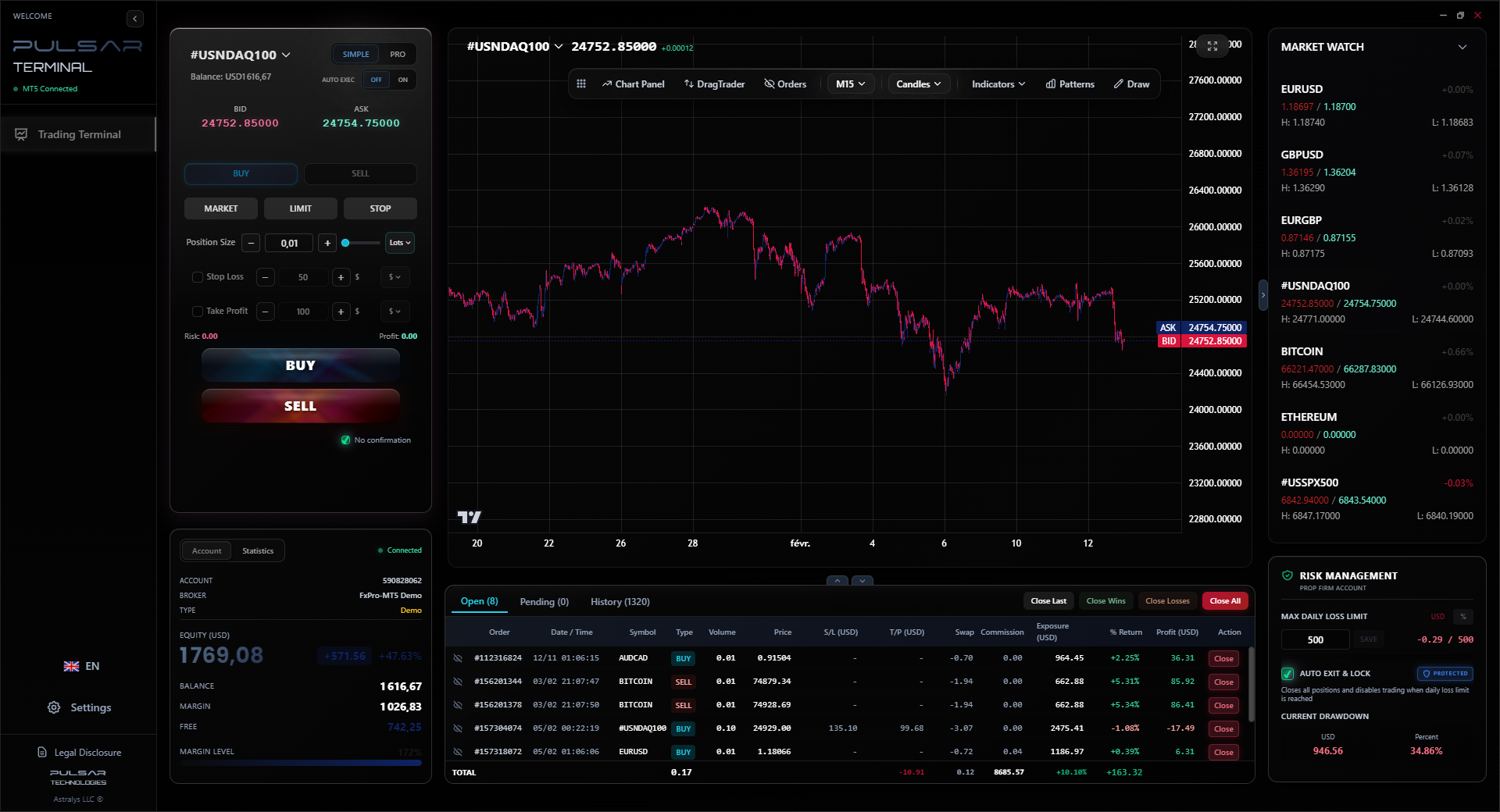
Managing multi-leg option spreads and adhering to strict daily loss limits—key for surviving prop firm challenges—is far easier with a tool that automates these rules directly on your trading platform.
Pulsar Terminal
Универсальный инструмент для MT5: drag-and-drop ордера, мульти-TP/SL, трейлинг-стоп, грид-трейдинг, Volume Profile и защита для проп-фирм. Используется 1000+ трейдерами ежедневно.
“Your broker's platform is your battlefield. Choose one that doesn't fight you.”
Let's get real. Here's where most traders blow up.
1. Trading Without a Plan: Entering a trade because you 'have a feeling.' Every trade needs a defined entry, exit (profit target), and stop loss. For options, this includes which strategy, what strike, and what expiry.
2. Ignoring Transaction Costs: Remember, it's not just brokerage. For every options trade, you pay:
- Brokerage (e.g., ₹20)
- STT (0.15% on sell-side premium as of 2026)
- Exchange charges (~0.035%)
- SEBI fee (₹10/crore)
- GST (18% on all the above fees)
On a small premium, these costs can eat 20-30% of your potential profit. You need the market to move just to cover costs.
3. Chasing Lost Money (Revenge Trading): That ₹5,000 loss hurts. The instinct is to double down on the next trade to make it back quickly. That's how a ₹5,000 loss becomes a ₹25,000 loss. Take a break. Close the platform.
4. Misunderstanding Seller Risk: Selling a naked Put feels great - you collect premium instantly. But your risk is massive. If Nifty crashes, your loss can be many times the premium you received. Always use defined-risk spreads if you want to sell options.
5. Not Accounting for Spread: In options, the bid-ask spread can be wide, especially for less liquid strikes. You might buy at the 'ask' price and have to sell at the lower 'bid' price. This slippage adds to your cost.
My Risk Management Rules:
- Never risk more than 1-2% of your total capital on a single trade. Use that position size calculator.
- Have a weekly loss limit. If I'm down 5% of my capital in a week, I stop trading for the week. No arguments.
- 80% of my trades are defined-risk spreads. I sleep better.
- I don't hold short options over major news events. The gap risk is too high.
💡 Совет Уинстона
Complexity is not sophistication. A well-executed, simple spread strategy will outperform a messy, multi-leg trade you don't fully understand every single time.
“The goal isn't to get rich tomorrow. The goal is to build a sustainable, disciplined process.”
Knowledge without execution is useless. Here's a simple weekly routine to follow.
Sunday Night:
- Review the global market close.
- Identify key support/resistance levels for Nifty/Bank Nifty using your charts.
- Check the economic calendar for the week (RBI minutes, US Fed speeches, etc.).
Morning (Before Market Open):
- Check for any gap-ups or gap-downs.
- Based on your view (bullish, bearish, sideways), decide on 2-3 potential strategies. E.g., "If Nifty holds above 22,100, a Bull Call Spread between 22,150-22,250. If it breaks 22,000, a Bear Put Spread."
- Use Sensibull or your broker's platform to calculate the exact risk, reward, and breakeven points for each.
During Market Hours:
- Place your trade ONLY if your predefined setup triggers.
- Enter the trade with a limit order, not a market order, to control the price.
- Immediately set alerts for your profit target and stop-loss levels.
End of Day:
- Journal your trade. Why did you enter? What was the outcome? How did the Greeks behave? This is the most important step for learning.
- Review your overall portfolio risk.
Remember, options are a marathon, not a sprint. The goal isn't to get rich tomorrow. The goal is to build a sustainable, disciplined process that generates consistent returns over years, while strictly managing your risks in this exciting but unforgiving market. Start small, learn continuously, and respect the rules - both SEBI's and your own.
FAQ
Q1What is the minimum capital required to start options trading in India?
It depends on the strategy. For buying options (Long Call/Put), you can start with ₹5,000-₹15,000 to cover the premium for one lot. For selling options or spread strategies, due to SEBI's 50% cash margin rule, you need significantly more. A single Nifty credit spread might require ₹30,000-₹80,000 in margin. Realistically, to trade actively and safely with proper position sizing, a minimum of ₹2-3 lakhs is recommended.
Q2Where can I learn option trading strategies in Hindi?
There's growing content on YouTube - search for terms like 'option strategies in Hindi' or 'option Greeks explained in Hindi.' Educational platforms like Upsurge.club offer Hindi courses. Also, use broker resources: Zerodha's Varsity (concepts apply regardless of language) and tools like Sensibull, which visually explain strategies, making them easier to understand even if the text is in English.
Q3What are the main costs involved in options trading?
The major costs are: 1) Brokerage (often a flat ₹20/order), 2) Securities Transaction Tax (STT) at 0.15% on the sell-side premium, 3) Exchange Transaction Charges (~0.035% of premium), 4) SEBI Turnover Fee (₹10 per crore), and 5) 18% GST on all these fees. These costs add up, so your trade needs enough movement to overcome them.
Q4Is options trading gambling?
It can be if you treat it like one - buying cheap, out-of-the-money options based on a tip. But when done correctly with defined-risk strategies (like spreads), proper analysis, and strict risk management (risking only 1-2% per trade), it's a calculated form of trading. The high loss rate comes from the former approach, not the latter.
Q5What is the best strategy for a beginner?
Start by paper trading simple Long Call and Long Put strategies to understand how price movement and time decay affect premiums. Then, quickly move to defined-risk spread strategies like the Bull Call Spread or Bear Put Spread. These teach you to think in terms of risk/reward ratios and have a capped, known maximum loss from the outset, which is crucial for survival.
Q6Can I trade Nifty options on international platforms like Interactive Brokers?
No. SEBI regulations prohibit Indian residents from trading Indian equity derivatives (like Nifty or stock options) on international platforms. You must use a SEBI-registered Indian broker (like Zerodha, Upstox, ICICI Direct, etc.) to trade these instruments.
Q7What is Theta and why is it important?
Theta represents time decay. It's the amount an option's price decreases each day as it approaches expiry. For option buyers, Theta is a constant drain - the market must move in their favor quickly to offset this decay. For option sellers, Theta works in their favor. Ignoring Theta is a primary reason buyers see their positions lose value even when the underlying stock doesn't move.
Урок проф. Уинстона
Ключевые выводы:
- ✓Define your max risk before every trade, always.
- ✓Time decay (Theta) erodes option buyer profits daily.
- ✓Use spreads to cap risk; naked selling is a trap.
- ✓Transaction costs eat 20-30% of small premiums.
- ✓Start with ₹2-3 lakh capital for serious trading.
Насколько полезна эта статья?
Нажмите на звезду
Еженедельные торговые инсайты
Бесплатный еженедельный анализ и стратегии. Без спама.
Об авторе
Rajesh Sharma
Старший форекс-аналитик
Более 10 лет торгует на индийских и южноазиатских рынках. Начинал с валютных деривативов на NSE, затем перешёл на международный форекс. Специализируется на USD/INR и парах развивающихся рынков.
Комментарии
Предупреждение о рисках
Торговля финансовыми инструментами сопряжена со значительным риском и может не подходить всем инвесторам. Прошлые результаты не гарантируют будущих доходов. Данный контент носит исключительно образовательный характер и не является инвестиционной рекомендацией. Всегда проводите собственное исследование перед торговлей.
Вам также может понравиться

Cara Trading Forex Sukses: 7 Prinsip dari Trader Profesional
Cara trading forex sukses dengan 7 prinsip trader pro: manajemen modal, disiplin, journal trading, backtest. Data nyata, bukan janji profit palsu.
Jam Trading Forex Terbaik untuk Trader Indonesia: Panduan Lengkap dengan Tabel Waktu
Panduan jam trading forex untuk trader Indonesia. Tabel 4 sesi dunia, jam emas 20:00-00:00, sesi mana yang harus dihindari. Data akurat + tips dari trader berpengalaman.
Top 5 Sàn Forex Uy Tín Nhất 2026: Review Jujur dari Trader Indonesia
Top 5 sàn forex uy tín 2026 untuk trader Indonesia. Review jujur: spread, deposit, withdraw, dukungan lokal. Exness, XM, IC Markets & lebih.
Скачать Pulsar Terminal
Все эти калькуляторы встроены в Pulsar Terminal с данными в реальном времени с вашего счёта MT5.
Скачать Pulsar Terminal