


Thinking about joining a prop firm in Australia to trade with 'house money'? Before you pay that evaluation fee, you need to know the real story.

Sarah Collins
Торговый стратег ·  Australia
☕ 12 мин чтения
Что вы узнаете:
- 1The Australian Prop Firm Reality in 2026
- 2ASIC Rules & What's Actually Legal
- 3The Real Costs & Payout Structures (2026 Numbers)
- 4Top Prop Firms for Aussie Traders (A 2026 Perspective)
- 5Passing the Challenge: A Real Strategy, Not Hype
- 6Taxes & Getting Paid in AUD
- 7Red Flags & Avoiding the Scams
- 8Is a Prop Firm Right for You?
Thinking about joining a prop firm in Australia to trade with 'house money'? Before you pay that evaluation fee, you need to know the real story. The landscape here is unique, shaped by ASIC's rules and a flood of international firms targeting Aussie traders. I've traded with prop capital for years, made payouts, and also had accounts blown from rules I didn't fully understand. This isn't hype. It's a practical, no-BS look at how prop trading works for Australians right now, what's legal, what's a scam, and how to actually keep the money you make.
Let's cut through the marketing. A prop firm in Australia isn't like your local bank. Most aren't even Australian companies. They're international entities (think Seychelles, Cyprus, SVG) that happily accept your AUD for an evaluation challenge. The key thing to understand is the regulatory gap.
ASIC cracked down hard on retail CFD brokers in 2021, slashing use to 30:1 for majors. That hurt a lot of retail traders. Prop firms swooped in, offering 100:1 or even 200:1 use. How? They argue they're not providing a financial service to you. You're being evaluated to trade their capital. It's a legal distinction, but a crucial one.
The market's been through a brutal shakeout. In 2024 alone, close to 100 prop firms globally just... vanished. Poof. Accounts gone, websites offline. That trend continued into 2025. This means the firms still standing by 2026 have either figured out a sustainable model or are just better at marketing. You need to know which is which.

Warning: Just because a firm 'accepts' Australian traders doesn't mean it's regulated by ASIC. It almost certainly isn't. Your protection comes from the firm's own terms, not Australian financial law.
My first prop firm experience was with a now-defunct outfit. I passed a $50k challenge, traded profitably for two months, and requested a $2,100 payout. Radio silence for weeks, then the website disappeared. That $289 evaluation fee? A very cheap lesson in due diligence.

💡 Совет Уинстона
The evaluation fee is the cost of tuition. Expect to pay it at least twice. If you pass on the first try, consider it a bonus, not the plan.
This is where everyone gets confused. Let's be clear: Proprietary trading itself is 100% legal in Australia. No government agency bans it. The confusion stems from ASIC's Product Intervention Order on CFDs, which targeted retail client offerings by licensed brokers.
The AFSL Loophole (It's Not a Loophole)
A prop firm typically doesn't need an Australian Financial Services License (AFSL) if it's structured correctly. ASIC's view, clarified years back, is that if a firm is trading its own capital and you're a contractor passing skills tests, it's not providing you with a financial product. You're paying for an evaluation, not investing your money with them to manage.
However, ASIC is watching. In 2025, they started issuing warnings to 'finfluencers' shilling prop firms without proper disclosures. The regulator's eyes are on the sector. By 2026, I wouldn't be surprised to see some form of registration requirement, maybe similar to how introducing brokers operate.
What This Means For You
- No Investor Compensation: If the prop firm collapses, you have zero recourse under Australian law. Your unpaid profits and evaluation fee are gone.
- use is Their Gift: They can offer 100:1 on forex because they set their own rules. This is a double-edged sword. It amplifies gains and losses instantly. You must have iron-clad risk management. I strongly advise using a position size calculator for every single trade.
- Tax Implications: Your profit share is income. It's not a capital gain. You need to declare it to the ATO. Keep careful records of all payouts.

Pro Tip: When researching a firm, don't just ask 'Are you regulated?' Ask 'In which jurisdiction are you incorporated, and under which regulatory body?' A legitimate firm will have this info in their FAQ or legal docs.
“Your profit share is income. It's not a capital gain. You need to declare it to the ATO.”
Forget the glossy ads. Let's talk real numbers from the current market. These are the figures you'll be dealing with.
Evaluation Fees (The Ticket to Play): This is your upfront, non-refundable cost. For a standard challenge aiming for a $100,000 funded account, expect to pay between AUD $450 and $850. Some firms offer smaller accounts for less. I've seen 'discount' challenges for $50k accounts around $200. Remember, this fee buys you nothing but the right to try.
The Profit Split: This is where firms compete. The standard used to be 80/20 in your favor. Now, 90/10 is common, and some even offer 100% on the first chunk of profits. For example, one firm might give you 100% of the first $10k, then 90% after. Sounds great, but read the fine print on scaling. If you're a consistent swing trading performer, a high split on a larger account is the real goal.
The Hidden Cost: The Rules. This is your real expense. Violate a rule, account failed. Common ones:
- Profit Target: Usually 8-10% in the evaluation. For a $100k account, that's $8k-$10k to make.
- Maximum Drawdown: Often 10% overall, but with a Daily Drawdown of 3-5%. This is the killer. Your daily loss limit might be $3,000 on that $100k account. Hit that, and it's game over, even if you're up overall.
- Minimum Trading Days: Can be 5-10 days. Forces you to trade, which can lead to forced, bad trades.

I'm not here to endorse anyone. I'm here to tell you which firms have a track record of actually paying Australian traders reliably as of this writing, based on my network and experience. This can change, so do your own homework.
| Firm (Example) | Key Feature for Aussies | Thing to Watch |
|---|---|---|
| FundedNext | Payouts in AUD via Wise, 90% profit split, no daily drawdown on some plans. | Relatively new (launched 2022), but strong community trust so far. |
| The5%ers | Very clear, simple rules. Slow growth model. Payouts in USD. | Lower use (up to 1:30 for forex), which some see as a pro for discipline. |
| FTMO | The old-school name. Established reputation. | Higher evaluation fees, stricter consistency rules. |
| Alpha Capital Group | Offers both instant funding and challenges. Good platform choice. | Mixed reviews on customer service response times. |
Why These Firms? Consistency of payouts is the only metric that matters. I've received payouts from two of the firms above into my AUD account. The process took 2-3 business days. The one time I had an issue (a withdrawal held for 'verification'), their support resolved it in 24 hours. That's the baseline you should expect.
A Local Contender? True local ASIC-regulated prop firms are rare. Most 'Australian' prop firms are just marketing offices for international entities. A true local firm would need an AFSL if they structured the deal as a managed investment, which makes the model much more expensive to run.
My mistake early on was chasing the highest use and biggest profit split. I ignored the firm's reputation for payout reliability. I chose a firm offering 1:200 use and a 95% split. Got funded, made 12% in two weeks ($12k on a $100k sim account). Requested my first $2,400 payout. It was 'processed' for 14 days, then my account was terminated for 'violation of trading rules' they couldn't specifically identify. The use was a trap that encouraged over-sizing, making it easier to breach their opaque daily loss rules.
💡 Совет Уинстона
Your personal daily loss limit should be half the firm's limit. If they allow a 5% daily drawdown, you stop at 2.5%. This buffer is your psychological safety net.
“The rules are the game. Master them, or they will master you.”
You've paid your fee. Now you have to make 8-10% without hitting a drawdown limit. This is a test of discipline, not genius.
Phase 1: The Grind (First 50% of Target) Your only goal here is survival. Do not think about the money. I aim for 0.5%-1% gains per day, maximum. I use a hard stop loss of 1% of my account balance on every trade. This means I need to be right more than I'm wrong, but my losses are capped. I trade only my highest-conviction setups, often just one or two pairs like EUR/USD or XAU/USD. I ignore all other noise.
Phase 2: The Homestretch (Last 50%) This is where psychology kicks in. You're close. The temptation to 'just get it done' with one big trade is immense. Don't.
I reduce my position size. Seriously. If I was trading 2 lots to get here, I drop to 1 lot. The pressure is too high. My most painful fail was being at 9.8% profit on a 10% target. I saw a 'sure thing' setup on the NASDAQ. Sized up to 3 lots to grab the last 0.2%. A news spike went against me, triggered my stop, and took out 4% of my account. I was so fixated on the profit target I forgot about the max drawdown rule. I breached it and failed. From 9.8% up to failed in one stupid, greedy trade.
Tools Are Your Friend Use the technology. If your firm allows MT5, get tools that help you manage risk automatically. Setting a trailing stop or breakeven manually is stressful. Automation removes emotion.
Pro Tip: Treat the challenge like a job. Set a daily loss limit for yourself that's HALF the firm's daily limit. If the firm says 5% daily drawdown, you say 2.5%. Once you hit your personal limit, walk away. The computer is off. This single habit is why I now pass more challenges than I fail.
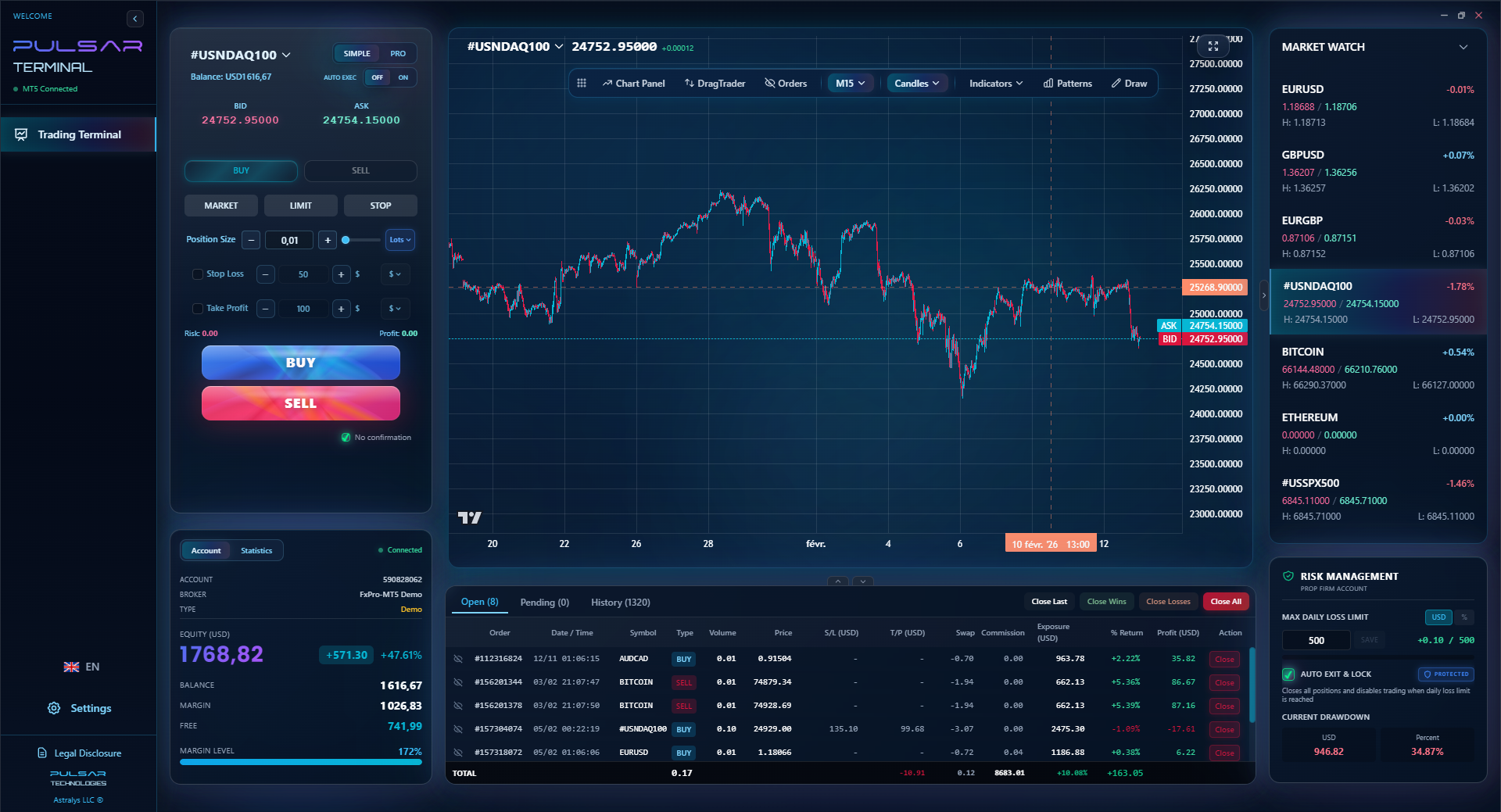
Managing prop firm daily loss limits is a constant mental battle, which is why automating risk with tools like Pulsar Terminal's prop firm daily loss protection is a game-saver.
Pulsar Terminal
Универсальный инструмент для MT5: drag-and-drop ордера, мульти-TP/SL, трейлинг-стоп, грид-трейдинг, Volume Profile и защита для проп-фирм. Используется 1000+ трейдерами ежедневно.
Let's get practical. The money hits your account. Now what?
Payment Methods: Most firms pay via cryptocurrency (USDT is most common) or international wire (USD). Some, like FundedNext, offer Wise transfers in AUD. Crypto is fastest, often within hours. Wire transfers take 2-5 business days and your bank will charge a foreign currency conversion fee (often 2-3%).
The Tax Man Cometh: The ATO views your profit share as ordinary income, not capital gains. This is a key distinction. It goes on your annual tax return as 'Other Income' or potentially as 'Business Income' if you're doing this regularly.
- Keep Records: Screenshot every payout request and the confirmation. Download all account statements.
- Track Your Costs: Your evaluation fees, platform data fees, even a portion of your internet bill can potentially be claimed as expenses against your trading income. Talk to an accountant who understands trading.
- GST: Generally, your trading income is not subject to GST, but again, consult a professional.
I made about $28,000 in prop firm payouts last financial year. I had about $1,200 in evaluation fees (some fails, some resets). My accountant helped me structure it so those fees were deductible. Don't try to wing this part. The ATO's data-matching is sophisticated.
“A prop firm is a capital partner, not a mentor. They provide the gunpowder, but you need to have already built the cannon.”
The prop firm space is full of brilliant marketers. Here's how to spot the likely problems.
Major Red Flags:
- 'Guaranteed' Payouts or Success: Nothing is guaranteed in trading. This is a lie.
- Unrealistically High use: 1:500, 1:1000. This is a trap designed to make you blow up faster.
- Vague or Constantly Changing Rules: If the 'Terms & Conditions' page is hard to find or reads like gibberish, run.
- No Verifiable Payout Proof: A reputable firm will have a transparent track record. Look for real, recent payout screenshots from users on independent forums, not just curated testimonials on their site.
- Pressure to Use Specific Signal Services: Some shady firms partner with signal sellers. You fail, they blame the signals, you buy another challenge.
The Withdrawal Test: The single best test of a prop firm is how they handle your first withdrawal. A legitimate firm has a clear, published process. They might have a minimum profit requirement for the first payout (e.g., $100) and a processing schedule (e.g., every Tuesday).
If you request a withdrawal and suddenly get hit with:
- Demands for additional 'verification' fees.
- Excuses about 'bank processing' for weeks.
- Your account being flagged for 'suspicious trading' on a winning trade.
...you're probably dealing with a firm that makes money from failed challenges, not successful traders. I fell for this once. The withdrawal process was so convoluted I gave up. That's exactly what they wanted.
💡 Совет Уинстона
When funded, withdraw your first profit share as soon as allowed. It's not real until it's in your bank account. This also tests the firm's payout system.
Let's be brutally honest. Prop trading isn't a golden ticket. It's a specific tool for a specific type of trader.
You might be a good candidate if:
- You have a proven, written trading strategy with a positive edge over at least 6 months of personal trading.
- You have rock-solid risk management. You know your win rate, average win/loss, and can stick to a position size calculator.
- You have the discipline to trade someone else's strict rules without getting emotional.
- You have the spare capital for evaluation fees (and can afford to lose them).
It's probably not for you if:
- You're new to trading and see this as a way to learn. (You'll lose your fee money, fast).
- You're struggling with profitability on a personal account. More capital just means bigger losses.
- You're emotionally attached to trades or can't handle drawdowns.
- You need the money urgently. This is a high-risk, high-stress endeavor.
My final thought: A prop firm is a capital partner, not a mentor. They provide the gunpowder, but you need to have already built the cannon. If you have a working strategy and the mental fortitude, the best prop firms in Australia (and abroad) offer a legitimate path to scale your earnings without risking your life savings. Just go in with your eyes wide open. The rules are the game. Master them, or they will master you.
FAQ
Q1Are prop trading firms legal in Australia?
Yes, absolutely. Proprietary trading itself is legal. Most firms operating here are international companies using a legal structure that doesn't require an Australian Financial Services License (AFSL). They are not regulated by ASIC in the same way your bank or a CFD broker is.
Q2How much does it cost to join a prop firm in Australia?
You pay a one-time evaluation fee, not a 'join' fee. For 2026, expect to pay between AUD $200 for a small account challenge (e.g., $25k) to AUD $850+ for a larger account (e.g., $200k). This fee is almost always non-refundable, even if you fail the challenge.
Q3What's the best prop firm for Australian traders?
There's no single 'best.' It depends on your trading style. Look for firms with a proven track record of fast, reliable payouts to AUD accounts (e.g., via Wise), clear and reasonable rules, and good platform support (like MT5). Firms like FundedNext, The5%ers, and FTMO are consistently mentioned by experienced Aussie traders for reliability.
Q4How are payouts from prop firms taxed in Australia?
The ATO treats your profit share as ordinary income, not capital gains. You must declare it on your tax return. Keep all records of payouts and your evaluation fees, as the fees may be tax-deductible as a business expense. Consult a tax professional.
Q5What's the biggest mistake traders make with prop firms?
Oversizing and ignoring the daily drawdown limit. They get focused on the profit target and take trades that are too large. A single loss can then breach the daily loss rule (often 3-5%), causing instant failure, even if they are up overall. Risk management is everything.
Q6Can I use any trading strategy with a prop firm?
Mostly, but with caveats. High-frequency scalping or use of certain EAs might be restricted. You must always follow their specific rules, which often ban news trading during major events or holding trades over the weekend. Always read the firm's rules first.
Q7What happens if I blow a funded account?
It depends on the firm. Many offer a 'second chance' or 'reset' option where you can pay a discounted fee (often 50-80% of the original) to get another funded account without re-taking the full challenge, provided you didn't violate rules. Others may make you start completely over.
Урок проф. Уинстона
Ключевые выводы:
- ✓ASIC doesn't regulate international prop firms; your protection is their reputation.
- ✓Daily drawdown limits (3-5%) are the #1 account killer, not the profit target.
- ✓Evaluation fees of $200-$850 are standard for $100k account challenges.
- ✓Profit splits of 90/10 are now common, but read scaling rules carefully.
- ✓Payouts are taxed as ordinary income by the ATO, not capital gains.
Насколько полезна эта статья?
Нажмите на звезду
Еженедельные торговые инсайты
Бесплатный еженедельный анализ и стратегии. Без спама.
Об авторе
Sarah Collins
Торговый стратег
Лондонский торговый стратег с 12-летним опытом на финансовых рынках. Бывший аналитик в брокерской компании Сити. Специализируется на GBP-парах, европейских рынках и FCA-регулированной торговле.
Комментарии
Предупреждение о рисках
Торговля финансовыми инструментами сопряжена со значительным риском и может не подходить всем инвесторам. Прошлые результаты не гарантируют будущих доходов. Данный контент носит исключительно образовательный характер и не является инвестиционной рекомендацией. Всегда проводите собственное исследование перед торговлей.
Вам также может понравиться

Cara Trading Forex Sukses: 7 Prinsip dari Trader Profesional
Cara trading forex sukses dengan 7 prinsip trader pro: manajemen modal, disiplin, journal trading, backtest. Data nyata, bukan janji profit palsu.
Jam Trading Forex Terbaik untuk Trader Indonesia: Panduan Lengkap dengan Tabel Waktu
Panduan jam trading forex untuk trader Indonesia. Tabel 4 sesi dunia, jam emas 20:00-00:00, sesi mana yang harus dihindari. Data akurat + tips dari trader berpengalaman.
Top 5 Sàn Forex Uy Tín Nhất 2026: Review Jujur dari Trader Indonesia
Top 5 sàn forex uy tín 2026 untuk trader Indonesia. Review jujur: spread, deposit, withdraw, dukungan lokal. Exness, XM, IC Markets & lebih.
Скачать Pulsar Terminal
Все эти калькуляторы встроены в Pulsar Terminal с данными в реальном времени с вашего счёта MT5.
Скачать Pulsar Terminal