


You're probably wondering who the richest South African forex traders are and how they did it.

David van der Merwe
Трейдер развивающихся рынков ·  South Africa
☕ 9 мин чтения
Что вы узнаете:
You're probably wondering who the richest South African forex traders are and how they did it. The truth is, you'll never know their names or see their bank statements. The real story isn't about secret millionaires; it's about a market where 69% of traders lose money, regulated by the FSCA, where survival is a bigger win than any get-rich-quick fantasy. Let's talk about what's real: the use limits, the taxman at SARS, and the brutal math that separates the few who last from the many who blow up.
Everyone wants to find the richest South African forex traders, as if they're a secret club with a handshake. They're not. The real wealth in this game is institutional, quiet, and boring. The flashy Instagram gurus showing off cars? Most are selling a course, not trading. The actual market size tells a clearer story: it hit USD 3.86 billion in 2024. That's institutional banks, hedge funds, and corporations moving money. The average retail trader is a minnow in that ocean.
I learned this the hard way early on. I'd see a guy on a forum claim he turned R50,000 into R500,000 in a month. So, I tried to trade like him - big use, chasing news. I blew 30% of my account in two weeks on USD/ZAR swings I didn't understand. The 'guru' disappeared a month later. The real pros aren't on forums boasting; they're risk managers at banks in Sandton or systematic quants running algorithms. Their performance is measured in basis points of consistency, not YouTube lambos.

Warning: If someone is publicly flaunting forex wealth and trying to sell you something, they are almost certainly making more money from you than from trading. Their real product is your hope.
The domestic market trades nearly $21.4 billion daily. ZAR pairs, mainly USD/ZAR, make up about 1% of global turnover. That's where local knowledge can give an edge, but it's also incredibly volatile. Chasing the dream of joining the richest South African forex traders blinds you to the actual opportunity: consistent, small-edge trading in a well-regulated environment. The FSCA didn't cap use at 30:1 for retail because it's easy to get rich; they did it because people were losing their shirts too fast.

💡 Совет Уинстона
The rand's volatility isn't your enemy; it's your testing ground. If you can manage risk on USD/ZAR, you can manage it anywhere. Start by risking no more than 0.5% per trade on that pair.
“The real pros aren't on forums boasting; they're risk managers at banks in Sandton or systematic quants running algorithms.”
You can't talk trading here without talking about the Financial Sector Conduct Authority (FSCA). This isn't a suggestion; it's your first line of defense. Trading with an unregulated offshore broker is a great way to have your local bank block your transaction and possibly lose everything. The FSCA license (an FSP number) is what separates legitimate operations from bucket shops.
Why the FSCA Matters to You
The 30:1 use cap for retail clients is the most famous rule. But some FSCA-licensed brokers still offer up to 1:500. How? They classify you as a professional client if you meet certain criteria (like a large portfolio or proven experience). It's a loophole, but a dangerous one. Higher use isn't a ladder to the ranks of the richest South African forex traders; it's a quicker escalator to a margin call.
The Taxman Always Wins
Here's a universal truth: SARS knows. Profits from forex trading are taxable income. It's not a hobby. You must declare it. I know a trader who had a great year, made about R800,000, and didn't declare it properly. The penalty and back-taxes wiped out nearly two years of profits. Keep a detailed log of every trade. Use a spreadsheet or proper software. Your accountant needs to see your wins, your losses, your spreads, and your commissions. If you ever do make serious money, this discipline is what keeps it.
“Higher use isn't a ladder to the ranks of the richest traders; it's a quicker escalator to a margin call.”
Let's cut through the fantasy with real stats. A 2020 survey found 69% of South African forex-only traders lost money. Most lost under R10,000. That's the baseline. Now, let's look at the economics of trying to be in the winning minority.
Costs You Can't Avoid:
- The Spread: This is your first hurdle. On EUR/USD, a good raw account might have a 0.1 pip spread plus a $3 commission per lot. A standard account might have a 1 pip spread, no commission. That difference is your cost of doing business before you're even right. On USD/ZAR, spreads are wider, often 50-80 pips. You need the price to move just to break even.
- Swap Rates: Holding a USD/ZAR position overnight? You'll pay or earn interest. If you're wrong on the interest rate differential, it slowly eats your capital.
- Slippage: In fast markets, your fill price won't be your click price. It's worse on exotic pairs.
Earning Potential (The Sober View):
| Trader Level | Realistic Monthly Return on Capital | What That Means (R50k Account) |
|---|---|---|
| Beginner (First 2 yrs) | -5% to +2% | Losing R2,500 or making R1,000 |
| Consistent Intermediate | 2% to 5% | R1,000 to R2,500 profit |
| Skilled Professional | 5% to 10% | R2,500 to R5,000 profit |

Example: Let's say you're skilled. You turn R100,000 into R110,000 in a month (a 10% return, which is outstanding). After 20% average costs and taxes, your real take-home is closer to R8,000. That's good money, but it's not "private jet" money. It's a very good salary. The richest South African forex traders, the real ones, got there by compounding these returns over decades, or by managing other people's money for a fee.
My own best month ever was a 14% return on a $20,000 account. I made $2,800. I felt like a king. The next month, I gave back $1,200 trying to force the same trades. Net for two months: $1,600. Humbling. That's why tools like a position size calculator are non-negotiable. You must know your exact risk per trade, in Rands, before you click buy.
💡 Совет Уинстона
Your FSCA-registered broker is your business partner. If their platform fails during a major SA news event, you have recourse. An offshore broker offers none. This is a critical, non-negotiable layer of protection.
“Your success metric in the first two years should be adherence to your rules, not your P&L.”
Choosing a broker isn't about who promises the most use. It's about who provides the most stable, fair access to the market. Because you're in South Africa, you have a specific need: ZAR accounts to avoid exchange fees, and local support.
FSCA-Licensed Brokers Worth Your Time:
- For Raw Costs: Tickmill and IC Markets offer tight spreads and ECN execution. Their raw accounts are for traders who understand that low cost is a long-term edge.
- For Platform Choice: FP Markets and Pepperstone are solid all-rounders with great MT4/MT5 support.
- For Beginners: XM and Exness have very low minimum deposits (like $5), which is good for learning without big risk.
Your Local Edge: USD/ZAR
This is your home game. You feel the rand's strength when you fill up your car. You hear about Eskom on the news. This fundamental awareness is an edge over a trader in London who only sees the charts. But it's a double-edged sword. USD/ZAR is highly volatile, prone to gaps on political news, and has wide spreads. Trading it requires specific strategies, often better suited to swing trading than scalping.
I once shorted USD/ZAR at R18.50 ahead of a budget speech, thinking the rand would strengthen. I was right on the direction, but the speech was at 2 PM. The pair spiked to R18.85 on low liquidity in the Asian session, hitting my stop loss at R18.80, before plummeting to R18.30 where I wanted to be. I was right, but I lost money. The market doesn't care if you're right. It cares about your order placement and risk.
“Your success metric in the first two years should be adherence to your rules, not your P&L.”
This is where 95% of traders fail. They focus on the prize, not the process. The mental game in South Africa is the same as anywhere, but with a unique pressure: the rand's volatility can make you feel stupidly smart or stupidly poor very quickly.
The Two Deadly Local Mindsets:
- The "I Need Rands" Tilt: Your car payment is due in Rands. You start seeing every trade as a way to solve that problem. You increase size, ignore your stop, and turn a small drawdown into a catastrophic loss. You're no longer trading the chart; you're trading your bills.
- The "Braai Boast" Trap: You have one good week. At the braai, you casually mention your forex prowess. Now your ego is on the line. You take trades to maintain your new identity as a market wizard, not because the setup is there.
I've been in both camps. After a bad loss, I'd double down on the next trade to "make it back fast." That's a guaranteed way to dig a deeper hole. The only way out is a boring, mechanical approach. Define your risk (e.g., 1% of capital per trade), define your setup, and execute. No arguments. Use the RSI indicator or MACD indicator if they're part of your plan, but don't curve-fit them to justify a bad trade.

Pro Tip: Keep a trading journal. Not just "bought EUR/USD." Write down your emotional state: "Felt impatient because I hadn't traded all day." "Felt greedy after two wins in a row." You'll see your own destructive patterns repeat. This is more valuable than any indicator.
💡 Совет Уинстона
That 30:1 use cap from the FSCA isn't a limit on your potential. It's a governor on your self-destruction. The traders who last a decade rarely use more than 10:1.
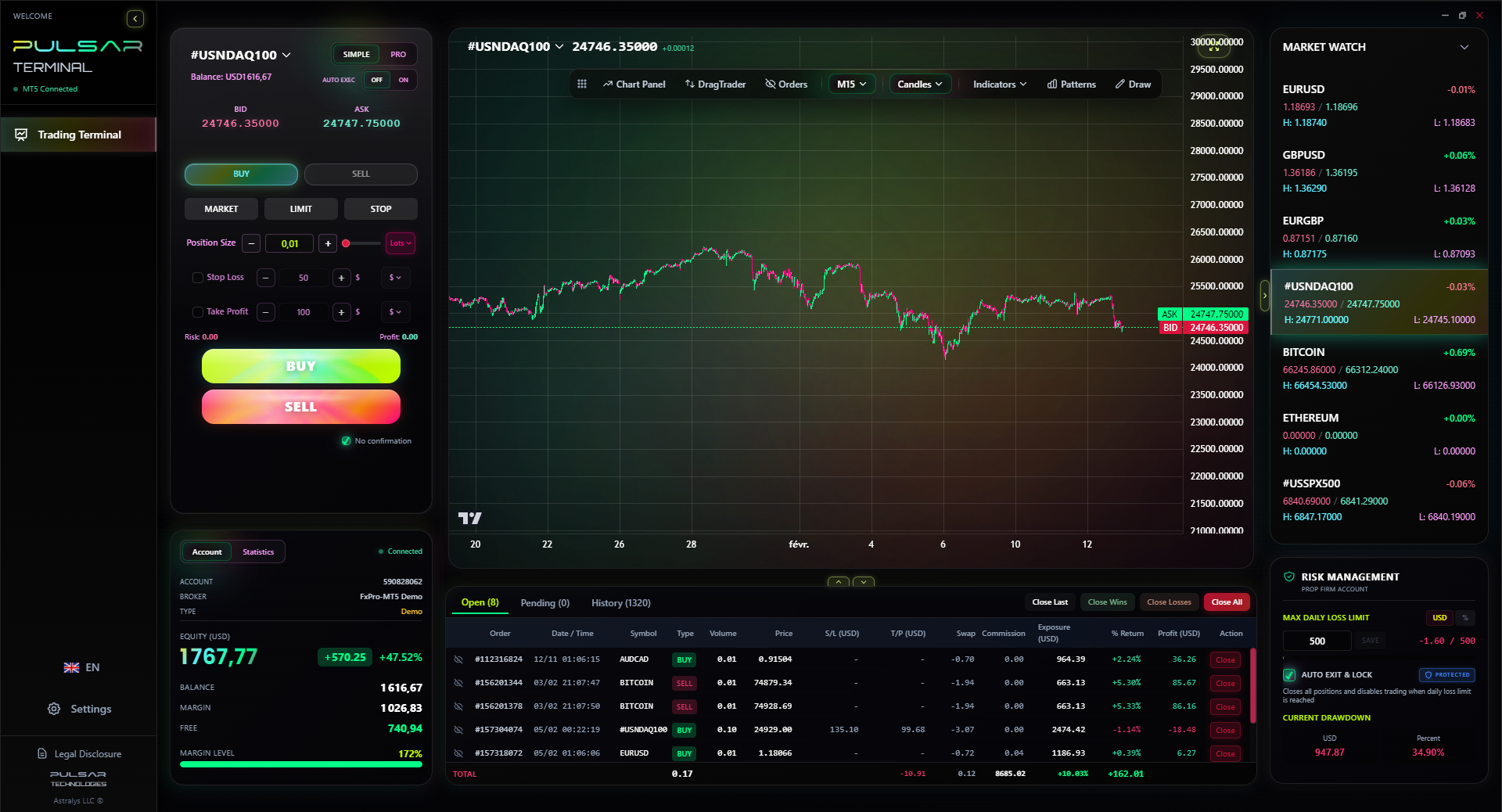
Managing the brutal psychology of trading, especially under prop firm rules, requires automated discipline—something Pulsar Terminal builds directly into your MT5 workflow with features like daily loss limits and one-click order templates.
Pulsar Terminal
Универсальный инструмент для MT5: drag-and-drop ордера, мульти-TP/SL, трейлинг-стоп, грид-трейдинг, Volume Profile и защита для проп-фирм. Используется 1000+ трейдерами ежедневно.
“The market doesn't care if you're right. It cares about your order placement and risk.”
So, how do you build real, lasting trading capital in South Africa? You forget about the richest South African forex traders and focus on becoming a survivor.
A Realistic 5-Year Progression:
- Year 1-2 (The Apprenticeship): Your goal is to not lose money. Fund a live account with money you can afford to lose completely - R5,000 to R10,000. Practice strict risk management. Your success metric is adherence to your rules, not your P&L. Expect to break even or lose slowly.
- Year 3-4 (Consistency): You should have a clear, written strategy. You're now aiming for consistent, small monthly returns (2-4%). You might scale your capital up to R50,000-R100,000. This is where compounding starts to work, but slowly.
- Year 5+ (Capital Growth): With a proven track record, you can consider scaling more aggressively or exploring funded accounts with prop firms. Your edge is now your discipline. A 5-10% monthly return on a R200,000 account is life-changing money (R10k-R20k per month). That's the real goal.
The Prop Firm Route:
This has become a popular shortcut. You pay a fee to take a challenge. If you pass, you trade a large simulated account and keep most of the profits. It's attractive because it requires less starting capital. But the rules are brutal - strict drawdown limits, time constraints. It's a test of pure discipline. To pass, you need the risk management of a Navy SEAL. Tools that automate protection, like setting a hard daily loss limit, are useful here.
The market will always be here. The question is, will you? Stop looking for the richest South African forex traders. Start building the habits of the ones who survive.
FAQ
Q1Who is the richest forex trader in South Africa?
No one knows for sure, and any name you see online is likely speculation or marketing. Real wealth from trading is private. The more useful question is: what habits do consistently profitable traders have? They focus on risk management, journal their trades, and treat it as a business, not a casino.
Q2Is forex trading legal and safe in South Africa?
It's legal, but 'safe' depends on you. It is regulated and safe if you use a broker licensed by the Financial Sector Conduct Authority (FSCA). Trading with unregulated offshore brokers is risky and your bank may block transactions. The trading itself is high-risk - 69% of retail traders lose money.
Q3How much do forex traders make in South Africa per month?
Earnings vary wildly. A beginner might lose money or make R1,000-R5,000. A skilled, consistent trader with a R100,000 account might aim for 5% monthly, or R5,000 profit before costs and tax. The stories of people making hundreds of thousands monthly are extreme outliers and not a realistic expectation.
Q4What is the best broker for South African traders?
There's no single 'best.' Choose an FSCA-licensed broker that fits your style. For low costs, look at Tickmill or IC Markets. For user-friendliness and low minimum deposits, consider XM or Exness. Always verify their FSP number on the FSCA website.
Q5Do I pay tax on forex profits in South Africa?
Yes. SARS views forex trading profits as taxable income. You must declare it on your annual tax return. Keep detailed records of all trades, including losses which can be offset against profits. Not declaring it can lead to severe penalties.
Q6Why do most South African forex traders fail?
They fail for the same reasons traders fail everywhere: poor risk management (using too much use), emotional trading, lack of a tested strategy, and unrealistic expectations of getting rich quick. The volatility of the rand can accelerate these failures.
Q7Can I trade with US dollars from South Africa?
Yes, most international brokers offer USD accounts. However, your South African bank will convert your ZAR to USD to fund it, and you'll pay their exchange rate and fees. Some local brokers offer ZAR-denominated accounts to avoid this, but your trading instruments will still be in their base currency (like USD/ZAR).
Урок проф. Уинстона
Ключевые выводы:
- ✓Verify your broker's FSCA FSP number. Always.
- ✓Risk a maximum of 1% of capital on any single trade.
- ✓USD/ZAR requires 3x the patience of EUR/USD.
- ✓Journal your emotions, not just your trades.
- ✓SARS gets a share. Plan for it from trade one.
Насколько полезна эта статья?
Нажмите на звезду
Еженедельные торговые инсайты
Бесплатный еженедельный анализ и стратегии. Без спама.
Об авторе
David van der Merwe
Трейдер развивающихся рынков
Трейдер из Йоханнесбурга с 11-летним опытом работы с валютами развивающихся рынков. Специализируется на ZAR-парах, торговле под регулированием FSCA и анализе южноафриканского рынка.
Комментарии
Предупреждение о рисках
Торговля финансовыми инструментами сопряжена со значительным риском и может не подходить всем инвесторам. Прошлые результаты не гарантируют будущих доходов. Данный контент носит исключительно образовательный характер и не является инвестиционной рекомендацией. Всегда проводите собственное исследование перед торговлей.
Вам также может понравиться

Cara Trading Forex Sukses: 7 Prinsip dari Trader Profesional
Cara trading forex sukses dengan 7 prinsip trader pro: manajemen modal, disiplin, journal trading, backtest. Data nyata, bukan janji profit palsu.
Jam Trading Forex Terbaik untuk Trader Indonesia: Panduan Lengkap dengan Tabel Waktu
Panduan jam trading forex untuk trader Indonesia. Tabel 4 sesi dunia, jam emas 20:00-00:00, sesi mana yang harus dihindari. Data akurat + tips dari trader berpengalaman.
Top 5 Sàn Forex Uy Tín Nhất 2026: Review Jujur dari Trader Indonesia
Top 5 sàn forex uy tín 2026 untuk trader Indonesia. Review jujur: spread, deposit, withdraw, dukungan lokal. Exness, XM, IC Markets & lebih.
Скачать Pulsar Terminal
Все эти калькуляторы встроены в Pulsar Terminal с данными в реальном времени с вашего счёта MT5.
Скачать Pulsar Terminal