


Most Nigerian traders think a sell stop is just a stop-loss.

Olumide Adeyemi
Пионер трейдинга в Западной Африке ·  Nigeria
☕ 10 мин чтения
Что вы узнаете:
- 1What Exactly Is a Sell Stop Order? (It's Not Just a Stop-Loss)
- 2Why Nigerian Traders Specifically Need to Master This
- 3Using a Sell Stop as an Entry: The Breakdown Strategy
- 4The Sell Stop as Your Ultimate Risk Manager
- 5Brokers, Platforms, and the Nigerian Reality Check
- 6Common Mistakes I've Made (So You Don't Have To)
- 7Leveling Up: Advanced Sell Stop Techniques
Most Nigerian traders think a sell stop is just a stop-loss. They're wrong, and that mistake costs them money. A sell stop is your most powerful tool for entering short trades and managing risk, but only if you know the local broker quirks and CBN's ever-changing rules. I've used it to catch massive breakouts on USD/NGN pairs and, yes, I've also had it fail spectacularly when I ignored slippage. This guide will show you the real way to use a sell stop in forex from Lagos to Port Harcourt.
Let's clear this up first. A sell stop order is an instruction you give your broker: "If the price falls TO or BELOW level X, then SELL at the market." It's a conditional order that sits dormant until its trigger price is hit.
Most guys here in Nigeria only use it one way: as a stop-loss on a buy trade. If you bought GBP/USD at 1.2600, you might put a sell stop at 1.2550 to limit your loss. That's correct, but it's only half the story. The other, more aggressive use is for entry. You place a sell stop BELOW the current price when you're anticipating a breakdown. When price crashes through support, your order fires, and you're short from the get-go.
There's a fancier version called a sell stop-limit. Here, you set two prices: a stop price and a limit price. If the stop is hit, it becomes a limit order to sell, but ONLY at your limit price or better. This can protect you from terrible fills in a volatile market, but it also risks the order not being filled at all if price gaps past your limit. For most retail traders in Nigeria, the plain sell stop is enough to start with.

Warning: Never confuse a sell stop with a buy stop. A buy stop is placed ABOVE the market to catch breakouts to the upside. Mixing these up is a classic, expensive rookie error.
Our market has unique challenges. Power outages, network issues, and the general hustle mean you can't always be glued to your screen. A sell stop automates your strategy. You can set your trade and go about your day without worrying about missing a move.
Catching USD/NGN and Exotic Pairs
When trading pairs involving the Naira or other exotics common here, volatility is king. These pairs can move fast. A sell stop allows you to position for a potential devaluation or breakdown without having to manually click sell as panic sets in. I remember setting a sell stop on USD/NGN (offshore) just below a key support at 780. When it broke, my order executed at 778.50. The pair then tumbled to 810 in two days. The sell stop got me in cleanly while others were hesitating.
Managing Risk in a Leveraged Environment
Brokers like Exness and HF Markets offer high use to Nigerian clients - sometimes 1:500 or more. That's a double-edged sword. A sell stop as a stop-loss is non-negotiable here. Without it, a small move against you can wipe out your account. It's your financial circuit breaker. I learned this the hard way early on with Gold (XAU/USD). I went long without a tight stop, got greedy, and a sudden spike down triggered a margin call before I could react. A sell stop would have saved me $1,200 that day.

Pro Tip: Always use a position size calculator before placing the order. Know exactly how much you're risking in Naira terms, not just pips. A 50-pip loss with 1:500 use feels very different on a $100 account versus a $5,000 account.

💡 Совет Уинстона
Your first job with a sell stop is to survive. Place it before you think about profit. A protected loser is better than an unprotected 'maybe'.
“A sell stop is your financial circuit breaker in a high-use environment.”
This is where the magic happens. You're not protecting a buy trade; you're initiating a sell trade. The psychology is different. You're betting that support will break.
Here's my simple process:
- Identify Strong Support: Use horizontal levels, trendlines, or the previous day's low. Don't just pick a random number.
- Place Sell Stop Just Below Support: I usually place it 5-10 pips below a clear support level on major pairs like EUR/USD. This allows for a little market noise or a false spike (wick) that doesn't actually signify a true break.
- Set Your Take-Profit and Stop-Loss: Yes, your entry has its own stop-loss (a buy stop order). Your risk is defined from your sell stop entry price to your buy stop loss price. Your take-profit should be at a minimum a 1:1.5 risk-to-reward ratio.
A Real Trade Example: On the GBP/JPY chart, I identified a clear support at 183.00. Price was hovering at 183.50. I placed a sell stop order at 182.90. My stop-loss (a buy stop) was at 183.40 (50 pips risk). My take-profit was at 181.90 (100 pips target). The support broke, my order executed, and the pair fell to 181.80 over the next 8 hours. That was a clean 2:1 winner, all set up in advance.
The key is patience. This isn't a scalping strategy. It might take hours or days for the level to be tested. Don't move your order up just because price is getting close. Let the market decide.
This is its primary, and most important, job. Every long position you open must have a sell stop attached to it from the moment you click "buy." No exceptions. Not tomorrow, not after you see how it goes - immediately.
How to Place a Protective Sell Stop:
- Technical Level: Below the most recent swing low or a key moving average.
- Percentage of Account: Many pros risk 1-2% of their account per trade. If you have a $1,000 account, that's $10-$20 risk. Use your position size calculator to work backwards to find the correct stop distance in pips.
- ATR (Average True Range): A more advanced method. Set your stop 1.5x the 14-period ATR away from your entry. This adjusts for current market volatility.
The Slippage Problem in Nigeria: Here's the ugly truth. During major news events (like CBN MPC announcements or US NFP), the market can gap. Your sell stop at 1.2550 might get filled at 1.2530. That's 20 pips of slippage, doubling your expected loss. This is why you should never risk more than 2% of your account on a single trade. That slippage cushion is part of the game. Brokers with deep liquidity like IC Markets or Pepperstone typically have less slippage than smaller, less regulated outfits.
Warning: Never move your stop-loss further away because the trade is going against you. That's called "widening your stop" and it's the fastest path to a blown account. You were wrong. Take the loss and move on.
“The key to a sell stop entry isn't aggression, it's patience.”
You can't talk execution without talking brokers. Many international brokers welcome Nigerians, but their terms matter.
Platforms:
- MT4/MT5: The universal standard. Placing a sell stop is straightforward: right-click, "Place Order," select "Sell Stop," and enter your price. Most Nigerian traders use this.
- cTrader: Gaining popularity for its clean execution. The process is similar.
Broker Execution Types:
| Broker Type | How Your Sell Stop is Filled | Good For Nigerian Traders? |
|---|---|---|
| Market Maker | Broker may take the other side of your trade. Risk of requotes during volatility. | Common, but can be frustrating during fast markets. |
| ECN/STP | Order routed to liquidity providers. Usually faster execution, tighter spreads. | Better for serious traders. Look for brokers like FP Markets or IC Markets. |
Funding & The CBN: This is the real hurdle. Funding your account with Naira can be a headache. Brokers like Exness and XM offer local bank transfers, which helps. But remember the CBN's rules: you're not supposed to use official forex windows to fund trading. This pushes traders towards e-wallets (Skrill, Neteller), crypto (USDT), or domiciliary accounts. Factor in that your sell stop profit, when withdrawn, might face delays or conversion fees.
My advice? Start with a broker that offers a demo account where you can practice placing sell stops for weeks before risking real money. Get the mechanics down cold.
💡 Совет Уинстона
If you find yourself constantly getting stopped out and then the market reverses, your stops are too tight. You're being picked off by market makers. Widen them based on volatility, not hope.
I've got the scars, so listen up.
- Placing Stops Too Close: In my early days, I'd put my sell stop loss 10 pips from entry on GBP/JPY, a notoriously volatile pair. I'd get stopped out by normal market noise, only to see price rocket in my original direction. The trade was right, the stop was wrong. Now, I give my trades room to breathe, using structure or ATR.
- Forgetting About Spreads: The spread is the cost of doing business. If you place a sell stop entry at 1.2550, and the bid/ask spread is 2 pips, the price actually needs to hit 1.2548 (bid price) to trigger your order. Always account for the spread in your calculations.
- Using Sell Stops in Illiquid Markets: Trying this on exotic pairs or during off-hours (Asian session for EUR pairs) is asking for massive slippage. Stick to major pairs during overlapping sessions (London/NY) for the cleanest fills.
- Not Having a Plan for the Trade: A sell stop is just an entry tool. If you don't know where you'll take profit or move your stop to breakeven, you're gambling. Before you click, know your exit. A proper swing trading plan includes all of this.
One brutal lesson: I once set a sell stop entry on USD/CAD during a Bank of Canada news event. The breakdown happened, but the slippage was 25 pips. My order filled so far past my planned entry that my risk was nearly triple what I'd calculated. I survived, but it was a white-knuckle ride. Now, I avoid news events for breakout entries.
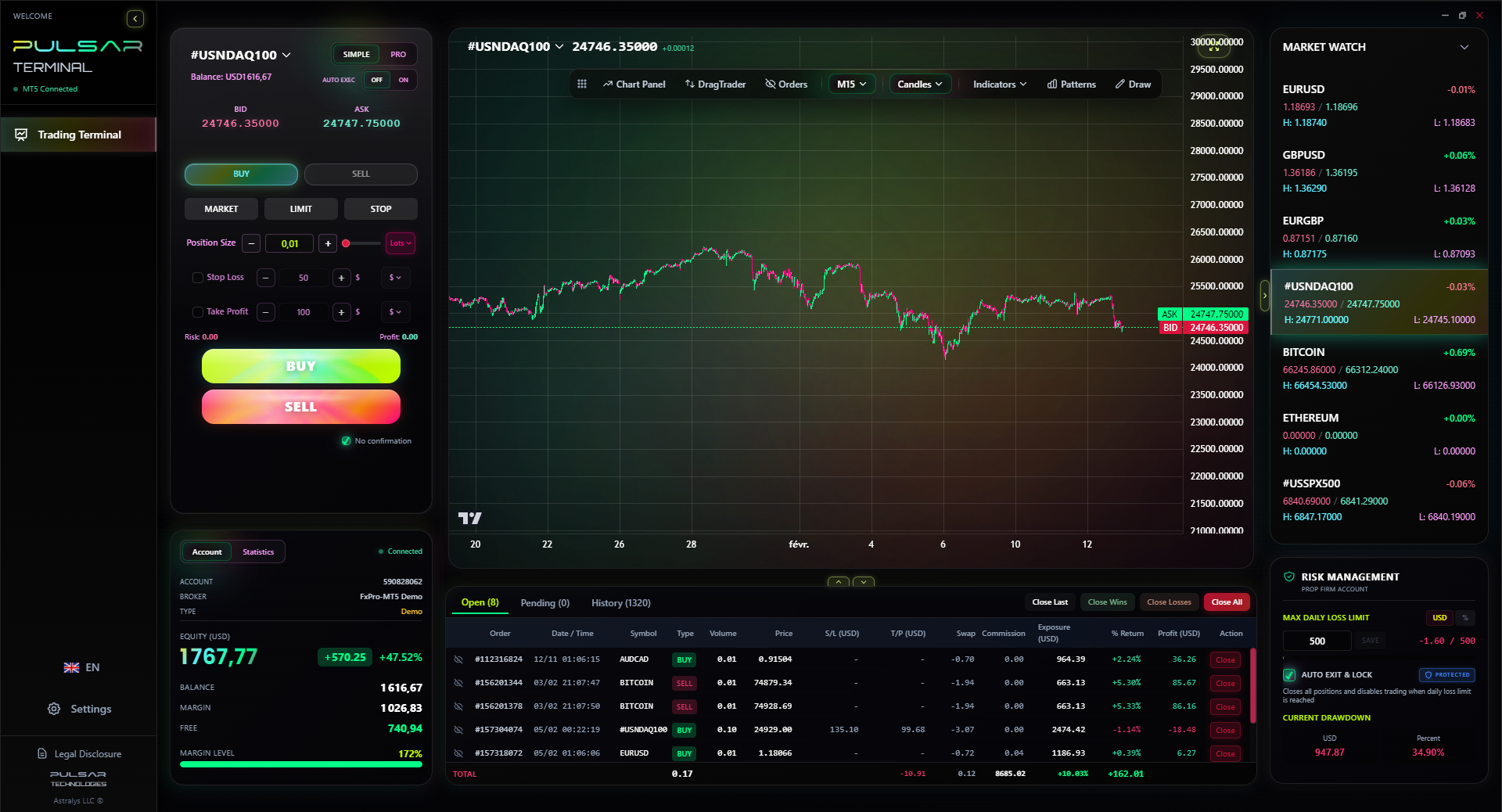
Managing advanced techniques like trailing stops and multiple take-profits is far easier with a tool that automates the process directly on your MT5 chart.
Pulsar Terminal
Универсальный инструмент для MT5: drag-and-drop ордера, мульти-TP/SL, трейлинг-стоп, грид-трейдинг, Volume Profile и защита для проп-фирм. Используется 1000+ трейдерами ежедневно.
“Never move your stop-loss further away because the trade is going against you. You were wrong. Take the loss and move on.”
Once you're comfortable with the basics, you can get creative.
Trailing Stop-Loss: This isn't placing the stop, but managing it. After your short trade from a sell stop entry starts making profit, you can trail your stop-loss (which is now a buy stop) below the price, locking in gains. Many platforms have an automated trailing stop function, but you need to understand how it works.
Multiple Take-Profit Levels with Partial Closure: Let's say you enter a short with a sell stop. Instead of one take-profit, set two. Close half your position at TP1 (a nearer target) and move your stop-loss on the remaining half to breakeven. Then, let the second half run to TP2. This books some profit early and removes risk from the rest of the trade.
Grid Trading (Use With Extreme Caution): This involves placing a series of sell stop orders at progressively lower levels, each with a small take-profit. It's a mean-reversion strategy that can work in a ranging market but will destroy you in a strong trend. I don't recommend this for beginners; it's a great way to test your pain tolerance.
These advanced tactics require precision and a platform that supports them well. Manual management is possible but stressful.
FAQ
Q1What's the difference between a sell stop and a sell limit?
A sell stop is placed BELOW the current market price to sell on a drop. A sell limit is placed ABOVE the current market price to sell on a rise (hoping to sell at a better price). They are opposites for entry. A sell limit is like saying, "If it rises to X, then sell."
Q2Can I change or cancel a sell stop order once it's placed?
Yes, absolutely. As long as the market price hasn't hit your trigger price, the order is just a pending order. You can modify its price, delete it, or replace it at any time from your trading platform's 'Order' or 'Trade' tab.
Q3Is a sell stop guaranteed to execute at my exact price?
No. It's guaranteed to execute only if the market trades at your price. However, the execution price itself is not guaranteed, especially in fast markets. Your sell stop becomes a market order, which gets filled at the next available price. This can lead to slippage, which can be positive or negative.
Q4Do Nigerian brokers charge extra for placing a sell stop order?
Generally, no. Brokers make money from the spread or a commission when the trade is executed. Placing the pending order itself is free. However, always check your broker's fee schedule for any unusual charges.
Q5What's the best pair to practice sell stop strategies on?
Start with a major, liquid pair with lower spreads like EUR/USD or USD/JPY. They have cleaner technical levels and more predictable behavior than exotics or cross pairs, making it easier to see if your strategy is working.
Q6How far below support should I place my sell stop entry?
There's no magic number. I use 5-10 pips on majors to avoid false breakouts (wicks). You need to look at the recent price action. If the pair typically has 15-pip wicks at key levels, place your stop 16-20 pips below. Use the ATR indicator for a data-driven approach.
Урок проф. Уинстона
Ключевые выводы:
- ✓Use a sell stop for two things: entering short breakouts and protecting long positions.
- ✓Always calculate your risk in Naira, not just pips, before placing the order.
- ✓Account for the spread and potential slippage, especially around CBN news.
- ✓Place stops based on market structure (support/swing lows), not arbitrary percentages.
Насколько полезна эта статья?
Нажмите на звезду
Еженедельные торговые инсайты
Бесплатный еженедельный анализ и стратегии. Без спама.
Об авторе
Olumide Adeyemi
Пионер трейдинга в Западной Африке
Один из самых активных преподавателей форекс-трейдинга в Нигерии. 8 лет торгового опыта из Лагоса. Специализируется на стратегиях с малым капиталом и челленджах проп-фирм для африканских трейдеров.
Комментарии
Предупреждение о рисках
Торговля финансовыми инструментами сопряжена со значительным риском и может не подходить всем инвесторам. Прошлые результаты не гарантируют будущих доходов. Данный контент носит исключительно образовательный характер и не является инвестиционной рекомендацией. Всегда проводите собственное исследование перед торговлей.
Вам также может понравиться

Cara Trading Forex Sukses: 7 Prinsip dari Trader Profesional
Cara trading forex sukses dengan 7 prinsip trader pro: manajemen modal, disiplin, journal trading, backtest. Data nyata, bukan janji profit palsu.
Jam Trading Forex Terbaik untuk Trader Indonesia: Panduan Lengkap dengan Tabel Waktu
Panduan jam trading forex untuk trader Indonesia. Tabel 4 sesi dunia, jam emas 20:00-00:00, sesi mana yang harus dihindari. Data akurat + tips dari trader berpengalaman.
Top 5 Sàn Forex Uy Tín Nhất 2026: Review Jujur dari Trader Indonesia
Top 5 sàn forex uy tín 2026 untuk trader Indonesia. Review jujur: spread, deposit, withdraw, dukungan lokal. Exness, XM, IC Markets & lebih.
Скачать Pulsar Terminal
Все эти калькуляторы встроены в Pulsar Terminal с данными в реальном времени с вашего счёта MT5.
Скачать Pulsar Terminal