


I watched a perfect swing setup on XAU/USD evaporate into a $1,200 floating loss because of a rule I didn't fully understand.

James Mitchell
Старший аналитик по трейдингу
☕ 12 мин чтения
Что вы узнаете:
- 1What Even Is a Swing Trading Prop Firm Anymore?
- 2The New Rules (SEC, CFTC) & Why You Should Care
- 3The Real Numbers: Fees, Splits, and The Scaling Trap
- 4Swing Trading Killers: The Rules That Will Break You
- 5Picking Your Arena: How to Vet a Prop Firm in 2025
- 6Bending Your Strategy to Their Rulebook
- 7Passing the Challenge is Just the Beginning
I watched a perfect swing setup on XAU/USD evaporate into a $1,200 floating loss because of a rule I didn't fully understand. I was in a prop firm challenge, holding a gold short from $1985, expecting a pullback. It kept drifting up to $1998 over three days. No problem, right? My analysis said it was just noise before the drop. Wrong. The firm used an equity-based drawdown, not balance-based. The floating loss breached my max drawdown while I slept, and they auto-liquidated my position at the worst possible moment. Gold then promptly tanked $50. The trade would have been a winner. I learned the hard way that swing trading prop firms isn't just about your strategy; it's about navigating their rulebook, which is getting rewritten by regulators as we speak.
Forget the old image of a sweaty trading floor. Today's prop firm is mostly a website, a rulebook, and a pile of evaluation fees. You pay them a one-time charge (say, $250) to take a 'challenge.' Pass it, and they give you a simulated account with 'their' capital - anywhere from $10k to $200k to start. You trade it, keep a chunk of the profits (usually 50-80% to start), and they take the rest. You lose, you're out. They keep your fee.
For swing traders, this model is uniquely tempting. You need patience, not lightning-fast reflexes. Holding trades for days or weeks fits the evaluation timeline, which is often 30 days minimum. The big appeal? use without personal bankruptcy. Trying to swing trade a $100,000 position with your own $5,000 is a one-way ticket to a margin call. With a prop firm, the 'blow-up' risk is limited to your evaluation fee.
But here's the critical shift happening right now. The SEC and CFTC are poking this model with a very big stick. The old 'regulatory gray area' - where firms claimed they were just selling educational evaluations - is getting narrower by the month. New rules passed in 2024 are forcing many to register as actual dealers or Commodity Trading Advisors. This is a good thing for you. It means more oversight, clearer rules, and hopefully, fewer outright scams. But it also means the firms that survive will have stricter compliance, which trickles down to how you can trade.

Warning: The 10-15% pass rate statistic is real. Over 90% of challenges fail. The firm's business model often relies on this. Your first job isn't to make money; it's to not lose money in their very specific way.

💡 Совет Уинстона
The prop firm's rulebook is your primary trading indicator. Master it before you even think about a chart pattern.
“Passing a prop challenge is a test of your ability to follow someone else's rules, not just your trading genius.”
You might think regulations are boring. Until they change how your profit split works or whether your favorite firm can even operate. Here's the breakdown in plain English.
The SEC "Dealer" Rule
As of 2024, the SEC expanded who counts as a 'dealer.' If a prop firm is actively making markets or trading significant volume, they might now have to register with the SEC and FINRA. This brings capital requirements, audits, and a whole new level of scrutiny. For you, this could mean more transparent pricing and fewer shenanigans with slippage. It also might push some smaller, shadier firms out of the US market.
The CFTC's Big Question
This is the bigger one for futures traders. The CFTC is asking: 'Are these prop firms actually Commodity Trading Advisors (CTAs)?' If the answer becomes 'yes,' everything changes. CTAs must register, meet capital rules, and keep detailed records. The compliance date for related rule amendments is March 2025, and the CLARITY Act (passed by the House in 2025) could drag crypto-focused firms into this net too.
What does this mean for your swing trading?
- Stability: The firms that adapt will be more legitimate, but possibly more rigid.
- Rule Clarity: Ambiguous profit-calculation or withdrawal policies should become less common.
- Instrument Availability: Some firms might pull certain products (like crypto futures) if the regulatory cost gets too high.
Bottom line: When choosing a swing trading prop firm in 2025, its regulatory posture is a key feature. A firm proactively adapting to these rules is a safer bet for the long haul. Check their website for compliance info. If it's totally silent, be wary.
“Balance-based drawdown isn't a feature for swing traders; it's the entry ticket.”
Let's talk dollars and cents, because the marketing is often divorced from reality.
Evaluation Fees: They range from $100 to $600. See a $99 'sale'? That's the norm, not a discount. I've paid $299 for a $100k challenge and $499 for a $200k one. Never pay the 'full' price. Always use a coupon code (they're everywhere).
Profit Splits: They'll advertise 'up to 90%!' or even '100% of first $10k!'. The starting split is what matters. Most are between 50% and 80%. Read the scaling plan. To get that 90%, you often need to generate tens of thousands in profit over months. It's a carrot.
The One-Star Experience: My first major payout was a lesson. I passed a challenge with a firm (not one of the big names) and made $8,200 in profit on my first $50k funded account over six weeks. My split was 80%. That's $6,560 coming to me. Sweet. The withdrawal process took 14 business days, required two extra verification calls, and they initially tried to deduct a mysterious 'processing fee.' I had to quote their own terms back to them. I got my money, but the hassle was immense. Now I only consider firms with proven, fast payout histories like those reviewed in our Pepperstone review for broker execution, though Pepperstone itself isn't a prop firm.
Account Sizes & Scaling: You see '$400,000 Account!' but that's usually the maximum after scaling. The initial grant might be $25k. The scaling rules are where they get you. You might need 3 consecutive profitable months, with a total profit over $X, without violating a single rule, to get a 25% increase. It's a grind.

Example: Let's say you take a $50,000 account with an 80% profit split. You have a great month and make a 6% return, or $3,000. Your payout is $2,400. Minus taxes (you're responsible for them), you're looking at ~$1,900 after a basic tax set-aside. That's a good return on a $299 fee, but it's not quit-your-job money. This is why consistent swing trading processes beat home-run hunting.
“Balance-based drawdown isn't a feature for swing traders; it's the entry ticket.”
This is the most important section. Your technical analysis can be perfect, but if you violate their risk rules, you're gone. For swing traders, three rules are absolute landmines.
1. Drawdown Type: Static vs. Trailing vs. Equity-Based
This is the one that got me, as I mentioned in the intro.
- Balance-Based (Static) Drawdown: The holy grail for swing traders. Your max loss is calculated from your starting balance. If you start with $100,000 and have a 10% max drawdown, your account is liquidated if your balance hits $90,000. Floating losses don't count. You can ride out volatility.
- Equity-Based Drawdown: The killer. Your max loss is calculated from your peak equity (balance + floating P/L). If you're in a trade that goes $2,000 against you, that dips into your drawdown limit immediately, even if you haven't closed the trade. This is utterly incompatible with sane swing trading. Always, always choose a firm offering balance-based drawdown for swing strategies.
2. Daily Loss Limits
Usually around 5%. Sounds like plenty. But on a volatile day, a gap open against your position can hit that limit instantly. For swing trading, you need a firm that calculates the daily loss at 5 PM EST (or their specified time) on your closed positions only, not on equity. Again, read the fine print.
3. Minimum Trading Days & Consistency Rules
Many challenges require you to trade a minimum number of days (e.g., 5 out of 30). For a swing trader who might only take 2-3 setups a month, this forces you into overtrading. Look for firms with no minimum trading day rule, or a very low one.

Pro Tip: Before you even look at a chart, open the firm's FAQ and rulebook. Ctrl+F for 'drawdown,' 'daily loss,' and 'minimum days.' If the answers aren't crystal clear and swing-trader friendly, close the tab. Your position size calculator must factor in their drawdown rules, not just your own risk tolerance.
💡 Совет Уинстона
Your first funded account withdrawal isn't about the money. It's about proving the pipeline works. Take it as soon as you can.
“The 90% failure rate isn't about bad traders; it's about good traders failing to adapt to a foreign rulebook.”
With the regulatory shift, your checklist has changed. Here’s my 2025 vetting process.
1. Regulatory Posture: Do they address the new SEC/CFTC environment? Do they mention registration, compliance, or partnerships with regulated entities? Silence is a red flag.
2. Rule Clarity & Swing-Friendliness: As above. Balance-based drawdown is non-negotiable. Clear, written policies on overnight/weekend holding, news trading, and economic data releases are essential.
3. Platform & Instruments: You need a platform that works for analysis, not just execution. MT5 is common and strong. Do they offer the instruments you want? If you trade XAU/USD or EUR/USD, check the spreads and whether they allow trading on it during the challenge phase (some don't).
4. Payout Proof & Community Sentiment: Go beyond the firm's 'success stories.' Search for independent payout proofs on Forex forums or YouTube. Look for consistent complaints. One or two complaints are normal; a pattern of 'withdrawal delayed' or 'account closed arbitrarily' is a deal-breaker.
5. use: For swing trading, you don't need crazy use. A cap of 1:30 is actually healthy - it forces sensible position sizing. Firms like IC Markets (as an execution broker for some firms) offer stable use environments.
A Quick Comparison Table:
| Feature | Why It Matters for Swing Trading | What to Look For |
|---|---|---|
| Drawdown Type | Allows you to hold through volatility. | Balance-Based (Static). Avoid Equity-Based. |
| Daily Loss Calc | Prevents a gap open from ending your challenge. | Based on closed P/L at a set time, not live equity. |
| Trading Days | Lets you wait for your A+ setup. | No minimum, or a very low minimum (e.g., 2 days). |
| Platform | For analysis and reliable order execution. | MT4/MT5, cTrader, or TradingView integration. |
| Payout Timeline | You want your money. | Clearly stated (e.g., 'Within 5 business days'). |
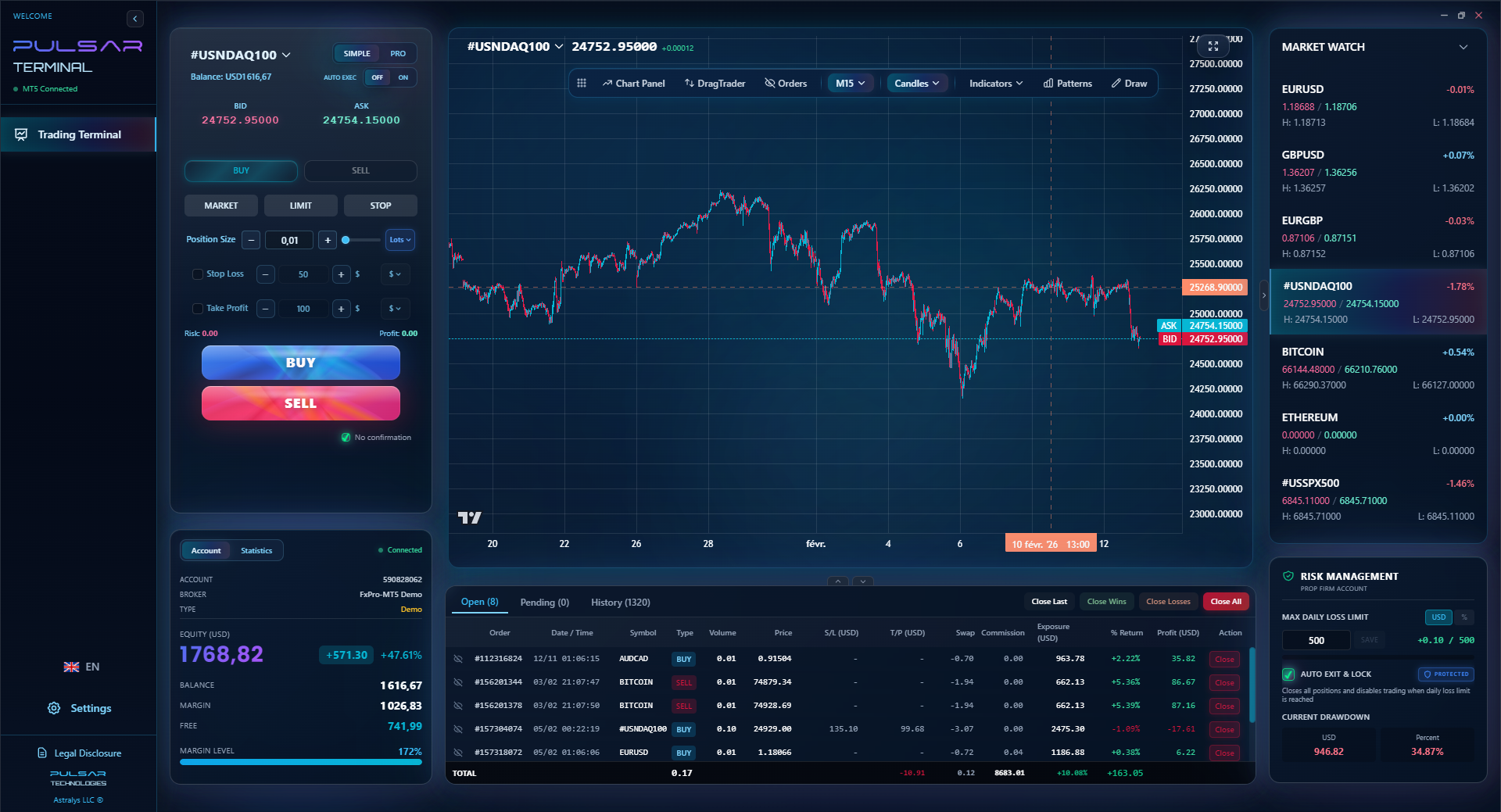
Managing multiple swing trades and adhering to strict prop firm drawdown rules is complex, which is where a tool like Pulsar Terminal for MT5 automates risk with features like one-click breakeven stops and trailing stops.
Pulsar Terminal
Универсальный инструмент для MT5: drag-and-drop ордера, мульти-TP/SL, трейлинг-стоп, грид-трейдинг, Volume Profile и защита для проп-фирм. Используется 1000+ трейдерами ежедневно.
“The 90% failure rate isn't about bad traders; it's about good traders failing to adapt to a foreign rulebook.”
You can't just port your personal account strategy into a prop challenge. You have to adapt. Here's how I changed my approach.
Position Sizing is Everything: Your first goal is survival, not maximizing returns. I risk no more than 0.5% of the account's starting balance on any single swing trade during a challenge. Once funded, I might go to 1%. This ultra-conservative approach ensures a string of losses can't touch their drawdown limit. It feels painfully small, but it works.
Wider Stop-Losses, Fewer Trades: In my personal account, I might use a 20-pip stop on a forex pair. In a prop challenge, I'll give the trade 50-70 pips of breathing room. This reduces the chance of being whipsawed out. It means I need a higher conviction level for each trade, so I take fewer of them. This aligns perfectly with a swing trading mindset.
The 'Weekend Hold' Test: Before entering a trade on a Thursday or Friday, I ask: 'If this goes 2% against me by Sunday open, will I still believe in the thesis, and will I still be within rules?' If the answer is no, I don't take the trade.
Using Their Tools: Some firms provide built-in risk calculators or dashboards. Use them. Set alerts for your daily loss limit. If you're using MT5, tools that can help manage these rules are useful. Automating parts of your risk management is a huge advantage.
Example Trade: In April 2023, I was in a challenge with a firm offering a balance-based drawdown. I shorted EUR/USD at 1.1075 on a weekly resistance rejection. My stop was at 1.1145 (70 pips). It drifted up to 1.1110 over two days, putting me in a floating loss. In an equity-based account, I'd have been sweating. Here, I just checked my balance (unchanged) and my thesis. I held. It reversed and I closed at 1.0950 for a 125-pip win. The rulebook allowed the patience my strategy required.
💡 Совет Уинстона
In swing trading, time is your ally. In a prop challenge, time is a fixed cost. Choose firms with longer challenge durations (e.g., 60 days, not 30) to let your edge play out.
“Your first goal in a challenge isn't to make money. It's to not lose money in their very specific way.”
Congratulations, you passed! You're 'funded.' Now the real psychological game starts. The simulated pressure of the challenge is replaced by the very real pressure of not losing this 'asset' you just worked for.
The First Two Weeks Are Dangerous: There's a huge temptation to trade immediately to 'start making money.' This is when most funded accounts blow up. I treat the first week as observation only. I re-familiarize myself with the live dashboard, the payout request process, and I paper trade my system to get a feel for execution.
Request a Payout Early: As soon as you hit the minimum profit threshold for a withdrawal, take it. Even if it's a small amount ($500). Getting that first payment into your bank account does two things: 1) It proves the firm pays, and 2) It psychologically converts some of this 'play money' into real earnings, reinforcing disciplined behavior.
Beware of Scaling Pressure: Once you're eligible for more capital, think carefully. Going from a $50k to a $100k account doubles your nominal risk. Your position size in lots might double, but the emotional weight can feel 10x heavier. I always take one scaling step, then consolidate for at least two months before even considering the next. I treat each new level like a new challenge.
The Long Game: The goal of swing trading prop firms isn't to get one payout. It's to build a consistent, rule-respecting process that generates a steady side income (or eventually, a primary income) from their capital. It's a marathon of discipline, constantly checked by their risk parameters. The firms that last will be partners in this process, not just gatekeepers. Choose accordingly.
FAQ
Q1Can I really make a living swing trading with a prop firm?
Possible, but don't plan on it year one. The stats are brutal: less than 1% of traders achieve meaningful, consistent payouts. It's a high-attrition business. View it as a way to use your strategy for supplemental income first. Building it into a full-time living requires passing multiple challenges, scaling accounts reliably, and managing the psychological pressure of trading large, 'not-your-own' capital. It's a multi-year grind.
Q2What's the single biggest mistake swing traders make in prop challenges?
Ignoring the drawdown type. Going into a challenge with an equity-based drawdown as a swing trader is like going into a boxing match with one hand tied behind your back. You will get stopped out by normal market noise. Always, always confirm it's a balance-based (static) drawdown calculated from your starting balance.
Q3How do the new SEC/CFTC rules affect me as a trader?
In the short term, maybe not much. In the long term, they should provide more protection. They will likely weed out unstable or fraudulent firms, leading to a more professional industry. You might see slightly higher evaluation fees to cover compliance costs, but also clearer contract terms, more reliable payouts, and better-defined rules. It's a net positive for serious traders.
Q4Is the profit split negotiable?
Almost never at the start. Your use is your performance. After you've been funded for several months and have a track record of consistent profits, some firms have programs where you can apply for a higher split (e.g., moving from 80% to 90%). But you can't haggle on your first challenge.
Q5Can I use automated trading or EAs in a prop firm challenge?
This is a firm-specific rule. Many allow it, but many also have restrictions. Common rules include: no high-frequency trading (HFT) EAs, no arbitrage EAs, and sometimes a requirement that the EA doesn't place more than X trades per hour. You must check their FAQ. Never assume it's allowed.
Q6What happens if I breach a rule by a tiny amount?
You fail. Period. There is no 'just this once.' The rules are automated. If your daily loss limit is 5% and your closed losses hit 5.01%, the account will be liquidated. The systems are not lenient. This is why your own position size calculator must have a buffer - if their limit is 5%, your personal max risk per day should be 4%.
Q7Are there any US-based prop firms you recommend for swing trading?
I don't give outright recommendations because rules change fast. My advice is to use the vetting criteria in this article. Look for firms that publicly address US regulatory compliance, offer clear balance-based drawdowns, have a track record of payouts verified by the community, and support platforms like MT5 that allow for serious analysis. Do your own deep dive.
Урок проф. Уинстона
Ключевые выводы:
- ✓Balance-based drawdown is non-negotiable for swing strategies.
- ✓Risk no more than 0.5% per trade during the challenge phase.
- ✓The SEC/CFTC rule changes are a long-term positive for trader security.
- ✓Vet a firm by its payout proof and rule clarity, not its advertised account size.
Насколько полезна эта статья?
Нажмите на звезду
Еженедельные торговые инсайты
Бесплатный еженедельный анализ и стратегии. Без спама.
Об авторе
James Mitchell
Старший аналитик по трейдингу
Базируется в Нью-Йорке, более 9 лет опыта торговли. Работает с основными USD-парами, проп-фирмами и регулированием в США.
Комментарии
Предупреждение о рисках
Торговля финансовыми инструментами сопряжена со значительным риском и может не подходить всем инвесторам. Прошлые результаты не гарантируют будущих доходов. Данный контент носит исключительно образовательный характер и не является инвестиционной рекомендацией. Всегда проводите собственное исследование перед торговлей.
Вам также может понравиться

Cara Trading Forex Sukses: 7 Prinsip dari Trader Profesional
Cara trading forex sukses dengan 7 prinsip trader pro: manajemen modal, disiplin, journal trading, backtest. Data nyata, bukan janji profit palsu.
Jam Trading Forex Terbaik untuk Trader Indonesia: Panduan Lengkap dengan Tabel Waktu
Panduan jam trading forex untuk trader Indonesia. Tabel 4 sesi dunia, jam emas 20:00-00:00, sesi mana yang harus dihindari. Data akurat + tips dari trader berpengalaman.
Top 5 Sàn Forex Uy Tín Nhất 2026: Review Jujur dari Trader Indonesia
Top 5 sàn forex uy tín 2026 untuk trader Indonesia. Review jujur: spread, deposit, withdraw, dukungan lokal. Exness, XM, IC Markets & lebih.
Скачать Pulsar Terminal
Все эти калькуляторы встроены в Pulsar Terminal с данными в реальном времени с вашего счёта MT5.
Скачать Pulsar Terminal