


I remember staring at the Nifty 50 chart on October 26th, 2022.

Rajesh Sharma
Старший форекс-аналитик ·  India
India
☕ 9 мин чтения
Что вы узнаете:
- 1The Foundation-First Mindset (Skip This and You'll Blow Up)
- 2Price Action Swing Trading (My Daily Bread & Butter)
- 3Momentum Scalping for Forex & Gold (When You Need Speed)
- 4The Breakout Fade (A Contrarian Play for Nifty & Bank Nifty)
- 5Why Your Tools & Platform Are Part of Your Strategy
- 6The 'Strategies' That Never Worked (Save Your Time & Money)

I remember staring at the Nifty 50 chart on October 26th, 2022. It was bouncing right off the 17,250 support level I'd marked weeks before, after a brutal sell-off. My phone was buzzing with panicked messages from a group I was in. Everyone was talking about 'the big crash' and selling everything. I took a deep breath, checked my volume profile, and bought the Nifty BEES ETF. That single trade, based on a simple support strategy, booked a 9.2% return in 11 trading sessions. It wasn't magic. It was a plan. And that's what we're building here: real, executable trading strategies for the Indian context, not theoretical fluff.
Most Indian traders I've mentored want to jump straight to the fancy stuff - Fibonacci retracements, harmonic patterns, you name it. They treat trading like a shortcut to a Lamborghini. I did the same thing in 2014. I lost ₹2.8 lakh in six months chasing 'sure-shot' intraday tips from Telegram groups. The first, non-negotiable strategy is managing yourself.
Your psychology and risk management aren't just part of the plan, they ARE the plan. The fancy entry technique is maybe 20% of the battle. The other 80% is not doing stupid things when you're scared or greedy.
The Only Three Rules That Matter
- Risk Per Trade: You should never, ever risk more than 1-2% of your total trading capital on a single idea. If you have a ₹5 lakh account, your maximum loss on any trade is ₹5,000 to ₹10,000. This is your lifeline. Use a position size calculator religiously. It's boring, but it keeps you in the game.
- The 1:2 Ratio: Aim for a reward-to-risk ratio of at least 2:1. If your stop loss is 50 points away (risking ₹5,000), your target should be at least 100 points away (potential gain ₹10,000). This means you can be wrong half the time and still break even.
- Daily Loss Limit: Set a hard stop for the day. Mine is 3% of my capital. If I hit it, I shut down the terminal. No 'revenge trading.' This one rule alone saved me from a 15% drawdown in May 2023 when the Bank Nifty was just whipsawing wildly.

Warning: I see so many guys using 5x use on Zerodha and risking 10% per trade because they saw someone on YouTube do it. That's not a strategy, it's a lottery ticket. One bad week and you're done. A margin call is a brutal teacher.

This is my core approach for Indian equities and indices. It's about catching moves that last 3 days to 3 weeks, avoiding the noise of intraday. You need patience, but the setups are cleaner.
I look for two things: key levels and simple candlestick patterns. Forget the 10-indicator charts that look like a rainbow exploded.
The Setup: Support/Resistance with Confirmation
- Identify the Level: On the daily chart of, say, Reliance or the Nifty, find where the price has reversed at least twice before. Draw a horizontal line. That's your zone.
- Wait for the Reaction: Don't pre-empt. Let price come to the level. Watch what it does.
- Get Confirmation: Look for a bullish reversal candle (like a hammer or bullish engulfing) near support for a buy. For a sell near resistance, look for a bearish pin bar or engulfing pattern.
- Enter on Break: My entry is a break of the high (for buys) or low (for sells) of that confirmation candle.
Real Trade Example (Nifty 50): In late Jan 2024, Nifty found support around 21,300 (a previous resistance-turned-support). On Jan 23rd, it formed a clear hammer candle right on that level. I entered a long on the break of that day's high (21,450) the next morning. Stop loss placed below the hammer's low (21,280). Target was the previous swing high near 22,100. The trade ran for weeks. This is classic swing trading.

Pro Tip: Volume is your truth-teller. A reversal at a key level with above-average volume is far more trustworthy. A quiet bounce on low volume often fails.

💡 Совет Уинстона
A strategy without a written plan is just a wish. Before you enter any trade, write down: 1) Why you're entering, 2) Your exact entry, stop loss, and target, 3) What would make you exit early. This simple logbook will teach you more than any guru.
“The best strategies are stupidly simple in concept but require iron discipline in execution.”
For markets like EUR/USD or XAU/USD (Gold), which are active during London/N.Y. sessions, I use a momentum scalping approach. This is for the 5-minute or 15-minute charts, holding for minutes to a few hours. It's higher intensity and not for everyone.
You need a broker with razor-thin spreads for this, like IC Markets or Pepperstone. A wide spread kills a scalper's edge.
The Strategy: Riding the Wave
- Find the Trend: Use two simple moving averages: a fast one (like 9-period) and a slower one (like 21-period) on the 15-min chart. When the fast MA is above the slow MA, look only for buy setups. When it's below, look only for sells. This keeps you on the right side.
- Use the RSI for Entry: I use the RSI indicator, but not in the standard 'overbought/oversold' way. In an uptrend, I wait for the RSI to dip back to 40-50 (not 30) and then start turning back up. That's my signal to look for a long entry on the price chart. In a downtrend, I wait for a bounce to 50-60 and then a turn down.
- Enter on Retest: Often, price will pull back to touch the fast moving average. A bounce off it with your RSI signal is a high-probability entry.
I used this on Gold (XAU/USD) on March 8th, 2024. The 15-min chart was in a clear uptrend (MAs aligned). Price pulled back to the 9 EMA, and the RSI hit 48 and curled up. I went long at $2178. My target was just 8-10 dollars away (about 40-50 pips), and my stop was 4 dollars below. In and out in under an hour. That's the essence of scalping strategy: small, quick bites.

Example: If you're scalping EUR/USD and the spread is 0.1 pips, a 5-pip target is viable. If your broker's spread is 1.5 pips, you need a 7-pip move just to break even. Broker choice is a strategic decision.

This is a higher-risk, higher-reward strategy I use specifically for Indian indices, which love to trap breakout traders. Everyone sees a 'key level' break and piles in. The smart money often fades it (takes the opposite trade).
You need strong nerves for this one. I only allocate half my normal position size.
How to Spot a False Breakout
- The Obvious Level: The price approaches a major, well-watched support or resistance level. Everyone is talking about it.
- The Sharp Break: It breaks through with a spike, often on news or opening gap.
- The Lack of Follow-Through: This is the key. The price immediately struggles to move further. On the 5-minute chart, it makes a long wick beyond the level and then closes back inside the range.
- Volume Check: The breakout spike happens on low or average volume. A real breakout should have surging volume.
I faded a Bank Nifty breakout on February 1st, 2024. It gapped up above 46,000 (a huge psychological level), traded there for about 20 minutes, but couldn't hold. The 5-min candles had long upper wicks. I shorted on a break below the opening candle's low. The index fell 400 points over the next two hours. The risk was high (stop above the spike high), so the reward had to justify it.
This strategy pairs well with the MACD indicator on a lower timeframe. Look for a sharp divergence as price makes the new high/low but MACD doesn't confirm it. It's a powerful reversal signal.
💡 Совет Уинстона
The market doesn't owe you anything. If your strategy says 'stay out' because conditions aren't right, then go read a book. The ability to do nothing is a strategic superpower most traders never develop.

“Trying to trade RBI announcements on the tick is like trying to catch a falling knife with your eyes closed.”
Your trading strategy isn't just lines on a chart. It's the entire environment. Trying to execute a precise scalping strategy on a platform with 300ms latency and slippage is like trying to win F1 in a Maruti 800.
For Indian Stocks/Indices: Zerodha's Kite is fantastic for the average retail trader. Their charts (TradingView powered) and execution are solid for swing and positional trading. But for advanced charting, I run MT5 through a data feed and use specialized tools.
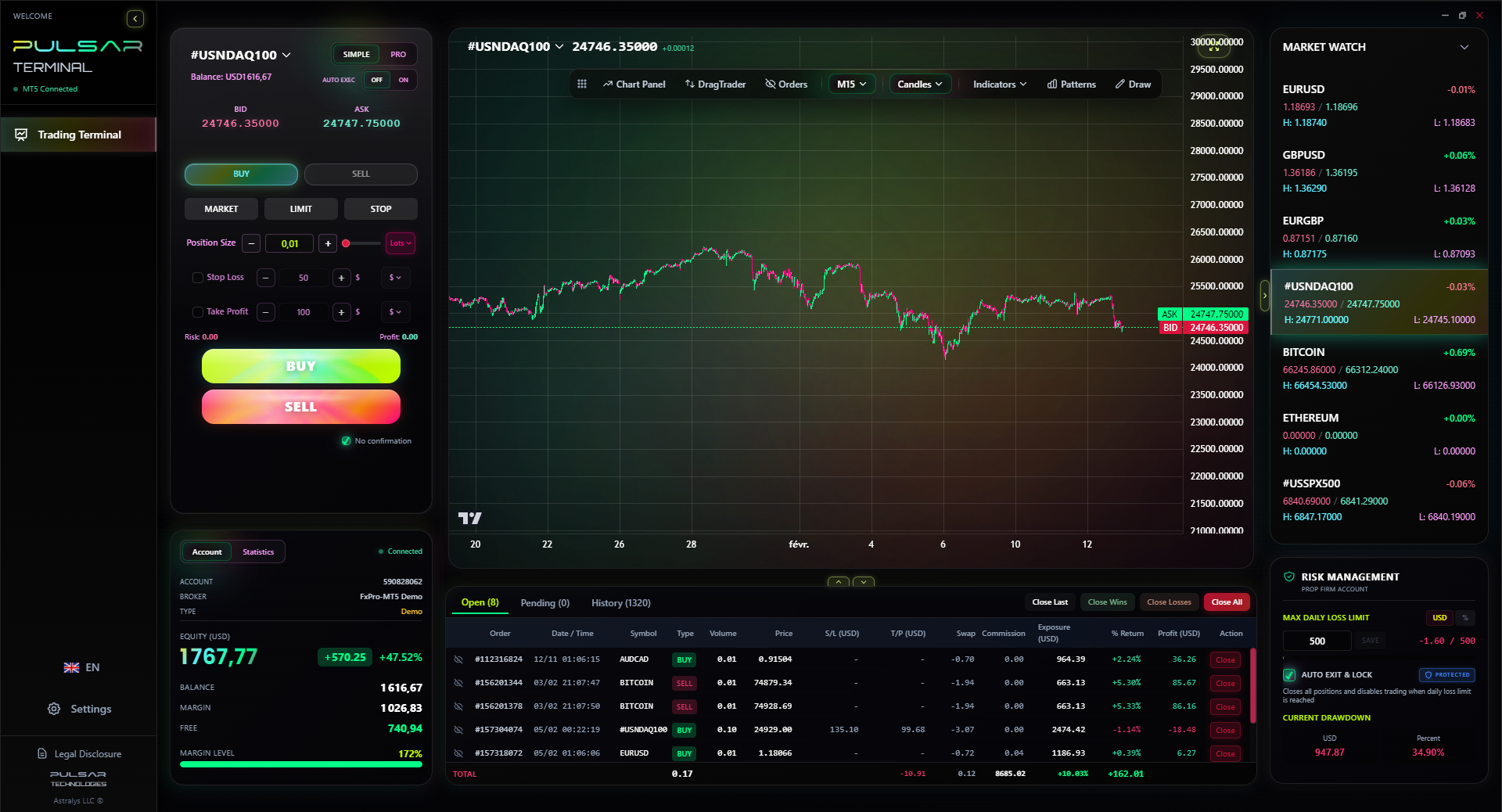
For Forex/Global Markets: You're likely using an international broker. I've found Exness great for raw spread accounts, and XM for their variety of assets. But the real game-changer for me was adding a professional trading terminal as a companion to MT5.
Let's say you're running the momentum scalping strategy. You need to move fast. Dragging stop-losses manually is slow and emotional. Having a tool that lets you set a trailing stop the moment you enter, or scale out of a position at multiple targets with one click, turns a good strategy into a strong system. It automates the disciplined exit, which is where most profits are lost.
If you're trading a prop firm challenge, where the daily loss limits are brutal and non-negotiable, an automated daily loss protection feature isn't a luxury, it's a career-saver. It prevents one bad emotional trade from blowing your entire account and your chance at funded capital.
Executing a multi-target scalping strategy or protecting a prop firm challenge requires tools that automate discipline, which is exactly what Pulsar Terminal is built for on MT5.
Pulsar Terminal
Универсальный инструмент для MT5: drag-and-drop ордера, мульти-TP/SL, трейлинг-стоп, грид-трейдинг, Volume Profile и защита для проп-фирм. Используется 1000+ трейдерами ежедневно.
In over a decade, I've blown money on enough bad ideas to fill a book. Let me save you the tuition.
- Pure Arbitrage: Between NSE and BSE, or in the forex market. By the time a retail trader sees a price discrepancy, it's gone. The algos have eaten it. I wasted months building 'systems' for this.
- News Trading (The 'Buy the Rumor' Trap): Trying to trade RBI announcements or US NFP data on the tick. The volatility is insane, spreads widen, and you're competing with institutions that have co-located servers. The whipsaws will stop you out before the real move happens. I now wait at least 15 minutes after major news for the dust to settle.
- Over-Optimized Mechanical Systems: I once built a system with 15 rules that backtested at 95% accuracy on Nifty historical data. It was a masterpiece of overfitting. In live markets, it failed spectacularly within a month. If your strategy has more than 3-4 core rules, it's probably too fragile.
- Copy Trading/'Signal Services': This isn't a strategy, it's outsourcing your brain. You have no idea of the risk management (if any) the signal provider is using. When it goes wrong - and it will - you're left holding the bag with no understanding of why. I learned this the hard, expensive way.
The common thread? Complexity and a lack of edge. The best strategies are stupidly simple in concept but require iron discipline in execution. They focus on one or two reliable market behaviors and manage risk ruthlessly around them.

FAQ
Q1What is the best trading strategy for a beginner in India?
Hands down, start with swing trading based on daily chart support and resistance. It's slower, gives you time to think, and avoids the chaos of intraday noise. Paper trade it for at least 2-3 months on Indian stocks you know (like the Nifty 50 constituents) before risking real money. Master the 1-2% risk rule first.
Q2Can I use these forex strategies with Indian brokers?
You can, but be very careful. Trading forex with INR pairs (like USD/INR) is heavily regulated in India. The use is low (max 1:20 for exchange-traded contracts), and the market is less liquid than the international spot forex market. For major pairs like EUR/USD, you'll need an international broker, which operates in a regulatory grey area for Indian residents. Always do your own due diligence on the broker's legality and reputation first.
Q3How much capital do I need to start?
It's less about a magic number and more about what the capital allows you to do. With ₹50,000, you can realistically practice swing trading in equities, but position sizes will be small. For effective practice with proper risk management (where a 1% loss is meaningful), I'd suggest a minimum of ₹1-2 lakhs. Never start with money you can't afford to lose completely.
Q4How many strategies should I use at once?
One. Seriously. Master one approach in one market. Trying to juggle a scalping strategy on forex, a swing strategy on Nifty, and a breakout strategy on stocks is a recipe for confusion and losses. Your brain can't context-switch that fast. Become an expert in one lane first.
Q5What's the biggest mistake in strategy execution?
Moving your stop loss further away because you 'believe' in the trade. This turns a small, managed loss into a catastrophic one. Your stop loss is a promise you make to your future self. Breaking it is the fastest way to blow up your account. Set it and forget it.
Q6Do I need to quit my job to trade successfully?
Absolutely not. In fact, having a steady income is your biggest trading advantage. It removes the desperation to make money from the markets, which leads to overtrading. Most successful traders I know started part-time. Treat it as a serious skill to learn over years, not a get-rich-quick scheme.
Урок проф. Уинстона
Ключевые выводы:
- ✓Never risk more than 2% of capital per trade.
- ✓Aim for a minimum 2:1 reward-to-risk ratio.
- ✓Master one market with one strategy first.
- ✓Your stop loss is a non-negotiable promise.
Насколько полезна эта статья?
Нажмите на звезду
Еженедельные торговые инсайты
Бесплатный еженедельный анализ и стратегии. Без спама.
Об авторе
Rajesh Sharma
Старший форекс-аналитик
Более 10 лет торгует на индийских и южноазиатских рынках. Начинал с валютных деривативов на NSE, затем перешёл на международный форекс. Специализируется на USD/INR и парах развивающихся рынков.
Комментарии
Предупреждение о рисках
Торговля финансовыми инструментами сопряжена со значительным риском и может не подходить всем инвесторам. Прошлые результаты не гарантируют будущих доходов. Данный контент носит исключительно образовательный характер и не является инвестиционной рекомендацией. Всегда проводите собственное исследование перед торговлей.
Вам также может понравиться

Cara Trading Forex Sukses: 7 Prinsip dari Trader Profesional
Cara trading forex sukses dengan 7 prinsip trader pro: manajemen modal, disiplin, journal trading, backtest. Data nyata, bukan janji profit palsu.
Jam Trading Forex Terbaik untuk Trader Indonesia: Panduan Lengkap dengan Tabel Waktu
Panduan jam trading forex untuk trader Indonesia. Tabel 4 sesi dunia, jam emas 20:00-00:00, sesi mana yang harus dihindari. Data akurat + tips dari trader berpengalaman.
Top 5 Sàn Forex Uy Tín Nhất 2026: Review Jujur dari Trader Indonesia
Top 5 sàn forex uy tín 2026 untuk trader Indonesia. Review jujur: spread, deposit, withdraw, dukungan lokal. Exness, XM, IC Markets & lebih.
Скачать Pulsar Terminal
Все эти калькуляторы встроены в Pulsar Terminal с данными в реальном времени с вашего счёта MT5.
Скачать Pulsar Terminal