


Here's a brutal truth: 90% of the wedge patterns you think you see on your chart are probably wrong.

Olumide Adeyemi
Пионер трейдинга в Западной Африке ·  Nigeria
☕ 10 мин чтения
Что вы узнаете:
- 1What Exactly Is a Wedge Pattern? (It's Not What You Think)
- 2How to Spot a Real Wedge (And Ignore the Fakes)
- 3Trading the Rising Wedge: The Bull Trap
- 4Trading the Falling Wedge: Catching the Knife (Safely)
- 55 Costly Mistakes Nigerian Traders Make with Wedges
- 6Risk Management: The Only Thing That Matters
- 7Wedge vs. Triangle: Don't Confuse Them
- 8Putting It All Together: A Sample Trade Plan
Here's a brutal truth: 90% of the wedge patterns you think you see on your chart are probably wrong. I've watched traders in Lagos and Port Harcourt blow accounts chasing 'obvious' wedge breakouts that never materialized. The wedge in forex is one of the most misunderstood patterns, not because it's complex, but because our psychology makes us see what we want to see. This guide cuts through the noise. We'll look at what a wedge really is, how to trade it in the Nigerian market with our specific challenges, and why getting this wrong costs you more than just pips.
Forget the textbook definition for a second. A wedge is a price compression. It's the market taking a breath, where buyers and sellers get stuck in a tighter and tighter range until one side gives up. The two converging trendlines are just visual representations of that struggle.
There are two main types you need to know:
The Rising Wedge: This forms during an uptrend. Both lines slope up, but the support line (bottom) is steeper than the resistance line (top). It looks bullish, but it's actually a bearish reversal pattern. Why? Because each new high is weaker than the last. The buying momentum is drying up. I've seen this play out perfectly on USD/NGN charts during periods of intense CBN intervention speculation.
The Falling Wedge: This forms during a downtrend. Both lines slope down, but the resistance line (top) is steeper than the support line (bottom). It looks bearish, but it's a bullish reversal pattern. The selling pressure is exhausting itself. This is common on pairs like GBP/NGN after a sharp sell-off driven by external news.
The critical thing most traders miss? A wedge is about momentum failure, not just lines on a chart. If the price is still making strong, wide swings, it's not a wedge. It's just noise.

Warning: Drawing a wedge on a 5-minute chart is mostly useless. The pattern needs time to develop its narrative. I rarely take a wedge signal seriously on anything below the 1-hour timeframe, especially with the volatility we see in emerging market crosses.

💡 Совет Уинстона
A wedge isn't confirmed until the price closes decisively outside the pattern on the timeframe you're trading. That close is your signal, not the initial spike.
This is where you save your money. A fake wedge will have you entering trades that reverse immediately. Here’s my 3-point checklist, developed after losing nearly ₦80,000 on bad wedge trades early in my career.
1. It Needs at Least 5 Touches. Two touches per trendline is the bare minimum, but for a high-probability setup, I wait for at least five total touches (e.g., three on the top, two on the bottom). This confirms the convergence is real and not just random price action. The more touches, the more significant the eventual breakout.
2. Volume Should Decline. As the price coils inside the wedge, trading volume should generally contract. This shows participation is fading - the calm before the storm. A loud, high-volume wedge is often a continuation pattern in disguise. Most MT5 platforms have a volume indicator; just make sure it's trending down as the pattern forms.
3. The Context is King. A rising wedge at the top of a massive, months-long rally on EUR/USD? Pay attention. A random "wedge" in the middle of a messy range on USD/JPY? Ignore it. The pattern must make sense within the larger trend. I use the MACD indicator on a higher timeframe to gauge the underlying momentum before I even look for wedges.
Let me give you a real example from last year. On the USD/ZAR chart (similar volatility to our crosses), I spotted a textbook rising wedge after a 15% rally. It had 6 clear touches, volume dried up, and it was sitting at a 2-year high. The breakdown was swift and netted over 500 pips. The pattern worked because all the conditions were met, not just the shape.
“A fake wedge will have you entering trades that reverse immediately.”
The rising wedge is a killer for optimistic traders. It looks like a pullback you should buy, but it's a trap. Here's my exact process.
Entry: I do NOT enter the moment the price breaks the lower (support) trendline. That's often a false break, especially with our Nigerian broker spreads that can be wide on exotic pairs. I wait for the price to break and then close a 4-hour candle below the trendline. This confirmation cost me a few pips sometimes, but it saved me from countless whipsaws.
Stop Loss: This is non-negotiable. Your stop loss goes above the most recent swing high inside the wedge. Not above the trendline, above the highest point the price reached inside the pattern. This gives the trade room to breathe.
Take Profit: My minimum target is the height of the wedge at its widest point, projected downward from the breakout point. I often use a position size calculator right then to see what my risk-to-reward will be. If it's not at least 1:1.5, I skip the trade.
The Psychology of the Failed Breakout
About 30% of the time, the price will break down, hit your profit target, and then reverse to soar higher. It's infuriating. That's why I rarely hold for the full measured move. I take 50% off at the first target and trail the rest with a simple moving average. Greed has broken more wedges than logic has.
The falling wedge feels risky - you're buying into what still looks like a downtrend. But when it works, the rallies are powerful.
Entry: Same rule: patience. Wait for a close above the upper (resistance) trendline on a meaningful timeframe. For a falling wedge, I also look for a bullish divergence on the RSI indicator as extra confirmation. It shows selling momentum is fading as the wedge forms.
Stop Loss: Place your stop below the most recent swing low inside the wedge. This seems tight, but if the price falls back into the wedge and makes a new low, the pattern structure is broken.
Take Profit: Project the height of the wedge upward from the breakout. With a falling wedge, the move can be explosive, so I might aim for a 1:2 or 1:3 risk-to-reward. I also watch for previous resistance levels that might act as interim targets.

Pro Tip: Falling wedges in a primary uptrend (as a bull flag continuation) are often more reliable than reversal wedges at absolute market bottoms. Look for them during pullbacks in a strong Naira recovery period, for instance.
💡 Совет Уинстона
If you can't immediately see where to place your stop loss when you draw a wedge, the pattern isn't clear enough to trade. Clarity precedes profit.
“The rising wedge is a killer for optimistic traders. It looks like a pullback you should buy, but it's a trap.”
These aren't theoretical. I've made most of them, and I see them in trading groups daily.
- Trading Wedges on Naira Pairs Without Context: USD/NGN is heavily influenced by CBN policy, not just technicals. A perfect wedge can be obliterated by a single circular from the Bank. Always check the economic calendar for MPC meeting dates before trading a wedge on a local pair.
- Ignoring the Spread: On a tight wedge, the spread can be your biggest enemy. If your broker's spread on GBP/NGN is 50 pips (common), a 100-pip wedge is meaningless. The spread will eat your profit. Stick to majors like EUR/USD or gold (XAU/USD) for cleaner wedge plays where spreads are low.
- Overleveraging the Breakout: "It's a sure thing!" No, it's not. Wedge breakouts fail. Using 1:500 use from a broker like Exness on a wedge trade is a fast track to a margin call. I never risk more than 1-2% of my account on any single pattern.
- Drawing the Lines to Fit the Narrative: You want a wedge to be there, so you angle the lines until it looks like one. This is self-deception. The lines should connect clear swing points with minimal adjustment.
- Forgetting About Taxes: That 500-pip win? Remember the 10% Capital Gains Tax. Factor your net profit into your risk calculations, not your gross. A ₦100,000 profit is actually ₦90,000.
A perfect wedge setup with poor risk management will still lose you money. Here’s the math for a Nigerian trader with a ₦500,000 account.
Let's say you identify a falling wedge on EUR/USD. Your analysis says entry at 1.0850, stop at 1.0820 (30 pips risk). Your account risk is 1%: ₦5,000.
Here’s the calculation:
- Pip Value: (₦5,000 risk) / (30 pip stop) = ₦166.67 per pip.
- Since 1 pip on a standard EUR/USD lot is roughly $10 (which varies with Naira value), you need to calculate the correct lot size. This is where a calculator is essential.
Without proper sizing, you could easily be risking 5% or 10% on one trade. Two losing wedge trades like that, and you're down 15-20%. Game over.
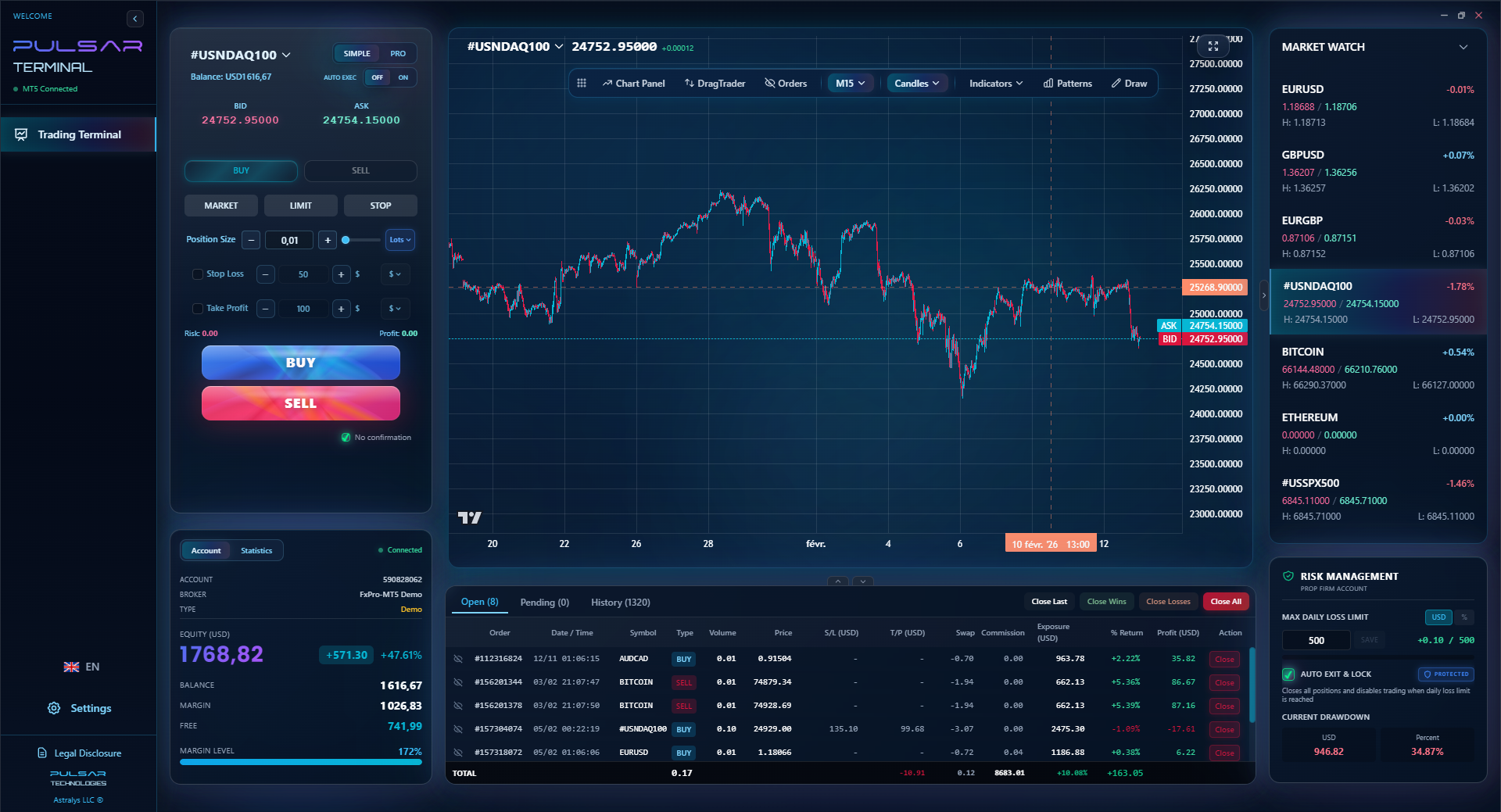
I automate this. Once I have my entry and stop levels, I plug the numbers into a calculator before I even think about executing. This removes emotion. Tools that can set stop-loss and take-profit orders directly on the chart, like those in Pulsar Terminal, help you stick to this plan without second-guessing.
Managing the precise stop-loss and multi-level take-profit orders for a wedge trade is critical, and Pulsar Terminal lets you drag and drop these directly onto your MT5 chart, removing execution hesitation.
Pulsar Terminal
Универсальный инструмент для MT5: drag-and-drop ордера, мульти-TP/SL, трейлинг-стоп, грид-трейдинг, Volume Profile и защита для проп-фирм. Используется 1000+ трейдерами ежедневно.
“Without proper sizing, you could easily be risking 5% or 10% on one trade. Two losing wedge trades like that, and you're down 15-20%. Game over.”
This confusion leads to bad entries. Both are consolidation patterns, but their implications are different.
| Feature | Wedge | Symmetrical Triangle |
|---|---|---|
| Trendlines | Both slope in the SAME direction (up or down) | One slopes down, one slopes up (they converge) |
| Bias | Strong reversal bias. A rising wedge breaks DOWN. | Neutral. Breakout can go either way, often continues prior trend. |
| Momentum | Shows momentum slowing in the direction of the trend. | Shows a balance between buyers and sellers. |
A triangle is a stalemate. A wedge is a slowdown. Trading a rising wedge expecting a bullish breakout (like you might in a triangle) is a classic, account-draining error. I learned this the hard way early on, buying into what I thought was a bull flag but was actually a rising wedge on a 4-hour chart. The resulting drop wiped out a week's profits.
💡 Совет Уинстона
The emotional urge to redraw your trendlines when the price approaches them is a sign you're fitting the narrative to your bias. Walk away from that chart.
Let's walk through a recent swing trade I took, from start to finish.
Instrument: AUD/USD (Good liquidity, lower spreads for Nigerian brokers like IC Markets or Pepperstone). Timeframe: Daily Chart (for significant pattern). Pattern: Rising wedge forming after a 2-month uptrend.
My Process:
- Identification: Price made higher highs and higher lows, but the rallies got weaker. Five clear touches on the trendlines. Volume declined over 3 weeks.
- Wait for Break: Price closed below the lower trendline. I didn't enter that day.
- Confirmation: The next day, price opened and stayed below the trendline. That was my signal. Entry: 0.6580.
- Risk Management: Stop Loss: 0.6630 (above the wedge's last high). Risk: 50 pips. My account risk was 1% of ₦750,000 = ₦7,500. My pip value was therefore ₦150. I calculated the appropriate lot size.
- Target: Height of wedge = 150 pips. First profit target at 0.6430. I set a limit order for half my position there.
- Result: Target hit in 5 days. I moved my stop on the remaining half to breakeven and trailed it. The trade eventually ran another 70 pips before stopping out at breakeven. Total gain: 75 pips on half the position.
This isn't glamorous. It's mechanical. But that's how you use a wedge in forex to build an account, not gamble one away. For faster-paced action, this methodical approach is even more critical for a scalping strategy.
FAQ
Q1Is the wedge pattern reliable in forex?
It can be, but its reliability is entirely dependent on correct identification and context. A poorly identified wedge or one traded on too low a timeframe is no better than a coin flip. In my experience, a well-formed wedge on a daily or 4-hour chart within a clear trend has a higher probability of working, but never confuse probability with certainty.
Q2What is the success rate of a wedge pattern?
There's no single magic number. Backtests vary, but a properly executed wedge trade with confirmed breakout, good volume profile, and sensible risk management can have a win rate between 55-65%. However, the key isn't just win rate - it's the risk-to-reward. A pattern with a 60% win rate and a 1:1.5 reward ratio is profitable over time. Chasing a 90% win rate is a fool's errand.
Q3Can I use wedge patterns for scalping?
I strongly advise against it. Scalping relies on tiny timeframes (1-min, 5-min) where market noise dominates. What looks like a wedge is often just random price fluctuation. The pattern needs time to develop its story. If you're a scalper, focus on order flow and liquidity, not daily chart patterns compressed into minutes.
Q4How do I draw a wedge trendline correctly?
Connect the absolute highest highs (for the upper line) and the absolute lowest lows (for the lower line) of the consolidation period. The lines must both slope in the same direction and should converge. Don't force the lines to touch every little wick; focus on the clear swing points. If you're constantly redrawing, it's not a valid pattern.
Q5What happens if a wedge breakout fails?
It happens often. The price breaks out, reverses, and slices through the other side of the pattern. This is why your stop loss is sacred. If you're long on a falling wedge breakout and the price drops back below the breakout point and especially below your stop (the wedge low), the pattern is invalidated. Take the loss immediately. The worst thing you can do is "give it more room" - that's how small losses become account-killers.
Q6Are rising wedges always bearish and falling wedges always bullish?
In theory, as reversal patterns, yes. But in practice, they can sometimes act as continuation patterns (e.g., a rising wedge in a downtrend as a bear flag). This is rare and tricky to trade. For simplicity and safety, always treat a rising wedge in an uptrend as a potential top and a falling wedge in a downtrend as a potential bottom. Stick to the high-probability interpretations.
Q7What's the minimum deposit I need to start trading wedges in Nigeria?
While some brokers allow tiny deposits, to trade wedges effectively you need enough capital to withstand volatility and pay the spread. With use, a $100 (about ₦140,000) account can be wiped out by one failed trade and the spread on an exotic pair. A more realistic starting point for serious practice is $500 (₦700,000+). This lets you use sensible position sizes without overleveraging on every trade.
Урок проф. Уинстона
Ключевые выводы:
- ✓Wait for the close outside the wedge, not the initial break.
- ✓Volume should decline as the pattern forms.
- ✓Always trade with a 1-2% maximum account risk.
- ✓A wedge needs at least 5 trendline touches to be valid.
- ✓Ignore wedges on timeframes below 1 hour.
Насколько полезна эта статья?
Нажмите на звезду
Еженедельные торговые инсайты
Бесплатный еженедельный анализ и стратегии. Без спама.
Об авторе
Olumide Adeyemi
Пионер трейдинга в Западной Африке
Один из самых активных преподавателей форекс-трейдинга в Нигерии. 8 лет торгового опыта из Лагоса. Специализируется на стратегиях с малым капиталом и челленджах проп-фирм для африканских трейдеров.
Комментарии
Предупреждение о рисках
Торговля финансовыми инструментами сопряжена со значительным риском и может не подходить всем инвесторам. Прошлые результаты не гарантируют будущих доходов. Данный контент носит исключительно образовательный характер и не является инвестиционной рекомендацией. Всегда проводите собственное исследование перед торговлей.
Вам также может понравиться

Cara Trading Forex Sukses: 7 Prinsip dari Trader Profesional
Cara trading forex sukses dengan 7 prinsip trader pro: manajemen modal, disiplin, journal trading, backtest. Data nyata, bukan janji profit palsu.
Jam Trading Forex Terbaik untuk Trader Indonesia: Panduan Lengkap dengan Tabel Waktu
Panduan jam trading forex untuk trader Indonesia. Tabel 4 sesi dunia, jam emas 20:00-00:00, sesi mana yang harus dihindari. Data akurat + tips dari trader berpengalaman.
Top 5 Sàn Forex Uy Tín Nhất 2026: Review Jujur dari Trader Indonesia
Top 5 sàn forex uy tín 2026 untuk trader Indonesia. Review jujur: spread, deposit, withdraw, dukungan lokal. Exness, XM, IC Markets & lebih.
Скачать Pulsar Terminal
Все эти калькуляторы встроены в Pulsar Terminal с данными в реальном времени с вашего счёта MT5.
Скачать Pulsar Terminal