


Most traders think swap-free accounts are just for the religious crowd.

David van der Merwe
Трейдер развивающихся рынков ·  South Africa
☕ 10 мин чтения
Что вы узнаете:
Most traders think swap-free accounts are just for the religious crowd. They're wrong, and it's costing them money. I've seen traders in Cape Town and Johannesburg blow up accounts not because of bad trades, but because they ignored the silent killer of overnight fees. In this guide, I'll show you exactly what a swap free account in forex is, who it's really for, and how to use it to your advantage without getting caught out by the fine print. This isn't about religion, it's about smart trading.
Let's cut through the jargon. A swap-free account, often called an Islamic account, is a trading account where you don't get charged or paid overnight interest (the swap) on positions you hold open past the daily rollover time, usually 10 PM GMT. In a standard account, if you're long a currency with a higher interest rate than the one you're short, you earn a small credit. If you're on the wrong side of that rate differential, you pay. It's called a swap or rollover fee.
A swap-free account eliminates those charges entirely. This is crucial for traders following Sharia law, which prohibits 'riba' (interest). But here's the kicker, it's not just for them. I've recommended these accounts to plenty of non-Muslim traders in Durban who run long-term swing trading strategies on pairs like AUD/JPY, where the swaps can be brutal.

Warning: Don't assume 'swap-free' means 'fee-free'. Brokers aren't charities. They often replace the swap with a fixed administrative fee or widen the spread slightly to cover their costs. You need to read the terms.
The core mechanism is simple: the broker doesn't apply the traditional interest-based swap calculation. Instead, they might charge a flat daily fee after a certain number of days, or bake the cost into the trading conditions from the start. The key is transparency, which is where our local regulator, the FSCA, comes in.

💡 Совет Уинстона
A swap is just another cost of doing business. Never choose an account type based on ideology; choose it based on a cold, hard cost-benefit analysis of your last 50 trades.
In South Africa, the Financial Sector Conduct Authority (FSCA) is the watchdog. They don't have a specific rulebook titled 'Swap-Free Accounts,' but their general framework is what protects you. Any broker offering services here, including these specialized accounts, must play by FSCA rules.
What the FSCA Demands
First, the broker must be licensed. You should see an FSP number on their South African website. No FSP number? Walk away. It's that simple. This license means they have to segregate client funds (your money is kept separate from the broker's operating cash), maintain enough capital, and have a clear complaints process.
The most important rule for us regarding swap-free accounts is transparent pricing. The FSCA requires all fees to be clearly disclosed. This means a broker can't just say 'Islamic account' and then hit you with hidden charges. They must spell out exactly what replaces the swap: a daily admin fee, a higher commission, or whatever it is.
I once reviewed a client's statement from an offshore broker (not FSCA-regulated) offering a 'swap-free' account. The swaps were gone, but his profit on a 3-week EUR/CHF trade was wiped out by a mysterious 'position holding fee' that wasn't clearly explained upfront. An FSCA-regulated broker like FP Markets or Vantage has to be clearer about this. Their 2024-2027 focus on ethical finance makes this transparency even more critical.
“The goal isn't to avoid swaps; the goal is to maximize your net profitability after all costs.”
Forget the theory. Let's talk numbers, because this is where you win or lose. The promise is no swap. The reality is often a different fee structure. You must compare this to what you'd pay in a standard account.
Here’s a breakdown of common models from FSCA-regulated brokers:
| Broker | Swap-Free Model | Key Detail for SA Traders |
|---|---|---|
| FP Markets | No swap on selected instruments. No admin fee for first 5 days. | After 5 days, a fee may apply. Check the schedule for your specific pair. |
| IC Markets | Islamic account available on Raw Spread & Standard accounts. | You get the same tight spreads (from 0.0 pips on Raw) with no swap. A commission still applies on Raw accounts. |
| Exness | All accounts are swap-free by default, but activity is monitored. | Unique model. They assess your trading to ensure it aligns with a bona fide swap-free need, not just swap avoidance. |
| Vault Markets | 'VAULT SWAP FREE' account, spreads from 1.0 pip. | Low min deposit (R100), but the cost is in the slightly wider spread instead of a separate fee. |

Example: Let's say you're swing trading GBP/AUD, holding for 2 weeks (14 days). In a standard account, you might pay a -$4.50 swap daily for being long. That's -$63 over the hold. In a swap-free account with a $10 daily admin fee after a 5-day grace period, you'd pay $10/day for 9 days = $90. In this case, the swap-free account is more expensive. You must do the math.
My own experience? I used a swap-free account from an FSCA broker for a long-term buy-and-hold position on XAU/USD (gold). I was in the trade for 6 months. The daily swap on a standard account would have been a constant drain. The swap-free account charged a one-time wider spread on entry (about 0.3 pips more). I saved hundreds of dollars. But for a short-term scalping strategy, a swap-free account is pointless and often more expensive due to wider spreads.
This is the heart of it. Who is this account really for?
You SHOULD use a swap-free account if:
- Your religious beliefs prohibit interest (riba). This is the primary purpose.
- You are a long-term position trader holding trades for weeks or months. The swap savings can be massive.
- You consistently trade currency pairs with a heavy negative swap against your typical direction. For example, if you're always short AUD/JPY, the daily cost adds up.
- You want complete predictability in your holding costs, swapping variable swap rates for a known admin fee.
You should probably AVOID a swap-free account if:
- You are a day trader or scalper who never holds positions overnight. You won't incur swaps anyway.
- Your strategy involves holding trades for only 2-5 days. The grace period on many accounts means you pay nothing in a standard account, but might trigger an admin fee in a swap-free one.
- You trade pairs where you often earn a positive swap. Why give up free money?
- You can't be bothered to read the fee schedule. Ignorance will cost you.
I made the mistake early on of putting all my clients on swap-free accounts thinking I was doing them a favour. One client, a day trader from Pretoria, was furious when he realized his spreads were consistently 0.2 pips wider than the market for no benefit. He never held trades overnight! I had to refund his losses for that quarter. It was a brutal lesson: use the right tool for the job.
💡 Совет Уинстона
The grace period is a trap for the disorganized. If your broker gives you 3 free days, your trade management plan must include an exit by the close of day 3, or you've just volunteered for a new fee.
“Ignoring the grace period on a swap-free account is like getting a free parking ticket and then complaining about the fine.”
Picking a broker here isn't just about who offers the account. It's about who offers it fairly under the protection of the FSCA. Here’s your checklist.
- FSCA License is Non-Negotiable. Verify the FSP number on the FSCA's website. This is your first and most important line of defence.
- Dissect the Fee Structure. Don't just click 'Open Islamic Account.' Find the schedule. Is it a flat daily fee? After how many days? Is it baked into the spread? Compare it directly to their standard account's swap table. Use a position size calculator to model the difference for your typical trade size and duration.
- Check ZAR Account & Deposits. Does the broker offer a ZAR-denominated account? This saves you from currency conversion fees on every deposit and withdrawal. Also, check their supported payment methods. EFT, Ozow, and even crypto options are common with good local brokers like Pepperstone.
- Platform Compatibility. Most swap-free accounts are on MT4/MT5. Ensure you can use your preferred platform. Some, like IC Markets, offer it on cTrader too.
- use and Margin. Swap-free accounts usually have the same use as standard accounts (e.g., 500:1 for professionals, lower for retail). Remember, high use is a double-edged sword and can lead to a margin call just as fast.
A broker like XM or AvaTrade might offer an easy conversion to a swap-free account, but always, always look at the final trading conditions, not just the marketing.
I've seen these mistakes over and over. Don't be the next example.
Pitfall 1: Assuming All Costs Are Gone. The biggest trap. You see 'swap-free' and think you're getting a free ride. You're not. The broker's cost of funding your position still exists. They will recover it. Your job is to find out how and if it's cheaper for your style.
Pitfall 2: Ignoring the Grace Period. Many brokers have a 3-5 day grace period where no admin fee is charged. If your average hold is 4 days, you might pay nothing. If you hold for 6 days, you might pay for 1 day. Plan your exits around this if you can.
Pitfall 3: Not Comparing Real Trading Costs. Look at the total cost of a typical trade. For a standard account: Spread + Commission + Swap. For a swap-free account: (Possibly wider Spread) + Commission + Admin Fee. Run the numbers. A tool that lets you visualize and plan these costs in advance is useful.
Pitfall 4: Using it for the Wrong Strategy. As I learned the hard way, putting a scalper in a swap-free account is dumb. The wider spreads eat into every single profit. Conversely, not using it for a multi-month position trade is also leaving money on the table.

Pro Tip: Keep a simple spreadsheet. List your last 20 trades: instrument, direction, hold time, profit/loss. Now, calculate what the swap charges would have been (your broker's statement shows this). If the total is a large negative number, a swap-free account is worth exploring. If it's positive or near zero, stick with your standard account.
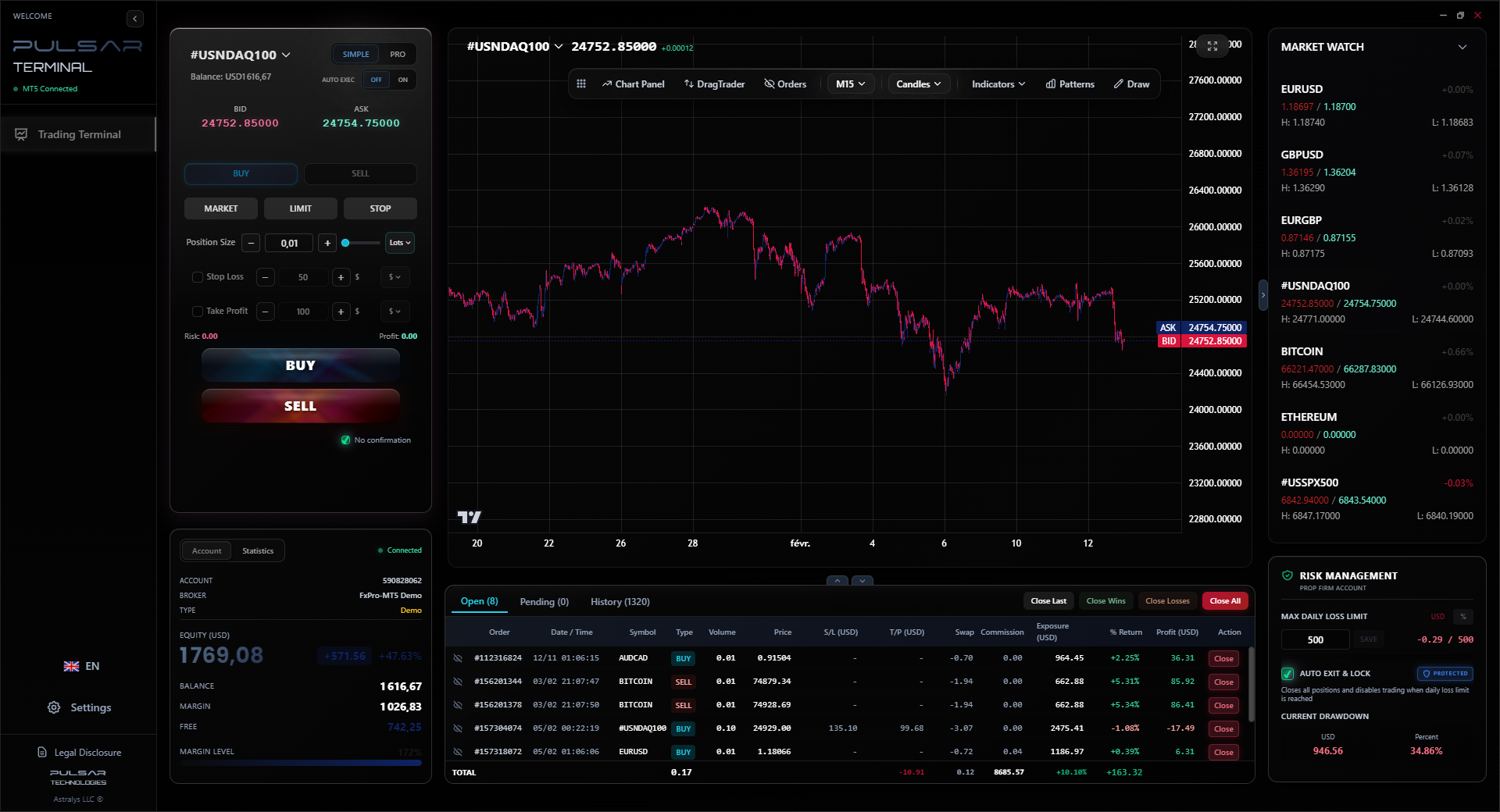
Managing multiple long-term positions and their associated swap or admin fees is complex, but a tool like Pulsar Terminal lets you set automated breakeven and trailing stops directly on MT5, so you can lock in profits and manage risk without babysitting the screen.
Pulsar Terminal
Универсальный инструмент для MT5: drag-and-drop ордера, мульти-TP/SL, трейлинг-стоп, грид-трейдинг, Volume Profile и защита для проп-фирм. Используется 1000+ трейдерами ежедневно.
“In South Africa, the FSP number isn't a suggestion; it's your ticket to a fair fight.”
So, what is a swap free account in forex? It's a specialized tool. It's not inherently better or worse than a standard account. It's different.
For the Muslim trader in Johannesburg who needs to adhere to Sharia law, it's essential. For the long-term investor in Cape Town building a forex portfolio over years, it can be a significant cost-saver. For the day trader in Sandton, it's probably a waste of time and might even be more expensive.
The South African advantage is the FSCA. It forces a level of transparency that you won't always get elsewhere. Use that to your advantage. Scrutinize the fee schedules of FSCA-regulated brokers. Ask their support specific questions: 'What is the exact daily fee for holding a mini lot of EUR/USD open for 10 days in your Islamic account?'
Start by analyzing your own trading. Be brutally honest about your average holding period. Then, and only then, decide if exploring a swap-free account makes financial sense. Remember, the goal isn't to avoid swaps; the goal is to maximize your net profitability after all costs. Sometimes, that means paying a swap. Sometimes, it means avoiding it. Now you have the knowledge to choose.
FAQ
Q1Is a swap-free account really free?
No, it's almost never free. Brokers typically replace the variable swap interest with a fixed administrative fee, a wider spread, or a higher commission. You must read the specific fee schedule for the account.
Q2Can any South African trader open a swap-free account?
Most FSCA-regulated brokers offering these accounts will allow any client to request one. However, some brokers like Exness monitor trading activity to ensure the account is used for genuine swap-free needs and not just to avoid negative swaps on short-term trades.
Q3Do I earn swaps on a swap-free account?
No. The account removes both positive (credits) and negative (debits) swaps. If your strategy relies on earning positive swap as part of your edge, a swap-free account destroys that advantage.
Q4Are swap-free accounts only on MT4?
No. They are most common on MT4 and MT5, but several brokers like IC Markets and FP Markets also offer swap-free conditions on their cTrader platforms.
Q5What's the difference between an Islamic account and a swap-free account?
In practice, they are the same thing. 'Islamic account' is the common marketing term for accounts compliant with Sharia law, which requires them to be swap-free. 'Swap-free' is the functional description. Both refer to accounts without overnight interest charges.
Q6How do I calculate if a swap-free account will save me money?
Take your broker's standard swap rate for your most-traded pair and direction. Multiply by your typical lot size and average hold time in days. Compare that total to the admin fee structure of the swap-free account (e.g., $X per day after Y days). You have to do the math for your specific trading style.
Q7Are swap-free accounts riskier?
No, the trading risk (market risk, use risk) is identical. The only added 'risk' is potentially choosing a more expensive fee structure for your strategy if you don't understand the costs.
Урок проф. Уинстона
Ключевые выводы:
- ✓Swap-free accounts replace interest with admin fees or wider spreads.
- ✓Always verify your broker's FSCA (FSP) license first.
- ✓Long-term traders save money; day traders often lose.
- ✓Calculate costs for your specific strategy before switching.
- ✓The 3-5 day grace period is a critical part of the fee structure.
Насколько полезна эта статья?
Нажмите на звезду
Еженедельные торговые инсайты
Бесплатный еженедельный анализ и стратегии. Без спама.
Об авторе
David van der Merwe
Трейдер развивающихся рынков
Трейдер из Йоханнесбурга с 11-летним опытом работы с валютами развивающихся рынков. Специализируется на ZAR-парах, торговле под регулированием FSCA и анализе южноафриканского рынка.
Комментарии
Предупреждение о рисках
Торговля финансовыми инструментами сопряжена со значительным риском и может не подходить всем инвесторам. Прошлые результаты не гарантируют будущих доходов. Данный контент носит исключительно образовательный характер и не является инвестиционной рекомендацией. Всегда проводите собственное исследование перед торговлей.
Вам также может понравиться

Cara Trading Forex Sukses: 7 Prinsip dari Trader Profesional
Cara trading forex sukses dengan 7 prinsip trader pro: manajemen modal, disiplin, journal trading, backtest. Data nyata, bukan janji profit palsu.
Jam Trading Forex Terbaik untuk Trader Indonesia: Panduan Lengkap dengan Tabel Waktu
Panduan jam trading forex untuk trader Indonesia. Tabel 4 sesi dunia, jam emas 20:00-00:00, sesi mana yang harus dihindari. Data akurat + tips dari trader berpengalaman.
Top 5 Sàn Forex Uy Tín Nhất 2026: Review Jujur dari Trader Indonesia
Top 5 sàn forex uy tín 2026 untuk trader Indonesia. Review jujur: spread, deposit, withdraw, dukungan lokal. Exness, XM, IC Markets & lebih.
Скачать Pulsar Terminal
Все эти калькуляторы встроены в Pulsar Terminal с данными в реальном времени с вашего счёта MT5.
Скачать Pulsar Terminal