


I remember the trade that taught me about liquidity the hard way.

Olumide Adeyemi
Пионер трейдинга в Западной Африке ·  Nigeria
☕ 13 мин чтения
Что вы узнаете:
- 1Liquidity Explained: Forget the Textbook, Think Traffic
- 2Why This Should Be Your #1 Concern (It Hits Your Pocket)
- 3The Liquidity Food Chain: Where Should You Trade?
- 4The Nigerian Angle: Our Unique Liquidity Landscape
- 5How to Trade Smarter Around Liquidity
- 6Can You See or Measure Liquidity?
- 7Liquidity Mistakes I've Made (So You Don't Have To)
- 8Wrapping Up: Liquidity as Your Silent Partner

I remember the trade that taught me about liquidity the hard way. It was on a Friday night, and I had a small position on GBP/JPY. News hit, and the market thinned out. My stop-loss at 152.30? It got filled at 152.85. That 55-pip slippage wiped out my profit for the week. I was furious at my broker until I realized the problem wasn't them - it was me not understanding what is liquidity in forex. The market simply had no one on the other side of my trade when I needed out. For us trading from Nigeria, where market access and costs are unique, getting a grip on liquidity isn't just theory; it's survival.
Let's cut through the jargon. What is liquidity in forex, really? Think of it like Lagos traffic on a good day versus a Sunday morning.
A major pair like EUR/USD is like the Third Mainland Bridge at 2 PM - chaotic, packed with cars (orders), but you can get in and out, even if it's slow. The price moves in small, predictable increments because there's always someone to buy your car (or your lot).
Now, picture an exotic pair, maybe USD/NGN on your broker's platform, during off-hours. That's like a quiet street in Gbagada at 3 AM. You want to sell your car, but there's no buyer. To get a deal done, you'd have to slash the price dramatically to attract the one interested person miles away. That's low liquidity: wide spreads, potential for huge price jumps (volatility), and painful slippage on your orders.

Warning: Many brokers offering insane use like 1:2000 do so under offshore licenses. That high use amplifies everything, including the damage from a liquidity crunch. A small move against you in a thin market can trigger a margin call much faster.
The core components are simple:
- Tight Spreads: The difference between buy and sell price. On EUR/USD, you might see 0.6 pips. On something less liquid, it could be 5 or 10 pips. You're losing money before the trade even moves.
- Fast Execution: Your market order gets filled at the price you see, or very close to it.
- Price Stability: The chart doesn't look like a heart monitor during a crisis; it flows.
For us in Nigeria, this matters double. Our internet isn't always the fastest, and every pip in spread costs us precious Naira. Trading liquid pairs is one of the few edges we can control completely.

You might think, "I'm just a small trader, what does the big market flow have to do with me?" Everything. It directly determines your profit and loss.
Let me give you a real example from last year. I was using a popular international broker (under their Seychelles entity for the use) and trading USD/ZAR. News on SA politics came out at 10 PM Nigerian time. The spread, normally 15 pips, ballooned to 45 pips instantly. I wasn't even in a trade, but I saw my pending buy order get triggered 30 pips above where I set it. The market just skipped over my price. If I'd had a stop-loss there, it would have been a disaster.
The Direct Costs to You
- Wider Spreads = Higher Costs: If you're a scalping strategy fan, this is your nemesis. Paying a 3-pip spread on EUR/USD is tough but workable. Paying a 12-pip spread on an exotic pair means the price has to move 12 pips just for you to break even. That's a huge hurdle.
- Slippage: This is when your order fills at a worse price than you expected. It happens most during news events (like CBN rate announcements) or in illiquid sessions. My GBP/JPY story is a classic case.
- Failed Orders: In extreme cases, your limit or stop order just won't get filled. The price gaps right over it. You're left watching a winning trade you couldn't enter or a losing one you couldn't exit.

Example: Let's say you trade a standard lot (100,000 units). A 5-pip slippage on EUR/USD costs you $50. On a $1,000 account, that's 5% gone in a blink, not from your analysis being wrong, but from poor market mechanics. Use a position size calculator to see how slippage affects your risk.
Liquidity is the invisible tax on trading. The more liquid your pair and session, the lower this tax is.

💡 Совет Уинстона
Liquidity is the first technical analysis. If the spread is wide, the chart is a lie. No pattern is valid in an empty market.
“A perfect MACD crossover in a dead market is often a fakeout.”
Not all currency pairs are created equal. Here’s how they stack up, from most to least liquid:
| Pair Type | Examples | Typical Spread (Approx.) | Liquidity Vibe | Good for Nigerian Traders? |
|---|---|---|---|---|
| Major Pairs | EUR/USD, USD/JPY, GBP/USD | 0.6 - 1.5 pips | Lagos Island on a weekday. Always moving. | YES. Best starting point. Lowest costs. |
| Minor Pairs (Crosses) | EUR/GBP, AUD/CAD | 1.5 - 3 pips | Ikeja City Mall. Busy, but not insane. | Yes, but be careful. Slightly wider spreads. |
| Exotic Pairs | USD/NGN, USD/ZAR, USD/TRY | 5 - 50+ pips | A specialist market in a small town. | Rarely. High spreads, unpredictable. Emotional attachment to USD/NGN is a trap. |
Session is Everything
Liquidity isn't just about the pair; it's about when. The market is a global relay race.
- Sydney Session (2 AM - 8 AM WAT): Quiet. Mostly AUD and NZD pairs moving.
- Tokyo Session (8 AM - 4 PM WAT): Gets busier. Focus on JPY pairs (USD/JPY).
- London Session (8 AM - 4 PM WAT): The King. Over 30% of all forex volume happens here. This is when EUR/USD, GBP/USD truly come alive. The best spreads and execution for us in Nigeria are during the London overlap with our morning.
- New York Session (1 PM - 9 PM WAT): Very liquid, especially when it overlaps with London (1 PM - 4 PM WAT). Then it slowly dies off.
My personal rule? I avoid placing new trades in the dead zone between 9 PM WAT and when Tokyo wakes up. That's when my bad slippage stories happened. If I'm in a swing trading position, I widen my stops during these hours to account for potential gaps.

Pro Tip: The most volatile (and dangerous) times are during major economic releases. When US Non-Farm Payrolls or a CBN Monetary Policy Committee announcement hits, liquidity can vanish for a second, then come back with a vengeance. Either trade these events with a specific strategy or stay away until the dust settles.

Trading from Nigeria isn't the same as trading from London or New York. We have our own set of realities that interact with liquidity.
1. The USD/NGN Obsession (and Why It's Tricky): We all watch the Naira rate. It's personal. But trading it on a retail forex platform is a different beast. The USD/NGN pair you see on Exness or XM is often a CFD (Contract for Difference) based on the offshore or derivative market price, not the direct CBN or parallel market rate. Liquidity can be thin, and spreads are notoriously wide. I've seen 50-pip spreads during local turmoil. It's often more of a speculative gamble than a technical trade. The real forex market turnover in Nigeria hit $8.6 billion in 2025, but that's the institutional, interbank market - not the retail CFD market we access.
2. Payment Methods & Capital: Our liquidity affects our funding. Depositing with a bank transfer or Verve card is fine, but withdrawing back to a Nigerian account can sometimes feel illiquid itself - delays of a few days are common. This means you need to manage your trading capital even more carefully. You can't always rely on instantly pulling out profits to cover an emergency.
3. Regulatory Liquidity: The new Investments and Securities Act (ISA) 2025 is a game-changer (editor's note: using this term as it's a direct quote from the research). It requires platforms to register with the SEC. In theory, this should improve transparency and protect us. More regulation can attract more legitimate players, increasing overall market depth and stability for Nigerian traders. Always check if your broker is on the SEC's registered list.
4. The use Trap: Brokers like IC Markets or Pepperstone might offer 1:500 or 1:1000 use to Nigerian clients via their offshore divisions. In a liquid market, that's powerful. In an illiquid one, it's a death sentence. A small price gap can wipe you out. High use is a tool, not a strategy.

“Understanding liquidity is what separates the gambler from the trader. In Nigeria, it's a non-negotiable part of your edge.”
Knowing about liquidity is one thing. Using that knowledge to protect your account is another. Here’s what I’ve learned over 12 years.
1. Pick Your Battles: Stick to the major pairs, especially when you're starting. EUR/USD is your best friend. It's the most liquid market in the world. The EUR/USD guide dives deep into why. The tight spreads (as low as 0.0 pips on some Exness Zero accounts) mean more of your profit stays yours.
2. Mind the Clock: Schedule your active trading for the London and New York session overlaps (1 PM - 4 PM WAT). That's your golden window. If you're analyzing charts, do it in the evening or early morning. Place your orders with limits and stops, and let the liquid market hours execute them.
3. Order Types Are Your Armor:
- Use Limit Orders: Instead of buying at market, set a limit order at the price you want. You avoid slippage on entry.
- Beware of Stops in Thin Markets: A stop-loss becomes a market order when triggered. In low liquidity, it can slip. Consider using a Guaranteed Stop Loss if your broker offers it (they usually charge a premium for it).
4. Size Matters (Even More): In low-liquidity environments, trade smaller. A 0.01 lot order will get filled much closer to your price than a 1.0 lot order when the market is thin. That’s just how it works. Always use a position size calculator.
5. Watch the Economic Calendar: If the Fed Chair is speaking or Nigerian inflation data is due, expect volatility and potential liquidity drops. Either close your positions before the news or have a very clear plan for if the spread blows out. I never hold a scalp trade through a major news event anymore. The stress isn't worth it.
💡 Совет Уинстона
Your most important trade is the one you don't take. When liquidity evaporates before news, sitting on your hands is a winning strategy.
You can't see liquidity directly like you see price, but you can read its footprints.
1. The Spread Tells All: The most direct real-time gauge. If your EUR/USD spread normally sits at 0.8 pips and suddenly jumps to 3.0 pips for no obvious reason, liquidity is drying up. Step back.
2. Volume Indicators: On MT4/MT5, the built-in "Volumes" indicator shows tick volume (number of price changes), not true trade volume. But it's useful. If price makes a big move on low tick volume, be skeptical - it might not be sustainable and could reverse easily when real liquidity returns.
3. Market Depth (DOM): Some brokers offer a Depth of Market window. It shows pending buy and sell orders at different price levels. A thick stack of orders near the current price suggests good liquidity. A sparse one is a warning sign. Few retail brokers for Nigerians offer true, reliable DOM data.
4. Price Action Clues:
- Smooth Trends: Liquid markets tend to trend with fewer, smaller retracements.
- Choppy, Spiky Moves: Illiquid markets look jagged. Lots of long wicks on candles, where price spiked to hit an isolated order then snapped back.
While tools like the RSI indicator or MACD indicator help with direction, always check the liquidity environment first. A perfect MACD crossover in a dead market is often a fakeout.

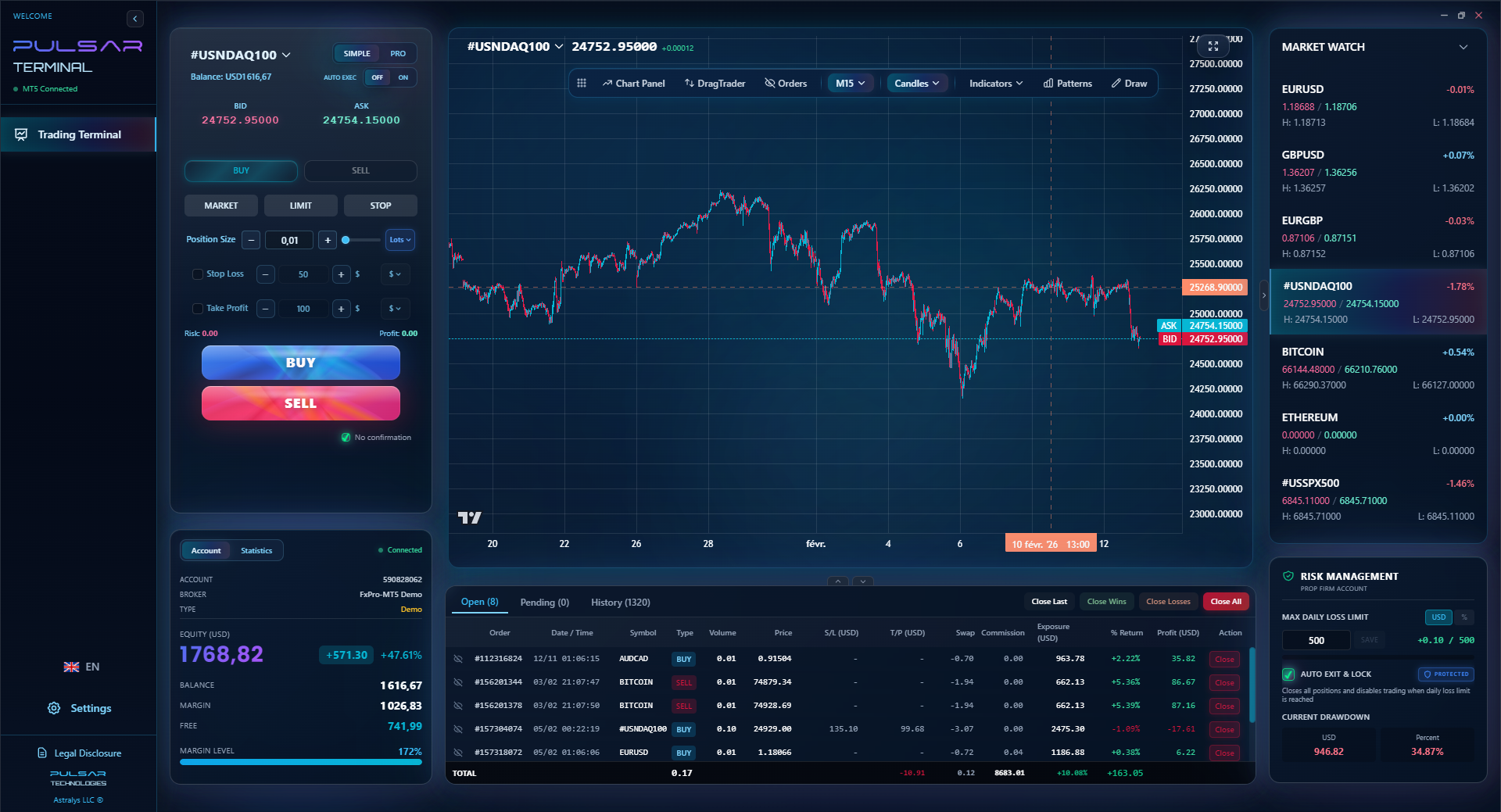
Managing orders in illiquid conditions is critical, and Pulsar Terminal's drag-and-drop order management on MT5 lets you adjust stops and take-profits instantly as the market moves.
Pulsar Terminal
Универсальный инструмент для MT5: drag-and-drop ордера, мульти-TP/SL, трейлинг-стоп, грид-трейдинг, Volume Profile и защита для проп-фирм. Используется 1000+ трейдерами ежедневно.
“The emotional connection to a currency can blind you to its terrible trading mechanics.”
Let me be the cautionary tale.
Mistake 1: Trading Exotics for "Familiarity." I traded USD/NGN because I followed the news every day. I felt informed. But the CFD's spread was 30 pips, and the price would jump in 10-pip increments. My clever analysis was irrelevant; the transaction costs ate me alive. The emotional connection to a currency can blind you to its terrible trading mechanics.
Mistake 2: Ignoring the Session. I once entered a beautiful setup on AUD/USD at 11 PM WAT. The chart was perfect. By 2 AM WAT, a tiny piece of news from China came out. The spread widened, my stop was hit with 8 pips of slippage, and the price immediately reversed and went to my original target. The trade was right, but the timing (liquidity) was completely wrong.
Mistake 3: Over-leveraging in Thin Markets. Early on, I used 1:500 use on a GBP/CAD trade during the Sydney session. A normal 10-pip move felt like a 50-pip move on my account. A minor wiggle triggered my tight stop, and I was out. I was treating a minor pair like a major, and the use magnified the inherent illiquidity.
Mistake 4: Chasing News. When the CBN first announced the Naira float in 2023, I rushed to sell USD/NGN CFDs. The platform froze for a second, my market order filled at a terrible price, and then the pair shot up. I was stopped out in minutes. The initial liquidity vacuum swallowed my order whole. Now, I wait at least 15 minutes after major news for the market to find its feet.
💡 Совет Уинстона
The Naira is your life, but USD/NGN is not your trade. Separate sentiment from execution. Trade the liquid majors to fund your life in Naira.

Understanding what is liquidity in forex is what separates the gambler from the trader. In Nigeria, where we face unique hurdles from internet speeds to currency volatility, respecting liquidity is a non-negotiable part of your edge.
It's not about making flashy predictions. It's about the grind: choosing the right pair (EUR/USD over exotics), trading at the right time (London session), using sensible order types, and always, always sizing your positions for the worst-case slippage scenario.
Liquidity is the ocean you're sailing on. You can't control it, but you can learn to read its tides and currents. Trade when it's calm and deep. Avoid the shallow, rocky shores where your ship can get wrecked on a hidden order. Do that consistently, and you'll find that the market's invisible flows start working for you, not against you.
Start by applying just one thing from this guide. Maybe this week, you only trade between 8 AM and 4 PM WAT. Or you switch your focus from that wide-spread exotic to watching the XAU/USD guide for a more liquid alternative. Small, disciplined steps in understanding market mechanics compound into real, lasting results. Now go look at your charts again - you'll see them differently.
FAQ
Q1What is liquidity in forex in simple terms?
It's how easily you can buy or sell a currency pair without messing up the price. High liquidity is like a busy Lagos market: lots of buyers and sellers, so prices are stable and you can trade quickly. Low liquidity is like a remote village market: few people, so buying or selling something requires a big price change to attract interest.
Q2Which forex pair has the highest liquidity?
EUR/USD is the king of liquidity. It has the tightest spreads (often below 1 pip), the fastest execution, and trades in huge volumes 24 hours a day. For Nigerian traders starting out, it's almost always the best and cheapest pair to trade.
Q3Is USD/NGN a liquid pair to trade?
On retail forex platforms, usually not. The USD/NGN you see as a CFD often has very wide spreads (30-50 pips or more) and can be prone to sudden gaps. While we follow the Naira rate closely, it's generally a poor choice for active trading due to high costs and lower liquidity compared to majors like EUR/USD.
Q4What time is forex most liquid for Nigerian traders?
The best time is during the London trading session (8 AM - 4 PM WAT) and especially when it overlaps with the New York session (1 PM - 4 PM WAT). This is when European and American banks are active, creating the deepest, most liquid market with the smallest spreads.
Q5How does low liquidity affect my trades?
It hurts your profits in three main ways: 1) Wider Spreads: You pay more to enter/exit. 2) Slippage: Your orders fill at worse prices than you wanted. 3) Price Gaps: The market can jump over your stop-loss, causing a bigger loss than you planned. It increases your trading costs and your risk.
Q6Does the new SEC law (ISA 2025) affect forex liquidity in Nigeria?
It could improve it over time. By forcing online trading platforms to register, the SEC aims to clean up the market, reduce scams, and increase transparency. A more trusted environment can attract more participants and capital, which can lead to better liquidity and stability for legitimate Nigerian traders.
Q7Can I check liquidity before I trade?
Yes, indirectly. Watch the live spread on your trading platform - a sudden widening is a red flag. Check the economic calendar for major news releases, as liquidity often drops just before and during these events. Also, avoid trading in the dead hours between the New York close and Tokyo open.
Урок проф. Уинстона
Ключевые выводы:
- ✓Trade EUR/USD during London hours for maximum liquidity.
- ✓A 5-pip slippage on a standard lot costs you $50 instantly.
- ✓Avoid trading 3 hours before and after major news releases.
- ✓If the spread is 3x its normal size, step away from the chart.
Насколько полезна эта статья?
Нажмите на звезду
Еженедельные торговые инсайты
Бесплатный еженедельный анализ и стратегии. Без спама.
Об авторе
Olumide Adeyemi
Пионер трейдинга в Западной Африке
Один из самых активных преподавателей форекс-трейдинга в Нигерии. 8 лет торгового опыта из Лагоса. Специализируется на стратегиях с малым капиталом и челленджах проп-фирм для африканских трейдеров.
Комментарии
Предупреждение о рисках
Торговля финансовыми инструментами сопряжена со значительным риском и может не подходить всем инвесторам. Прошлые результаты не гарантируют будущих доходов. Данный контент носит исключительно образовательный характер и не является инвестиционной рекомендацией. Всегда проводите собственное исследование перед торговлей.
Вам также может понравиться

Cara Trading Forex Sukses: 7 Prinsip dari Trader Profesional
Cara trading forex sukses dengan 7 prinsip trader pro: manajemen modal, disiplin, journal trading, backtest. Data nyata, bukan janji profit palsu.
Jam Trading Forex Terbaik untuk Trader Indonesia: Panduan Lengkap dengan Tabel Waktu
Panduan jam trading forex untuk trader Indonesia. Tabel 4 sesi dunia, jam emas 20:00-00:00, sesi mana yang harus dihindari. Data akurat + tips dari trader berpengalaman.
Top 5 Sàn Forex Uy Tín Nhất 2026: Review Jujur dari Trader Indonesia
Top 5 sàn forex uy tín 2026 untuk trader Indonesia. Review jujur: spread, deposit, withdraw, dukungan lokal. Exness, XM, IC Markets & lebih.
Скачать Pulsar Terminal
Все эти калькуляторы встроены в Pulsar Terminal с данными в реальном времени с вашего счёта MT5.
Скачать Pulsar Terminal