


Let's cut through the noise.

Olumide Adeyemi
Пионер трейдинга в Западной Африке ·  Nigeria
☕ 11 мин чтения
Что вы узнаете:
- 1Forex Trading Defined: The Nigerian Context
- 2How It Actually Works: Pips, Spreads, and the use Trap
- 3The Nigerian Regulatory Reality: It's a Wild West
- 4Why Most Nigerian Traders Lose: The Four Killers
- 5Getting Started the Right Way (The Slow Path)
- 6Forex vs. Other Options in Nigeria
- 7Final Verdict: Is It Worth It?
Let's cut through the noise. The meaning of forex trading isn't about Lamborghinis or financial freedom seminars. It's a simple, brutal fact: you're speculating on the price movement between two currencies, and the odds are stacked against you. In Nigeria, with over 300,000 retail traders and a market that grew 300% in 2020, the allure is massive. But here's the kicker: global data shows between 51% and 89% of retail accounts lose money trading the instruments we use. This isn't a get-rich-quick scheme. It's a professional undertaking where most participants are the liquidity.
At its core, forex trading is the simultaneous buying of one currency and selling of another. You're betting on the exchange rate between them, like the Naira against the US Dollar (USD/NGN) or the Euro against the Dollar (EUR/USD). The global market is enormous, turning over trillions daily, but your slice of it is microscopic.
In Nigeria, the practical meaning of forex trading is shaped by two harsh realities. First, you're almost certainly trading Contracts for Difference (CFDs) with an offshore broker. You don't own the actual currency; you have a contract with your broker based on its price movement. Second, our local regulations make funding and withdrawing a strategic challenge itself. The CBN doesn't want you using official forex windows to fund speculative trading accounts, and many banks block international card transactions for brokers.
So, while the textbook definition is simple, the Nigerian experience adds layers of complexity, cost, and risk before you even place your first trade. Understanding this gap between theory and local practice is your first line of defense.

Warning: Don't confuse trading with money changing. The Bureau de Change trader on your street is providing a physical service for travel or trade. You, as a retail forex trader, are purely speculating on price movements through a broker's platform. The goals, risks, and methods are completely different.

💡 Совет Уинстона
The market doesn't know you exist. Your ego, your hopes, your rent - none of it matters to the charts. Trade the price you see, not the price you want.
“The meaning of forex trading isn't about Lamborghinis; it's a professional undertaking where most participants are the liquidity.”
Let's break down the mechanics. Currencies move in tiny increments called pips. For most pairs, a pip is 0.0001. If EUR/USD moves from 1.0850 to 1.0851, it gained one pip.
The Hidden Cost: The Spread
Your first obstacle is the spread. This is the difference between the buy (ask) and sell (bid) price. If EUR/USD is quoted at 1.0850 / 1.0852, the spread is 2 pips. You start your trade in a 2-pip hole. You need the market to move in your favor by more than the spread just to break even. With a good broker, a major pair like EUR/USD might have a tight average spread around 0.6 pips. With a bad one, it can be 3 pips or more. That's a huge headwind. I always check the live spread on my broker's platform before entering, not just the advertised 'typical' spread. You can learn more about this critical cost in our guide on spread definition.
The Double-Edged Sword: use
This is where dreams blow up. use lets you control a large position with a small deposit. A common use in Nigeria is 1:500. With $100, you can control a $50,000 position. Sounds great, right? Here's my painful lesson.
Early on, I used 1:500 use on a GBP/USD trade. I put down $200, controlling $100,000. The market moved just 20 pips against me. A 20-pip move on a $100,000 position is a $200 loss. My entire account was wiped out in minutes. I didn't understand that use multiplies your risk per pip. That trade taught me that use isn't a tool for amplifying profits; it's a risk multiplier that requires military-grade discipline. Most brokers here offer high use because it attracts clients, but it's the fastest route to a margin call.

Example:
- Trade: Buy EUR/USD at 1.0850
- Position Size: 1 mini lot (10,000 units)
- Spread: 2 pips (cost = $2)
- use: 1:100
- Your Capital: $108.50 margin held
- Risk: A 11-pip move against you (1.0839) wipes out 10% of your margin. A 110-pip move wipes out your entire margin deposit.
The math is unforgiving. This is why a position size calculator isn't a nice-to-have; it's a non-negotiable survival tool.
“High use is offered because it causes clients to blow up faster, which is profitable for the broker.”
Let's be frank about the rules, or lack thereof. Forex trading itself is legal for you as an individual. However, the regulatory framework for online retail forex trading is, to put it kindly, underdeveloped.
The Central Bank of Nigeria (CBN) and the Securities and Exchange Commission (SEC) are the main bodies. The CBN regulates banks and the official forex market. The SEC is supposed to regulate capital markets, including securities and derivatives. But specific, strong rules for the online CFD forex brokers targeting Nigerians? They're not fully there yet. This creates a dangerous gap.
What does this mean for you?
- You're likely using an international broker. Nigerian brokers authorized by the CBN are few. Most traders use offshore brokers regulated in places like Cyprus (CySEC), Australia (ASIC), or South Africa (FSCA). Your protection is their foreign regulation, not Nigerian law. You need to do your own deep due diligence. I've had to navigate account issues with brokers where my only recourse was their overseas support team. It's stressful.
- Funding is a battle. The CBN has made it clear: don't use the official forex window (your bank) to fund trading. Many banks now block card payments to known brokerages. This pushes people towards crypto transfers or fintech apps, adding extra steps, fees, and counterparty risk.
- Taxes are very real. Just because your broker is offshore doesn't mean the FIRS won't want their share. Profits from forex trading are generally subject to a 10% Capital Gains Tax. Keep careful records. The meaning of forex trading success includes a line item for the taxman.
This environment means you are your own first and last line of defense. Choosing a reputable, well-regulated international broker is critical. We maintain detailed reviews of brokers like Exness, IC Markets, and XM to help you start your research.
“High use is offered because it causes clients to blow up faster, which is profitable for the broker.”
With 8 out of 10 retail traders losing money, the reasons aren't mysterious. They're behavioral, and I've been guilty of every one.
1. Treating Trading Like a Casino. This was my biggest sin. I'd see a 'sure thing' on USD/NGN or GBP/JPY and throw a huge chunk of my account at it with tight stops. No plan, just emotion. The market doesn't care about your conviction. It will take your money. Trading requires the patience of a sniper, not the excitement of a gambler.
2. Overleveraging. We covered this, but it bears repeating. High use is offered because it causes clients to blow up faster, which is profitable for the broker. Using 1:500 use is like doing brain surgery with a chainsaw. You might get lucky once, but the odds of disaster are overwhelming. I now never exceed 1:30 use, even on my smallest account.
3. Chasing 'Magic Bullet' Strategies. The internet is flooded with 'secret indicators' or '100% win rate' systems sold by gurus. I wasted over ₦150,000 on courses and signals that promised the moon. They all failed in live market conditions. The truth is, no indicator like the RSI or MACD works consistently on its own. Profit comes from risk management, discipline, and a deep understanding of price action, not a magical formula.
4. No Risk Management. This is the ultimate killer. You must know exactly how much you are willing to lose on a trade before you enter, and you must use a stop-loss order. Period. Letting a losing trade run, hoping it will come back, is how small losses become account-ending disasters. My rule now: I never risk more than 1% of my account on any single trade. It's boring, but it keeps me in the game.

Pro Tip: Your trading plan is worthless without a risk management annex. Before you define your entry, you must define your exit - for both loss and profit. Decide your risk-per-trade percentage and stick to it with religious fervor.
💡 Совет Уинстона
Your first profit target should always be your stop-loss. Getting to breakeven on a trade is a win. Protecting capital is the only strategy that never goes out of style.
“Forget about making money for the first year. Your goal is to not lose money while you learn.”
If you're still determined after all that, here's the only sane path forward. Forget about making money for the first year. Your goal is to not lose money while you learn.
Step 1: Education with a Focus on Risk. Don't buy a fancy course. Start with free, quality resources that explain concepts like support/resistance, trend, and - most importantly - position sizing and stop-loss placement. Paper trade (use a demo account) for a minimum of 3-6 months. Not a week. Months.
Step 2: Broker Selection is a Security Decision. Don't just pick the broker with the highest use or biggest bonus. Research their regulation, reputation for withdrawals, and trading conditions. Read our reviews on platforms like Pepperstone to understand what to look for. Your broker is your business partner; choose one with integrity.
Step 3: Develop a Simple, Testable Strategy. Start with one currency pair, like EUR/USD. Develop a simple rule-based strategy. For example, only trade in the direction of the daily chart trend, and only on pullbacks to a key moving average. Define your entry, stop loss, and take profit rules precisely. Then, test it for 100 trades in your demo account. Record every trade in a journal.
Step 4: The Live Account Leap. Start with the absolute minimum deposit. Treat this real money as tuition fees you expect to lose. Your mission is to execute your plan and manage your risk, not to be profitable. The psychological shift from demo to live is massive. Only when you can consistently follow your rules for months should you consider adding more capital.
This path isn't sexy. It doesn't sell YouTube ads. But it's the only one that leads to a possibility of long-term survival. Whether you lean towards fast-paced scalping or more patient swing trading, the foundational principles of risk management are the same.
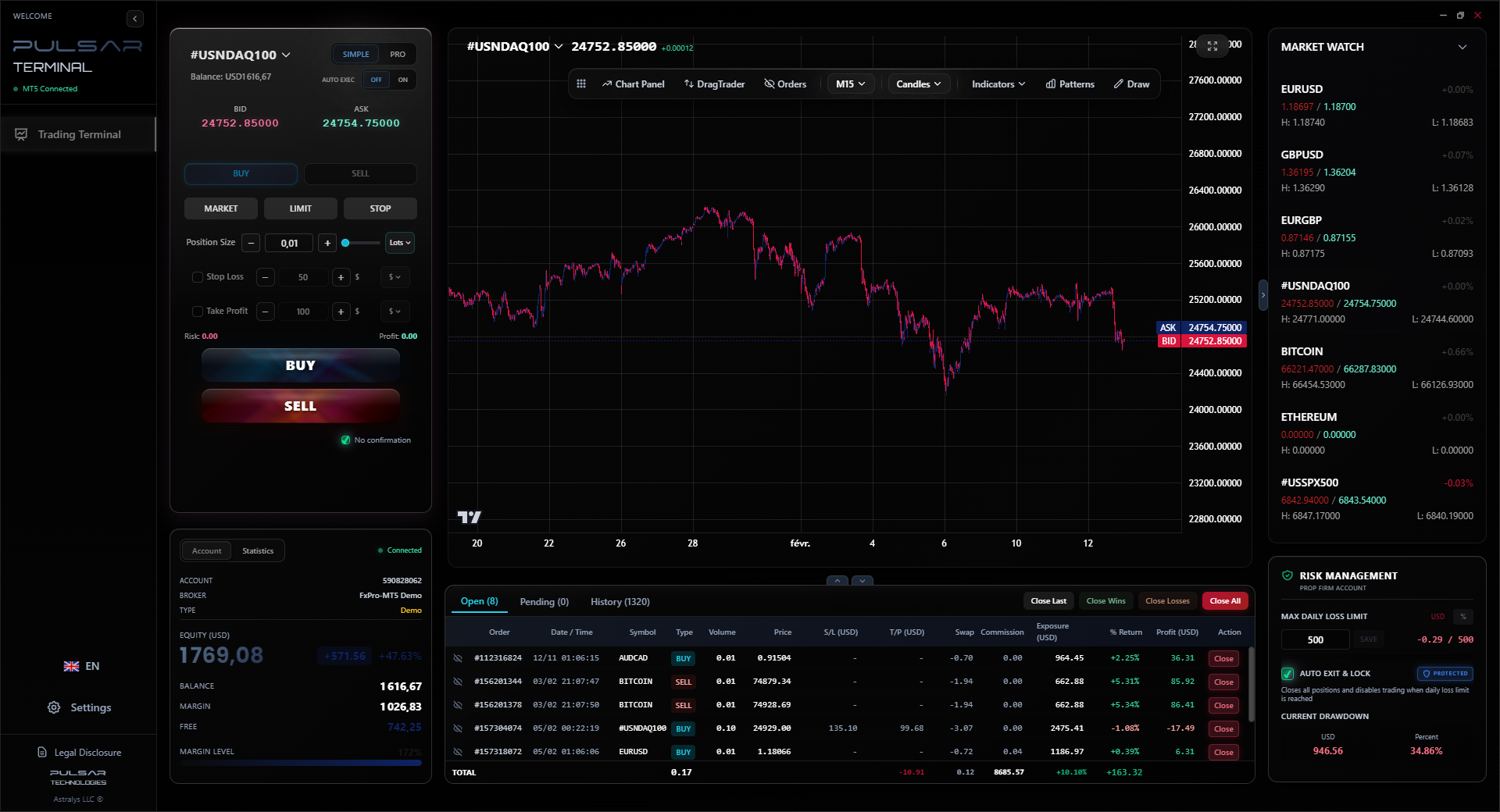
Executing a disciplined trading plan with precise stop-loss and take-profit levels is hard, but tools like Pulsar Terminal automate this directly on your MT5 platform, removing emotion from the equation.
Pulsar Terminal
Универсальный инструмент для MT5: drag-and-drop ордера, мульти-TP/SL, трейлинг-стоп, грид-трейдинг, Volume Profile и защита для проп-фирм. Используется 1000+ трейдерами ежедневно.
“Forget about making money for the first year. Your goal is to not lose money while you learn.”
Forex isn't the only game in town. It's crucial to understand how it stacks up against other common avenues for Nigerians.
| Instrument | What It Is | Key Risk for Nigerians | Liquidity |
|---|---|---|---|
| Forex (CFDs) | Speculating on currency pairs via a broker. | Extreme use, high volatility, offshore broker risk. | Extremely High (24/5) |
| Stocks (NGX) | Buying shares of Nigerian companies. | Limited market diversity, corporate governance risks, lower liquidity. | Medium |
| Crypto | Buying digital currencies like Bitcoin. | Extreme volatility, regulatory uncertainty, exchange hack risk. | High (24/7) |
| Gold (XAU/USD) | Speculating on gold price vs USD via CFDs. | Similar broker risk as forex, influenced by USD strength. | High |
| Agriculture/Real Estate | Physical investment in land or farming. | High capital requirement, illiquidity, management overhead. | Very Low |
Forex offers unparalleled liquidity and the ability to trade in any direction (up or down) with small starting capital. But that small capital is a trap if you use high use. Compared to buying physical assets, it's liquid. Compared to crypto, it's less prone to catastrophic, exchange-driven collapses (though broker risk exists).
For many, a hybrid approach makes sense. Using a core of your capital for longer-term, physical investments in Nigeria, and allocating a very small, risk-defined portion to speculative trading like forex or XAU/USD. Never let the speculative tail wag the investment dog.
“Accessibility does not equal suitability.”
So, what is the ultimate meaning of forex trading for the average Nigerian? It's a high-skill, high-risk professional endeavor disguised as an accessible side hustle.
The market's growth here is fueled by youth unemployment, naira volatility, and the dream of quick money. The infrastructure (internet, brokers) makes it accessible. But accessibility does not equal suitability.
It is worth it only if you approach it with the mindset of a student for years, not a profit-seeker for months. It is worth it only if you can afford to lose every kobo you put in. It is worth it only if you possess a level of emotional discipline that most people (including my former self) simply do not have.
For the vast majority, the meaning of forex trading will be an expensive lesson in statistics and human psychology. For a tiny, disciplined minority, it can be a legitimate way to generate supplemental income. But it will never be easy money. The market exists precisely because so many people believe it is.
My advice? If you're curious, dedicate yourself to the learning phase on a demo account. If after six months of disciplined practice, journaling, and study you still have the passion, then and only then consider risking real money. And start so small that losing it wouldn't change your life. That's the only way to find out what forex trading truly means for you.
FAQ
Q1Is forex trading legal in Nigeria?
Yes, forex trading is legal for individuals in Nigeria. However, the online retail forex market is not tightly regulated by Nigerian authorities like the SEC. Most Nigerian traders use international brokers regulated overseas. The Central Bank of Nigeria (CBN) also restricts using official banking channels to fund trading accounts, making deposits and withdrawals a practical challenge.
Q2How much money do I need to start forex trading in Nigeria?
Technically, you can start with as little as $10 or $20 with some offshore brokers due to high use. But this is a terrible idea. That high use means you'll likely lose it instantly. A more sensible minimum, after thorough demo practice, is an amount you can afford to lose completely - think of it as tuition. Many serious traders suggest starting with at least $500-$1000 to properly implement risk management without being forced to use extreme use.
Q3Do I pay tax on forex trading profits in Nigeria?
Yes. According to Nigerian law, profits from forex trading are generally subject to Capital Gains Tax (CGT), which is currently 10% of your gross profits. You are responsible for declaring this income to the Federal Inland Revenue Service (FIRS), even if your broker is based outside Nigeria. Keep detailed records of all your trades, deposits, and withdrawals.
Q4What is the best time to trade forex in Nigeria?
The most volatile and liquid sessions overlap with the London session (1 PM - 10 PM Nigerian Time) and the overlap between London and New York sessions (3 PM - 5 PM Nigerian Time). This is when you'll see the biggest moves and the tightest spreads on major pairs like EUR/USD and GBP/USD. The Asian session (late night to early morning Nigerian time) is typically quieter.
Q5Which forex broker is best for Nigerians?
There's no single 'best' broker, as it depends on your needs. The critical factors are strong international regulation (e.g., ASIC, FSCA, CySEC), a reliable track record for processing withdrawals to Nigeria, and competitive trading conditions (spreads, fees). You should always research brokers thoroughly, reading independent reviews like our IC Markets review, before depositing any money.
Q6Can I make a living from forex trading in Nigeria?
Statistically, it's highly unlikely. With 80-90% of retail traders losing money, expecting to make a consistent living is unrealistic for most. It requires significant capital, years of experience, and exceptional discipline. View it as a potential source of supplemental income, not a primary career, especially in the early years. The vast majority who try to trade for a living end up blowing their accounts.
Q7What is a pip in forex trading?
A pip (percentage in point) is the standard unit for measuring how much a currency pair's exchange rate has changed. For most pairs, like EUR/USD, a pip is 0.0001. If EUR/USD moves from 1.0850 to 1.0851, it has moved 1 pip. Understanding pips is essential for calculating your profit, loss, and risk on every trade. We have a full breakdown in our pip definition guide.
Урок проф. Уинстона
Ключевые выводы:
- ✓Define risk first, entry second. Always.
- ✓use above 1:30 is a hazard, not a tool.
- ✓Demo trade for 100+ trades minimum.
- ✓Never risk more than 1% of your capital per trade.
Насколько полезна эта статья?
Нажмите на звезду
Еженедельные торговые инсайты
Бесплатный еженедельный анализ и стратегии. Без спама.
Об авторе
Olumide Adeyemi
Пионер трейдинга в Западной Африке
Один из самых активных преподавателей форекс-трейдинга в Нигерии. 8 лет торгового опыта из Лагоса. Специализируется на стратегиях с малым капиталом и челленджах проп-фирм для африканских трейдеров.
Комментарии
Предупреждение о рисках
Торговля финансовыми инструментами сопряжена со значительным риском и может не подходить всем инвесторам. Прошлые результаты не гарантируют будущих доходов. Данный контент носит исключительно образовательный характер и не является инвестиционной рекомендацией. Всегда проводите собственное исследование перед торговлей.
Вам также может понравиться

Cara Trading Forex Sukses: 7 Prinsip dari Trader Profesional
Cara trading forex sukses dengan 7 prinsip trader pro: manajemen modal, disiplin, journal trading, backtest. Data nyata, bukan janji profit palsu.
Jam Trading Forex Terbaik untuk Trader Indonesia: Panduan Lengkap dengan Tabel Waktu
Panduan jam trading forex untuk trader Indonesia. Tabel 4 sesi dunia, jam emas 20:00-00:00, sesi mana yang harus dihindari. Data akurat + tips dari trader berpengalaman.
Top 5 Sàn Forex Uy Tín Nhất 2026: Review Jujur dari Trader Indonesia
Top 5 sàn forex uy tín 2026 untuk trader Indonesia. Review jujur: spread, deposit, withdraw, dukungan lokal. Exness, XM, IC Markets & lebih.
Скачать Pulsar Terminal
Все эти калькуляторы встроены в Pulsar Terminal с данными в реальном времени с вашего счёта MT5.
Скачать Pulsar Terminal