


You're sitting in Johannesburg or Cape Town, charts open, coffee in hand, wondering when the real action kicks off.

David van der Merwe
Трейдер развивающихся рынков ·  South Africa
☕ 9 мин чтения
Что вы узнаете:
- 1The US Forex Session in South African Time
- 2Why the New York Open Matters for South African Traders
- 3Local Rules and Regulations You Can't Ignore
- 4Costs and Brokers for the South African Trader
- 5Strategies for Trading the US Session from SA
- 6Common Pitfalls and How to Avoid Them
- 7Putting It All Together: Your SA Trading Schedule
You're sitting in Johannesburg or Cape Town, charts open, coffee in hand, wondering when the real action kicks off. When does the US forex market open for us? It's not just about a clock time, it's about knowing when liquidity floods in and the Rand might start dancing. Getting this wrong means you're either trading in a ghost town or getting run over by a volatility truck. Let's cut through the noise and get you synced to the money-making hours, South African style.
Forget New York for a second. You need the time in your world. The US Forex market, specifically the New York session, officially opens at 8:00 AM Eastern Standard Time (EST).
That translates directly to 3:00 PM South African Standard Time (SAST). It closes at 5:00 PM EST, which is 12:00 AM (midnight) SAST.
Here’s the practical breakdown for your trading day:
| Session | SAST Time | Key Characteristic |
|---|---|---|
| Asian Session | 2:00 AM - 11:00 AM | Quiet, range-bound. Good for scalping strategy small moves. |
| European/London Session | 10:00 AM - 7:00 PM | Volatility picks up. Major EUR pairs active. |
| US/New York Session OPEN | 3:00 PM | Liquidity tsunami hits. |
| Session Overlap (EU & US) | 3:00 PM - 7:00 PM | The golden hours. Highest volume, best opportunities. |
| US/New York Session CLOSE | 12:00 AM | Liquidity dries up fast. Wrap it up. |
The entire global forex market runs from Sunday 10:00 PM SAST to Friday 11:00 PM SAST. But you don't want to trade all of it. You want the sweet spot.

Warning: Many brokers list session times in GMT or their own server time. Always, always check what timezone your trading platform is set to. I once placed a trade based on my local clock, not realizing my MT4 was on GMT+3. Missed the entire New York open. Rookie mistake, costly lesson.

💡 Совет Уинстона
The market doesn't care about your schedule. Your job is to be there when it cares about moving. 3 PM SAST is that time. Be ready, or be gone.
Liquidity is King (and Queen)
At 3:00 PM SAST, the big banks, hedge funds, and institutional players in New York log on. This influx of money means spreads tighten. You’ll see the bid/ask spread on major pairs like EUR/USD often hit their lowest point of the day. For you, that means lower transaction costs and less slippage when you enter a trade. It’s the difference between getting filled at your exact price and watching the market jump 2 pips past your limit order.
The ZAR Gets a Kick
This is crucial for us. The USD/ZAR pair often sees its most significant moves during the New York session. US economic data (like Non-Farm Payrolls, CPI, Fed decisions) is released in their morning, which is our afternoon. This data directly impacts global risk sentiment and commodity prices, which the Rand is highly sensitive to. If you’re trading the Rand, you absolutely must be at your desk by 2:30 PM SAST to prepare.
The Overlap is Pure Opportunity
The period from 3:00 PM to about 7:00 PM SAST, when both London and New York are fully online, is where I’ve made - and lost - the most money. The volume is insane. Trends accelerate, breakouts become more reliable, and momentum strategies really shine. It’s also the most dangerous time for inexperienced traders, as whip-like reversals can happen just as fast.

Example: On a typical Wednesday, the average true range (ATR) for EUR/USD might be 60 pips. During the 2-hour core of the overlap, it can easily cover 40 of those pips. That’s where the movement is.
I learned this the hard way in 2018. I was swing trading GBP/USD and left a stop-loss order from the Asian session. The New York open triggered a massive, news-driven spike that hit my stop and reversed immediately, taking me out for a loss before the real move in my intended direction even began. My stop was too tight for the session’s volatility. Now, I either adjust my stops wider before 3:00 PM or I’m actively managing the trade.
“The period from 3:00 PM to about 7:00 PM SAST is where I’ve made - and lost - the most money.”
Trading the US session from South Africa isn't a free-for-all. Our regulators have rules, and ignoring them is a shortcut to trouble.
The Financial Sector Conduct Authority (FSCA) is the main watchdog. Any broker you use should be licensed by them. This isn't just bureaucracy; it means your funds should be segregated, and you have a local recourse if things go south. I stick with FSCA-regulated entities like IG or Exness for this reason.
Then there's the South African Reserve Bank (SARB). Their exchange control rules are serious business. You are generally not allowed to speculate directly against the ZAR with an offshore broker. You trade major pairs (EUR/USD, GBP/USD) or crosses. Also, all your foreign currency transactions must go through an authorised dealer. Your broker handles this, but you need to declare investment income to SARS. Yes, your forex profits are taxable. Keep detailed records.
Finally, use. The FSCA capped retail use at 30:1. This might feel low if you’ve heard stories of 500:1 elsewhere, but it’s a lifesaver. It forces sane position size calculator use. Blowing up an account with 30:1 use takes real effort.
Let's talk numbers, because that's what matters. Trading the volatile New York session with high costs will eat your profits for breakfast.
Spreads & Commissions: During the 3:00 PM overlap, you should expect the best pricing of the day. On a good ECN account, EUR/USD spreads can go under 0.2 pips. But you need to account for commissions. A typical model is a raw spread plus a commission per lot. For example, a broker might charge 0.1 pips spread + $3.50 per side per 100k lot. That’s your total cost. Always look at the effective cost, not just the advertised spread.
Broker Choices: You want a broker with a solid local presence and fast execution, especially for that New York open volatility.
- Local (FSCA): Khwezi Trade is a solid, Cape Town-based broker. Min deposit ZAR 500, spreads from 0.4 pips. Good for peace of mind.
- International (with FSCA license): Exness and XM are hugely popular here. Exness offers ZAR accounts, min deposit ~R180. XM’s min is $5. Both have decent execution.
- For the Serious Trader: IC Markets and Pepperstone, while internationally focused, offer some of the best raw spreads and lightning-fast execution I’ve seen, crucial for that New York session action.
Payment Methods: Use ZAR-denominated accounts if possible to avoid conversion fees. EFTs from your local bank are usually free for deposits. Withdrawals can take a day or two. I avoid card withdrawals because my bank slaps on extra fees.
💡 Совет Уинстона
A wide stop that survives the New York open volatility is better than a tight stop that gets picked off by noise. Give your trade room to breathe.
“Trading the US session blind is suicide. A high-impact news release will vaporize your careful technical analysis.”
The First 60 Minutes: News & Momentum
From 3:00 PM to 4:00 PM SAST is pure reaction time. US economic data drops at 3:30 PM SAST (8:30 AM EST). You can trade the news spike, but it’s risky. I prefer to wait 5-15 minutes for the initial panic to settle, then look for the momentum direction. A strong MACD indicator crossover on the 5-minute chart here can be very effective.
The Overlap Grind (3:00 PM - 7:00 PM SAST)
This is where trend-following works. Identify the direction from the higher timeframes (1H, 4H) and use pullbacks on the 15-minute chart to enter. Place stops beyond the recent swing low/high to account for the higher volatility. This is also prime time for breakouts of Asian/European session ranges.
Managing Your Evening (7:00 PM - Midnight SAST)
After London closes, volume drops but directional moves from the overlap can continue. I often move my stop to breakeven once a trade is 15-20 pips in profit. The goal is to let runners go, but protect capital. By 11:00 PM, I’m usually closing any remaining positions. Trading the late New York session from SA is like picking up scraps, and the sleep deprivation isn’t worth it.

Pro Tip: Set an alarm for 2:55 PM SAST. Use those 5 minutes before the open to check the economic calendar, assess your open positions, and clear your head. Do not enter a new trade at 2:59 PM. Wait for the volume to confirm the direction.
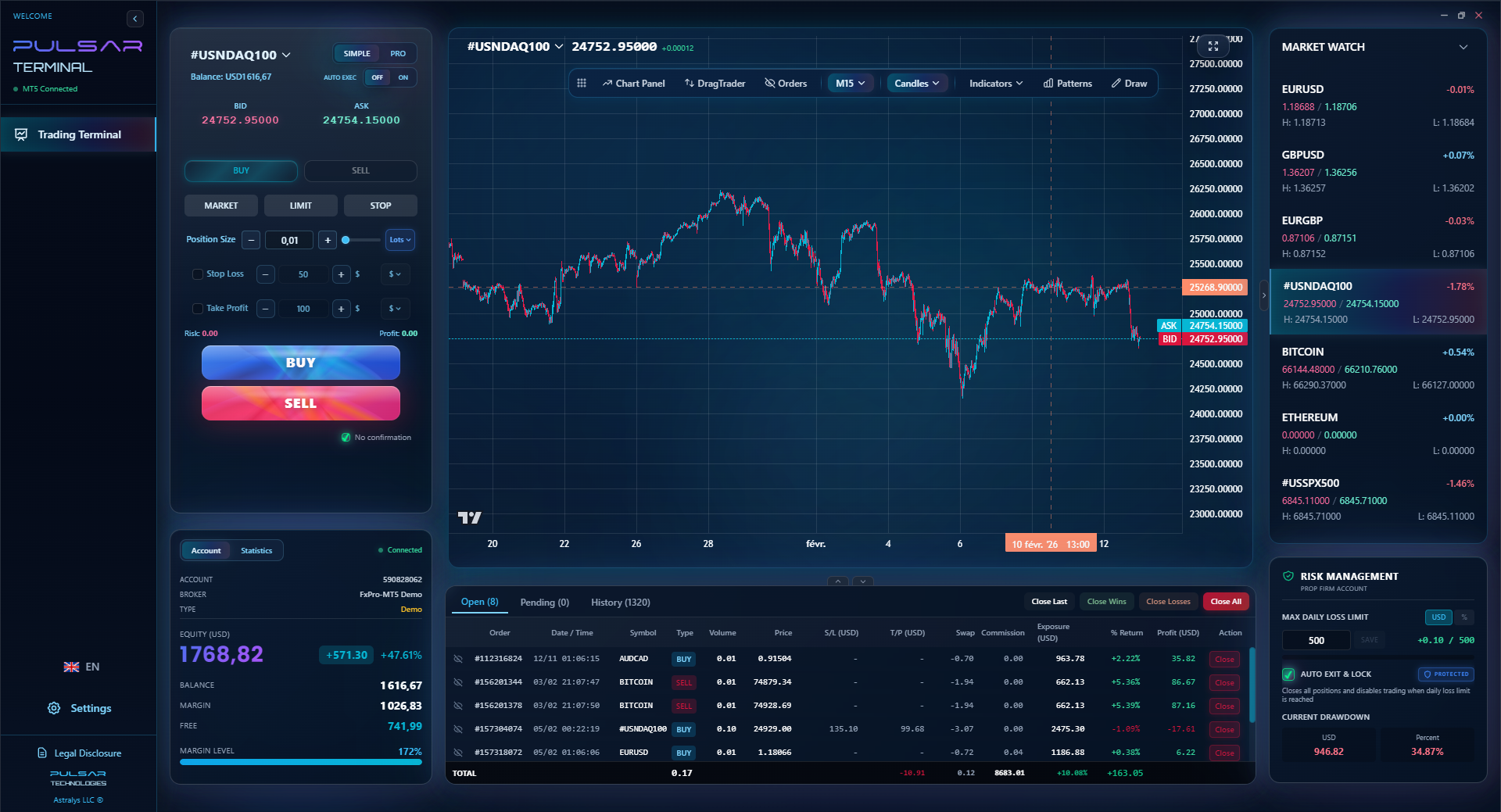
Managing trades during the volatile New York session is stressful; Pulsar Terminal lets you set multi-level take-profits and trailing stops on MT5 before the news even drops, so you can trade the reaction, not babysit the screen.
Pulsar Terminal
Универсальный инструмент для MT5: drag-and-drop ордера, мульти-TP/SL, трейлинг-стоп, грид-трейдинг, Volume Profile и защита для проп-фирм. Используется 1000+ трейдерами ежедневно.
Pitfall 1: Overtrading the Open. The flood of action is exciting. It’s easy to jump into every little move. Stick to your pre-defined setup. One good trade is better than three mediocre ones.
Pitfall 2: Ignoring the Economic Calendar. Trading the US session blind is suicide. A high-impact news release will vaporize your careful technical analysis. Know when data is due. I use a simple rule: No new entries 5 minutes before major news, and I often widen my stops on existing positions.
Pitfall 3: Forgetting About Loadshedding. It’s our unique risk. Have a plan. A UPS for your router and laptop can give you 30-60 minutes to manage or close trades. Know your broker’s mobile app inside out. I once had to close a XAU/USD trade via my phone during a stage 6 blackout. Saved me from a margin call.
Pitfall 4: Chasing the ZAR. USD/ZAR is seductive but brutally volatile. It can gap hundreds of pips on local political news. If you trade it, size small. Treat it with more respect than the majors. A 50-pip stop on EUR/USD might be reasonable; on USD/ZAR, it’s a coin toss.
💡 Совет Уинстона
The first rule of trading from SA: Never let a generator failure be your risk management strategy. Have a power and internet contingency plan, written down.
“The key is recognizing that the US open is the start of your main event, not the start of a 9-hour marathon.”
Here’s a sample schedule that’s sustainable and profitable:
- Morning (8:00 AM - 11:00 AM SAST): Review. Analyse the daily charts, plan your day. Maybe take a quiet Asian range trade if a setup is perfect.
- Lunchtime (11:00 AM - 2:30 PM): Monitor the London session. See if any trends are establishing. Prepare for the US open. Identify key support/resistance levels.
- US Open Prep (2:30 PM - 3:00 PM): Final checks. Economic calendar. Mental reset.
- Power Hours (3:00 PM - 7:00 PM SAST): Be at your desk. Execute your plan. Focus. This is your main trading window.
- Evening Wind-Down (7:00 PM - 10:00 PM): Manage existing trades. Look to secure profits. No new entries after 9:00 PM unless it’s a crystal-clear setup.
- After 10:00 PM: Walk away. The pip definition movements left aren’t worth your sanity. Review your trades, journal, and disconnect.
The key is recognizing that what time does the US forex market open is the start of your main event, not the start of a 9-hour marathon. Trade the overlap with focus, and then protect your capital and your sleep. That’s the South African trader’s edge.
FAQ
Q1What time does the US Forex market open in South Africa?
The US Forex market (New York session) opens at 3:00 PM South African Standard Time (SAST) and closes at 12:00 AM (midnight) SAST.
Q2What is the best time to trade forex in South Africa?
The absolute best time is the overlap between the European and US sessions, from 3:00 PM to 7:00 PM SAST. This period has the highest liquidity and volatility, offering the best trading opportunities.
Q3Is forex trading legal in South Africa?
Yes, retail forex trading is legal in South Africa. It is regulated by the Financial Sector Conduct Authority (FSCA). You must use an FSCA-licensed broker and comply with South African Reserve Bank (SARB) exchange control regulations.
Q4Can I trade the South African Rand (ZAR) with international brokers?
Generally, no. SARB regulations typically prohibit direct speculation on the ZAR with offshore brokers. South African traders usually trade major currency pairs like EUR/USD or GBP/USD through their international accounts.
Q5What use can I use in South Africa?
The FSCA has capped maximum use for retail traders at 30:1 for major forex pairs. This is a protective measure to limit risk.
Q6How do I handle trading during loadshedding?
Have a backup plan. This includes a UPS for your internet router and laptop, knowing your broker's mobile app thoroughly, and potentially using a mobile data hotspot. Always know how to quickly close positions manually.
Q7Are my forex profits taxable in South Africa?
Yes. The South African Revenue Service (SARS) considers net profits from forex trading as taxable income. You must declare this income and can deduct related trading expenses. Keep detailed records of all trades and statements.
Урок проф. Уинстона
Ключевые выводы:
- ✓The US session opens at 3:00 PM SAST, closes at midnight.
- ✓The 4-hour overlap (3-7 PM SAST) is your primary trading window.
- ✓FSCA use is capped at 30:1 for retail traders.
- ✓Always account for loadshedding in your risk plan.
- ✓USD/ZAR moves are explosive; trade them with half your usual size.
Насколько полезна эта статья?
Нажмите на звезду
Еженедельные торговые инсайты
Бесплатный еженедельный анализ и стратегии. Без спама.
Об авторе
David van der Merwe
Трейдер развивающихся рынков
Трейдер из Йоханнесбурга с 11-летним опытом работы с валютами развивающихся рынков. Специализируется на ZAR-парах, торговле под регулированием FSCA и анализе южноафриканского рынка.
Комментарии
Предупреждение о рисках
Торговля финансовыми инструментами сопряжена со значительным риском и может не подходить всем инвесторам. Прошлые результаты не гарантируют будущих доходов. Данный контент носит исключительно образовательный характер и не является инвестиционной рекомендацией. Всегда проводите собственное исследование перед торговлей.
Вам также может понравиться

Cara Trading Forex Sukses: 7 Prinsip dari Trader Profesional
Cara trading forex sukses dengan 7 prinsip trader pro: manajemen modal, disiplin, journal trading, backtest. Data nyata, bukan janji profit palsu.
Jam Trading Forex Terbaik untuk Trader Indonesia: Panduan Lengkap dengan Tabel Waktu
Panduan jam trading forex untuk trader Indonesia. Tabel 4 sesi dunia, jam emas 20:00-00:00, sesi mana yang harus dihindari. Data akurat + tips dari trader berpengalaman.
Top 5 Sàn Forex Uy Tín Nhất 2026: Review Jujur dari Trader Indonesia
Top 5 sàn forex uy tín 2026 untuk trader Indonesia. Review jujur: spread, deposit, withdraw, dukungan lokal. Exness, XM, IC Markets & lebih.
Скачать Pulsar Terminal
Все эти калькуляторы встроены в Pulsar Terminal с данными в реальном времени с вашего счёта MT5.
Скачать Pulsar Terminal