


So you want to know where to trade forex from South Africa? Good.

David van der Merwe
Трейдер развивающихся рынков ·  South Africa
☕ 9 мин чтения
Что вы узнаете:
- 1The Legal Landscape: FSCA Rules You Can't Ignore
- 2Local FSCA Brokers vs. International Giants
- 3The Real Costs: Spreads, Commissions, and Hidden Fees
- 4Platforms & Tools: What You Actually Need
- 5Getting Money In & Out: The ZAR Reality
- 6My Step-by-Step Process for Choosing a Broker
- 7Classic Mistakes (I've Made Most of These)
So you want to know where to trade forex from South Africa? Good. You should be asking that. It's not just about picking the shiniest platform; it's about finding a broker that won't disappear with your money, respects the local rules, and doesn't bleed you dry with hidden fees. I've seen too many traders, especially new ones, get this wrong from the start. Let's cut through the marketing nonsense and look at what actually matters.
Before you even think about a deposit, you need to understand the rules of the game here. The Financial Sector Conduct Authority (FSCA) is your main watchdog. They're not perfect, but they're what we've got.
The biggest rule, and one I see people try to cleverly bypass, is this: South African residents are NOT allowed to speculate against the South African Rand (ZAR). That means you can't open a USD/ZAR trade hoping the Rand will crash. Platforms advertising this to you from offshore are operating illegally here. It's a quick way to get your account frozen and lose your capital.
Since 2021, the FSCA has also capped use for retail traders at 30:1 on major forex pairs. This is a good thing for most of you. Anyone offering you 500:1 is an international broker not bound by our rules, which brings its own set of dangers. The FSCA also mandates client fund segregation, so your money is kept separate from the broker's operating funds. Always, and I mean always, check the broker's FSP number on the FSCA's public register. It takes two minutes.

Warning: Trading with an international broker means the FSCA can't help you if things go south. You're relying on that broker's home regulator, which might be in Cyprus or the Seychelles. That's a risk you need to consciously accept.
And let's talk tax. SARS considers your net trading profits as taxable income. It doesn't matter if your broker is in Mauritius or Mars; if you're a South African tax resident, you need to declare it. I learned this the hard way early on, facing a nasty bill because I didn't keep proper records. Start a simple spreadsheet from day one.
This is the core of your 'where to trade forex' decision. You have two main paths, each with trade-offs.
The Local, FSCA-Regulated Route
These brokers are physically here, understand our market, and operate under FSCA oversight. The peace of mind is their main selling point. If you have a dispute, you have a local entity to complain to. The downside? Their trading conditions (like spreads and platform options) can sometimes be less competitive than the global players. They're playing by the strict FSCA rulebook, including that 30:1 use cap.
The International Broker Route
These are the big names you see advertised everywhere: IC Markets, Pepperstone, XM. They often offer tighter spreads, more advanced platforms like MT4/MT5, and a wider range of instruments. However, they are NOT regulated by the FSCA. They typically hold licenses from places like ASIC (Australia) or CySEC (Cyprus). This isn't inherently bad, but it means you're on your own if there's a problem. Your recourse is with a foreign financial ombuds.
My personal stance? If you're starting out, or if your account size is under R50,000, the safety of a local FSCA broker is worth the slightly higher cost. As you scale up and your strategy demands razor-thin spreads for scalping, then you can weigh the risks of an international broker. I use both: a local broker for my core, longer-term positions, and an international one for specific, high-frequency strategies.

💡 Совет Уинстона
A broker's withdrawal policy tells you everything about their respect for clients. If it's convoluted or expensive, walk away.
“Your first withdrawal request is the ultimate test of a broker.”
Brokers make money from you. Let's be clear about how, so you're not surprised.
Spreads: This is the difference between the buy and sell price. It's your primary cost. For EUR/USD, a good raw spread from a top-tier international broker can be 0.0 pips (yes, zero), but you'll pay a commission. A typical local broker might offer a spread of 1.2 pips with no commission. You need to do the math based on your trade size. A wider spread kills the profitability of short-term strategies.
Commissions: Usually charged per lot. A common rate is $7 per standard lot (100,000 units). So, on a EUR/USD trade, you'd pay $7 to open and $7 to close. Always factor this into your risk/reward calculation.
The Fee Killers: This is where they get you.
- Inactivity Fees: After 3-6 months of no trading, some brokers charge up to $50 a month. Read the fine print.
- Withdrawal Fees: Especially common with international brokers. A $25 wire fee on a $100 withdrawal is a 25% loss. Ouch.
- Currency Conversion: If your ZAR account is trading USD pairs, the broker may add a 1-2% fee on the conversion. This silently eats your profits.

Example: Let's say you make 10 trades a month, each 1 standard lot on EUR/USD. At a $7 commission per side, that's $140 in commissions alone (10 trades * $14 open/close). If your average profit per trade is only $15, you're actually losing money. This is why understanding costs is non-negotiable. Use a position size calculator that includes commission to see your true break-even point.
MetaTrader 4 and 5 are the industry standards here for a reason. They're reliable, have countless indicators, and support automated trading. Most local and international brokers offer them. Don't get sucked into a broker's 'proprietary' platform unless it offers something truly revolutionary (hint: they rarely do).
You need a platform that lets you execute your plan without friction. For me, that means reliable stop-loss and take-profit orders, the ability to set a trailing stop, and clear charting. If you're into swing trading, you might lean more on tools like the MACD indicator or RSI indicator.
The real edge often comes from external tools that plug into MT4/MT5. Having a tool that can manage multiple take-profit levels or move your stop to breakeven automatically can save you from emotional mistakes. It's one less thing to worry about when the market moves fast.
💡 Совет Уинстона
Your first R10,000 in the market is tuition, not capital. Choose a broker that lets you learn without punishing you for every tiny trade.
“The minimum deposit is not a suggestion for how much you should trade with.”
This is the most practical headache for South African traders using international brokers.
Deposits: Local FSCA brokers make it easy: EFT, debit card, maybe even SnapScan. For international brokers, you'll likely use a credit/debit card or an international wire transfer. Your bank will charge a forex conversion fee (often around 2-3%) and may even call you to ask why you're sending money overseas. It's a hassle.
Withdrawals: This is the critical part. International brokers can take 3-7 business days to process a wire back to your South African bank. You'll pay their withdrawal fee (e.g., $25) AND your bank's fee for receiving foreign currency (another R100-R200). The double conversion (USD to ZAR) also happens at the bank's mediocre rate.
My advice? When using an international broker, make larger, less frequent withdrawals to minimize the impact of fixed fees. And always keep a detailed record of every deposit and withdrawal for SARS. I once had to reconstruct six months of transactions from bank statements because my broker's records were messy. Never again.
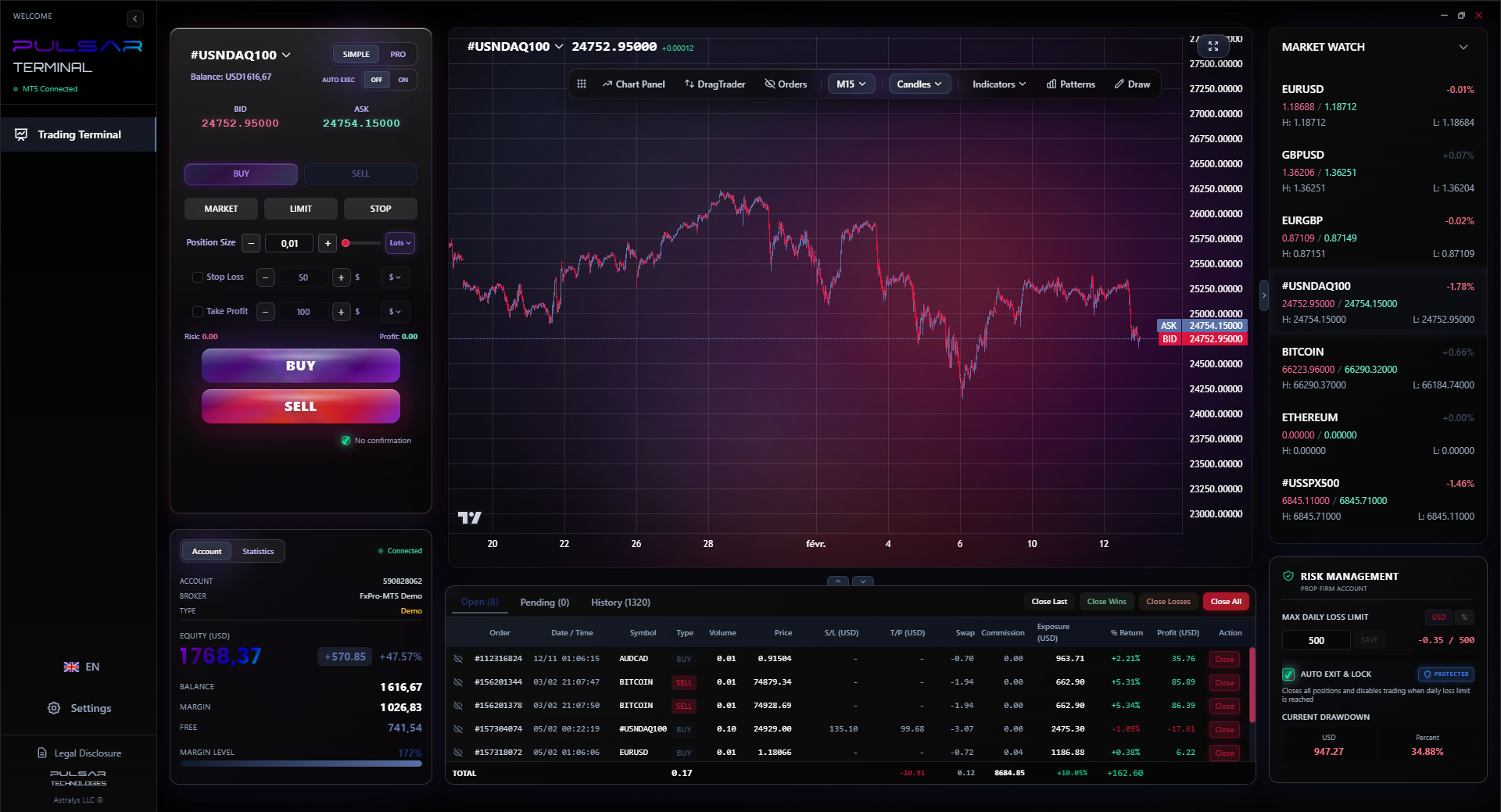
Managing complex trades with multiple take-profit levels and trailing stops is a headache on vanilla MT5, which is why tools like Pulsar Terminal that automate this directly on your charts are a game-saver.
Pulsar Terminal
Универсальный инструмент для MT5: drag-and-drop ордера, мульти-TP/SL, трейлинг-стоп, грид-трейдинг, Volume Profile и защита для проп-фирм. Используется 1000+ трейдерами ежедневно.
Here's what I do, and what you should do, before opening an account.
- Define Your Needs: Are you a scalping fiend who needs 0.0 spreads? Or a long-term position trader where spreads matter less? This decides the 'local vs. international' question.
- Check Regulation: FSCA register for locals. For internationals, verify their primary license (ASIC, FCA, CySEC) on the regulator's own website. Don't just trust the broker's homepage.
- Audit the Costs: Open a demo account. Look at the live spreads on the pairs you'll trade (EUR/USD, XAU/USD) during your trading hours. Find the commission schedule and the fee schedule. Calculate the cost of a typical trade for you.
- Test the Platform: Use the demo. Is it stable? Can you place orders quickly? Does it have the tools you need? Try placing a complex order with a stop-loss and multiple take-profit levels.
- Contact Support: Ask a specific question via live chat or email. How long do they take to respond? Is the answer helpful? This is a preview of your experience when you really need help.
- Start Small: Once you choose, deposit the minimum amount. Place a few real trades to test execution, deposits, and withdrawals. Do not go all in immediately.
Following this process saved me from signing up with a broker that had great marketing but execution speeds that were 500ms slower than their competitors - a death sentence for my strategy at the time.
💡 Совет Уинстона
If a broker's support can't explain their own fee structure in plain English, you shouldn't trust them with your money.
“Anyone offering you 500:1 use is not bound by our rules, and that's a danger sign.”
Let me save you some pain and money.
- Chasing Bonuses: A 100% deposit bonus is a trap. It always comes with impossible withdrawal conditions. Your focus should be on low costs and good execution, not 'free' money.
- Ignoring the 'Small Print' on use: That 30:1 FSCA cap is there for a reason. Trading at 500:1 might seem exciting, but it massively increases your risk of a margin call. I blew up a small account in my early days because I didn't respect use.
- Assuming All ECN/STP Brokers Are the Same: These models promise direct market access. The reality is that their liquidity providers and how they route orders make a huge difference. One broker's 'ECN' can be far superior to another's.
- Not Having a Backup: What if your broker's platform goes down during a major news event? You need a plan. For me, that means having a second broker with some capital ready, or at least knowing how to place orders over the phone.

Pro Tip: Your first withdrawal request is the ultimate test of a broker. If it's smooth, timely, and the fees are as advertised, you've probably found a decent one. If it's a nightmare of delays and unexpected charges, get your money out and leave.
FAQ
Q1Is forex trading legal and safe in South Africa?
Yes, it's legal and regulated by the FSCA. 'Safe' depends on you. Using an FSCA-regulated broker provides a layer of protection for your funds and a local recourse for disputes. Trading itself is high-risk, so safety comes from your knowledge, risk management, and a reputable broker.
Q2Can I use international brokers like IG or Forex.com?
You can, but they are not regulated by the FSCA. They operate under their home country's regulations (like the UK's FCA). This means you forfeit local regulatory protection. It also makes deposits and withdrawals in ZAR more expensive and slower.
Q3What is the minimum deposit to start trading forex in South Africa?
It varies wildly. Some local brokers let you start with R500 or less. International brokers often have minimums of $100 (roughly R1800) or more for standard accounts. Remember, the minimum deposit is not a suggestion for how much you should trade with. Start with an amount you can afford to lose completely while you learn.
Q4How are my forex trading profits taxed?
SARS treats your net profits (profits minus losses and allowable expenses) as ordinary taxable income. You must declare it in your annual tax return. Keep careful records of all trades, deposits, withdrawals, and any related expenses (like data fees, software subscriptions).
Q5Why can't I trade USD/ZAR to speculate on the Rand?
This is a specific FSCA rule to protect the South African currency. South African residents are prohibited from speculative trading against the ZAR on margin. You can trade the pair for legitimate hedging purposes (e.g., a business), but not for pure speculation on an online retail platform.
Q6What's more important: low spreads or FSCA regulation?
For beginners, FSCA regulation is more important. The safety of your capital is paramount. As you gain experience and your strategy becomes dependent on ultra-low costs (like scalping), you might then consider a reputable international broker with tight spreads, fully accepting the regulatory trade-off.
Урок проф. Уинстона
Ключевые выводы:
- ✓Always verify FSCA registration on the official public register.
- ✓Calculate the full cost per trade: spread + commission + potential conversion fees.
- ✓Never trade USD/ZAR for speculation - it's against FSCA rules.
- ✓International brokers mean foreign regulation and costly ZAR withdrawals.
- ✓Start with a demo, then a minimum deposit, before going all-in.
Насколько полезна эта статья?
Нажмите на звезду
Еженедельные торговые инсайты
Бесплатный еженедельный анализ и стратегии. Без спама.
Об авторе
David van der Merwe
Трейдер развивающихся рынков
Трейдер из Йоханнесбурга с 11-летним опытом работы с валютами развивающихся рынков. Специализируется на ZAR-парах, торговле под регулированием FSCA и анализе южноафриканского рынка.
Комментарии
Предупреждение о рисках
Торговля финансовыми инструментами сопряжена со значительным риском и может не подходить всем инвесторам. Прошлые результаты не гарантируют будущих доходов. Данный контент носит исключительно образовательный характер и не является инвестиционной рекомендацией. Всегда проводите собственное исследование перед торговлей.
Вам также может понравиться

Cara Trading Forex Sukses: 7 Prinsip dari Trader Profesional
Cara trading forex sukses dengan 7 prinsip trader pro: manajemen modal, disiplin, journal trading, backtest. Data nyata, bukan janji profit palsu.
Jam Trading Forex Terbaik untuk Trader Indonesia: Panduan Lengkap dengan Tabel Waktu
Panduan jam trading forex untuk trader Indonesia. Tabel 4 sesi dunia, jam emas 20:00-00:00, sesi mana yang harus dihindari. Data akurat + tips dari trader berpengalaman.
Top 5 Sàn Forex Uy Tín Nhất 2026: Review Jujur dari Trader Indonesia
Top 5 sàn forex uy tín 2026 untuk trader Indonesia. Review jujur: spread, deposit, withdraw, dukungan lokal. Exness, XM, IC Markets & lebih.
Скачать Pulsar Terminal
Все эти калькуляторы встроены в Pulsar Terminal с данными в реальном времени с вашего счёта MT5.
Скачать Pulsar Terminal