


I lost ₹18,500 in a single morning chasing a 'zero spread' setup on EUR/USD.

Rajesh Sharma
นักวิเคราะห์ฟอเร็กซ์อาวุโส ·  India
India
☕ 10 นาทีอ่าน
สิ่งที่คุณจะได้เรียนรู้:
- 1What 'Zero Spread' Actually Means (It's a Marketing Trick)
- 2The Indian Legal Reality: You Probably Can't Use One
- 3The Hidden Costs That Wipe Out Your 'Zero Spread' Advantage
- 4Who Actually Benefits from a Zero Spread Account? (Spoiler: It's Not Beginners)
- 5Broker Comparison: International vs. Indian Reality
- 6Practical Alternatives: How to Lower Costs Legally in India
- 7Major Red Flags in 'Zero Spread' Broker Offers
- 8Final Verdict: Should You Bother?

I lost ₹18,500 in a single morning chasing a 'zero spread' setup on EUR/USD. I was using an offshore broker, convinced I'd found the holy grail. The spread was indeed 0.0 pips, but they charged a $7 commission per lot. My scalping strategy, which worked in backtests with 'average' spreads, got slaughtered by slippage and that hidden fee. I was so focused on the spread number I forgot to calculate my actual cost per trade. Let me save you that tuition fee.
When a broker advertises a 0 spread forex broker account, they're showing you the tightest possible quote on their most liquid pair, usually EUR/USD, during the London-New York overlap. It's the broker equivalent of a car dealership advertising a base model price you can never actually get.
In reality, you're looking at a Raw Spread or ECN account model. The broker passes the interbank spread directly to you (which can indeed hit 0.0 pips), but they add a separate commission on every trade to make their money. You haven't eliminated cost, you've just changed its name.
Let's break down the math, because this is where most traders get blindsided.

Example: The Real Cost of a 'Zero' Trade
- Broker A (Standard Account): EUR/USD spread = 1.2 pips. Commission = $0.
- Broker B (Zero Spread Account): EUR/USD spread = 0.0 pips. Commission = $7 per standard lot (round turn).
- For a 1-lot (100,000 unit) trade:
- Broker A cost: 1.2 pips * $10 per pip = $12.
- Broker B cost: $7 commission + (0.0 pips * $10) = $7. In this case, Broker B is cheaper. But if the 'zero' account's spread widens to 0.5 pips during news, your cost is now $7 + $5 = $12. It's dynamic, not fixed.
The promise is transparency, but it adds a variable you must constantly monitor. I learned this the hard way during a volatile session where my 'zero' spread ballooned to 2.1 pips on GBP/JPY for a few seconds, while the commission remained. My position size calculator didn't save me from that surprise.

💡 เคล็ดลับจาก Winston
A 'zero' on your screen doesn't mean zero cost. It just means the cost moved to a different line on your statement. Always add the commission back in pips to see your true effective spread.
Here's the uncomfortable truth most 'gurus' won't tell you. If you're a retail trader based in India, seeking a true international 0 spread forex broker for pairs like EUR/USD or GBP/JPY is not just risky, it's illegal.
The Reserve Bank of India (RBI) and SEBI have clear rules under the Foreign Exchange Management Act (FEMA). You are only allowed to trade currency derivatives (futures and options) on INR pairs - like USD/INR, EUR/INR, GBP/INR - through SEBI-regulated brokers on Indian exchanges (NSE, BSE).
Using an offshore broker like Exness, IC Markets, or Pepperstone to trade major forex pairs violates FEMA. The RBI has explicitly stated you cannot use the Liberalised Remittance Scheme (LRS) for speculative forex trading abroad. Consequences can include penalties, account freezing, and tax complications.
Your Legal Broker Options in India
Your choices for low-cost currency trading are limited to the Indian derivatives market. Brokers like Zerodha, Upstox, and Angel One provide access. They don't offer 'zero spread' in the forex sense; you pay brokerage fees, exchange charges, and GST. The liquidity and trading hours are also completely different from the 24/5 forex market.

Warning: Any international broker actively marketing 'zero spread' accounts to Indian residents for trading non-INR pairs is operating in a regulatory grey area at best. Your funds may not have the protection you think. I've seen traders get their withdrawal requests 'under review' for weeks when using such brokers from India.
“The promise of a zero spread is transparency, but it adds a variable you must constantly monitor.”
Assuming for a moment the legal barriers weren't there, chasing a zero spread is still a rookie mistake if you ignore these other costs. I made it. Don't be me.
1. Slippage: This is the killer. A 0 spread means nothing if your market order gets filled 3 pips away from where you clicked. During news events or low liquidity (Asian session for EUR pairs), slippage on a 'zero' account can be brutal. My worst was a 4.2-pip slippage on a USD/JPY news trade. That's ₹3,360 gone on a single lot before the market even moved my way.
2. Commission Structure: Is it per side or round turn? Does it scale with lot size? A $7 round turn is common, but some brokers charge $5 per side, making it $10 total. Always calculate the commission in pips. A $7 commission on a standard EUR/USD lot is equivalent to 0.7 pips. Your 'zero' spread account has a minimum effective spread of 0.7 pips.
3. Swap/Rollover Rates: If you hold positions overnight, the swap fee or credit can be significant. Some brokers offering tight spreads have less competitive swap rates. For a swing trading strategy, this can eat your profits over time.
4. Deposit/Withdrawal Fees: Funding an international account from India often involves currency conversion fees (INR to USD) and sometimes wire transfer charges. Withdrawing profits back adds another layer of cost and scrutiny.
The bottom line: Your total trade cost = Spread + Commission + Slippage + Swap + Funding Fees. Obsessing over just the first one is a sure path to the poorhouse.
💡 เคล็ดลับจาก Winston
In India, the most expensive 'cost' you can incur isn't a wide spread. It's a penalty from the RBI for breaking FEMA rules. Don't be clever with regulations; they always win.
These accounts have a specific purpose. They are tools, not magic wands.
You might benefit IF you are:
- A high-volume scalper executing 50+ trades per day, where every 0.1 pip saved compounds. (But ask yourself, are you really that good? Most aren't).
- Trading very large position sizes where the fixed commission becomes a smaller percentage of your trade cost compared to a wide spread.
- Using automated strategies (Expert Advisors) that are hyper-sensitive to spread variations and are coded to factor in the commission.
You should AVOID a zero spread account if you:
- Are a beginner or intermediate trader.
- Make fewer than 10 trades a day.
- Trade during volatile periods (news) where slippage dominates.
- Have a small account size where the fixed commission represents a significant chunk of your risk per trade.
I switched back to a standard commission-free account for two years after my initial failure. My average cost per trade was more predictable, which helped my psychology. I only reconsidered a raw spread model when my strategy evolved into a high-frequency scalping strategy on the 1-minute chart, and even then, I paper-traded it for months first.
“Your total trade cost = Spread + Commission + Slippage + Swap + Funding Fees. Obsessing over just the first one is a sure path to the poorhouse.”
Let's look at this with clear eyes. The table below contrasts the theoretical international model with the actual Indian legal model. It's not about which is better, it's about understanding the two different worlds.
| Feature | International 'Zero Spread' Broker (e.g., IC Markets, Pepperstone) | SEBI-Regulated Indian Broker (e.g., Zerodha, Upstox) |
|---|---|---|
| Legal Status for INR Pairs | Not permitted for Indian retail traders | Fully legal and regulated |
| Instruments | Global Forex (EUR/USD, Gold, Indices) | USD/INR, EUR/INR, GBP/INR Futures & Options |
| Spread on USD/INR | N/A (Can't legally offer) | Variable, based on NSE liquidity |
| Primary Cost | Commission + Variable Spread | Brokerage Fee + Exchange Charges + GST |
| use | Can be very high (e.g., 1:500) | Capped by SEBI (e.g., 1:50 for currencies) |
| Key Risk | Regulatory violation, fund safety | Market risk, lower liquidity vs. global forex |
Notice something? The international brokers often praised for low spreads (IC Markets review, Pepperstone review) are not a legal option for your goal of trading EUR/USD from India. Your real choice is between the Indian derivatives market or breaking the law. That's not a choice at all for a serious trader thinking long-term.

Pro Tip: If you're determined to trade global forex, the only legitimate path for an Indian resident is through a proprietary trading firm's challenge. Some international prop firms allow global traders. You pass their evaluation (often using their capital on a simulated account), and then trade their capital for a profit split. Your personal capital never leaves India. It's complex, but it's within the rules.

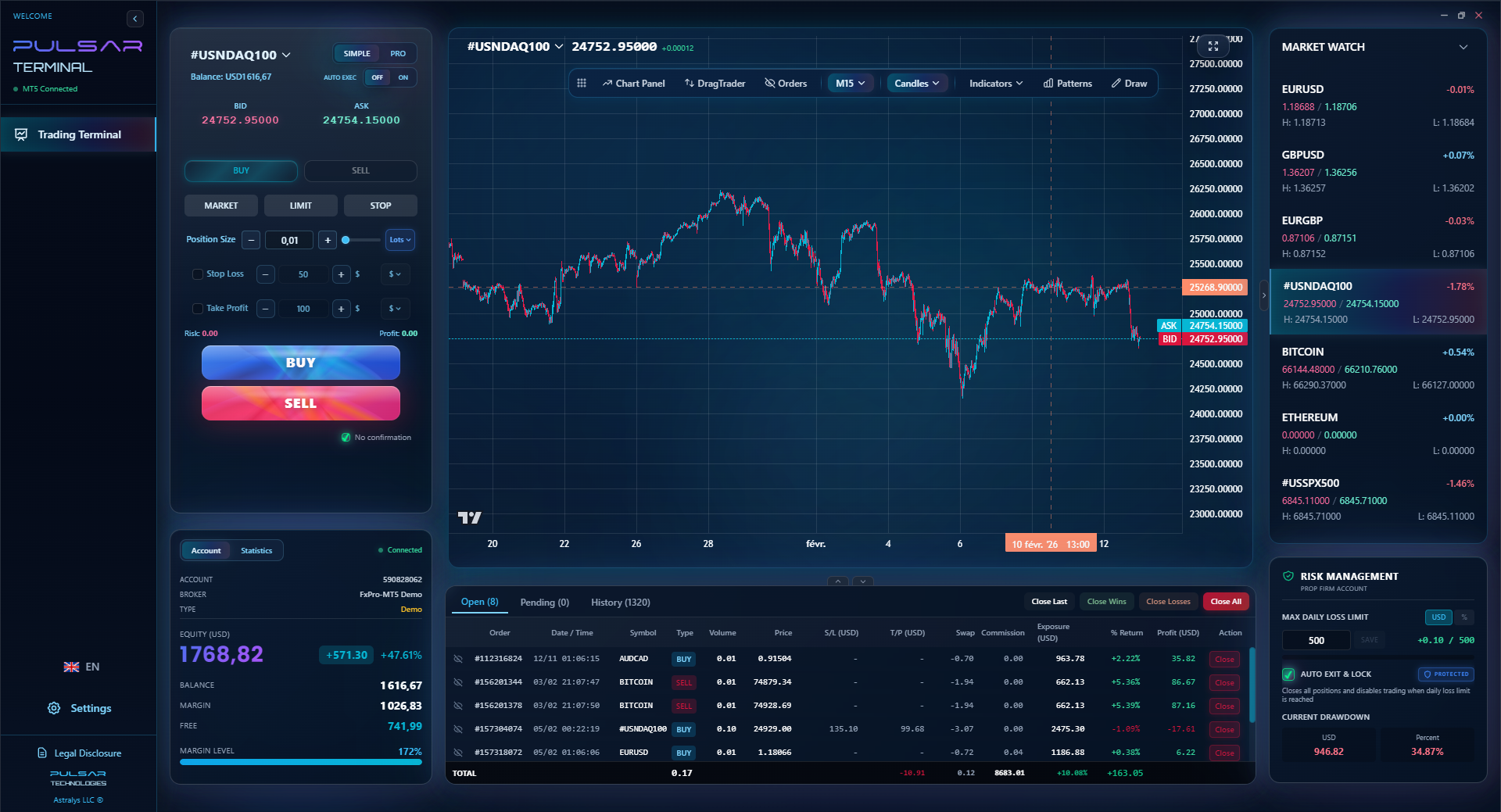
Managing multiple take-profit levels and partial closures on a volatile USD/INR futures trade is complex, but tools like Pulsar Terminal simplify it with drag-and-drop order management directly on your MT5 platform.
Pulsar Terminal
เครื่องมือ MT5 ครบวงจร: ลากวางคำสั่ง, multi-TP/SL, trailing stop, grid trading, Volume Profile และการป้องกัน prop firm ใช้งานโดยเทรดเดอร์กว่า 1,000 คนทุกวัน
Since you can't chase global zero spreads, focus on what you can control within the legal framework.
1. Optimize Your INR Derivatives Trading:
- Choose Your Broker Wisely: Compare brokerage plans. Some offer flat fees per trade regardless of size, which benefits larger positions. Others have a percentage-based model.
- Trade in Peak Liquidity: The USD/INR futures market is most liquid during Indian market hours (9:00 AM - 5:00 PM). Spreads (the difference between bid/ask) will be tightest then.
- Understand All Fees: Know the breakdown: Brokerage, Exchange Transaction Charge, SEBI Turnover Fee, GST (18% on brokerage). Use a broker's calculator before you trade.
2. Improve Your Trading, Not Just Your Costs:
- Master Entry/Exit: A well-timed limit order in a liquid market does more for your bottom line than shaving 0.1 pip off a spread. Work on your precision.
- Increase Your Win Rate & Risk/Reward: This is the biggest lever you have. Moving from a 1:1 to a 1:2 risk/reward ratio doubles the 'spread' you can afford to pay and still be profitable. I spent a year refining my use of the RSI indicator and MACD indicator for confirmation, which helped my timing far more than any account switch.
- Size Appropriately: Don't over-use. A margin call is the ultimate 'cost'. Use sensible position sizing so market noise doesn't knock you out.
Thinking about cost is smart. Letting it dominate your strategy is foolish. The goal is net profitability, not minimal spread.
💡 เคล็ดลับจาก Winston
If you can't be consistently profitable paying a 1-pip spread, you won't be profitable paying 0.3. Fix your strategy first, then worry about optimizing fees.
“Your constraints aren't holding you back. Your focus on them is.”
If you're still looking at international brokers despite the warnings, know these scams. I've had students get caught in them.
- 'Absolutely No Commission' Guarantees: If they promise zero spread AND zero commission, how do they make money? Through massive hidden markups, requotes, or worse, trading against you. It's a mathematical impossibility for a legitimate business.
- Offshore Registration Only: The broker is registered in a remote island jurisdiction with vague financial authority oversight. Your legal recourse is near zero.
- Aggressive Marketing to Indians: Emails or ads specifically targeting Indian traders with promises of 'unlimited use' and 'zero cost' on EUR/USD. This is a direct attempt to exploit regulatory confusion.
- Difficulty Withdrawing Profits: The first test of any broker is taking money out. If they delay, ask for excessive documentation, or try to charge huge fees, you're in trouble. Small, test withdrawals are a must.
- No Demo Account for the 'Zero' Platform: They won't let you test the actual execution and slippage on their premium account. That's because it's often terrible.
A good broker, even an international one, is transparent about all costs. Read reviews like our XM review or Exness review with a critical eye for how they discuss commissions and execution. The best ones openly explain their pricing model.

For the vast majority of Indian traders, the hunt for a 0 spread forex broker is a dangerous distraction.
It leads you toward illegal activity, focuses your energy on the wrong metric (cost vs. edge), and exposes you to sophisticated marketing traps. The few hundred rupees you might save per trade is meaningless if your strategy isn't profitable, or if your capital gets stuck in an offshore regulatory black hole.
Your path is clearer and harder: become a better trader within the system that exists. Master the USD/INR futures contract. Understand its nuances, its liquidity patterns, its drivers (which are different from EUR/USD). Build a real edge there. The pip definition might be different, the spread definition might be wider at times, but it's a real market where you can legally build wealth.
I wasted two years and significant capital chasing the illusion of 'free' trading on global platforms. My biggest profit years came after I accepted the constraints, focused on my craft within the Indian market, and stopped looking for loopholes. Your constraints aren't holding you back. Your focus on them is.
FAQ
Q1Is it illegal for an Indian to open an account with a foreign forex broker like IC Markets?
Yes, for the purpose of trading forex (like EUR/USD), it is illegal under FEMA for an Indian retail trader. Using the Liberalised Remittance Scheme (LRS) to fund such an account for speculative trading is explicitly prohibited by the RBI. You can open an account for other assets like international stocks, but not for forex speculation.
Q2What is the cheapest way to trade currencies legally in India?
Trade USD/INR or other INR-pair futures/options through a discount broker like Zerodha or Upstox on the NSE. Compare their brokerage plans - often a flat fee of ₹20 per executed order - and be aware of all exchange and statutory charges. The 'cost' is transparent and predictable, which is more valuable than a theoretically low spread.
Q3Do any Indian brokers offer true zero-spread accounts?
No. The concept of a 'zero spread' ECN account doesn't exist on Indian exchanges for currency derivatives. The market maker model and exchange structure are different. You pay brokerage and fees, not a spread+commission model. Focus on finding a broker with low, transparent brokerage fees instead.
Q4Can I use a VPN to hide my location and trade with an international broker?
This is a terrible idea. You would be violating the broker's Terms of Service (which require you to declare your correct residency) and Indian law. The broker will eventually ask for proof of address and ID for verification or withdrawal. If you provide fake documents, that's fraud. If you provide real Indian documents, your account will be closed. Either way, you risk losing all your money.
Q5How do I calculate if a zero-spread account is cheaper than a standard account?
Convert everything to a cost per standard lot. For the zero account: (Spread in pips x $10) + Commission. For the standard account: (Spread in pips x $10). You must use the typical spread you experience, not the advertised minimum. For example, if the zero account's typical spread is 0.2 pips with a $7 commission, cost = (0.2 x 10) + 7 = $9. If the standard account's typical spread is 1.1 pips, cost = $11. The zero account is cheaper, but only by $2, and only if you avoid slippage.
Q6What is more important than low spreads for a profitable trader?
Execution quality (minimal slippage), strategy edge (win rate & risk/reward), rock-solid psychology, and strict risk management. A trader with a 1.5 pip average cost and a proven edge will crush a trader with a 0.5 pip cost who chases markets and overtrades. Your trading plan is infinitely more important than your spread.
บทเรียนจาก Prof. Winston
สรุปสาระสำคัญ:
- ✓'Zero spread' is a pricing model, not free trading.
- ✓Trading global forex from India via offshore brokers is illegal under FEMA.
- ✓Calculate effective cost: spread + commission + slippage.
- ✓High-frequency scalpers benefit; beginners get slaughtered.
- ✓Legal Indian USD/INR futures have different costs & rules.
บทความนี้มีประโยชน์แค่ไหน?
คลิกดาวเพื่อให้คะแนน
ข้อมูลเชิงลึกการเทรดรายสัปดาห์
การวิเคราะห์และกลยุทธ์รายสัปดาห์ฟรี ไม่มีสแปม
เกี่ยวกับผู้เขียน
Rajesh Sharma
นักวิเคราะห์ฟอเร็กซ์อาวุโส
ซื้อขายในตลาดอินเดียและเอเชียใต้มากกว่า 10 ปี เริ่มต้นจากอนุพันธ์สกุลเงินของ NSE ก่อนเข้าสู่ตลาดฟอเร็กซ์สากล เชี่ยวชาญคู่ USD/INR และคู่สกุลเงินตลาดเกิดใหม่
ความคิดเห็น
คำเตือนความเสี่ยง
การซื้อขายตราสารทางการเงินมีความเสี่ยงสูงและอาจไม่เหมาะสำหรับนักลงทุนทุกคน ผลการดำเนินงานในอดีตไม่ได้รับประกันผลลัพธ์ในอนาคต เนื้อหานี้มีวัตถุประสงค์เพื่อการศึกษาเท่านั้นและไม่ควรถือเป็นคำแนะนำในการลงทุน โปรดทำการวิจัยของคุณเองก่อนการซื้อขาย
คุณอาจชอบสิ่งนี้

Cara Trading Forex Sukses: 7 Prinsip dari Trader Profesional
Cara trading forex sukses dengan 7 prinsip trader pro: manajemen modal, disiplin, journal trading, backtest. Data nyata, bukan janji profit palsu.
Jam Trading Forex Terbaik untuk Trader Indonesia: Panduan Lengkap dengan Tabel Waktu
Panduan jam trading forex untuk trader Indonesia. Tabel 4 sesi dunia, jam emas 20:00-00:00, sesi mana yang harus dihindari. Data akurat + tips dari trader berpengalaman.
Top 5 Sàn Forex Uy Tín Nhất 2026: Review Jujur dari Trader Indonesia
Top 5 sàn forex uy tín 2026 untuk trader Indonesia. Review jujur: spread, deposit, withdraw, dukungan lokal. Exness, XM, IC Markets & lebih.
รับ Pulsar Terminal
เครื่องคำนวณทั้งหมดนี้ถูกสร้างไว้ใน Pulsar Terminal พร้อมข้อมูลเรียลไทม์จากบัญชี MT5 ของคุณ
รับ Pulsar Terminal