


I remember staring at my screen in 2014, watching a USD/NGN trade go completely against me.

Olumide Adeyemi
ผู้บุกเบิกการเทรดในแอฟริกาตะวันตก ·  Nigeria
☕ 14 นาทีอ่าน
สิ่งที่คุณจะได้เรียนรู้:
- 1What is Forex and How It Really Works
- 2Setting Up Shop: Accounts, Brokers & Regulations in Nigeria
- 3The Lingo: Pips, Lots, and That Double-Edged Sword Called use
- 4Analysis: How to Read the Market (Without the Voodoo)
- 5Executing Your First Trade: A Step-by-Step Walkthrough
- 6Common Pitfalls (And How I Fell Into Every One)
- 7Building a Sustainable Trading Plan (Your Business Blueprint)
- 8Next Steps and Continuous Learning
I remember staring at my screen in 2014, watching a USD/NGN trade go completely against me. I'd put N150,000 on a hunch, convinced the naira would strengthen. It didn't. The spread was wider than I'd calculated, my position was too big, and before I knew it, I was down N40,000. That loss, right here in Lagos, taught me more than any winning trade ever could. It wasn't about a fancy strategy; it was about not knowing the absolute basics. This guide is the a to z of forex trading I wish I'd had back then - no fluff, just the real foundation you need to build on, tailored for our market.
Forex, or foreign exchange, is simply the global marketplace for trading currencies. Think of it like the Bureau de Change on a planetary scale. You're buying one currency while selling another, always in pairs like EUR/USD or GBP/NGN. The price tells you how much of the second currency you need to buy one unit of the first.
It's a decentralized market, meaning there's no single physical location. It runs 24 hours a day, five days a week, through a network of banks, brokers, and traders. For us in Nigeria, this means you can trade when the London market opens (around 9 AM our time) or catch the US session in the evening. The main 'sessions' are Tokyo, London, and New York, and volatility often spikes when they overlap.

Warning: Many new traders think forex is a get-rich-quick scheme. It's not. It's a skill-based profession with a high risk of loss. The Central Bank of Nigeria (CBN) has issued warnings about unregulated platforms, so knowing who you're dealing with is step one.
The core mechanic is speculating on price movement. If you think the euro will strengthen against the US dollar, you buy (go long) EUR/USD. If you think it will weaken, you sell (go short). Your profit or loss is the difference between your entry and exit price, multiplied by your trade size. This is measured in pips, which is the smallest price move a pair can make. For most pairs, that's 0.0001. Understanding the pip definition is non-negotiable.
The Nigerian Angle
Trading pairs involving the Naira (like USD/NGN) can be tricky. Liquidity is often lower and spreads can be wide, especially on platforms that aren't primarily forex brokers. Many Nigerian traders focus on major pairs like EUR/USD or GBP/USD because they have tighter spreads and more predictable liquidity. Your capital is in naira, but you're trading dollar-based pairs, so you also need to be vaguely aware of USD/NGN movements as it affects your final profit and loss in your local currency.
This is where most people make their first big mistake. Choosing a broker isn't about who has the flashiest ads on Instagram. It's about safety, costs, and reliability. In Nigeria, you have two main paths: international brokers that accept Nigerian clients, and local platforms.
International brokers like Exness, IC Markets, and XM are popular for good reason. They are typically regulated by top-tier authorities (like CySEC in Cyprus or ASIC in Australia), offer strong platforms like MT4/MT5, and have competitive spreads. They accept deposits in naira via bank transfer and sometimes local debit cards, but your trading account will be in USD, EUR, or GBP.
Local platforms or fintech apps can be easier for funding, but you must do extreme due diligence. Check: Are they registered with the Securities and Exchange Commission (SEC) Nigeria? What is their execution model? I've seen platforms with massive hidden fees disguised as 'commission' or 'processing fees' that eat 2-3% of your capital before you even trade.
Here’s a quick comparison based on my experience and community feedback:
| Feature | International Broker (e.g., IC Markets) | Local Trading Platform |
|---|---|---|
| Regulation | Often overseas (ASIC, FCA, CySEC) | Possibly SEC Nigeria, varies widely |
| Minimum Deposit | Can be as low as $100 (≈₦140k) | Can be very low, like ₦5,000 |
| Spreads on EUR/USD | Tight, often from 0.0 - 1.0 pips | Usually much wider, 2-5 pips common |
| Funding/Ease | Bank transfer, card; may take hours | Instant bank transfer, USSD |
| Primary Risk | Exchange rate risk on deposits/withdrawals | Platform solvency, regulatory gaps |
You'll need to provide proof of identity (International Passport, National ID, or Driver's License) and proof of address (utility bill or bank statement) to open an account. This is standard KYC (Know Your Customer) practice globally. Start with a demo account. Please, I'm begging you. Practice for at least a month. Then, fund a live account with money you can afford to lose completely. Your first deposit shouldn't be your life savings; it should be your tuition fee.

💡 เคล็ดลับจาก Winston
Your first 50 trades are for data collection, not profit. Journal every detail - entry reason, emotional state, outcome. Patterns in your failures are your real teacher.
“Trading without a plan is like driving from Lagos to Abuja without a map, fuel, or a spare tire.”
Let's decode the jargon. A pip is your measuring stick. If EUR/USD moves from 1.1050 to 1.1051, that's a 1-pip move. A standard lot is 100,000 units of the base currency. That's too big for most individuals, so we have mini lots (10,000 units) and micro lots (1,000 units).
Now, use. This is the ultimate test of a trader's discipline. use allows you to control a large position with a small amount of capital. Your broker might offer 100:1, 200:1, or even 500:1. This means with ₦100,000 margin, you could control a ₦10,000,000 position (at 100:1).

Pro Tip: use magnifies both profits AND losses. I treat high use like a powerful car engine - useful for experts in specific conditions, but deadly in the wrong hands. Start with 10:1 or 20:1 maximum.
Here's a real example from a painful lesson. I once used 200:1 use on a GBP/USD trade. I put down $500 as margin to control a $100,000 position (one standard lot). The pair moved just 50 pips against me. At 50 pips x $10 per pip (for a standard lot), that was a $500 loss. My entire margin was wiped out in minutes - a margin call. That $500 was gone because I didn't respect the power of use and didn't set a proper stop-loss.
The spread is the broker's commission, the difference between the buy (ask) and sell (bid) price. A tight spread on EUR/USD might be 0.7 pips. A wide spread on an exotic pair could be 15 pips. You are "down" the spread amount the moment you enter a trade. Always check typical spreads for your chosen pair on your broker's platform before trading. You can learn more about this cost in our guide on the spread definition.
Your trade size is your most important risk control tool. Never risk more than 1-2% of your account on a single trade. Use a position size calculator every single time. If you have a ₦500,000 account, 1% is ₦5,000. If your stop-loss is 30 pips away, you calculate your lot size so that a 30-pip loss equals ₦5,000. This math saves accounts.
There are two main schools of thought: technical analysis and fundamental analysis. You need a bit of both.
Technical Analysis is about studying price charts and historical data to identify patterns and potential future movements. You're looking for trends, support/resistance levels, and using indicators. I'm a chart guy at heart. I spent years thinking more indicators meant more smarts. It doesn't. Now I use maybe two or three.
The RSI indicator (Relative Strength Index) helps spot overbought or oversold conditions. The MACD indicator can help identify trend changes and momentum. But the chart itself - the raw price action - is king. Learn to spot higher highs and higher lows for an uptrend, and the opposite for a downtrend. Draw horizontal lines where the price has bounced or reversed multiple times; that's support or resistance.
Fundamental Analysis looks at economic factors that affect a currency's value: interest rates (set by the US Federal Reserve, Bank of England, or our own CBN), inflation reports, employment data, and political stability. For a Nigerian trader, US Non-Farm Payrolls data or Federal Reserve announcements can cause massive volatility in USD pairs. You need an economic calendar.

Example: In 2022, when the US Fed started aggressively hiking rates, the US dollar strengthened massively against almost everything. A trader using fundamental analysis would have had a strong bias to look for opportunities to buy USD pairs. That was a clearer, fundamentals-driven trend.
The best approach is a blend. Use fundamentals to get your overall bias (is the USD strong or weak this quarter?). Then use technicals to find precise entry and exit points. For instance, if the USD is fundamentally strong, wait for EUR/USD to rally up to a key technical resistance level on the chart before looking to sell. This confluence increases your odds.
Don't forget sentiment. Sometimes the market moves on pure fear or greed. Keeping a trading journal where you note not just your trades, but the overall market mood, is incredibly revealing over time.
“Your first deposit shouldn't be your life savings; it should be your tuition fee.”
Let's make this concrete. Imagine it's a Tuesday afternoon in Lagos, and you've done your analysis. You think EUR/USD is likely to rise.
- Analysis & Plan: You see EUR/USD has bounced off a support level at 1.0750 twice before. The RSI indicator is coming out of oversold territory. Your plan: Buy if price approaches 1.0760 again, with a stop-loss at 1.0730 (30 pips risk). Your take-profit target is at the previous resistance, 1.0830 (70 pips potential reward). That's a risk-to-reward ratio of about 1:2.3, which is decent.
- Position Sizing: Your account balance is $2,000 (≈₦2.8m). You decide to risk 1%, which is $20. With a 30-pip stop-loss, how much can you trade? Each pip movement on a micro lot (1,000 units) is worth $0.10. To risk $20 over 30 pips, you'd trade: $20 / (30 pips * $0.10) = 6.66 micro lots. Round down to 6 micro lots. This is where that position size calculator is your best friend.
- Placing the Order: On your MT4/MT5 platform, right-click on the EUR/USD chart. Select 'New Order'. A window pops up. Set volume to 0.06 (this represents 6 micro lots). Set your stop-loss (SL) to 1.0730 and your take-profit (TP) to 1.0830. Click 'Buy by Market'. The trade is now live.
- Management & Exit: Now you wait. The trade goes in your favor, moving up to 1.0800. You could do nothing and let it hit your TP. Or, you could move your stop-loss to breakeven (1.0760) to eliminate risk. This is where a tool for swing trading management comes in handy. Never move your stop-loss further away to avoid a loss. That's how small losses become account-killers.
- The Outcome: Price hits your take-profit at 1.0830. The trade closes automatically. Your profit: (1.0830 - 1.0760) = 70 pips. 70 pips x $0.10 per pip per micro lot x 6 lots = $42 profit. You risked $20 to make $42.
That's the ideal scenario. Sometimes price will hit your stop-loss. That's okay. A 1% loss is a cost of doing business. The key is consistency in your process, not winning every single trade.
💡 เคล็ดลับจาก Winston
If you can't explain your trade setup in one simple sentence ('price bounced from support with RSI oversold'), it's too complicated. Complexity is the enemy of execution.
Let me save you some time and money by listing my greatest hits of failure.
Overtrading: This was my biggest vice. After a loss, I'd jump right back in to 'make it back.' After a win, I'd feel invincible and take three more low-quality trades. Both destroyed my equity. Set a max number of trades per day (e.g., 2 or 3) and stick to it.
Ignoring the Spread: Trading right before a major news event or during low liquidity (like Friday night). The spread can widen from 1 pip to 10 pips instantly. You enter a trade and you're already down a huge amount. I learned this trading GBP/JPY on a Sunday open. Check the economic calendar.
No Stop-Loss: The classic. 'It'll come back,' I'd tell myself. In 2016, I watched a USD/CAD trade go 200 pips against me because I didn't have a stop. I was frozen. That loss took months to recover from. Always, always use a stop-loss. It's not a suggestion; it's a seatbelt.
Chasing the Market: Seeing a pair rocket up 100 pips and FOMO-ing (Fear Of Missing Out) in at the top, just in time for the pullback. I've bought the exact high and sold the exact low more times than I care to admit. Have a plan and wait for the market to come to your entry level. If you miss a move, there will be another. The market isn't going anywhere.
Trading Based on Tips: Someone in a WhatsApp group says 'GU buy now!' and you do it without looking at the chart. You are giving your hard-earned naira to a stranger's guess. Be your own analyst. Trust your own process, even if it's simple.
These mistakes are universal, but they feel very personal when your naira is on the line. The only cure is a written trading plan that explicitly forbids these behaviors, and the discipline to follow it.
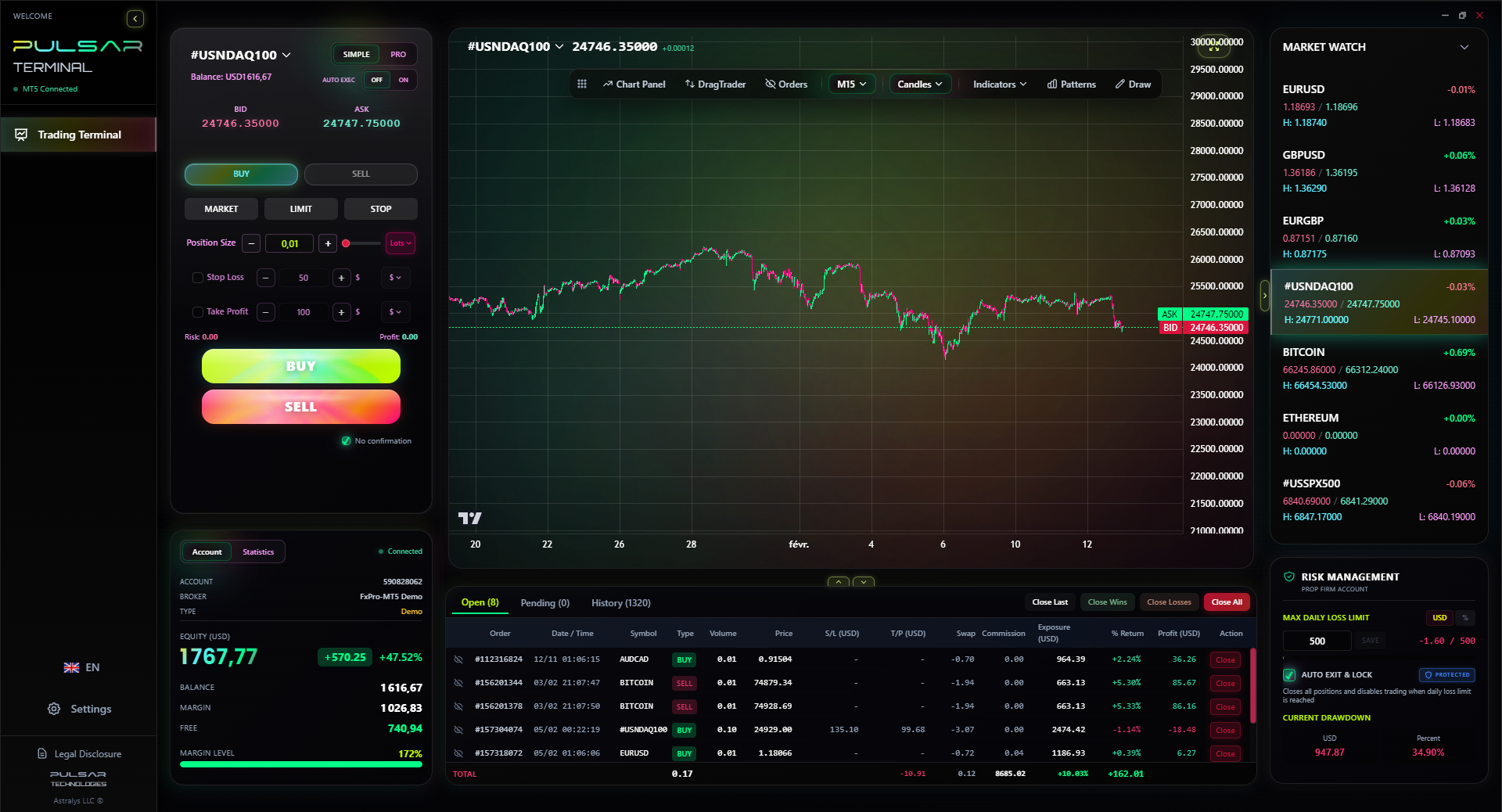
When a trade moves in your favor, managing it without emotion is critical; Pulsar Terminal lets you set multi-level take-profits and trailing stops automatically, so you can lock in gains systematically.
Pulsar Terminal
เครื่องมือ MT5 ครบวงจร: ลากวางคำสั่ง, multi-TP/SL, trailing stop, grid trading, Volume Profile และการป้องกัน prop firm ใช้งานโดยเทรดเดอร์กว่า 1,000 คนทุกวัน
“The goal is not to be right on every trade. The goal is to execute your plan perfectly, trade after trade.”
Trading without a plan is like driving from Lagos to Abuja without a map, fuel, or a spare tire. Your trading plan is your business blueprint. It doesn't need to be 50 pages. Mine fits on one page.
1. Your Trading Style: Are you a scalping strategy trader (in and out in minutes), a day trader (close all positions by day's end), or a swing trading trader (hold for days or weeks)? Your style dictates your charts (1-minute for scalping, 4-hour for swing), your profit targets, and your time commitment. I'm a swing trader. It suits my personality and lets me have a life.
2. Your Edge: What is your specific, repeatable setup? For example: 'I only buy EUR/USD on a pullback to the 50-day moving average during an overall uptrend, when the RSI is above 30 and showing bullish divergence.' That's specific and testable.
3. Risk Management Rules: This is the most important section.
- Maximum risk per trade: 1% of account balance.
- Maximum risk per day: 3%.
- Maximum risk per week: 6%.
- Stop-loss placed immediately on entry.
- Minimum risk-to-reward ratio: 1:1.5.
4. Entry & Exit Criteria: The exact conditions that must be met to enter a trade (e.g., candle close above resistance, MACD crossover). Your rules for moving stop-loss to breakeven, taking partial profits, etc.
5. Journaling & Review: You will review your trades weekly. What went right? What went wrong? Was it your analysis or your psychology? This feedback loop is how you improve.
Stick to this plan for at least 100 trades before you even think about changing it. The goal is not to be right on every trade. The goal is to execute your plan perfectly, trade after trade. Profits are a byproduct of consistency.
Pro Tip: Print your plan. Sign it. Keep it next to your screen. When you feel the urge to deviate - to revenge trade or chase - read it aloud. It's a contract with your future self.
💡 เคล็ดลับจาก Winston
The market's job is to make you feel wrong. A good trade can lose money. Judge your trades by your process, not the P&L. A well-managed loss is a better trade than a reckless win.
You now have the a to z of forex trading foundation. But this is just the beginning. Trading is a journey of continuous learning and adaptation.
Start in Simulation: Open a demo account that mirrors live conditions. Trade your plan for 2-3 months. Your goal is not to make fake money, but to achieve a consistent, slow equity curve and to make every mistake possible in a risk-free environment.
Go Live Small: When you fund your first live account, make it small. An amount that, if lost, would be disappointing but not life-altering. The psychological pressure is completely different from demo trading. You need to learn to manage that pressure with small stakes first.
Deepen Your Knowledge: Pick one area at a time to study in depth. Maybe it's price action patterns one month, then correlation between commodities and currencies the next. Our guides on specific instruments like EUR/USD or XAU/USD (Gold) are good places to start.
Find a Community, Not a Guru: Be wary of anyone selling 'secret signals' or a '100% win rate system.' Find a community of serious traders where you can discuss ideas and share charts. Learning is collaborative.
Finally, manage your expectations. The legendary trader Paul Tudor Jones once said his win rate was about 60%. The best in the world are wrong 4 times out of 10. Your job is to keep losses small and let winners run. If you can master risk management and your own psychology, you'll be ahead of 90% of those who try this. Welcome to the marathon. Pace yourself.
FAQ
Q1Is forex trading legal in Nigeria?
Yes, forex trading is legal in Nigeria. Individuals can trade through licensed international brokers or local platforms registered with the Securities and Exchange Commission (SEC) Nigeria. However, the Central Bank of Nigeria (CBN) restricts banks from facilitating payments to unlicensed platforms, so choosing a reputable, well-regulated broker is crucial for smooth deposits and withdrawals.
Q2How much money do I need to start forex trading in Nigeria?
You can start with a very small amount. Some international brokers have minimum deposits as low as $50-$100 (approx. ₦70,000 - ₦140,000). However, I strongly advise starting with a larger 'tuition' amount, like ₦500,000, to properly practice position sizing and risk management without being wiped out by a single trade. More importantly, only use risk capital - money you can afford to lose completely.
Q3What is the best time to trade forex in Nigeria?
The most volatile and liquid sessions for a Nigerian trader are the London session (9:00 AM - 5:00 PM WAT) and the overlap with the US session (starting around 2:00 PM WAT). This is when the majority of price movement happens on major pairs like EUR/USD and GBP/USD. Avoid trading during very thin liquidity periods, like the Asian session late at night or just before/after major holiday weekends.
Q4Can I trade the Nigerian Naira (NGN) in forex?
Directly trading NGN pairs (like USD/NGN) on major international retail forex platforms is uncommon. These pairs often have very wide spreads and low liquidity for retail traders. Most Nigerian traders focus on major currency pairs (EUR/USD, GBP/USD) or crosses, where spreads are tighter. Your profit/loss in these pairs is in USD or another currency, which is then converted to Naira when you withdraw.
Q5How do I withdraw my profits from forex trading in Nigeria?
Withdrawal is typically the reverse of your deposit method. If you funded your international broker account via a naira bank transfer, you can usually request a withdrawal back to the same bank account in naira. The broker converts your trading profits (in USD, for example) to naira at the prevailing exchange rate and sends it. Processing can take 1-5 business days. Always check your broker's specific withdrawal policy and fees.
Q6What's the difference between a demo account and a live account?
A demo account uses virtual money to simulate trading in real-time market conditions. It's for learning the platform and testing strategies without risk. A live account uses your real money. The key difference is psychology - the fear and greed you feel with real capital can lead to mistakes you'd never make on demo. That's why moving from demo to live should be done with a very small amount first.
Q7How long does it take to become a profitable forex trader?
There's no fixed timeline, but treat it like learning a skilled profession. A realistic expectation is 1-2 years of dedicated study, practice (on demo and small live accounts), and consistent journaling before achieving consistent profitability. Most people give up within the first few months after losses. The key is to focus on the learning process, not the money, in the beginning.
บทเรียนจาก Prof. Winston
สรุปสาระสำคัญ:
- ✓Risk only 1% of your account per trade.
- ✓Always use a stop-loss. No exceptions.
- ✓Master position sizing before any strategy.
- ✓Demo trade for 2-3 months minimum.
- ✓A 1:1.5 risk-reward ratio is a solid baseline.
บทความนี้มีประโยชน์แค่ไหน?
คลิกดาวเพื่อให้คะแนน
ข้อมูลเชิงลึกการเทรดรายสัปดาห์
การวิเคราะห์และกลยุทธ์รายสัปดาห์ฟรี ไม่มีสแปม
เกี่ยวกับผู้เขียน
Olumide Adeyemi
ผู้บุกเบิกการเทรดในแอฟริกาตะวันตก
หนึ่งในนักการศึกษาฟอเร็กซ์ที่กระตือรือร้นที่สุดของไนจีเรีย 8 ปีประสบการณ์เทรดจากลากอส เชี่ยวชาญกลยุทธ์ทุนต่ำและความท้าทาย prop firm สำหรับเทรดเดอร์ในแอฟริกา
ความคิดเห็น
คำเตือนความเสี่ยง
การซื้อขายตราสารทางการเงินมีความเสี่ยงสูงและอาจไม่เหมาะสำหรับนักลงทุนทุกคน ผลการดำเนินงานในอดีตไม่ได้รับประกันผลลัพธ์ในอนาคต เนื้อหานี้มีวัตถุประสงค์เพื่อการศึกษาเท่านั้นและไม่ควรถือเป็นคำแนะนำในการลงทุน โปรดทำการวิจัยของคุณเองก่อนการซื้อขาย
คุณอาจชอบสิ่งนี้

Cara Trading Forex Sukses: 7 Prinsip dari Trader Profesional
Cara trading forex sukses dengan 7 prinsip trader pro: manajemen modal, disiplin, journal trading, backtest. Data nyata, bukan janji profit palsu.
Jam Trading Forex Terbaik untuk Trader Indonesia: Panduan Lengkap dengan Tabel Waktu
Panduan jam trading forex untuk trader Indonesia. Tabel 4 sesi dunia, jam emas 20:00-00:00, sesi mana yang harus dihindari. Data akurat + tips dari trader berpengalaman.
Top 5 Sàn Forex Uy Tín Nhất 2026: Review Jujur dari Trader Indonesia
Top 5 sàn forex uy tín 2026 untuk trader Indonesia. Review jujur: spread, deposit, withdraw, dukungan lokal. Exness, XM, IC Markets & lebih.
รับ Pulsar Terminal
เครื่องคำนวณทั้งหมดนี้ถูกสร้างไว้ใน Pulsar Terminal พร้อมข้อมูลเรียลไทม์จากบัญชี MT5 ของคุณ
รับ Pulsar Terminal