


Most advice you get about accessing the forex market in South Africa is outdated, overly optimistic, or just plain wrong.

David van der Merwe
เทรดเดอร์ตลาดเกิดใหม่ ·  South Africa
☕ 11 นาทีอ่าน
สิ่งที่คุณจะได้เรียนรู้:
- 1The Legal Landscape: FSCA, SARB, and What 'Legal' Really Means
- 2real-costs-trading-south-africa
- 3Choosing a Broker as a South African
- 4Funding Your Account: A Practical, Step-by-Step Guide
- 5Trading ZAR Pairs vs. Majors: A Local Trader's Dilemma
- 6Common Mistakes to Avoid When Starting
- 7Your 2026 Action Plan to Access Forex
Most advice you get about accessing the forex market in South Africa is outdated, overly optimistic, or just plain wrong. Everyone talks about the potential, but nobody wants to sit you down and explain the real costs, the legal minefield of exchange controls, and the fact that most local traders are set up to fail from their first deposit. I've traded here for over a decade, watched regulations change, and lost real money learning these lessons. This isn't a hype piece. It's a practical, no-BS guide to legally and smartly access forex in 2026, so you don't blow up your account before you even understand what a pip definition is.
Let's clear this up first. Yes, forex trading is legal in South Africa. But 'legal' comes with a stack of rules that can trip you up if you're not careful. The two big players are the Financial Sector Conduct Authority (FSCA) and the South African Reserve Bank (SARB). They're not the same, and they govern different parts of your trading life.
The FSCA is your broker watchdog. They license the companies offering CFDs and forex. An FSCA license means the broker must keep your money in a separate bank account (segregated client funds), follow anti-money laundering rules, and be transparent about their fees. Crucially, since 2021, the FSCA capped use for retail traders at 30:1. If a 'local' broker offers you 500:1, they're likely operating under a different license from another country (like Cyprus or Mauritius). That's not illegal for you, but it means you're not protected by South African law if things go south.
Then there's SARB and its infamous Exchange Control Regulations. This is where it gets personal. You, as a South African resident, are technically not allowed to speculate against the Rand. More importantly, you have limits on how much money you can send offshore. You get a R1 million single discretionary allowance and a R10 million foreign capital allowance per year. To move money to an international broker, you'll use this allowance. Transfers over R1 million need a tax clearance from SARS. This isn't the broker's problem; it's between you, your bank, and the government. I learned this the hard way in 2019 when a R200,000 transfer to an offshore account was held up for two weeks for 'additional verification.'

Warning: Using an unregulated or purely offshore broker might give you higher use, but you have zero recourse with the FSCA if the broker disappears with your funds. Your bank's forex department is an Authorized Dealer (AD) and your legal gateway for moving funds.
“Accessing forex isn't about finding a broker; it's about navigating a system of regulations, costs, and psychological traps.”
Forget the 'trade with $10' ads. You can technically do it, but you'll get eaten alive by costs. To access forex sustainably, you need to understand where your money actually goes.
The Spread: Your Silent Tax
This is your main cost. It's the difference between the buy and sell price. For EUR/USD, a good raw spread is around 0.1 pips. On a standard lot (100,000 units), that's about $1. But that's for majors. If you're looking at the ZAR pairs everyone talks about, like USD/ZAR, expect spreads of 5 pips or more. That's $50 per lot before you've even made a cent. I once tried scalping strategy on EUR/ZAR. The 14-pip spread at Pepperstone meant my trade needed to move 14 pips just to break even. It was a terrible idea for that strategy.
Commissions, Swaps, and Hidden Fees
Some brokers, especially ECN-style ones like IC Markets review, charge a commission instead of marking up the spread. It might be $7 per lot round turn. Do the math: spread cost + commission = your real entry cost. Then there's the swap, or overnight financing fee. If you hold a position past 5 PM New York time, you pay or receive interest based on the difference between the two currencies' central bank rates. Holding a ZAR pair can get expensive fast.
Finally, mind the deposit and withdrawal fees. Many brokers offer 'free' deposits, but your bank might charge you. Standard Bank's Shyft, for example, takes 2.5% for a card top-up. Always use a broker that offers a ZAR account if you can. It saves you the double conversion fee (ZAR to USD to ZAR).

Example: Let's say you trade 2 standard lots of EUR/USD on a commission account.
- Spread: 0.1 pips = $2
- Commission: $7 per lot x 2 = $14
- Total Cost to Open: $16. Your trade needs to gain 1.6 pips just to cover costs.

💡 เคล็ดลับจาก Winston
Your first R10,000 in the market is tuition, not investment. Pay it willingly to learn, but don't overpay by being reckless.
“The FSCA's 30:1 use limit isn't a restriction; it's a reality check most traders desperately need.”
This is the most critical step in how you access forex. Your broker is your gateway. You have two main paths: a locally FSCA-licensed broker or an international broker that accepts South African clients.
Local FSCA Brokers (e.g., Khwezi Trade, some offerings from IG):
- Pros: You deal in Rands. Deposits/withdrawals are easy via EFT. You have direct FSCA protection. They understand local tax (SARS) implications.
- Cons: Stricter use (max 30:1). Sometimes higher spreads on international pairs. Fewer advanced platform options.
Top-Tier International Brokers (e.g., Pepperstone review, IC Markets, Exness review):
- Pros: Often better pricing (tighter spreads), access to raw ECN liquidity, more platform choices (cTrader, advanced MT4/MT5), and sometimes higher use on their global entities.
- Cons: You must use your foreign allowance to fund the account. Withdrawals take longer (1-3 days). You are under that broker's home regulator (e.g., ASIC, CySEC), not the FSCA.
My personal setup? I use an international broker for my main trading because the pricing and execution on majors are superior. But I keep a small account with a local FSCA broker for quick experiments and because it simplifies my annual tax reporting. Don't just pick the one with the flashiest bonus. Look at the real trading conditions. A position size calculator is useless if your broker's spreads are so wide they invalidate your risk model.

Pro Tip: Always open a demo account first. Test the spreads during the London-New York overlap (2-6 PM SAST) and during thin Asian hours. See how many times your limit orders get slipped. That demo tells you more than any review.
“The FSCA's 30:1 use limit isn't a restriction; it's a reality check most traders desperately need.”
This is the most bureaucratic part of accessing forex from South Africa. Here’s how I do it, step by step.
- Choose Your Broker & Account Type: Decide on local (ZAR account) or international (USD, EUR account). For international, ensure they accept South African clients.
- Initiate Deposit from Broker Platform: Select 'Bank Wire Transfer' or 'International SWIFT'.
- Use Your Bank's Forex Portal: Log into your online banking (e.g., FNB Forex, Absa Forex, Standard Bank Shyft). You'll use your Single Discretionary Allowance (SDA).
- Provide Broker's Bank Details: You'll need the broker's beneficiary name, bank name, address, SWIFT/BIC, and your unique account number as the reference. Get this 100% right.
- Declare the Purpose: You will be asked the purpose of the payment. Common acceptable purposes are 'Investment abroad' or 'Trading margin.' DO NOT put 'Forex speculation' or anything similar. I use 'Portfolio investment.'
- Pay & Keep Records: You'll get a forex rate from your bank, pay the Rand equivalent plus fees, and get an electronic confirmation (FNB calls it an 'AIT'). Keep this. You'll need it for SARS and for future withdrawals.
For withdrawals, the process reverses. The broker sends USD back to your local bank. Your bank converts it to ZAR at their rate and credits you. The whole cycle can take 3-7 business days. Plan your trading capital accordingly; this isn't instant money.
I made a mistake in 2020 by not keeping my AIT documentation for several small deposits. When I went to withdraw a larger sum, my bank asked for proof the original funds left the country legally. It was a paperwork nightmare that locked my profits for a month.
💡 เคล็ดลับจาก Winston
The SARB's exchange controls feel like a cage, but for a beginner, they're training wheels. They slow down the process of sending good money after bad.
“Trading USD/ZAR because you follow local news is an emotional trap. The spread is a 10-pip tax on your intelligence.”
There's a strong pull to trade what you know: USD/ZAR, EUR/ZAR. It feels familiar. But from a pure trading standpoint, they are exotic pairs, and exotics are brutal.
Let's compare:
| Feature | Major Pair (e.g., EUR/USD) | ZAR Pair (e.g., USD/ZAR) |
|---|---|---|
| Spread | 0.1 - 1.0 pips | 5.0 - 20.0 pips |
| Liquidity | Extremely High | Moderate to Low |
| Volatility | Predictable, news-driven | Can be erratic, driven by local politics & commodity prices |
| Slippage Risk | Low on major news | High, especially on SARB rate announcements |
| Cost to Trade | Low | Very High |
Trading USD/ZAR because you follow South African news is a common emotional trap. The spread is a massive hurdle. If your swing trading strategy aims for 50-pip profits, giving up 5-10 pips immediately to the spread is a 10-20% tax on your target.
My advice? Learn on the majors. The EUR/USD guide is a great starting point. The costs are lower, the charts are cleaner, and the global news flow is easier to interpret. Once you have a profitable system on majors, then you can consider if your edge applies to ZAR pairs. I only trade USD/ZAR a few times a year, usually around budget speeches or major SARB meetings, and I treat it as a high-risk, high-reward speculation, not my core trading.
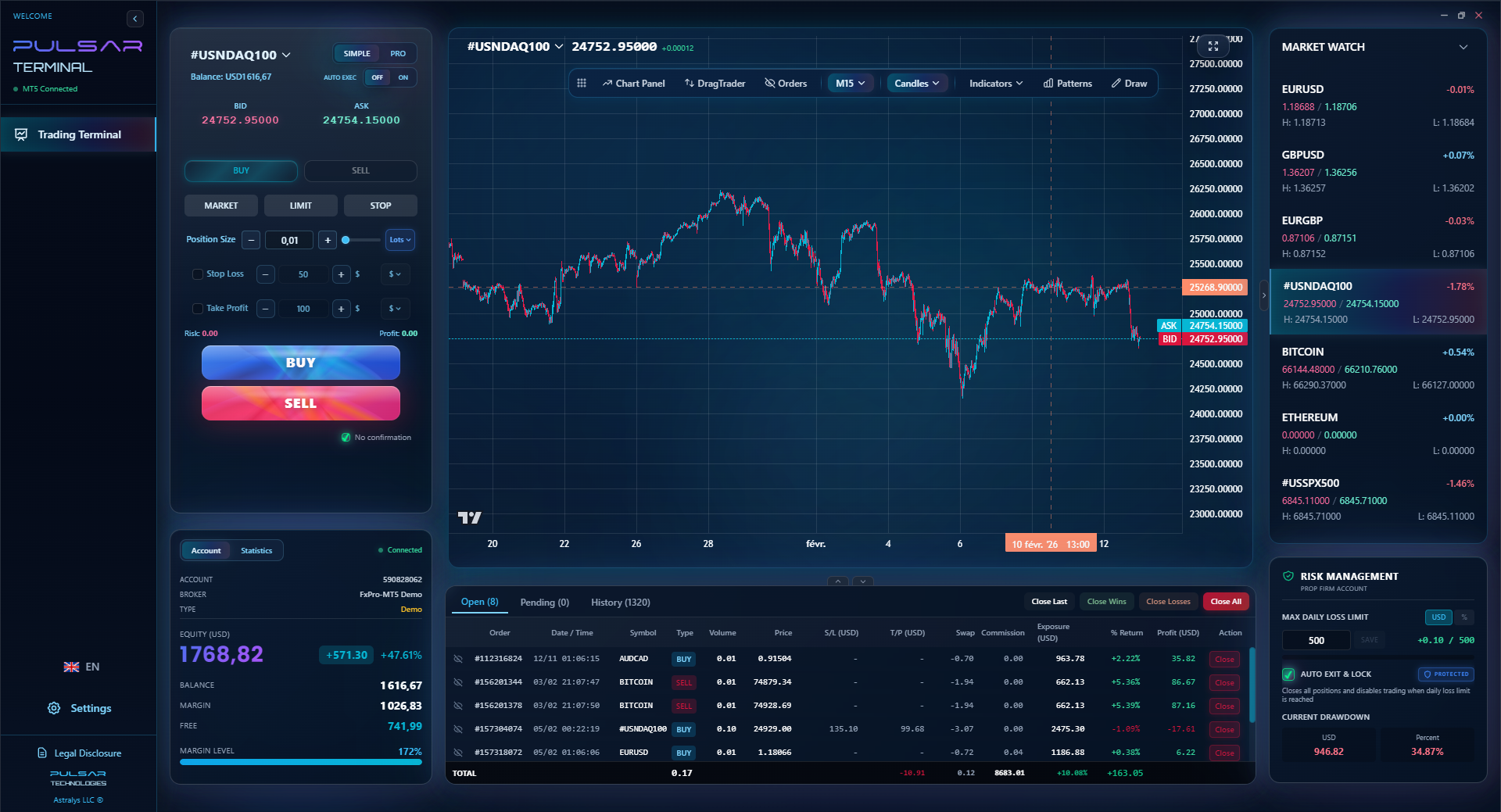
Managing complex trades on volatile pairs like USD/ZAR requires precise order tools, which is where a platform enhancer like Pulsar Terminal shines for MT5 users.
Pulsar Terminal
เครื่องมือ MT5 ครบวงจร: ลากวางคำสั่ง, multi-TP/SL, trailing stop, grid trading, Volume Profile และการป้องกัน prop firm ใช้งานโดยเทรดเดอร์กว่า 1,000 คนทุกวัน
“Trading USD/ZAR because you follow local news is an emotional trap. The spread is a 10-pip tax on your intelligence.”
I've made most of these. Learn from my losses.
1. Chasing High use: A broker offering 1000:1 isn't doing you a favor. They're giving you a rope to hang yourself. The FSCA's 30:1 limit is annoying for some strategies, but it's there for a reason. With high use, a small move against you can trigger a margin call and wipe you out. I once lost R8,000 in under a minute on a 500:1 gold trade. The use magnified my stupidity.
2. Ignoring Total Cost of Trading: You see a 0.0 pip spread ad and think 'free trading.' You forget the $10 commission per lot. Or you trade exotics without factoring in the 15-pip spread. Your trading plan must include breakeven calculations that factor in the real cost.
3. Underfunding Your Account: Starting with R500 because a broker allows it is a recipe for frustration. One losing trade will be 20% of your capital. A realistic minimum to learn properly, in my opinion, is R5,000-R10,000. This lets you take sensible risks (1-2% per trade) and actually learn about psychology without blowing up in a week.
4. Platform Obsession: MT4 vs. MT5 vs. cTrader. It doesn't matter that much when you start. Pick one your broker supports well and learn it inside out. The MACD indicator works the same on all of them. Your success is 95% psychology and risk management, 5% platform.
5. Going It Alone: The South African trading community is active on forums and Telegram. Listen, ask questions, but be wary of 'gurus' selling signals. Find people who talk about risk management and losing trades, not just their Lamborghinis.
💡 เคล็ดลับจาก Winston
If you feel a burning urge to trade USD/ZAR because you 'understand SA politics,' ask yourself: do the hedge funds in London with PhD economists and real-time data feeds understand it less? Trade the chart, not the headline.
“Your bank's forex department isn't a hurdle; it's your legal gateway. The paperwork is part of the cost of doing business.”
Let's turn this into a concrete, step-by-step plan for the first month.
Week 1: Education & Paperwork.
- Read the FSCA's website section on forex trading. Understand your rights.
- Talk to your bank. Ask about their process and fees for international investment transfers. Get the forms.
- Decide on your broker path (local FSCA or international). I'd suggest a beginner start with a reputable international broker like XM review or a local like Khwezi for simplicity.
Week 2: Demo Trading.
- Open a demo account with your chosen broker. Don't fake it. Fund it with a virtual amount equal to what you'd really start with (e.g., R10,000).
- Practice executing trades. Focus on one major pair, like EUR/USD. Learn how to set stop-losses, take-profits, and calculate your position size.
- Test deposits and withdrawals in the demo environment if possible.
Week 3: Strategy & Risk.
- Develop a simple plan. It could be as basic as: 'I will only trade if the price is above the 200-period moving average on the 4-hour chart, and I will use the RSI indicator to look for oversold conditions for buys.'
- Define your risk. Never risk more than 1-2% of your account on a single trade. Use a calculator.
- Paper trade this plan for a week. Keep a journal. Did you follow your rules?
Week 4: Going Live (Small).
- If your demo trading was disciplined, fund a live account with the minimum amount you're willing to lose completely. Maybe R2,000.
- Trade your plan with micro lots (0.01). The goal is not to make money. The goal is to feel the emotion of real money on the line and see if you still follow your rules.
- Your only metric for success this month is adherence to your risk management rules, not your P&L.
This process filters out the gamblers. It's boring, but it's how you build a foundation to access forex as a business, not a casino.
FAQ
Q1What is the minimum amount I need to start forex trading in South Africa?
Technically, some brokers allow deposits as low as $10 (≈R150). Practically, this is a terrible idea. With such a small amount, proper risk management is impossible, and fees will consume you. A more realistic and educational starting point is between R5,000 and R10,000. This allows you to trade micro lots and risk a sensible 1-2% per trade without blowing up your account on a single bad move.
Q2Can I use my credit card to fund a forex trading account?
Sometimes, but I strongly advise against it. Many brokers do accept credit/debit card deposits. However, your South African bank will likely treat this as a cash advance, incurring immediate interest charges and high fees. More importantly, trading with borrowed money (which is what a credit card provides) is a catastrophic risk to your personal finances. Always use cleared, risk-capital from your savings that you can afford to lose 100%.
Q3Is forex trading tax-free in South Africa?
No, it is not. Profits from forex trading are considered taxable income by SARS. If you trade frequently, it could be seen as carrying on a business, and your net profits (after deducting allowable expenses like platform fees, data costs, and even a portion of home office costs) are added to your other income. You must declare this on your annual tax return. Keep careful records of all trades, deposits, and withdrawals.
Q4What's better for a beginner: MT4 or MT5?
For a pure forex beginner, it makes almost no difference. MT4 is simpler and has slightly less clutter. MT5 can handle more asset types (like stocks) and has a few more built-in indicators. The core concepts - charts, orders, indicators - are identical. Choose the one your chosen broker supports best. Don't get paralyzed by this choice; your energy is better spent learning risk management and market structure.
Q5Why are the spreads on USD/ZAR so much wider than on EUR/USD?
Liquidity. EUR/USD is the most traded financial instrument in the world. Banks, corporations, and funds trade trillions daily, creating a deep, liquid market with tight spreads. USD/ZAR is an exotic pair. Far fewer participants trade it, so the market is shallower. To compensate for the higher risk of not being able to quickly offset their own risk, market makers and liquidity providers quote with a wider spread definition. It's a direct cost of trading a less popular currency.
Q6Can I trade with an international broker like Pepperstone or IC Markets from South Africa?
Yes, absolutely. Most major international brokers accept South African clients. You will be opening an account under their global entity (regulated by ASIC, CySEC, etc.), not their FSCA one. This means you use your foreign investment allowance to fund the account via international wire transfer. The pros are often better pricing and technology. The con is you are not protected by the FSCA, and withdrawals take a bit longer.
Q7What happens if my forex broker goes bankrupt?
This depends entirely on their regulation. If they are FSCA-licensed and compliant, your client funds should be held in segregated accounts at a reputable bank. In theory, these funds are separate from the broker's operating capital and can be returned to you. If they are an unregulated offshore broker, your money is likely gone. This is the single biggest reason to choose a well-regulated broker, even if their use is lower.
บทเรียนจาก Prof. Winston
สรุปสาระสำคัญ:
- ✓Real start capital: R5,000 minimum, not R500.
- ✓FSCA protection is worth the 30:1 use limit.
- ✓Major pairs cost 0.1-1 pip; ZAR pairs cost 5-20 pips.
- ✓Use your Single Discretionary Allowance (R1m) for funding.
- ✓Your first year's goal is survival, not profits.
บทความนี้มีประโยชน์แค่ไหน?
คลิกดาวเพื่อให้คะแนน
ข้อมูลเชิงลึกการเทรดรายสัปดาห์
การวิเคราะห์และกลยุทธ์รายสัปดาห์ฟรี ไม่มีสแปม
เกี่ยวกับผู้เขียน
David van der Merwe
เทรดเดอร์ตลาดเกิดใหม่
เทรดเดอร์ประจำโจฮันเนสเบิร์ก มีประสบการณ์ 11 ปีในสกุลเงินตลาดเกิดใหม่ เชี่ยวชาญคู่ ZAR การเทรดภายใต้กฎระเบียบ FSCA และการวิเคราะห์ตลาดแอฟริกาใต้
ความคิดเห็น
คำเตือนความเสี่ยง
การซื้อขายตราสารทางการเงินมีความเสี่ยงสูงและอาจไม่เหมาะสำหรับนักลงทุนทุกคน ผลการดำเนินงานในอดีตไม่ได้รับประกันผลลัพธ์ในอนาคต เนื้อหานี้มีวัตถุประสงค์เพื่อการศึกษาเท่านั้นและไม่ควรถือเป็นคำแนะนำในการลงทุน โปรดทำการวิจัยของคุณเองก่อนการซื้อขาย
คุณอาจชอบสิ่งนี้

Cara Trading Forex Sukses: 7 Prinsip dari Trader Profesional
Cara trading forex sukses dengan 7 prinsip trader pro: manajemen modal, disiplin, journal trading, backtest. Data nyata, bukan janji profit palsu.
Jam Trading Forex Terbaik untuk Trader Indonesia: Panduan Lengkap dengan Tabel Waktu
Panduan jam trading forex untuk trader Indonesia. Tabel 4 sesi dunia, jam emas 20:00-00:00, sesi mana yang harus dihindari. Data akurat + tips dari trader berpengalaman.
Top 5 Sàn Forex Uy Tín Nhất 2026: Review Jujur dari Trader Indonesia
Top 5 sàn forex uy tín 2026 untuk trader Indonesia. Review jujur: spread, deposit, withdraw, dukungan lokal. Exness, XM, IC Markets & lebih.
รับ Pulsar Terminal
เครื่องคำนวณทั้งหมดนี้ถูกสร้างไว้ใน Pulsar Terminal พร้อมข้อมูลเรียลไทม์จากบัญชี MT5 ของคุณ
รับ Pulsar Terminal