


Here's a fact that'll save you a headache: searching for 'Albaraka forex' in South Africa mixes up two completely different worlds.

David van der Merwe
เทรดเดอร์ตลาดเกิดใหม่ ·  South Africa
☕ 12 นาทีอ่าน
สิ่งที่คุณจะได้เรียนรู้:
- 1Albaraka Bank vs. Forex Trading: The Critical Difference
- 2What Albaraka Actually Offers (The Numbers)
- 3The Murky World of South African Forex Trading Law
- 4Where South Africans Actually Trade: Real Broker Data
- 5Costs: Sending Money vs. Trading Money
- 6Practical Advice: How to Proceed Based on Your Goal
- 7The Future: Regulation, Tech, and Your Money
Here's a fact that'll save you a headache: searching for 'Albaraka forex' in South Africa mixes up two completely different worlds. On one side, you have Albaraka Bank, a legitimate Authorised Dealer for foreign exchange transfers. On the other, you have the wild west of online forex trading, where most platforms locals use operate in a legal grey area at best. I've seen too many traders blow accounts because they didn't understand this distinction. Let's clear the fog. This isn't about bashing a bank; it's about showing you exactly what Albaraka offers, what the SARB and FSCA actually allow, and where you should put your money if you want to trade.
This is the most important point, so I'll be blunt. Albaraka Bank is not a forex trading broker. You cannot download MetaTrader from them, you cannot open a leveraged EUR/USD position, and you certainly cannot scalp the ZAR/JPY pair on their platform.
What Albaraka Bank is, is an Authorised Dealer with a license from the South African Reserve Bank (SARB). This license lets them do one main thing: help the movement of real money across borders. Think international wire transfers, paying for imports, receiving dividends from overseas, or getting a foreign currency account to hold dollars. It's banking, not speculation.
The confusion happens because the term 'forex' gets thrown around for both. When a manufacturer needs to pay a supplier in China in USD, they use a bank like Albaraka for 'forex.' When a guy in Sandton wants to bet on the Fed's next interest rate decision using 1:500 use, that's 'forex trading.' They are not the same game. Not even the same stadium.
I learned this the hard way early on. I spent weeks researching 'forex services' from major banks, thinking I'd found a safe, regulated way to trade. I was ready to move a chunk of capital. Then I realized all they offered was a spot transaction to convert my rands to dollars at a marked-up rate and send them abroad. The spread was about 200 pips on a good day. A complete non-starter for active trading. That misunderstanding cost me time and almost cost me money.

Warning: If you're looking for a platform to actively buy and sell currency pairs for profit, you are looking for a trading broker (like IC Markets or Pepperstone), not a commercial bank like Albaraka. Getting this wrong is your first and most expensive mistake.

💡 เคล็ดลับจาก Winston
A bank's job is to move your money safely. A broker's job is to provide a venue for you to risk it. Never ask a bank to be a broker, or a broker to be a bank. You'll be disappointed and poorer.
“Albaraka Bank is for moving value. A forex broker is for trading on price changes. Confusing the two is the first and most expensive mistake.”
So, if you're not trading with them, what do you get? Albaraka provides foreign exchange services, primarily for transactional and savings purposes. Let's talk specifics, because vague promises are useless.
The Vivere Foreign Currency Account
Launched in late 2025, this is their flagship product for individuals. It's a Shari'ah-compliant account that lets you hold six currencies: USD, EUR, GBP, TRY, AED, and SAR. You get a Visa card linked to it.
- Annual Fee: $10. Straightforward.
- Use Case: It's for saving in a stronger currency or spending abroad without constant conversion. If you believe the rand is going to tank, you could move some of your ZAR 1 million Single Discretionary Allowance into this account as dollars. It's a hedge, not a trade.
International Transfer and Payment Fees
This is where they make their money. Their fee schedule (effective July 2025) gives us real numbers:
- International POS Purchase: 2.50% of the ZAR equivalent. That means if you buy a $100 item online, you're paying an extra $2.50 on top of the bank's exchange rate margin.
- International ATM Balance Inquiry: R6.00.
- SWIFT Transfers: They use the SWIFT network (code ALBRZAJJ). The cost isn't a flat fee on their site; you must contact them. Expect a combination of a fixed fee (say, R200-R400) plus a margin on the exchange rate.

Example: Let's say you need to send $10,000 to the UK for university fees. Albaraka's quoted rate might be ZAR 18.50/USD when the interbank rate is 18.40. That's a 0.54% margin (about ZAR 1,000 on this transaction), plus the transfer fee. You're paying for the service and compliance, not getting a raw deal.
Their role is to execute your transaction within SARB's rules. They provide forward contracts too, which is crucial for businesses. If you know you need to pay $100k in 90 days, you can lock in a rate today. That's risk management, not speculation. For active price speculation, you need a different toolset entirely, like the platforms discussed in our XM review.
“The official line is simple: speculative forex trading by individuals is not permitted. The reality is a tolerated grey area of loopholes and offshore entities.”
Now, let's enter the grey zone. This is where most South African 'traders' actually operate, whether they know it or not.
The official line from the SARB's Exchange Control Regulations is simple: speculative forex trading by individuals is not permitted. The law, framed decades ago, intended to prevent capital flight. Only Authorised Dealers (like Albaraka) can deal in foreign currency.
So how are thousands of South Africans trading on platforms like MetaTrader? The answer is loopholes, enforcement priorities, and offshore entities.
- The Brokerage Loophole: Many international brokers (IC Markets, Exness, etc.) offer services to South Africans. They are not Authorised Dealers in South Africa. Technically, when you deposit ZAR with them, you're likely buying a CFD (Contract for Difference) based on the forex price, not actually trading the underlying currency. This falls under the FSCA's jurisdiction for financial product providers.
- FSCA Regulation: The Financial Sector Conduct Authority licenses brokers to offer CFDs and leveraged forex products. A broker like Pepperstone can be licensed by the FSCA, which gives them a legal basis to offer trading services as a derivative product provider, not a currency exchanger. This is the critical regulatory nuance.
- The Allowance Route: You are legally allowed to send up to ZAR 1 million per year abroad (Single Discretionary Allowance) and another ZAR 10 million (Foreign Capital Allowance) with tax clearance. Some use part of this to fund offshore trading accounts, which is a cleaner method but has its own hurdles.
The reality? The SARB isn't knocking down the doors of retail traders with $500 accounts. Their focus is on large-scale illicit flows. But the risk exists. Your broker could be shut down, or banking channels to them could be blocked. I once had a R50,000 withdrawal from an offshore broker held up for two months while my local bank asked for a million documents proving the source of funds. The trade profit was nice, but the administrative nightmare wasn't.

Pro Tip: If you trade, use an FSCA-licensed broker. It's the closest thing to a 'legal' shield you have. It also means you have some recourse if they rip you off. Check our IC Markets review for an example of a globally recognized broker with FSCA licensing.
“The official line is simple: speculative forex trading by individuals is not permitted. The reality is a tolerated grey area of loopholes and offshore entities.”
Since Albaraka isn't in this business, let's look at who is. These are the platforms where the real action happens. I've traded with most of these over the years.
Here’s a quick comparison of popular FSCA-regulated or accessible brokers:
| Broker | Min. Deposit (Approx.) | Typical EUR/USD Spread | Key Feature for SA Traders |
|---|---|---|---|
| XM | $5 | 0.6 pips | Very low barrier to entry, good for testing. |
| Exness | $10 | 0.0 pips (Raw) | Ultra-low spreads, popular for scalping strategy. |
| IC Markets | $200 | 0.0 pips (Raw) | Top-tier execution, great for ECN trading. |
| FP Markets | 100 AUD | 0.0 pips (Raw) | Strong ASIC & FSCA regulation. |
| Pepperstone | $200 | 0.0 pips (Razor) | Reliable, great platform support. |
use: This is a big one. The FSCA has capped use for retail clients. It's currently 1:30 for major forex pairs and 1:20 for minors. However, many traders access higher use (like 1:500) by signing up with the broker's global entity, which is not FSCA regulated. You gain use but lose regulatory protection. It's a trade-off I don't recommend for beginners.
My Experience: I started on a platform offering 1:500 use. I turned $1,000 into $5,000 in two weeks trading gold (XAU/USD guide). I felt like a genius. Then I lost it all in one afternoon when a news event spiked volatility and I didn't have a stop-loss. The high use amplified my gains and vaporized my account. Now, I rarely go above 1:20, even on my prop firm accounts. Survival beats excitement.
Deposits and withdrawals are usually via credit card, Skrill, Neteller, or local bank transfer to the broker's South African affiliate account. It works, but it's not the same as walking into an Albaraka branch.
💡 เคล็ดลับจาก Winston
The most important currency pair for a South African trader isn't EUR/USD. It's ZAR/(Your Patience). Protect your patience capital more fiercely than your trading capital.
“Your first goal isn't to make money; it's to not lose money while you learn what a pip really means in live market conditions.”
This is where the rubber meets the road. Let's compare the cost structures of using Albaraka's service versus using a trading broker. Different purposes, different economics.
Albaraka (For a Transfer): Your cost is the spread/margin + a fixed fee. As we saw, the margin might be 0.5%-1% on the exchange rate. For a $10,000 transfer, that's a cost of $50-$100, plus maybe R300. You pay this once for the service of moving currency from A to B. There's no ongoing cost. It's a transaction fee.
Trading Broker (For Speculation): Your costs are ongoing and performance-based:
- The Spread: The difference between buy and sell price. On a raw ECN account, this can be 0.0 pips + a commission (e.g., $7 per lot round turn). On a standard account, it's baked into a wider spread (e.g., 0.6 pips).
- Commission: Paid per trade on raw accounts.
- Swap/Overnight Financing: If you hold a position past 5 PM EST, you pay or receive interest. This can be a major cost on long-term swing trading positions.
- Inactivity Fees: Some brokers charge if you don't trade for a few months.
Example: You buy 1 standard lot (100,000 units) of EUR/USD on a standard account with a 0.6 pip spread. The spread cost is 0.00006 * 100,000 = $6 immediately. If you hold for a week, you might pay another $10 in swap fees. Your trade needs to move over 0.6 pips just to break even.
The trading cost structure is built for frequency. The bank transfer cost is built for certainty and compliance. Never use a bank's spread to judge a trading broker's spread, or vice-versa. They solve different problems. Always use a position size calculator to understand your true trade cost before entering.
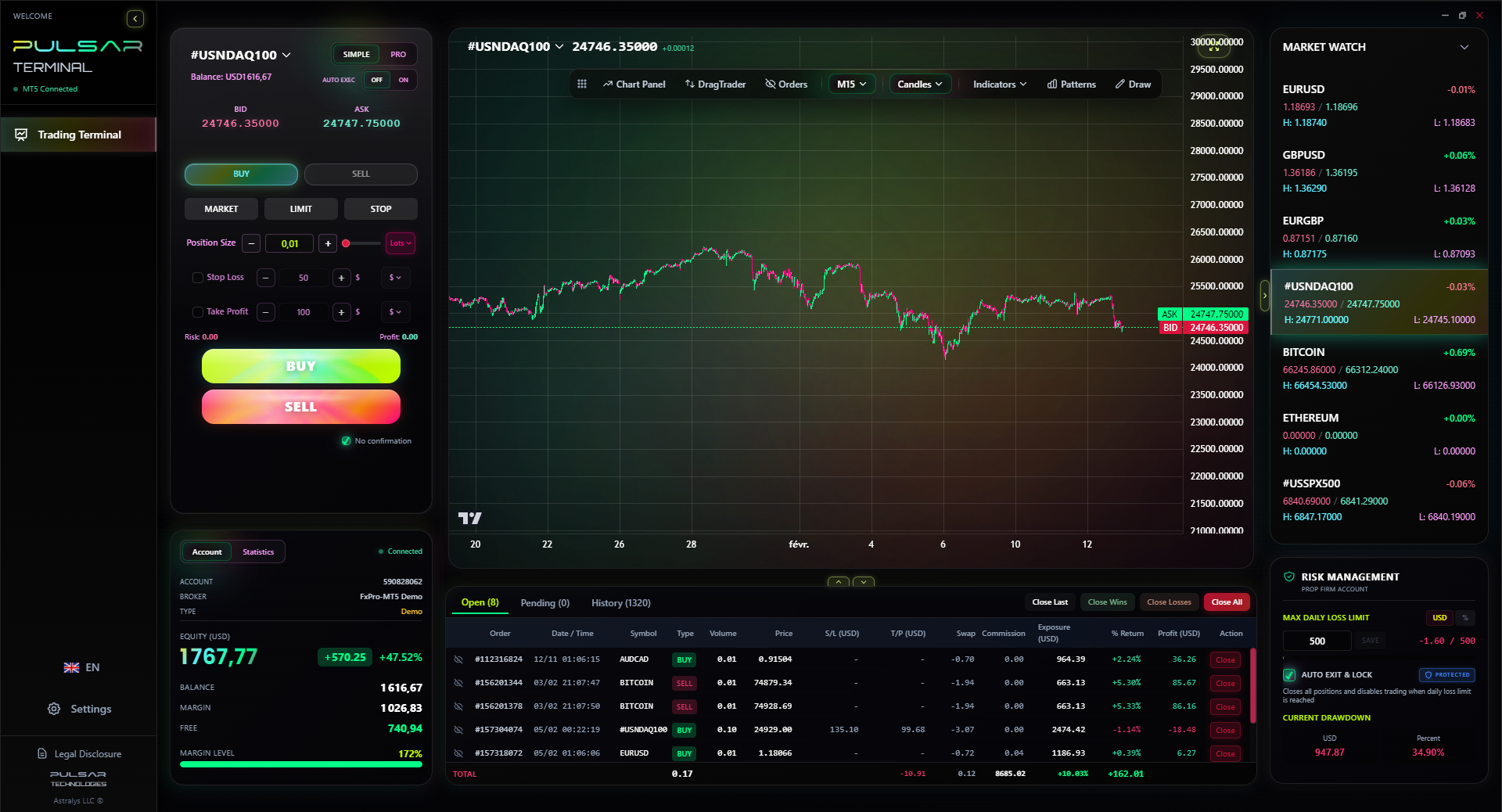
Managing the complex costs and risks of live trading requires tools that go beyond basic platform orders, which is where advanced trade management software becomes essential.
Pulsar Terminal
เครื่องมือ MT5 ครบวงจร: ลากวางคำสั่ง, multi-TP/SL, trailing stop, grid trading, Volume Profile และการป้องกัน prop firm ใช้งานโดยเทรดเดอร์กว่า 1,000 คนทุกวัน
“Your first goal isn't to make money; it's to not lose money while you learn what a pip really means in live market conditions.”
Cut through the noise. Here’s what you should do, depending on what you actually want.
If you need to send money overseas for tuition, business, or family: Use Albaraka Bank or another major Authorised Dealer. Get quotes from 2-3 banks for the specific amount. Compare the final ZAR amount they will debit. The process is regulated, safe, and final. This is what the system is designed for.
If you want to save in foreign currency as a hedge against the rand: Consider Albaraka's Vivere account. It's a straightforward way to hold dollars or euros. Also look at dollar-denominated unit trusts or ETFs on the JSE. They offer similar exposure without the bank account fees.
If you want to actively trade forex for profit:
- Accept the reality: You're operating in a complex regulatory space. Get comfortable with that.
- Start with an FSCA-licensed broker. It's the safest legal footing. Our Exness review covers a popular option.
- Fund your account using your Single Discretionary Allowance. Keep records of all transfers.
- Start small. I mean really small. Your first goal isn't to make money; it's to not lose money while you learn what a pip definition really means in live market conditions.
- Learn risk management first. Understand margin call mechanics before you learn a fancy indicator like the MACD indicator.
I made every mistake in the book. I traded without understanding the spread definition, used excessive use, and chased losses. The market is a brutal teacher. Your first line of defense isn't a winning strategy; it's knowing the rules of the environment you're playing in. Albaraka is part of the official, controlled financial environment. Online forex trading exists in its adjacent, evolving space. Know which one you're in.
💡 เคล็ดลับจาก Winston
If you're confused about whether a service is for trading or transferring, look at the fee structure. Transaction fees mean moving money. Spreads and commissions mean trading volatility. It's that simple.
“I turned $1,000 into $5,000 with high use. Then I lost it all in one afternoon. Survival beats excitement.”
Where is this all headed? The landscape is shifting, mostly toward more clarity and digitization.
For Banks like Albaraka: The trend is digital integration and product innovation like the Vivere account. Cross-border payments will get faster and cheaper due to new technologies and competition. Their role as gatekeepers of SARB's rules will remain.
For Traders: The big development is the impending Conduct of Financial Institutions (COFI) Bill, expected from the FSCA. This will further formalize the regulation of derivative providers (brokers). Expect more stringent client protection rules, possibly stricter use caps, and clearer operational guidelines. This is good for trader safety but may limit some risky behaviors the pros sometimes use.
Technologically, algorithmic and app-based trading is already dominant. Tools that help manage risk are becoming non-negotiable. The days of manually moving stop-losses are over. If you're serious, you need tools that automate protection, especially when dealing with the volatile moves common in forex.
The line might blur slightly with crypto, but for traditional forex, the dichotomy will remain: banks for moving value, brokers for trading on price changes. Your job is to pick the right tool, understand its costs and risks, and never confuse one for the other again.
FAQ
Q1Can I open a forex trading account with Albaraka Bank?
No, you cannot. Albaraka Bank is an Authorised Dealer for foreign exchange transfers and currency accounts, not a leveraged speculative trading broker. They do not offer MetaTrader, CFDs, or the ability to take positions on currency pair price movements.
Q2Is forex trading legal for individuals in South Africa?
It's complex. Speculative forex trading by individuals is not permitted under the SARB's Exchange Control Regulations. However, the FSCA licenses brokers to offer forex CFDs as derivative financial products. Many South Africans trade through these FSCA-licensed or international brokers, operating in a tolerated grey area. Using your legal offshore allowance to fund an account is the cleanest method.
Q3What is the Vivere account and who is it for?
The Vivere Resident Foreign Currency Account is a Shari'ah-compliant account from Albaraka that lets you hold and spend six foreign currencies (USD, EUR, GBP, TRY, AED, SAR). It has a $10 annual fee. It's for savers, travelers, or online shoppers who want to hold foreign currency to hedge against rand volatility or avoid conversion fees, not for active trading.
Q4How do the costs of using Albaraka compare to a trading broker?
They are completely different. Albaraka charges a margin on the exchange rate (e.g., 0.5-1%) plus a fixed fee for a transfer. It's a one-time transaction cost. A trading broker charges a spread (e.g., 0.6 pips), possibly a commission, and swap fees for overnight positions. Broker costs are frequent and scale with your trading volume.
Q5What should I look for in a forex trading broker in South Africa?
Prioritize FSCA regulation for local protection. Then look at realistic costs (spreads/commissions), reliable deposit/withdrawal methods for ZAR, the trading platform (MT4/MT5 are standard), and the quality of execution. Start with a demo account. Never choose a broker solely based on the highest use offered.
Q6Can I use my Albaraka account to fund a trading broker?
Potentially, yes, as part of your Single Discretionary Allowance (ZAR 1 million per year). You would initiate an international transfer from your Albaraka account to the broker's nominated bank account. However, you must ensure the broker accepts clients from South Africa and be prepared to provide documentation to Albaraka on the purpose of the payment.
บทเรียนจาก Prof. Winston
สรุปสาระสำคัญ:
- ✓Albaraka Bank is not a trading broker; it's an Authorised Dealer for transfers.
- ✓SA forex trading exists in a regulatory grey area via FSCA-licensed CFD brokers.
- ✓The Vivere account costs $10/year to hold forex, not trade it.
- ✓Broker spreads are for frequent trading; bank margins are for one-time transfers.
- ✓Always prioritize FSCA regulation and risk management over high use promises.
บทความนี้มีประโยชน์แค่ไหน?
คลิกดาวเพื่อให้คะแนน
ข้อมูลเชิงลึกการเทรดรายสัปดาห์
การวิเคราะห์และกลยุทธ์รายสัปดาห์ฟรี ไม่มีสแปม
เกี่ยวกับผู้เขียน
David van der Merwe
เทรดเดอร์ตลาดเกิดใหม่
เทรดเดอร์ประจำโจฮันเนสเบิร์ก มีประสบการณ์ 11 ปีในสกุลเงินตลาดเกิดใหม่ เชี่ยวชาญคู่ ZAR การเทรดภายใต้กฎระเบียบ FSCA และการวิเคราะห์ตลาดแอฟริกาใต้
ความคิดเห็น
คำเตือนความเสี่ยง
การซื้อขายตราสารทางการเงินมีความเสี่ยงสูงและอาจไม่เหมาะสำหรับนักลงทุนทุกคน ผลการดำเนินงานในอดีตไม่ได้รับประกันผลลัพธ์ในอนาคต เนื้อหานี้มีวัตถุประสงค์เพื่อการศึกษาเท่านั้นและไม่ควรถือเป็นคำแนะนำในการลงทุน โปรดทำการวิจัยของคุณเองก่อนการซื้อขาย
คุณอาจชอบสิ่งนี้

Cara Trading Forex Sukses: 7 Prinsip dari Trader Profesional
Cara trading forex sukses dengan 7 prinsip trader pro: manajemen modal, disiplin, journal trading, backtest. Data nyata, bukan janji profit palsu.
Jam Trading Forex Terbaik untuk Trader Indonesia: Panduan Lengkap dengan Tabel Waktu
Panduan jam trading forex untuk trader Indonesia. Tabel 4 sesi dunia, jam emas 20:00-00:00, sesi mana yang harus dihindari. Data akurat + tips dari trader berpengalaman.
Top 5 Sàn Forex Uy Tín Nhất 2026: Review Jujur dari Trader Indonesia
Top 5 sàn forex uy tín 2026 untuk trader Indonesia. Review jujur: spread, deposit, withdraw, dukungan lokal. Exness, XM, IC Markets & lebih.
รับ Pulsar Terminal
เครื่องคำนวณทั้งหมดนี้ถูกสร้างไว้ใน Pulsar Terminal พร้อมข้อมูลเรียลไทม์จากบัญชี MT5 ของคุณ
รับ Pulsar Terminal