


Here's a fact that might surprise you: right now, the South African Reserve Bank (SARB) doesn't consider Bitcoin 'currency' for exchange control purposes.

David van der Merwe
เทรดเดอร์ตลาดเกิดใหม่ ·  South Africa
☕ 10 นาทีอ่าน
สิ่งที่คุณจะได้เรียนรู้:
- 1What Exactly Are We Talking About?
- 2The South African Rulebook (It's Not What You Think)
- 3Trading Crypto Pairs vs. Traditional Forex: A Side-by-Side Look
- 4How to Actually Start Trading (The Safe Way)
- 5Brokers & Exchanges: What's Available in SA
- 6The Big Risks & How to Avoid Them
- 7What's Next for South Africa?
Here's a fact that might surprise you: right now, the South African Reserve Bank (SARB) doesn't consider Bitcoin 'currency' for exchange control purposes. That 2025 court ruling changed everything, making cross-border crypto transfers a whole lot simpler. But does that mean you should jump into trading Bitcoin against the US Dollar like it's just another forex pair? Not so fast. The term 'blockchain forex' gets thrown around a lot, but in reality, it's a messy, exciting, and heavily regulated intersection. I've traded through this evolution, and I'll tell you exactly what works, what's legal, and where the real opportunities (and pitfalls) are for South African traders today.
When someone says 'blockchain forex,' they're usually mashing two worlds together. It's not an official term. On one side, you have traditional forex (FX): trading currency pairs like EUR/USD or GBP/ZAR through regulated brokers. On the other, you have crypto: trading digital assets like Bitcoin (BTC) or Ethereum (ETH).
'Blockchain forex' typically refers to one of two things:
- Crypto-to-Fiat Pairs: Trading a cryptocurrency against a traditional fiat currency. The most common example is BTC/USD. This is where the 'forex' analogy is strongest - you're speculating on the price movement of one asset against another.
- Crypto-to-Crypto Pairs: Trading one crypto against another, like ETH/BTC. While not 'forex' in the traditional sense, the trading mechanics on an exchange can feel very similar.
In South Africa, the moment you involve the South African Rand (ZAR), things get specific. Finding a BTC/ZAR pair with decent liquidity and tight spreads is different from trading major forex pairs. The volatility is another beast entirely. I remember a trade on BTC/ZAR back in late 2023 where the price swung 15% in a single session based on a US regulatory rumor that had nothing to do with South Africa. That's not your typical forex move.

Warning: Don't be fooled by slick marketing. A platform offering 'blockchain forex' might just be a crypto exchange with a fancy UI. The regulatory protections are completely different from those governing your standard XM review or Pepperstone review forex account.
This is the most important part. You can't trade smart if you don't know the rules of the game. South Africa's approach has been pragmatic but firm.
The FSCA License is Everything
Since October 2022, the Financial Sector Conduct Authority (FSCA) has classified crypto assets as financial products. This was a game-changer. It means any local company that wants to offer you advice on crypto, hold your crypto, or help trading as a service provider (a CASP) must be licensed as a Financial Service Provider (FSP).
Before you deposit a single Rand, check the FSCA's website. Type in the company's name and verify their FSP number. If they're not there, walk away. It's that simple. I learned this the hard way early on with a platform that seemed legit but vanished overnight. That was a R5,000 lesson.
FICA is Your Friend (Seriously)
Since December 2022, Crypto Asset Service Providers are 'accountable institutions' under FICA. This is good news for you. It means they are legally required to:
- Know their customer (KYC): You'll need to provide your ID and proof of address.
- Monitor transactions for suspicious activity.
- Keep records. This adds a layer of security and legitimacy that the wild west of crypto once lacked.
The Big One: Exchange Controls
Here's the juicy bit from that 2025 court case. The ruling stated that cryptocurrencies are not 'currency' or 'capital' under the old Exchange Control Regulations. In practical terms, this made it easier to move crypto assets in and out of South Africa. However, this doesn't mean it's a free-for-all. When you cash out crypto to ZAR in your local bank account, large or frequent transactions will likely be questioned by your bank under their own risk policies. Always keep clear records of your trades and withdrawals.

Pro Tip: Your tax obligations haven't changed. SARS still sees crypto gains as taxable income. Keep a detailed log of every buy, sell, and trade. The onus is on you to declare it.
“The term 'blockchain forex' is marketing gloss over a heavily regulated and wildly volatile new asset class.”
If you're coming from forex, trading crypto pairs will feel familiar but with the difficulty dial turned up. Let's break it down.
| Feature | Traditional Forex (e.g., EUR/USD) | Crypto Pair (e.g., BTC/USD) |
|---|---|---|
| Market Hours | 24/5 (Closes weekends) | 24/7/365 |
| Volatility | Generally lower, spikes around news | Extremely high, can spike on tweets, rumors |
| Liquidity | Enormous (Trillions daily) | Varies wildly; high for BTC/ETH, low for alts |
| Regulation (in SA) | Highly regulated (FSCA, FSB legacy) | Emerging regulation (FSCA license required) |
| Spread | Typically very tight (e.g., 0.1-1.0 pips) | Can be wide, especially on smaller pairs/exchanges |
| Core Drivers | Central banks, economic data, geopolitics | Tech developments, regulatory news, sentiment, 'whale' activity |
The 24/7 market is a double-edged sword. Yes, you can trade anytime. But it also means you can wake up to a 20% gap if major news hits on a Sunday. I once got caught in a weekend margin call on a leveraged ETH position because I didn't have a stop-loss wide enough to account for off-hours volatility. My own fault, but a classic rookie mistake in this space.
Technical analysis still works - support/resistance, trend lines, indicators like RSI and MACD are all valid. But fundamental analysis is totally different. You're not reading CPI reports; you're reading GitHub commit histories and parsing statements from the US Securities and Exchange Commission.

💡 เคล็ดลับจาก Winston
The 24/7 crypto market doesn't mean you should be. Set specific trading hours and stick to them. Fatigue leads to expensive mistakes.
Ready to dip a toe in? Here's a step-by-step guide tailored for South Africans.
Step 1: Choose Your Path & Platform
You have two main routes:
- International Crypto Exchanges: Platforms like Binance or Bybit offer a huge range of pairs (like BTC/USD) and advanced trading features. They are not FSCA-licensed, as they are not South African entities. You use them at your own risk, but they are often the only place to find certain pairs or use options. You'll fund them with crypto (bought locally) or sometimes via card.
- Local, FSCA-Licensed CASPs: Platforms like VALR, Luno, or Altcoin Trader. These are your safest bet for onboarding ZAR. They offer limited pairs (usually BTC/ZAR, ETH/ZAR, etc.) and often simpler trading interfaces. They are fully regulated under South African law.
My advice? Start locally. Use a licensed platform like VALR to get your first Bitcoin or Ethereum with Rands. Get comfortable with the wallet and security steps.
Step 2: Funding & Security
On a local platform, you'll typically EFT your ZAR directly to their bank account (they are an FSP, remember?). Once your funds clear, you can buy. Security is non-negotiable:
- Enable Two-Factor Authentication (2FA) using an app like Google Authenticator, NOT SMS.
- Never share your private keys or seed phrase. Ever.
- Consider a hardware wallet (like a Ledger) for storing large amounts long-term, not on the exchange.
Step 3: Develop a Strategy & Risk Management
You wouldn't throw money at the EUR/USD guide without a plan. Don't do it here.
- Define Your Style: Is this a long-term hold? Are you trying scalping on 5-minute charts? Crypto's volatility can suit many styles, but pick one and stick to its rules.
- Risk Management is King: This is even more critical than in forex. I never risk more than 1-2% of my trading capital on a single crypto trade. Use a position size calculator religiously.
- Use Stop-Losses: And place them wider than you think. A 5% stop on a major forex pair is huge; on crypto, it can get taken out by normal market noise.

Example: Let's say you have a R10,000 trading account and you're willing to risk 1% (R100) on a BTC/USD trade. You buy at $60,000 and place your stop-loss at $58,000 (a 3.33% drop). Your position size should be R100 / (0.0333) = ~R3,000 worth of Bitcoin. Not your entire account.
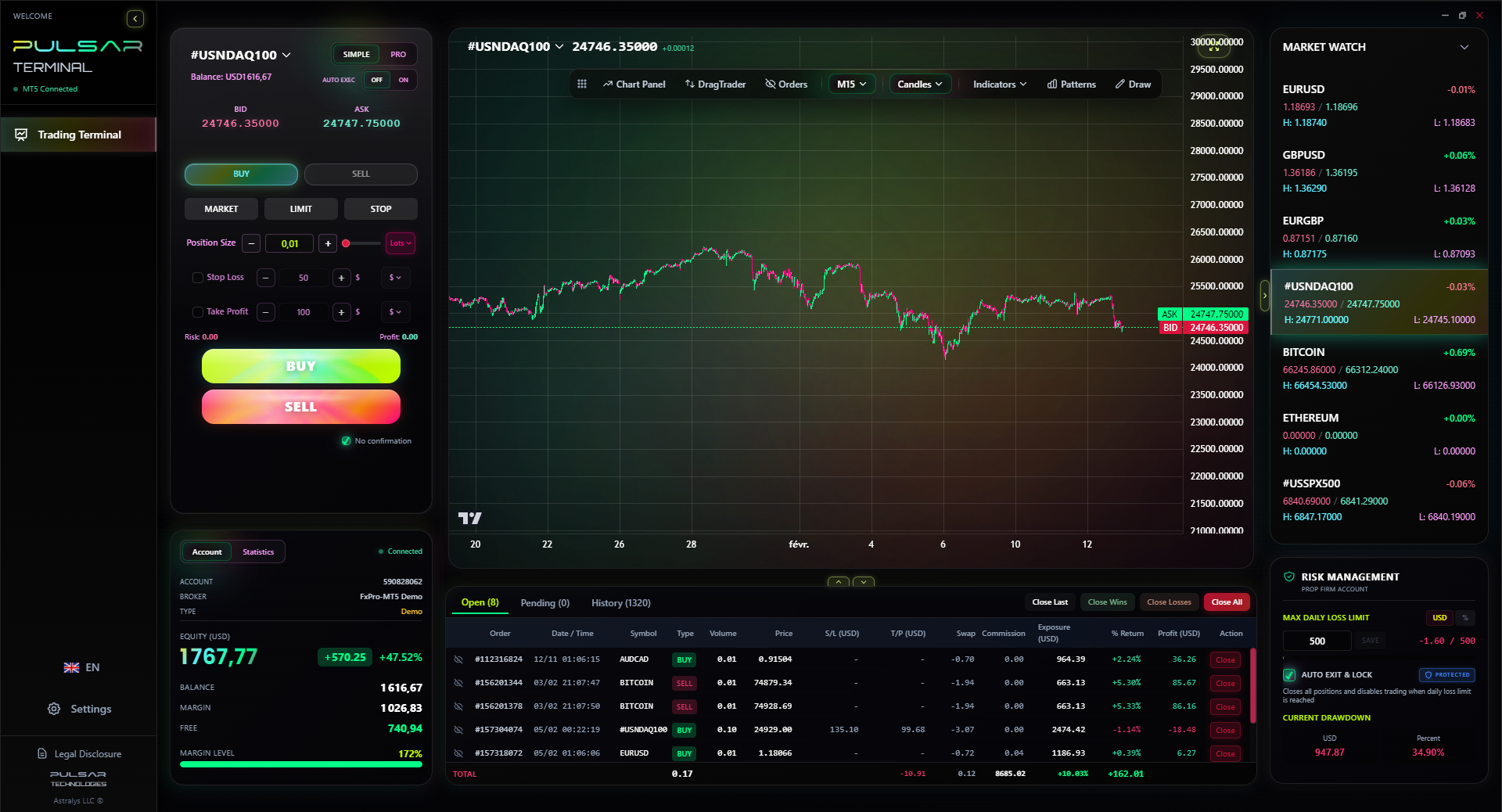
Managing multiple take-profit levels and wide stop-losses on volatile crypto pairs is complex, but Pulsar Terminal's drag-and-drop order tools on MT5 make it visual and precise.
Pulsar Terminal
เครื่องมือ MT5 ครบวงจร: ลากวางคำสั่ง, multi-TP/SL, trailing stop, grid trading, Volume Profile และการป้องกัน prop firm ใช้งานโดยเทรดเดอร์กว่า 1,000 คนทุกวัน
“In South Africa, the FSCA license isn't just a sticker on a website; it's your first line of defense against losing everything.”
Let's cut through the noise. Here’s the lay of the land as of now.
Local, FSCA-Licensed Options (Safest for ZAR On/Off Ramp):
- VALR: Probably the leader for serious traders. Offers spot trading, some derivatives, and a good range of ZAR pairs. They are a licensed FSP.
- Luno: Great for beginners. Very simple interface, easy EFT deposits. Offers BTC, ETH, XRP, and a few others against ZAR. Also licensed.
- Altcoin Trader: Another long-standing local exchange with a variety of altcoins available for ZAR.
International Platforms (More Pairs, Higher Risk):
- Binance: The global giant. Offers hundreds of pairs, futures, and sophisticated tools. Not FSCA-regulated. South Africans can use it, but banking access can be tricky.
- Bybit/Kucoin: Similar to Binance, popular for derivatives and altcoin trading.
A Hybrid Approach: This is what I and many serious traders do. We use a local, licensed exchange like VALR to convert ZAR into a stablecoin like USDT. Then, we transfer that USDT to an international exchange like Binance to access more pairs and trading tools. When done, we transfer profits back to USDT, send it to VALR, and cash out to ZAR. It adds steps but gives you the best of both worlds: local regulatory safety and global market access.
Remember, the forex brokers you know like IC Markets review or Exness review primarily offer CFD trading on crypto. You don't own the actual crypto asset, you're just speculating on the price difference. This is a different product with its own pros (use, easy ZAR accounts) and cons (counterparty risk, no asset ownership).
💡 เคล็ดลับจาก Winston
When testing a strategy on volatile crypto pairs, use a demo account for at least 100 trades. The 'noise' will reveal flaws your forex strategies might hide.
I've made mistakes so you don't have to. Here are the major pitfalls in blockchain forex.
1. Regulatory Whiplash: A single tweet from a foreign regulator can crash the market. Your solid technical setup on XAU/USD guide won't save you. Stay informed on global crypto news, not just charts.
2. Exchange Risk: The platform itself can fail, get hacked, or 'pause withdrawals.' This is why using FSCA-licensed locals for custody is safer, and why you never leave large sums on an international exchange. Not your keys, not your crypto.
3. Emotional Trading & Volatility: The fear of missing out (FOMO) is intense. I bought a meme coin in 2021 after it had already pumped 300%, convinced it would go higher. It didn't. I lost 60% in two days. The volatility amplifies greed and fear. Have a written plan and follow it.
4. Scams and 'Yield Farming': If an offer sounds too good to be true (e.g., '20% monthly returns staking with us'), it's a scam. Full stop. Stick to well-known, reputable platforms.
5. Tax Complexity: Unlike forex, which might be taxed under swing trading income rules, crypto disposals are clearly in SARS's sight. They have data-sharing agreements with major exchanges. Do not ignore this. Use a crypto tax calculator or an accountant who understands it.
“Crypto volatility doesn't break the rules of technical analysis, but it does demand wider stops and stricter risk management.”
The trend is clear: more regulation, not less. The FSCA licensing regime is just the beginning. We'll likely see:
- Tighter rules on use for crypto trading offered by local entities.
- More clarity on taxation of different crypto activities (staking, lending, etc.).
- Potential integration of blockchain technology into traditional finance (like bond or equity settlements), which is different from trading but will boost overall legitimacy.
The 2025 exchange control ruling was a massive step towards normalizing crypto as a transferable asset. It opens doors for South African traders and businesses to operate more freely in the global crypto economy. However, it also means regulators will be watching even closer to ensure AML and tax compliance.
The bottom line? The 'wild west' days are over in South Africa. Blockchain forex, or more accurately, trading crypto assets, is becoming a professionalized, regulated part of the financial landscape. That's good for reducing fraud and protecting traders, but it also means you need to be just as diligent, if not more so, than when trading traditional markets.
💡 เคล็ดลับจาก Winston
Your first withdrawal should be your initial investment. Trade with the house's money. The psychological relief is worth more than the extra capital.
FAQ
Q1Is trading Bitcoin against USD considered forex in South Africa?
No, not legally. The South African Reserve Bank does not classify cryptocurrencies as 'currency.' While trading BTC/USD has similar mechanics to forex, it is regulated as a crypto asset financial product by the FSCA, not under forex-specific rules. The platforms offering it are different from your standard forex broker.
Q2Do I need to pay tax on my crypto trading profits in South Africa?
Yes, absolutely. SARS treats profits from crypto trading as taxable income. You need to declare your net capital gains (profits minus losses and costs) in your annual tax return. Keep detailed records of every transaction, including dates, amounts in ZAR, and fees.
Q3What's the safest way to buy crypto with South African Rands?
The safest way is to use a locally-based Crypto Asset Service Provider (CASP) that is licensed as a Financial Service Provider (FSP) by the FSCA. Check the FSCA website for their FSP number. These platforms, like VALR or Luno, allow direct EFT deposits from your South African bank account and operate under South African law.
Q4Can I use my normal forex broker to trade crypto?
Many forex brokers offer Crypto CFDs (Contracts for Difference). This means you can speculate on the price movement of Bitcoin or Ethereum without owning the actual asset. It's convenient and allows use of use, but it's a different product with its own risks (like counterparty risk). It's not the same as buying spot crypto on a dedicated exchange.
Q5What was the impact of the 2025 court ruling on exchange controls?
The Pretoria High Court ruled that cryptocurrencies are not 'currency' or 'capital' under the old Exchange Control Regulations. In practice, this made it significantly easier to transfer crypto assets across South Africa's borders, as these transfers are no longer subject to the same controls as moving traditional foreign currency. However, normal tax and FICA reporting rules still apply when you convert crypto to ZAR.
Q6How much should I risk per trade when starting with crypto pairs?
Even less than with forex. I recommend risking no more than 1% of your total trading capital on any single crypto trade. The extreme volatility means stops are hit more frequently. Always use a stop-loss and calculate your position size carefully before entering. A position size calculator is essential.
บทเรียนจาก Prof. Winston
สรุปสาระสำคัญ:
- ✓Verify FSCA FSP license before depositing any ZAR.
- ✓Risk a maximum of 1% per trade on crypto pairs.
- ✓Use local regulated exchanges for ZAR on/off ramps.
- ✓Keep impeccable records for SARS from day one.
- ✓24/7 markets require disciplined, scheduled trading hours.
บทความนี้มีประโยชน์แค่ไหน?
คลิกดาวเพื่อให้คะแนน
ข้อมูลเชิงลึกการเทรดรายสัปดาห์
การวิเคราะห์และกลยุทธ์รายสัปดาห์ฟรี ไม่มีสแปม
เกี่ยวกับผู้เขียน
David van der Merwe
เทรดเดอร์ตลาดเกิดใหม่
เทรดเดอร์ประจำโจฮันเนสเบิร์ก มีประสบการณ์ 11 ปีในสกุลเงินตลาดเกิดใหม่ เชี่ยวชาญคู่ ZAR การเทรดภายใต้กฎระเบียบ FSCA และการวิเคราะห์ตลาดแอฟริกาใต้
ความคิดเห็น
คำเตือนความเสี่ยง
การซื้อขายตราสารทางการเงินมีความเสี่ยงสูงและอาจไม่เหมาะสำหรับนักลงทุนทุกคน ผลการดำเนินงานในอดีตไม่ได้รับประกันผลลัพธ์ในอนาคต เนื้อหานี้มีวัตถุประสงค์เพื่อการศึกษาเท่านั้นและไม่ควรถือเป็นคำแนะนำในการลงทุน โปรดทำการวิจัยของคุณเองก่อนการซื้อขาย
คุณอาจชอบสิ่งนี้

Cara Trading Forex Sukses: 7 Prinsip dari Trader Profesional
Cara trading forex sukses dengan 7 prinsip trader pro: manajemen modal, disiplin, journal trading, backtest. Data nyata, bukan janji profit palsu.
Jam Trading Forex Terbaik untuk Trader Indonesia: Panduan Lengkap dengan Tabel Waktu
Panduan jam trading forex untuk trader Indonesia. Tabel 4 sesi dunia, jam emas 20:00-00:00, sesi mana yang harus dihindari. Data akurat + tips dari trader berpengalaman.
Top 5 Sàn Forex Uy Tín Nhất 2026: Review Jujur dari Trader Indonesia
Top 5 sàn forex uy tín 2026 untuk trader Indonesia. Review jujur: spread, deposit, withdraw, dukungan lokal. Exness, XM, IC Markets & lebih.
รับ Pulsar Terminal
เครื่องคำนวณทั้งหมดนี้ถูกสร้างไว้ใน Pulsar Terminal พร้อมข้อมูลเรียลไทม์จากบัญชี MT5 ของคุณ
รับ Pulsar Terminal