


Here's something most new traders don't know: over 80% of India's commodity trading volume happens on just one exchange, the MCX.
Rajesh Sharma
นักวิเคราะห์ฟอเร็กซ์อาวุโส ·  India
India
☕ 12 นาทีอ่าน
สิ่งที่คุณจะได้เรียนรู้:
- 1Why Trade Commodities in India? (It's Not Just Gold)
- 2Understanding the Market Structure: MCX vs. NCDEX
- 3The Real Costs: It's More Than Just Brokerage
- 4Core Commodity Trading Strategies That Actually Work
- 5Risk Management: The Non-Negotiable Part of Your Strategy
- 6Choosing a Broker & Platform in India
- 7Common Pitfalls & How to Avoid Them
- 8Putting It All Together: Your Weekly Routine
Here's something most new traders don't know: over 80% of India's commodity trading volume happens on just one exchange, the MCX. Yet, most retail traders I meet are trying to trade crude oil like it's a tech stock. It doesn't work. Commodities have their own rhythm, driven by monsoons, geopolitics, and global supply chains that don't care about Nifty's closing price. I've made my share of mistakes here - like the time I lost ₹42,000 on a silver trade because I ignored contract expiry. This guide is the conversation I wish I'd had before placing that first order.
When you think of commodities in India, gold probably comes to mind first. It's cultural, right? But the market is way bigger. You've got crude oil reacting to OPEC meetings, natural gas swinging with winter demand, and agricultural products like chana (chickpeas) moving with the monsoon forecast. Trading here gives you a hedge against inflation in a very direct way. If you think vegetable oil prices are going up because of a poor soybean crop, you can trade that view on the NCDEX.
The big draw for me has always been the clear, fundamental drivers. A drought in Maharashtra affects soybean yields. Tensions in the Middle East send crude oil higher. These are tangible stories you can follow, unlike sometimes abstract moves in equity. Plus, with SEBI's oversight since the FMC merger, the market structure is strong. Just remember, the first preference for settlement is physical delivery. You don't want 100 kg of zinc showing up at your door because you forgot to square off a futures contract.

Warning: Commodity trading is taxed as business income, not capital gains. That means your profits get added to your total income and taxed at your slab rate. Keep immaculate records from day one.
You need to know where you're playing. India has two major commodity exchanges, and they're like different stadiums for different sports.
The Multi Commodity Exchange (MCX) is the heavyweight. It handles over 80% of the volume. This is where you trade the 'big boys': Gold (1 kg, 100 grams), Silver (30 kg, 5 kg), Crude Oil, Natural Gas, and base metals like Copper and Zinc. The action here is heavily influenced by international prices (think London Metal Exchange, COMEX, NYMEX) and the USD/INR exchange rate. Trading hours are long, often from 9 AM to 11:30 PM or later, to overlap with global markets.
The National Commodity and Derivatives Exchange (NCDEX) is the agri-specialist. Think of it as the exchange for the heartland. You're trading Chana, Soybean, Refined Soy Oil, Cotton, and spices. The drivers here are hyper-local: monsoon progress, government Minimum Support Prices (MSP), harvest reports, and even local mandi arrivals. The hours are typically 9 AM to 9 PM.
Choosing your arena is the first part of any commodity trading strategy. I mostly stick to MCX metals and energy because I can track global catalysts better. My forays into guar seed on NCDEX... let's just say I learned to respect local knowledge the hard way.
| Aspect | MCX (Non-Agri) | NCDEX (Agri) |
|---|---|---|
| Main Products | Gold, Silver, Crude, Metals | Soybean, Chana, Cotton, Spices |
| Primary Drivers | Global Prices, USD/INR, Geopolitics | Monsoon, MSP, Domestic Supply |
| Trading Hours | ~9:00 AM - 11:30/11:55 PM | ~9:00 AM - 9:00 PM |
| CTT Tax | 0.01% on sell side (futures) | Usually exempt |

💡 เคล็ดลับจาก Winston
The monsoon in Kota isn't just weather; it's a trading signal for NCDEX soybean. Your best commodity trading strategy starts by reading the right newspaper section.
“The brokerage fee is just the tip of the iceberg. The real costs are in the taxes and spreads.”
This is where many new traders get a nasty surprise. The brokerage fee is just the tip of the iceberg. Let me break down a real trade I did recently so you can see the math.
I sold 1 lot of Silver MIC (5 kg) on MCX at ₹82,450 per kg. The total contract value was ₹4,12,250 (5 kg * ₹82,450).
Here’s what got deducted:
- Brokerage: My broker charges a flat ₹20 per order. So, ₹20.
- Exchange Transaction Charge: MCX charges 0.0021% of the turnover. That's ₹8.66 (₹4,12,250 * 0.000021).
- SEBI Turnover Fee: 0.0001% of the turnover. ₹0.41.
- Commodity Transaction Tax (CTT): This is the big one for non-agri trades. 0.01% on the sell side only. ₹41.23 (₹4,12,250 * 0.0001).
- Stamp Duty: Varies by state, but let's assume 0.002% on the buy side (when I later bought to close). That was another ~₹8.24.
- GST: 18% on the sum of the brokerage, exchange charge, and SEBI fee. 18% of (₹20 + ₹8.66 + ₹0.41) = ₹5.23.
Total direct costs for this round trip? About ₹83.77. That doesn't even include the spread, which is the difference between the buy and sell price. On a volatile day in silver, that spread can be ₹10-20 per kg, adding another ₹50-100 to your cost. You need your trade to move enough just to cover this. This is why a tight scalping strategy on low-margin commodities can be a fast way to bleed money. Always, and I mean always, use a position size calculator that factors in these costs before you enter.
💡 เคล็ดลับจาก Winston
That ₹41 CTT charge on a silver trade? It's not a fee, it's a speed bump. If your trade can't clear that bump with room to spare, you're not in a trade, you're in a gamble.
Forget trying to reinvent the wheel. In commodities, classic strategies work because the markets are classic. They're driven by supply, demand, and human emotion. Here are the two I rely on.
Trend Following with Moving Averages
Commodities are famous for strong, sustained trends. A simple 20-period and 50-period Exponential Moving Average (EMA) crossover on a daily chart can catch big moves in crude or gold. The key is patience. I don't jump in at the first crossover tick. I wait for the price to close beyond the crossover and then pull back to test the 20 EMA as support (in an uptrend) or resistance (downtrend). That's my entry. My stop-loss goes just below the 50 EMA. This isn't glamorous, but it saved me during the 2024 gold rally. I caught a ₹15,000 move per 10 grams by just riding the trend.
Range Trading in Agricultural Commodities
Agri goods like Chana often trade in ranges between harvests. The price is bounded by the cost of production (support) and the government's MSP or import parity price (resistance). I use horizontal support/resistance lines and the RSI indicator to spot overbought (>70) and oversold (<30) conditions within the range. I buy near support with an RSI reading under 30 and sell near resistance with an RSI over 70. The profit target is the opposite end of the range. The risk? A surprise government policy or an unseasonal weather report can blow the range apart. That's why my stop-loss is always tight, just outside the established range.

Pro Tip: Never use the same strategy for MCX crude and NCDEX soybean. Crude needs global macro analysis. Soybean needs you to watch the sky over Madhya Pradesh. Tailor your approach.
“If you don't master risk management, you will blow up your account. Commodities don't forgive.”
I'll be blunt: if you don't master this, you will blow up your account. Commodities can be volatile. A 2% daily move in crude oil is a quiet day. Here’s my iron-clad rule set.
First, position sizing. I never risk more than 1% of my trading capital on a single trade. Ever. For a ₹5 lakh account, that's ₹5,000. If my stop-loss is 100 points away on a gold mini contract (100 grams), and each point is ₹1, then my risk per contract is ₹100. That means I can take 5 contracts (₹5,000 total risk / ₹100 risk per contract). This math is sacred. Use a calculator.
Second, the stop-loss. It's not a suggestion; it's an insurance policy. I place my stop based on market structure - like below a recent swing low - not an arbitrary rupee amount. And here's a confession: I used to move my stop-loss further away when a trade went against me, hoping it would come back. It's called 'stop-loss hunting' your own account, and it's a guaranteed path to a margin call. I lost ₹28,000 in one week doing that with copper futures. Never again.
Third, know the contract. Is it a futures contract expiring this month? What's the delivery process? I got caught in the 'rollover crush' once, where to keep a position open, I had to sell the expiring contract and buy the next month's at a higher price (a contango market). It ate a chunk of my paper profits. Now, I set a calendar reminder a week before expiry to decide: close or roll over?
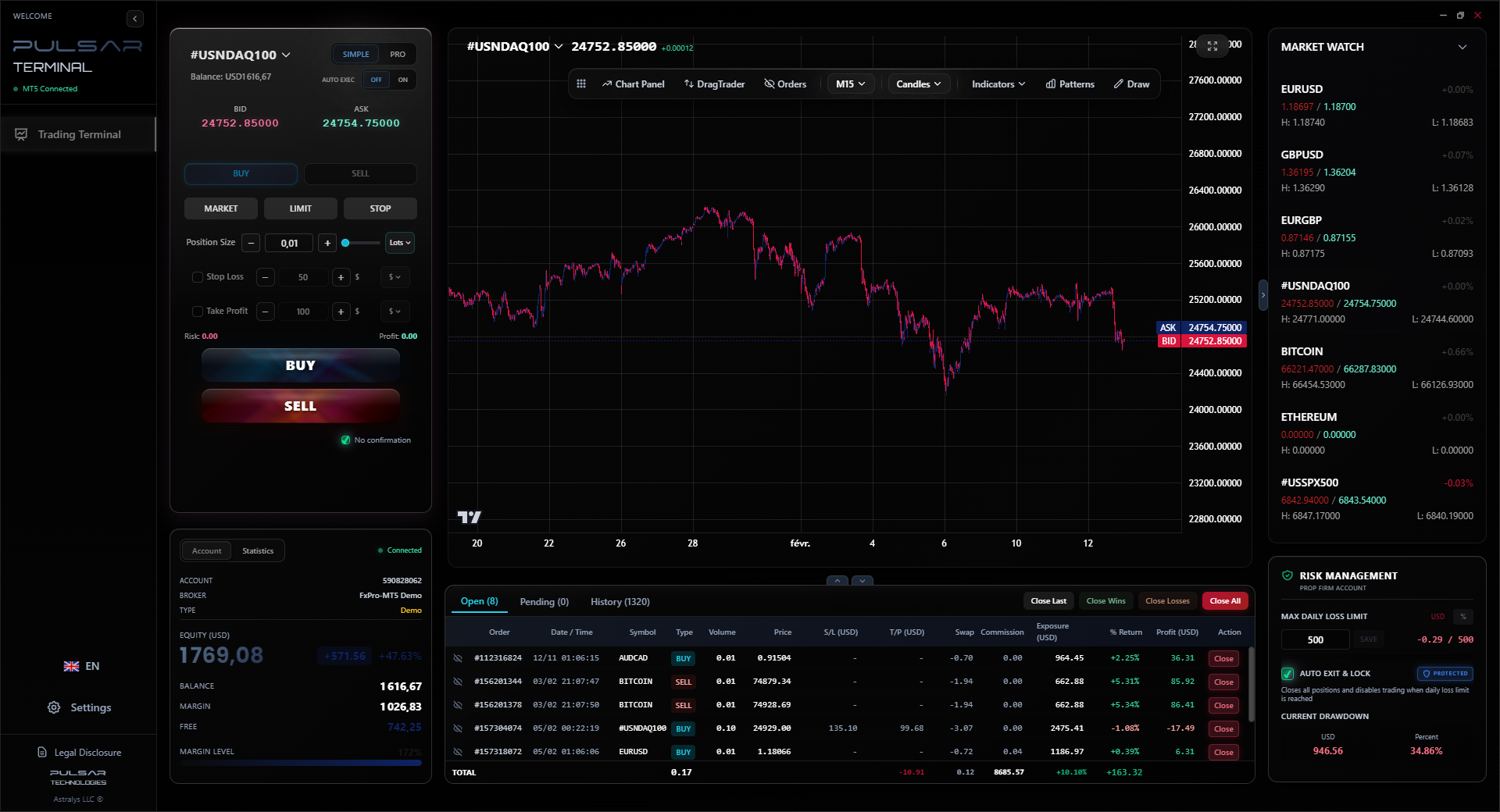
Managing these trades manually on a platform like MT5 can be stressful. That's where automation helps. Setting a trailing stop or a breakeven order automatically removes emotion. For example, tools like Pulsar Terminal can automate this directly on MT5, letting you set a rule like 'move stop to breakeven when price moves 1.5x my risk,' so you can focus on analysis, not order management.
💡 เคล็ดลับจาก Winston
Your stop-loss isn't a prediction of where the market will go. It's the price at which your reason for entering is proven wrong. Moving it is editing the truth.
Managing volatile commodity trades requires automated risk tools, and Pulsar Terminal provides trailing stops and breakeven orders directly on your MT5 platform.
Pulsar Terminal
เครื่องมือ MT5 ครบวงจร: ลากวางคำสั่ง, multi-TP/SL, trailing stop, grid trading, Volume Profile และการป้องกัน prop firm ใช้งานโดยเทรดเดอร์กว่า 1,000 คนทุกวัน
All brokers must be SEBI-registered, so that's your first check. Beyond that, you're looking for three things: cost, platform stability, and commodity-specific features.
Cost: Look beyond the advertised '₹20 per trade.' Scrutinize the full list: brokerage, exchange charges, CTT pass-through, and platform fees. Some brokers bundle it into a higher flat fee; others itemize. I prefer itemized so I know exactly what I'm paying. Also, check the margin requirements. They can vary slightly between brokers. A broker offering 85% margin on gold vs. 90% elsewhere means you need more capital for the same trade.
Platform: You need real-time data, reliable execution (especially during the US market open for crude), and good charting. Most Indian brokers have their own platforms (like Zerodha's Kite, Angel One). They're decent. But if you're a serious technical trader, you might want access to MT5. Some international brokers like Exness or IC Markets offer MT5 with access to Indian commodities, but you must ensure they are compliant with local regulations for Indian residents. The charting and indicator depth on MT5 is superior for developing a complex commodity trading strategy.
My experience: I started with a popular discount broker. The platform was fine for equities but clunky for commodities. Switching to a broker that offered direct MT5 access was a game-changer for my chart analysis, especially for using tools like Volume Profile to find key support and resistance levels in gold. Do your own research - read our detailed Exness review and IC Markets review to see how they stack up for commodity traders.
“Your job isn't to outsmart the market, but to understand its patterns and manage your risks.”
Let me save you some money by sharing where I and others have tripped up.
Trading Without a Catalyst: Entering a gold trade on a Tuesday afternoon with no scheduled news is often a chop-fest. Commodities move on data: US Non-Farm Payrolls, CPI, OPEC meetings, USDA reports. I have a economic calendar pinned next to my screens. No catalyst, no trade. It forces discipline.
Ignoring the USD/INR: This is critical for MCX. If international gold price is flat but the rupee is weakening, MCX gold will go up. You need to watch the USD/INR pair almost as closely as the commodity itself. A strong rupee can cap your gains on a global rally.
Overleveraging: Because margins can be as low as 10-12%, the temptation to over-use is huge. A ₹50,000 margin can control a ₹5 lakh gold contract. A 2% move against you wipes out 20% of your margin. It happens fast. Use the position size calculator religiously.
Forgetting About Taxes: Remember, this is business income. If you're trading actively, consider the presumptive taxation scheme under Section 44AD if your turnover is under ₹2 crore. It lets you pay tax on just 8% of your turnover as profit, simplifying things massively. Talk to a CA who understands trading.

Example: Bad Trade. I bought 1 lot of Crude Oil Mini (100 barrels) at ₹6,800, expecting a bounce. No specific catalyst. Stop-loss at ₹6,750 (50 point risk = ₹5,000). Price drifted to ₹6,770, I moved my stop to ₹6,760 'to give it room.' It spiked down on inventory data, hit my new stop, and kept going. Loss: ₹4,000. Mistake: No catalyst, emotional stop adjustment.
A commodity trading strategy isn't just the entry and exit. It's the process. Here's my weekly checklist.
Sunday Evening: Review the global economic calendar for the week. Flag the big ones: US Fed speeches, crude oil inventory (API/EIA), PMI data.
Pre-Market (8:30 AM): Check overnight moves in COMEX gold, NYMEX crude, LME metals. Check the USD/INR opening. This sets the tone for MCX.
Market Hours: I'm not staring at screens all day. I have my charts set with alerts at key levels. I execute my plan when the alert hits, then walk away. Overtrading is the death of good strategy.
Post-Market: Journal the trade. Why did I enter? Did the catalyst play out as expected? What was the spread cost? This log is more valuable than any indicator. I review it every Saturday morning.
Finally, start small. Trade the mini or micro contracts (like Gold Guinea or Crude Oil Mini) first. Get a feel for the volatility and the costs. Paper trade your commodity trading strategy on the agri side to understand the seasonal rhythms. This market has been around for centuries. Your job isn't to outsmart it, but to understand its patterns and manage your risks so you can be around to trade it for years to come.
For managing multiple trades and complex exits, the right tools are essential. Platforms that allow for multi-TP/SL with partial closures and automated trailing stops take the psychology out of the equation, letting your strategy run as planned. This is the edge you need in volatile commodity markets.
FAQ
Q1What is the minimum amount needed to start commodity trading in India?
There's no fixed minimum, but practically, you need enough to cover the margin and withstand volatility. For a mini contract of a cheaper agri commodity, you might start with ₹5,000-₹10,000. For something like gold, a more comfortable starting point is ₹40,000-₹60,000 to properly manage position size and risk on a single trade.
Q2How are commodity trading profits taxed in India?
Profits are treated as business income (usually non-speculative if traded on exchanges like MCX/NCDEX). They are added to your total income and taxed at your applicable income tax slab rate. You can also opt for the presumptive taxation scheme (Section 44AD) if your turnover is below ₹2 crore, where you pay tax on 8% of your turnover as profit.
Q3What is CTT, and do I have to pay it?
Commodity Transaction Tax (CTT) is a tax levied on the sale side of commodity futures and options contracts traded on recognized exchanges. For non-agricultural futures (like gold, crude), it's 0.01% of the transaction value. For options, it's 0.05% of the premium. Most agricultural commodities are exempt from CTT.
Q4Can I trade commodities intraday?
Absolutely. Intraday trading is very common in commodities, especially on MCX. However, be aware that the costs (spread, brokerage) can eat into smaller profits, so your strategy needs a sufficient profit target. Also, intraday trades settled in cash without delivery intent may be classified as speculative business income for tax purposes.
Q5What's the difference between trading gold on MCX and buying physical gold?
MCX gold is a futures contract - you're trading a promise to buy/sell gold at a future date. It's highly leveraged, allowing you to control a large value with a small margin. It's for price speculation or hedging. Buying physical gold is outright ownership with no use. MCX trading has expiry dates; physical gold does not.
Q6Is commodity trading riskier than stock trading?
It can be, primarily due to higher use and volatility driven by global events. A 5% move in a stock is significant; in crude oil, it can happen in a day. The risk isn't inherently higher, but the speed and magnitude of price moves require stricter risk management and position sizing than many equity traders are used to.
บทเรียนจาก Prof. Winston
สรุปสาระสำคัญ:
- ✓Trade MCX for global stories, NCDEX for local monsoons.
- ✓Always calculate full cost: brokerage + exchange fee + CTT + GST.
- ✓Never risk more than 1% of capital on a single trade.
- ✓Place stops on market structure, not arbitrary rupee amounts.
- ✓Your tax is business income, not capital gains. Plan for it.
บทความนี้มีประโยชน์แค่ไหน?
คลิกดาวเพื่อให้คะแนน
ข้อมูลเชิงลึกการเทรดรายสัปดาห์
การวิเคราะห์และกลยุทธ์รายสัปดาห์ฟรี ไม่มีสแปม
เกี่ยวกับผู้เขียน
Rajesh Sharma
นักวิเคราะห์ฟอเร็กซ์อาวุโส
ซื้อขายในตลาดอินเดียและเอเชียใต้มากกว่า 10 ปี เริ่มต้นจากอนุพันธ์สกุลเงินของ NSE ก่อนเข้าสู่ตลาดฟอเร็กซ์สากล เชี่ยวชาญคู่ USD/INR และคู่สกุลเงินตลาดเกิดใหม่
ความคิดเห็น
คำเตือนความเสี่ยง
การซื้อขายตราสารทางการเงินมีความเสี่ยงสูงและอาจไม่เหมาะสำหรับนักลงทุนทุกคน ผลการดำเนินงานในอดีตไม่ได้รับประกันผลลัพธ์ในอนาคต เนื้อหานี้มีวัตถุประสงค์เพื่อการศึกษาเท่านั้นและไม่ควรถือเป็นคำแนะนำในการลงทุน โปรดทำการวิจัยของคุณเองก่อนการซื้อขาย
คุณอาจชอบสิ่งนี้

Cara Trading Forex Sukses: 7 Prinsip dari Trader Profesional
Cara trading forex sukses dengan 7 prinsip trader pro: manajemen modal, disiplin, journal trading, backtest. Data nyata, bukan janji profit palsu.
Jam Trading Forex Terbaik untuk Trader Indonesia: Panduan Lengkap dengan Tabel Waktu
Panduan jam trading forex untuk trader Indonesia. Tabel 4 sesi dunia, jam emas 20:00-00:00, sesi mana yang harus dihindari. Data akurat + tips dari trader berpengalaman.
Top 5 Sàn Forex Uy Tín Nhất 2026: Review Jujur dari Trader Indonesia
Top 5 sàn forex uy tín 2026 untuk trader Indonesia. Review jujur: spread, deposit, withdraw, dukungan lokal. Exness, XM, IC Markets & lebih.
รับ Pulsar Terminal
เครื่องคำนวณทั้งหมดนี้ถูกสร้างไว้ใน Pulsar Terminal พร้อมข้อมูลเรียลไทม์จากบัญชี MT5 ของคุณ
รับ Pulsar Terminal