


Thinking about buying daily forex signals to shortcut your way to profits? You're not alone.

Olumide Adeyemi
ผู้บุกเบิกการเทรดในแอฟริกาตะวันตก ·  Nigeria
☕ 10 นาทีอ่าน
สิ่งที่คุณจะได้เรียนรู้:
- 1What Are Daily Forex Signals, Really?
- 2The Nigerian Signal Market: Hustles, Prophets & Scams
- 3How to Vet a Signal Provider (Without Losing Your Shirt)
- 4How to Actually Use Signals in Your Trading (The Right Way)
- 5The Endgame: Building Your Own Signal System
- 6Brokers, Tech, and Execution: The Nitty-Gritty
- 7The Final Verdict: Are Daily Forex Signals Worth It?

Thinking about buying daily forex signals to shortcut your way to profits? You're not alone. Every trader in Lagos, from the guy in a cyber cafe to the one with three screens in VI, has been tempted. I was too, back in the day. Let me save you some serious Naira and heartache by telling you exactly how this game works, what to look for, and when to run for the hills.
At their core, daily forex signals are just trade suggestions. Someone, or some algorithm, tells you: "Buy GBP/USD at 1.2550, stop loss at 1.2520, take profit at 1.2600." They get blasted out via Telegram, WhatsApp, SMS, or email, usually once or twice a day. Sounds simple, right? Just copy the trade and make money. If only.
The reality is far messier. A signal is just an entry, stop, and target. It doesn't tell you about the market context, the risk sentiment that day, or what the Central Bank of Nigeria (CBN) might be up to with the Naira. It's a snapshot without the story. I learned this the hard way early on. I followed a "guru's" signal to short EUR/USD. The entry was perfect, the analysis sounded smart. What the signal didn't mention was that the ECB was giving a major speech in 30 minutes. The pair spiked, hit my stop loss, and then reversed exactly as the signal predicted. The idea was right, but the timing and risk management were terrible. The signal provider got to say "I was right!" while I was left with a loss.
There are two main types: manual and automated. Manual signals come from a human analyst staring at charts. Automated ones are generated by a bot or algorithm scanning for specific conditions. Neither is inherently better. A good human understands nuance; a good bot doesn't get emotional. A bad version of either will blow up your account.
“A signal is a snapshot without the story. It's an entry, stop, and target, but none of the context that makes a trade intelligent.”
Naija, we have a special talent for the hustle, and the forex signal space is a prime example. Open Instagram or Facebook, and you'll be bombarded. Lamborghinis, stacks of dollars, screenshots of 1000-pip wins. It's a fantasy factory. Let's break down the common characters you'll meet.
The Instagram Prophet
This guy's entire proof is photoshopped MT4 screenshots and a rented supercar. His pitch is pure emotion: "God revealed this strategy to me." "Join my VIP group for N50,000 monthly and see miracles." They prey on hope and desperation. I once paid one of these characters $100 (about N150k at the time) for a month of "divine signals." The first week was small wins. The second week, a massive loss wiped out all profits and half my capital. When I asked for the logic, I was told to "have more faith." My faith was in my wallet, and it was emptying fast.
The Copy Trading Mirage
Some "services" aren't even signals; they offer to manage your account or let you copy their trades via a platform. The danger here is colossal. You're handing over direct access to your money. I've seen cases where the "manager" uses client funds to take wild risks, chasing losses to try and get back to breakeven, triggering a margin call for everyone involved.

Warning: Never, ever give your trading login details to a signal provider or "account manager." Legitimate copy trading is done through regulated platforms where they trade on their own account and you choose to mirror it, with no access to your funds.
The Legitimate(ish) Analyst
These are harder to find, but they exist. They might have a decent swing trading record. The key differentiator? Transparency. They show a verifiable, long-term track record (not just last week's wins). They talk about risk, losing trades, and market conditions. They don't promise daily riches. Their price might be high, but at least it's not a blatant scam.

💡 เคล็ดลับจาก Winston
The most expensive signal service is the one that works for a month. It teaches you to trust blindly, just before it fails spectacularly.

“The Instagram Prophet's entire proof is photoshopped MT4 screenshots and a rented supercar. His pitch is pure emotion.”
So you're still curious. Maybe you find someone who seems genuine. Before you send that bank transfer, do this detective work.
-
Demand a Real Track Record: Ask for a verified myfxbook or fxblue link. These are third-party sites that connect to a live MT4/MT5 account and automatically track every trade. It can't be easily faked. Look for at least 6-12 months of history. Check the drawdown (the biggest peak-to-valley drop in the account). If it's over 20%, walk away. Consistent 2-5% monthly gains with low drawdown are more impressive than 50% months followed by 40% crashes.
-
Analyze the Trade Logic: Don't just look at the profit. Ask why they took each trade. What was the setup? Was it a support bounce, a breakout, a news play? A provider who can't or won't explain their reasoning is just guessing. A good one will often share a chart snippet with the signal.
-
Test with a Demo Account: Any provider worth their salt will let you test their signals on a demo account for a week or two. Do it. Don't just watch the wins. See how they handle losses. What's the average risk/reward? I tested one provider promising 1:3 risk/reward. In reality, over 20 signals, it was 1:1.2. They were closing trades early for small profits and letting losses run. Demo revealed the truth.
-
Check Their Risk Management: Every signal must have a clear stop loss and take profit. No "we'll trail it" or "we'll decide later." That's a recipe for disaster. Use a position size calculator to see what their suggested lot size would do to your account. A signal telling you to risk 5% of your capital per trade is reckless.

“The Instagram Prophet's entire proof is photoshopped MT4 screenshots and a rented supercar. His pitch is pure emotion.”
Let's say you find a decent provider. The biggest mistake is blind following. Signals should be a tool, not a crutch. Here's how to integrate them without surrendering your brain.
Use Them as a Second Opinion: Do your own analysis first. Look at the charts. Maybe you were thinking of buying USD/JPY. If a signal comes in to sell it, that's a powerful contradiction that should make you pause and re-evaluate. It can prevent a bad trade.
Reverse-Engineer Their Edge: Don't just take the trade. Study it. Why did they enter there? Mark their entry, stop, and target on your chart. Watch how price behaves around those levels. Over time, you might start to see the pattern or strategy they're using. You're paying for an education, not just a ticket.
Manage Your Own Risk: The provider doesn't know your account size, your risk tolerance, or your other open positions. Their suggested lot size is generic. You must adjust it. If their signal risks 50 pips, but you only want to risk $50 on the trade, you need to calculate your own lot size. Never let a stranger determine how much you can lose.
Beware of Slippage & Spreads: A signal might say "Buy at 1.1050." By the time you get the alert, log in, and place the order, the price could be 1.1053. On a volatile day or with a slow broker, it could be worse. Also, if the trade is on a pair with a wide spread, your actual entry cost is higher. This is especially true for scalping strategies where targets are small. I once tried following scalping signals from Europe. The 5-pip target was immediately eaten up by the 3-pip spread and 2-pip slippage. I broke even on winning trades and lost big on losers.
💡 เคล็ดลับจาก Winston
If you wouldn't risk your own money on the logic behind a signal, don't risk it on the signal itself. Your brain must be part of the trade.
“For 95% of traders, paying for daily forex signals is a waste of money that slows down your education.”
Relying on someone else forever is a dead end. The real goal is to learn enough to generate your own high-probability ideas. This is where the work begins.
Start with a simple framework. Combine a trend-following tool with an oscillator for timing. For example, use price action to determine the trend (higher highs/higher lows). Then, use the RSI indicator to look for pullbacks into oversold territory in an uptrend. That's a basic buy signal you generated yourself.
Backtest it. Don't just guess. Go back on your chart and mark where your rules would have triggered trades over the last year. Use a demo account to forward-test it for a month. Write down every trade, the reason, and the outcome.
Refine your rules. Maybe you find that your RSI signals work better on the 4-hour chart than the 1-hour. Maybe adding a moving average filter improves your win rate. This process is slow, but it builds real, unshakeable confidence. I built my first crude system around the MACD indicator and support/resistance. It wasn't glamorous, but it was mine. I knew its weaknesses because I had coded them.

Example: Your rule: Buy when price pulls back to the 50-day moving average and the 4-hour RSI is below 30. In January, this happened 4 times on EUR/USD. 3 wins, 1 loss. Average win: 65 pips. Average loss: 40 pips. That's a track record you can trust because you built it.

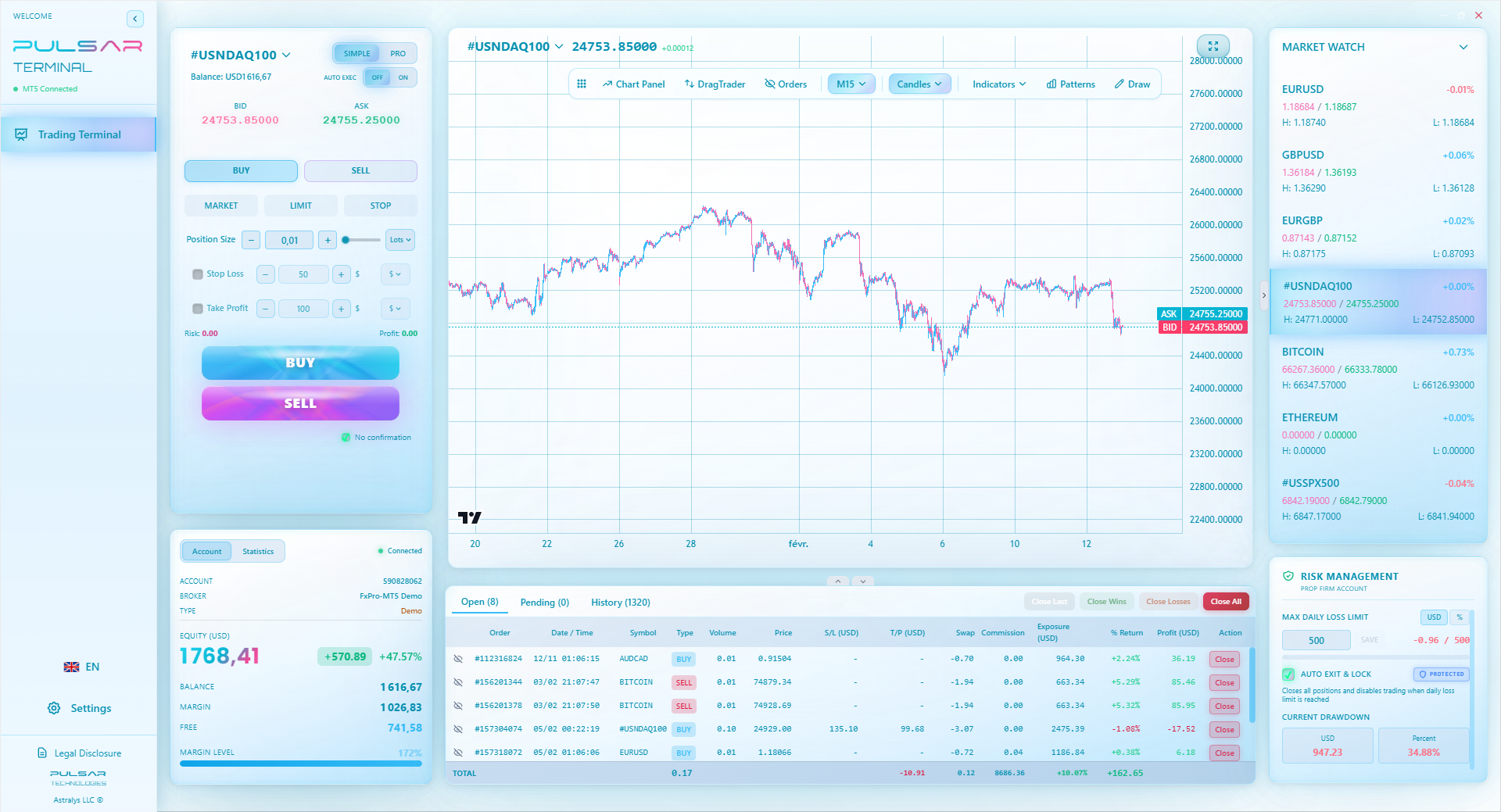
When building and testing your own signal system, precise order management and visualization are key, which is where a tool like Pulsar Terminal for MT5 shines.
Pulsar Terminal
เครื่องมือ MT5 ครบวงจร: ลากวางคำสั่ง, multi-TP/SL, trailing stop, grid trading, Volume Profile และการป้องกัน prop firm ใช้งานโดยเทรดเดอร์กว่า 1,000 คนทุกวัน
“For 95% of traders, paying for daily forex signals is a waste of money that slows down your education.”
Your broker and tech setup can make or break signal following, especially in Nigeria with our... unique internet challenges.
Choosing a Broker: You need a broker with fast, reliable execution and tight spreads. Slippage will kill signal profits. Look for brokers with strong local reputations and good technology. International brokers like IC Markets and Pepperstone are popular here for their raw spreads and fast execution. Some, like Exness, have a massive local presence. XM is another common choice. Do your research, read reviews, and start with a small live account to test their execution speed during Lagos peak hours.
The Tech Setup: Having the signal alert on your phone isn't enough. You need to be able to act fast. This means having MT5 or your trading platform open and ready, preferably on a computer with a stable connection (a good MiFi can be a lifesaver). Consider setting up price alerts on your platform at the signal's entry level so you're notified the moment it's hit, not when the provider's message finally comes through.
Automation? Some platforms allow for semi-automation. You can't fully auto-copy a signal (that's a different service), but you can have orders pre-set. The moment you get the signal, you just click to submit a pending order you already have ready. This shaves off precious seconds.
💡 เคล็ดลับจาก Winston
Spend N50,000 on trading books and a year of demo trading instead of a month of VIP signals. In one year, you'll have a skill. In one month, you'll have nothing.
“The market doesn't reward followers for long. It rewards those who learn its language.”
Here's my blunt opinion after 12 years: For 95% of traders, paying for daily forex signals is a waste of money that slows down your education.
You become passive. You stop learning to read the market because you're waiting for the next text. You develop no intuition. When the signal service eventually fails (and most do), you're left with nothing but an empty account and zero skill.
That said, there's a 5% use case. If you are a disciplined trader with your own strategy, using a signal from a respected analyst as a confirmation tool or an idea generator can have value. It's like having a trading buddy to bounce ideas off of. You're still the one making the final call, managing the risk, and pulling the trigger.
Invest the money you'd spend on signals into your education. Buy books. Take a reputable course. Fund a demo account and practice. The path is harder, but it's the only one that leads to lasting independence. The market doesn't reward followers for long. It rewards those who learn its language. Start learning.
FAQ
Q1Can I get rich quick by following daily forex signals?
No. Full stop. Anyone selling that dream is lying. Consistent profitability in forex requires deep understanding and risk management, which you cannot get from blindly following alerts. The quick-rich narrative is the hook for most scams.
Q2What is a realistic win rate for a good signal service?
Don't fixate on win rate. A service with a 70% win rate but a poor risk/reward ratio (e.g., risking 50 pips to make 20) can still lose money. Look for a combination of a win rate above 55% and an average risk/reward of at least 1:1.5. The key metric is the profit factor (total profits / total losses) over a long period; anything above 1.2 is decent, above 1.5 is very good.
Q3Are free forex signal groups on Telegram reliable?
Almost never. They are often run by unqualified individuals or used as a funnel to push you into a paid "VIP" group. The free signals are frequently low-quality or fake. Remember, if the strategy was so profitable, why would they give it away for free? They're either selling a dream or using you to create market movement (pump and dump on less liquid pairs).
Q4How much should I risk per trade when using a signal?
The same amount you'd risk on your own trades: never more than 1-2% of your trading capital. The signal provider does not know your financial situation. Use a position size calculator to determine the correct lot size based on the distance of the stop loss provided in the signal. This is non-negotiable.
Q5What's the difference between a forex signal and copy trading?
A signal is an instruction you manually execute. Copy trading is automated; you link your account to a master account, and trades are replicated automatically. Signals require your action and discretion. Copy trading is hands-off but requires extreme trust in the master trader's long-term strategy and risk management.
Q6I'm a beginner. Should I start with signals?
Absolutely not. It's the worst way to start. You'll learn nothing and develop terrible habits. Start with a demo account, learn the basics of what a pip is, how to read a chart, and what drives currency prices. Build a foundation first. Signals are for later-stage confirmation, not for training wheels.
บทเรียนจาก Prof. Winston
สรุปสาระสำคัญ:
- ✓Demand a verified 6-month track record, not testimonials.
- ✓Never risk more than 2% per trade, even on a "sure" signal.
- ✓Use signals as a second opinion, not a primary strategy.
- ✓Slippage and wide spreads can turn a winning signal into a loser.
- ✓The goal is to build your own system, not follow forever.
บทความนี้มีประโยชน์แค่ไหน?
คลิกดาวเพื่อให้คะแนน
ข้อมูลเชิงลึกการเทรดรายสัปดาห์
การวิเคราะห์และกลยุทธ์รายสัปดาห์ฟรี ไม่มีสแปม
เกี่ยวกับผู้เขียน
Olumide Adeyemi
ผู้บุกเบิกการเทรดในแอฟริกาตะวันตก
หนึ่งในนักการศึกษาฟอเร็กซ์ที่กระตือรือร้นที่สุดของไนจีเรีย 8 ปีประสบการณ์เทรดจากลากอส เชี่ยวชาญกลยุทธ์ทุนต่ำและความท้าทาย prop firm สำหรับเทรดเดอร์ในแอฟริกา
ความคิดเห็น
คำเตือนความเสี่ยง
การซื้อขายตราสารทางการเงินมีความเสี่ยงสูงและอาจไม่เหมาะสำหรับนักลงทุนทุกคน ผลการดำเนินงานในอดีตไม่ได้รับประกันผลลัพธ์ในอนาคต เนื้อหานี้มีวัตถุประสงค์เพื่อการศึกษาเท่านั้นและไม่ควรถือเป็นคำแนะนำในการลงทุน โปรดทำการวิจัยของคุณเองก่อนการซื้อขาย
คุณอาจชอบสิ่งนี้

Cara Trading Forex Sukses: 7 Prinsip dari Trader Profesional
Cara trading forex sukses dengan 7 prinsip trader pro: manajemen modal, disiplin, journal trading, backtest. Data nyata, bukan janji profit palsu.
Jam Trading Forex Terbaik untuk Trader Indonesia: Panduan Lengkap dengan Tabel Waktu
Panduan jam trading forex untuk trader Indonesia. Tabel 4 sesi dunia, jam emas 20:00-00:00, sesi mana yang harus dihindari. Data akurat + tips dari trader berpengalaman.
Top 5 Sàn Forex Uy Tín Nhất 2026: Review Jujur dari Trader Indonesia
Top 5 sàn forex uy tín 2026 untuk trader Indonesia. Review jujur: spread, deposit, withdraw, dukungan lokal. Exness, XM, IC Markets & lebih.
รับ Pulsar Terminal
เครื่องคำนวณทั้งหมดนี้ถูกสร้างไว้ใน Pulsar Terminal พร้อมข้อมูลเรียลไทม์จากบัญชี MT5 ของคุณ
รับ Pulsar Terminal