


You've finally started making consistent profits from forex trading.

David van der Merwe
เทรดเดอร์ตลาดเกิดใหม่ ·  South Africa
☕ 9 นาทีอ่าน
สิ่งที่คุณจะได้เรียนรู้:
- 1How SARS Sees Your Trading: Income vs. Capital
- 2The 2026 Numbers: What You'll Actually Pay (and Keep)
- 3Provisional Tax: The System That Catches Everyone Off Guard
- 4Your Trading Bible: Records, Brokers, and The FSCA
- 5How Traders Get Destroyed by SARS (And How to Avoid It)
- 6Your 2026 Action Plan: From Chaos to Compliance
You've finally started making consistent profits from forex trading. The adrenaline rush of a winning trade is familiar now. Then, a cold thought hits you in the middle of the night: 'Do I pay tax on forex trading in South Africa?' Let me stop you right there. The answer isn't a simple yes or no. It's a 'hell yes, and if you don't, SARS will find you.' I've seen too many traders get wiped out by a tax bill they never saw coming. This isn't about theory; it's about keeping the money you worked for.
This is the single most important concept you need to get right. SARS doesn't care what you call yourself. They look at what you actually do.
If you're trading frequently, aiming for short-term profits from price movements, you're a speculator. Full stop. In SARS's eyes, your profits are ordinary revenue. That means every rand you make gets added to your other income (your salary, rental income, etc.) and taxed at your marginal income tax rate. We're talking the full progressive scale, from 18% up to 45%.
Now, you might be thinking, 'But I'm an investor!' Maybe you hold positions for weeks or months. SARS might consider this for Capital Gains Tax (CGT) treatment, but it's an uphill battle. They'll assess your intent, frequency, and organization. Are you keeping detailed records like a business? Using a scalping strategy? You're likely a revenue trader.
Here’s the brutal truth: the default assumption for active retail traders is income tax. The CGT route is the exception, not the rule.

Warning: Don't try to cleverly structure your trading to fit CGT unless you have a tax professional guiding you. Getting this wrong means penalties, interest, and a massive headache.
The Inclusion Rate Loophole (Sort Of)
If, and only if, your trading is deemed a capital gain, you get a break. Only 40% of the net gain is included in your taxable income. So, if you made R100,000, only R40,000 is added to your income and taxed at your rate. The effective maximum tax on that gain is 18% (45% of 40%). This is why everyone wants CGT status, but wanting it doesn't make it so.
Let's talk real numbers. The 2026/27 tax year brought some relief with full inflation adjustments. Here’s what you're working with.
Income Tax Rates (for Revenue Traders):
| Taxable Income (R) | Rate |
|---|---|
| 1 – 245,100 | 18% |
| 245,101 – 384,200 | 26% |
| 384,201 – 512,800 | 31% |
| 512,801 – 673,000 | 36% |
| 673,001 – 857,900 | 39% |
| 857,901 – 1,878,601 | 41% |
| 1,878,601+ | 45% |
Your Secret Weapon: Deductions This is where you fight back. If you're taxed as a revenue trader, you can deduct expenses "incurred in the production of income." This is huge. You can legitimately subtract:
- Trading platform fees & data subscriptions: That MT5 premium data feed? Deductible.
- Hardware & Software: The portion of your computer, monitors, and internet used for trading. Keep a log.
- Education: Trading courses, books, seminars. (Yes, really).
- Home Office Expenses: If you have a dedicated trading space.
- Professional Fees: Accountant and legal fees for your trading business.
I once had a student who made R300,000 in profit. By carefully tracking his R40,000 in legitimate expenses (new PC, course, portion of rent), he reduced his taxable profit to R260,000. That moved him from the 36% bracket down into the 31% bracket for a chunk of his income. He saved over R15,000 in tax. That's a new trading laptop right there.

Example:
- Gross Trading Profit: R500,000
- Legitimate Expenses: R65,000 (Computer, software, courses, internet)
- Taxable Income: R435,000 Without deductions, tax on R500k is roughly R143,258. With deductions, tax on R435k is roughly R116,258. You just saved R27,000.
Don't sleep on the Tax-Free Savings Account (TFSA) either. The annual limit is now R46,000 (R500,000 lifetime). You can't trade forex directly in most TFSAs, but the growth on any investments inside is completely tax-free. Use it for your long-term investment bucket.

💡 เคล็ดลับจาก Winston
Your first profitable year, hire a tax pro. The cost is a business expense, and the peace of mind is priceless. Trying to DIY complex provisional tax is a great way to turn profits into penalties.
“The system is designed to catch the unaware, and it works perfectly.”
This is the part that breaks new traders. If you have a normal job, your employer withholds your tax (PAYE). As a forex trader, you don't have an employer. You are a provisional taxpayer. This means SARS expects you to pay your tax as you earn, in installments, during the year.
You must file an IRP6 return and make payments twice a year:
- First Period: Ends August 31. You estimate your total year's tax liability and pay half.
- Second Period: Ends February 28. You pay the remainder based on a revised estimate.
If you still owe money after your second estimate, there's a third period (September 30) to settle up.
Here's my painful lesson. In my third year trading, I had a killer first half. I made R200,000 profit by July. I was celebrating, reinvesting, the whole deal. I completely forgot about the August provisional payment. Come February, I got a letter from SARS with a penalty for underpayment. I owed not just the tax, but interest on the late amount. It wiped out the profits from three solid months of work. I felt like an idiot. The system is designed to catch the unaware, and it works perfectly.
You need to set aside a percentage of every single withdrawal you make for tax. I treat it like a non-negotiable cost of business, right up there with the spread. Open a separate savings account and drip-feed it every month.
If you get audited (and with rising forex profits, chances are increasing), your trading log is your only defense. It's not complicated, but it must be careful.
You MUST keep records of:
- Every trade: Entry/exit price, date, time, instrument (e.g., EUR/USD), position size.
- All statements from your broker (monthly, yearly).
- All deposits and withdrawals, with proof (bank statements).
- All expenses, with invoices.
- A summary P&L statement.
Broker Regulation is Non-Negotiable You must use an FSCA-regulated broker. Why? Safety, sure. But for tax, it's about legitimacy. SARS is less likely to question income from a well-regulated entity like Exness or Pepperstone (both have FSCA licenses) than from some offshore shell company. It makes your life easier. Also, FSCA brokers must segregate client funds and adhere to strict reporting. This protects you from fraud and gives you clean, official statements for SARS.
I recommend brokers that offer detailed, downloadable trade history reports in CSV format. Manually logging 100 trades a month is a recipe for disaster and errors. Automate as much as you can.

Pro Tip: At the end of each month, block out one hour. Download your statement, update your master spreadsheet (Google Sheets or Excel), and reconcile your account balance. Do it while it's fresh. Future-you will want to hug past-you.
💡 เคล็ดลับจาก Winston
Treat your tax savings account like a mandatory trade cost. The moment you withdraw profit, send 25-30% of it straight to that account. Don't let it touch your spending money.
“Thinking about taxes won't make you a better trader, but not thinking about them can end your trading career.”
Let's look at the cliffs you need to steer clear of.
Mistake 1: The Ostrich Approach. 'If I don't declare it, SARS won't know.' Wrong. Financial institutions report large or suspicious transactions to the FIC, which shares data with SARS. That R150,000 withdrawal from your IC Markets account to your FNB account? It's flagged. SARS's automated systems are scarily good. The penalty for non-disclosure starts at 10% of the tax owed and can go much higher.
Mistake 2: Mixing Personal and Trading Money. This is a bookkeeping nightmare. Open a separate bank account exclusively for trading. All deposits to your broker come from this account. All withdrawals go back into it. All expenses are paid from it. This creates a clear audit trail and saves your sanity.
Mistake 3: Ignoring Currency Conversion. You trade in USD, but pay tax in ZAR. You must convert your profits/losses to Rand using the official SARS exchange rate for the day of the transaction. Your broker's ZAR equivalent on a statement might not use the correct rate. You need to do this calculation yourself for each trade. It's tedious, but mandatory.
Mistake 4: Not Planning for a Bad Year. You pay provisional tax based on an estimate. If you estimate R500k profit but only make R100k, you've overpaid. That's okay, you'll get a refund. But if you estimate R100k and make R500k, you've underpaid and will face penalties. If you have a volatile strategy, be conservative with estimates or get professional help.
The biggest penalty isn't always financial. It's the stress, the time spent dealing with SARS, and the potential black mark on your financial record. It's not worth the risk.
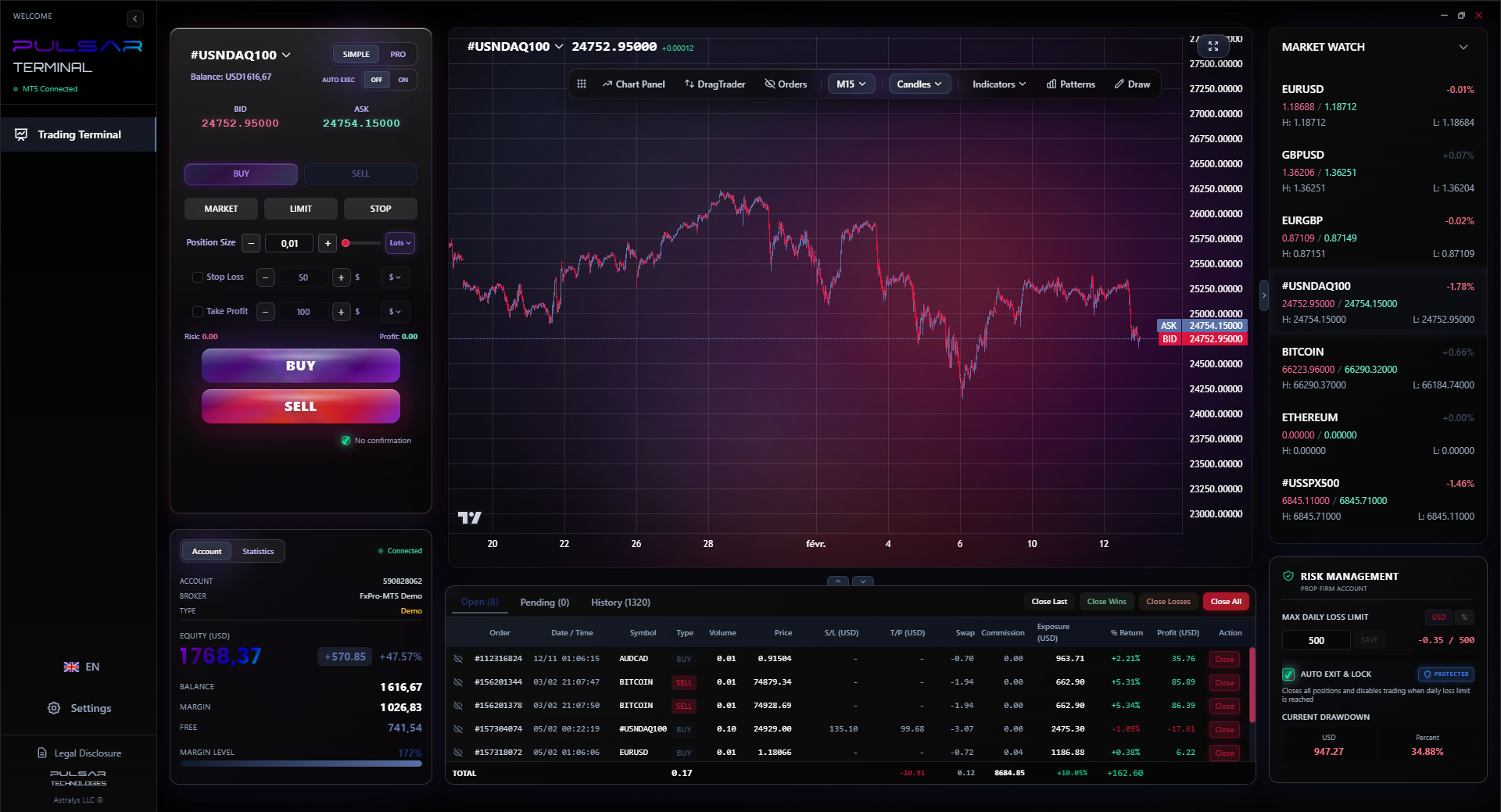
Accurate trade logging is the foundation of tax compliance, and Pulsar Terminal's advanced journaling and reporting features can automate this directly from your MT5 trades.
Pulsar Terminal
เครื่องมือ MT5 ครบวงจร: ลากวางคำสั่ง, multi-TP/SL, trailing stop, grid trading, Volume Profile และการป้องกัน prop firm ใช้งานโดยเทรดเดอร์กว่า 1,000 คนทุกวัน
Stop feeling overwhelmed. Here is your step-by-step plan for this tax year.
Step 1: Gather Your Evidence (Right Now) Log into every broker account you've used in the past 3 years (XM, etc.). Download all monthly statements and trade history reports. If you can't find them, contact support. This is your baseline.
Step 2: Create Your Master Ledger Start a simple spreadsheet. Columns: Date, Pair, Action (Buy/Sell), Entry Price, Exit Price, P&L (USD), Exchange Rate, P&L (ZAR). Input your historical trades. Yes, it will take a weekend. Do it.
Step 3: Find a Tax Professional Not just any accountant. Find one who has clients who trade. Ask them directly: 'Have you filed tax returns for forex traders?' If they hesitate, move on. Their fee is a deductible expense and your best insurance policy. They'll help you with the IRP6 provisional returns.
Step 4: Calculate Your Provisional Liability With your pro, look at your year-to-date profit. Project conservatively for the rest of the year. Calculate the tax. Set up that separate savings account and transfer the money for your August payment.
Step 5: Systematize Your Future Trading From today forward, every trade gets logged immediately. I use a simple journal app on my phone right after I execute. Every expense gets a photo of the receipt saved to a dedicated cloud folder. One hour on the last Saturday of the month for reconciliation. No exceptions.
Thinking about taxes won't make you a better trader, but not thinking about them can end your trading career. Get this admin side solid, and you trade with peace of mind. That's when you make your best decisions.
💡 เคล็ดลับจาก Winston
If you're serious about trading as a business, get a separate business bank account and credit card. The clean paper trail will save you weeks of headache come tax season.
FAQ
Q1Is forex trading legal in South Africa?
Yes, absolutely. It's legal and regulated by the Financial Sector Conduct Authority (FSCA). You must use an FSCA-licensed broker. The old rule about not speculating against the Rand is largely irrelevant for trading through these regulated international brokers.
Q2What is the tax-free threshold for forex trading income?
There is no special tax-free threshold for trading income. It's added to your total taxable income. The first R245,100 of your total annual income (from all sources, including trading) is taxed at 18%. So if your only income is from trading, your first R245,100 in profit is taxed at 18%.
Q3Can I trade forex through my company to pay less tax?
Possibly. Companies pay a flat 27% corporate income tax (for 2026/27). This can be lower than the top personal rates (41-45%). However, running a company has additional costs (accounting, audits), and when you take money out as a salary or dividend, you may be taxed again. It only makes sense once your profits are consistently high. Talk to a professional.
Q4Do I pay tax on demo account profits?
No. Tax is only levied on real, realized profits. Demo trading is practice. The moment you fund a live account and execute a real trade, the tax implications begin.
Q5What if I make a loss in a tax year?
If your trading is classified as revenue, the net loss can be offset against your other income (like your salary), reducing your overall tax bill. If it's classified as capital, a capital loss can only be offset against other capital gains in the current or future years. This is another reason getting the classification right is critical.
Q6How does SARS know about my forex profits?
Through several channels: 1) Your bank reports large deposits from foreign brokers. 2) The FSCA-regulated broker may have reporting obligations. 3) If you are audited, SARS can directly request your trading statements. 4) Third-party data sharing agreements. Assume they will find out.
Q7Can I deduct losses from previous years?
Yes, but with rules. Revenue losses can be carried forward indefinitely to offset future trading income. Capital losses can be carried forward to offset future capital gains. You must have declared those losses in the original year's return to carry them forward.
บทเรียนจาก Prof. Winston
สรุปสาระสำคัญ:
- ✓SARS treats frequent trading as income, taxed up to 45%.
- ✓Deduct all legitimate expenses: courses, software, hardware.
- ✓You MUST pay provisional tax twice a year (Aug & Feb).
- ✓Use only FSCA-regulated brokers for clean records.
- ✓Keep a careful, trade-by-trade log in ZAR.
บทความนี้มีประโยชน์แค่ไหน?
คลิกดาวเพื่อให้คะแนน
ข้อมูลเชิงลึกการเทรดรายสัปดาห์
การวิเคราะห์และกลยุทธ์รายสัปดาห์ฟรี ไม่มีสแปม
เกี่ยวกับผู้เขียน
David van der Merwe
เทรดเดอร์ตลาดเกิดใหม่
เทรดเดอร์ประจำโจฮันเนสเบิร์ก มีประสบการณ์ 11 ปีในสกุลเงินตลาดเกิดใหม่ เชี่ยวชาญคู่ ZAR การเทรดภายใต้กฎระเบียบ FSCA และการวิเคราะห์ตลาดแอฟริกาใต้
ความคิดเห็น
คำเตือนความเสี่ยง
การซื้อขายตราสารทางการเงินมีความเสี่ยงสูงและอาจไม่เหมาะสำหรับนักลงทุนทุกคน ผลการดำเนินงานในอดีตไม่ได้รับประกันผลลัพธ์ในอนาคต เนื้อหานี้มีวัตถุประสงค์เพื่อการศึกษาเท่านั้นและไม่ควรถือเป็นคำแนะนำในการลงทุน โปรดทำการวิจัยของคุณเองก่อนการซื้อขาย
คุณอาจชอบสิ่งนี้

Cara Trading Forex Sukses: 7 Prinsip dari Trader Profesional
Cara trading forex sukses dengan 7 prinsip trader pro: manajemen modal, disiplin, journal trading, backtest. Data nyata, bukan janji profit palsu.
Jam Trading Forex Terbaik untuk Trader Indonesia: Panduan Lengkap dengan Tabel Waktu
Panduan jam trading forex untuk trader Indonesia. Tabel 4 sesi dunia, jam emas 20:00-00:00, sesi mana yang harus dihindari. Data akurat + tips dari trader berpengalaman.
Top 5 Sàn Forex Uy Tín Nhất 2026: Review Jujur dari Trader Indonesia
Top 5 sàn forex uy tín 2026 untuk trader Indonesia. Review jujur: spread, deposit, withdraw, dukungan lokal. Exness, XM, IC Markets & lebih.
รับ Pulsar Terminal
เครื่องคำนวณทั้งหมดนี้ถูกสร้างไว้ใน Pulsar Terminal พร้อมข้อมูลเรียลไทม์จากบัญชี MT5 ของคุณ
รับ Pulsar Terminal