


Here's a fact that will ruffle some feathers: the average female forex trader in Nigeria has a statistical edge over her male counterpart from day one.

Olumide Adeyemi
ผู้บุกเบิกการเทรดในแอฟริกาตะวันตก ·  Nigeria
☕ 11 นาทีอ่าน
สิ่งที่คุณจะได้เรียนรู้:
Here's a fact that will ruffle some feathers: the average female forex trader in Nigeria has a statistical edge over her male counterpart from day one. I'm not saying it's easy, but the data doesn't lie. While men are busy over-trading and ego-trading, women are quietly building accounts. The problem is, most new traders, regardless of gender, are fed the same garbage about getting rich quick. They never learn the real game, which is about survival first, consistency second, and profits third. This guide isn't about 'girl power' platitudes. It's a frank, evidence-based manual for the Nigerian woman who wants to trade seriously. We'll break down why your potential advantage is real, how to structure your trading around it, and the specific realities of trading from Nigeria.
Let's cut through the noise. Globally, women make up a small minority of traders - around 10%. But in Nigeria, that's changing fast. In the year leading up to March 2021, there was a 46% surge in women registering trading accounts. That's not a fluke. It's a movement.
The real kicker? Performance. Multiple studies, including one from a major social trading platform, show that women consistently outperform men by about 1.8% annually. Think about that. In a game where a 5-10% annual return is considered excellent, a nearly 2% edge is massive. It's the difference between blowing up and building wealth.
Why does this happen? It's not magical. It's behavioral.
Men tend to trade more frequently, chasing every blip on the chart. It's a testosterone-fueled confidence (or overconfidence) game. They ignore their position size calculator and risk 5% on a 'sure thing.' Women, broadly speaking, approach it more like portfolio management. There's more research, more patience, and a healthier respect for risk. You're less likely to revenge-trade after a loss and more likely to stick to a plan. This isn't a stereotype; it's what the aggregated trade data shows. Your natural inclination to be more deliberate is your first and biggest asset. Don't let any 'guru' talk you out of it.

💡 เคล็ดลับจาก Winston
Your greatest edge is patience. The market will always be there tomorrow. A missed opportunity is infinitely better than a forced, bad trade.
Before we build your strategy, let's autopsy the common failures. I've seen this pattern a thousand times. It starts with a demo account win streak. Then, with real money, the psychology shifts completely.
The use Trap
This is the number one account killer, especially with Nigerian brokers offering insane use like 1:2000 or 1:1000. I see it all the time. A trader deposits ₦50,000, gets 1:1000 use, and suddenly they're controlling a ₦50 million position. They think, 'Small move, big profit!' What they forget is the inverse: a small move against them is a 100% loss. A 10-pip move on a standard lot with that use can wipe out a huge chunk of their capital. They don't understand margin call mechanics until it's too late.

Warning: use is a tool, not a strategy. Using 1:1000 use is like doing brain surgery with a chainsaw. You might get lucky once, but the mess is inevitable.
The Overtrading Disease
This is where the gender performance gap often widens. Boredom sets in. The market is slow, so you take a mediocre trade just to 'be in the game.' This is a tax on your account. Every trade has a cost - the spread definition. If your broker's spread on EUR/USD is 1.6 pips, you start that trade 1.6 pips in the hole. Do that 10 times a day with no edge, and you're just donating money to the broker. I blew my first $2000 account this way in 2012, taking 20-30 scalps a day on the EUR/USD guide until my capital was just... gone. It felt like activity, but it was just expensive entertainment.
The Prop Firm Mirage
Prop firms are huge in Nigeria. They promise you a $100,000 account if you pass a challenge. Sounds great, right? Here's the dirty secret: their rules are designed to make you fail. They impose strict daily loss limits (e.g., 5%) and overall drawdown limits that force you into a scared, tiny position size where making the profit target becomes a statistical nightmare. You're trading not just the market, but their punitive rulebook. The pressure makes even good traders freeze up.
“A 1.8% annual performance edge isn't just a statistic; it's the difference between blowing up and building wealth.”
You can't win with a bad setup. In Nigeria, this means choosing the right broker, understanding costs, and getting your money in and out safely.
Broker Selection is Critical: You want a broker that is stable, has clear regulation (even if offshore), and accepts Naira. Many top international brokers cater to Nigeria. For example, Exness review offers NGN accounts and local deposits, while IC Markets review is famous for its raw spreads. XM review and Pepperstone review are also solid, reputable choices. Don't get dazzled by the highest use offer. Look at the spreads on the pairs you'll actually trade and their deposit/withdrawal process.
Understand the Real Costs:
| Cost Type | What It Is | Nigerian Example |
|---|---|---|
| Spread | Difference between buy/sell price | 1.5 pips on USD/NGN |
| Commission | Fixed fee per trade | $3.50 per lot (common on RAW accounts) |
| Swap/Overnight | Fee for holding a position past 5 PM EST | Can be positive or negative |
| Payment Fees | Bank or processor charges for funding | Your bank may charge for international transfer |
A trade isn't just 'win or lose.' It's 'win minus costs' or 'lose plus costs.' If your average win is 10 pips, but your spread + commission costs you 2 pips, your real win is 8 pips. You need a strategy that accounts for this friction.
Taxes: Yes, you have to pay. Profits are considered capital gains, taxable at 10%. Keep a detailed trade journal. The FIRS may not be knocking today, but if you build significant wealth, you need to be clean.
Forget the 1-minute chart. Your statistical advantage is patience and risk management, not lightning-fast reflexes. You should lean into that.
Swing Trading Over Scalping: For most new female traders in Nigeria, swing trading is a perfect fit. You're looking at the 4-hour or daily charts, holding trades for days or weeks. This aligns with a more research-based, less impulsive approach. You're not fighting the scalping strategy crowd and their high-speed bots. You're analyzing broader trends. A classic setup is using the MACD indicator on a daily chart for trend direction and the RSI indicator on the 4-hour to find potential entry points during pullbacks.
My Personal Gold Trade: In early 2023, I was watching XAU/USD guide (Gold). The daily chart showed a strong bounce off a key support level around $1810. The MACD was turning up from deep negative territory. Instead of jumping in, I waited. I set an alert for a pullback to $1825 on the 4-hour chart. It hit three days later. My entry was $1825.80. I placed my stop loss at $1815 (a sensible 10.8 points/1% of my account risk). My target was the previous weekly high near $1880. I walked away. It took two weeks, but the trade hit my target. Profit: ~54 points. The work was in the analysis and the patience, not in staring at screens.
Position Sizing is Everything: This is where you lock in your edge. Never, ever risk more than 1-2% of your account on a single trade. If you have a ₦100,000 account, your max risk per trade is ₦1,000-₦2,000. Use a position size calculator for every single trade. This one habit will keep you in the game longer than 90% of other traders.
💡 เคล็ดลับจาก Winston
If you wouldn't risk ₦1,000 on a bet with a friend, don't risk it on a trade. Trading is just a series of calculated, documented bets.
“Using 1:1000 use is like doing brain surgery with a chainsaw. You might get lucky once, but the mess is inevitable.”
Your mindset will make or break you. The market is designed to trigger every emotional flaw you have.
The Isolation Problem: Trading can be lonely. In Nigeria, you might be the only person in your social circle doing this. For women, this can be compounded by unsupportive family who see it as gambling, not a business. You need to find your community - not a signal-chasing WhatsApp group, but a serious forum or network of process-oriented traders. It keeps you sane.
Dealing with Losses: You will have losing trades. A lot of them. A 40% win rate with good risk/reward can be highly profitable. The key is to not let a loss become an emotional event. It's just the cost of doing business. I keep a 'loss journal.' After a losing trade, I write down the setup. Was it a valid setup according to my rules? If yes, I note 'Good Process, Bad Outcome' and move on. If I broke my rules, I note the specific mistake. This turns loss from a failure into data.
The Pressure of 'Side Hustle' Culture: In Nigeria, there's immense pressure to monetize everything. Trading shouldn't be a 'side hustle' to pay for airtime next week. That need forces terrible trades. View it as a capital allocation business you're building over years. Your first goal is not to make money. Your first goal is to not lose money. The profits come after you've mastered survival.

Pro Tip: Have a 'pre-flight checklist' on a sticky note next to your screen. Mine says: 1) Is this my chart timeframe? 2) Did I calculate position size? 3) Is my stop loss set? 4) Am I calm? No trade unless all are 'Yes.'
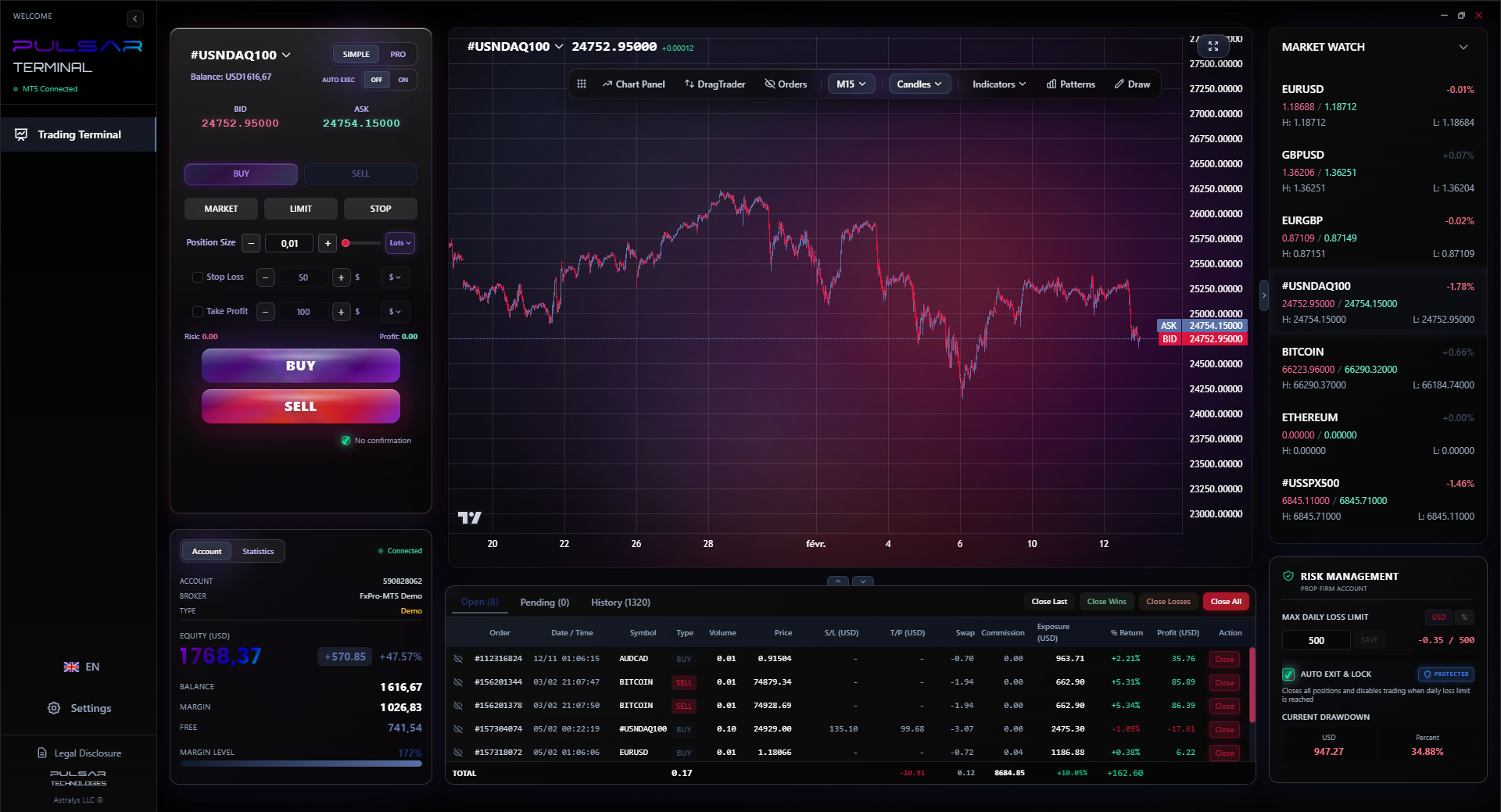
Managing the psychology of multiple trades is easier when your platform handles the mechanics, like setting automatic breakeven or trailing stops on your MT5 charts.
Pulsar Terminal
เครื่องมือ MT5 ครบวงจร: ลากวางคำสั่ง, multi-TP/SL, trailing stop, grid trading, Volume Profile และการป้องกัน prop firm ใช้งานโดยเทรดเดอร์กว่า 1,000 คนทุกวัน
Trading from Nigeria isn't the same as trading from London. You have to adapt.
The Naira Pair (USD/NGN): It's tempting to trade your local currency. Be warned, it can be highly volatile and subject to CBN policy shocks (like the new Foreign Exchange Code in 2024). Liquidity can dry up. I treat it more like an exotic pair - wider spreads, unpredictable jumps. It's not for beginners. Stick to the major pairs like EUR/USD or GBP/USD where the global liquidity is deep and spreads are tight.
Internet and Power: This is your operational risk. A power cut during a live trade is a nightmare. Solution: a reliable inverter/solar setup and a mobile data backup from a different provider than your main WiFi. It's a non-negotiable business expense.
Local Regulations: The CBN's focus is on macro stability and banking flows, not on shutting down individual retail traders using international brokers. The 2024 reforms (like the Electronic FX Matching System) are about the institutional market. Your main regulatory risk is with your chosen broker's overseas regulator (like the Seychelles FSA or CySEC). Always choose a broker with a real license.
Funding Your Account: Use the methods your broker offers that have the lowest cost for you. Fintech wallets (like Opay, Moniepoint) are often faster and cheaper than direct bank transfers for funding broker accounts that accept them. Always check the exchange rate used for converting your Naira deposit to USD in your trading account - sometimes hidden fees live there.
💡 เคล็ดลับจาก Winston
The 'secret' isn't a magical indicator. It's surviving 1000 trades with solid risk management. Profits are a byproduct of survival.
“Your first goal is not to make money. Your first goal is to not lose money. The profits come after you've mastered survival.”
Here's what your first year should look like. This is the boring, unsexy path that works.
Months 1-3: Demo & Education (Zero Naira Risk) Pick one major currency pair. Learn everything about it. Paper trade your swing strategy on a demo account. Your goal is not profit. Your goal is to execute 25 trades with perfect adherence to your checklist and journaling. If you can't be disciplined with fake money, you have zero chance with real money.
Months 4-6: Live Micro-Account (Risk Capital You Can Afford to Lose) Deposit the smallest amount your broker allows - maybe $50 or ₦25,000. The amount should be meaningless to your life. Your goal is to make 50 live trades. The focus? Emotional control and consistent position sizing. The P&L is irrelevant. I started my 'real' journey with a $100 account at IC Markets review. I lost $30 over 6 weeks. But I learned more about my own fear during those losses than in 6 months of demo trading.
Months 7-12: Scaling the Process After 75 total trades (25 demo + 50 live), you'll have data. What's your actual win rate? Your average win vs. average loss? Now you can start to cautiously scale your position size, but never your risk percentage. If your account grew 20%, you can increase your trade size by 20%, but you're still only risking 1% of the new account size. This is how you grow sustainably.
Remember, the successful female forex traders in Nigeria you might hear about didn't get there by luck. They got there by treating trading like a rigorous, evidence-based business. They used their natural patience as a weapon, managed risk like a hawk, and ignored the noise. You can do exactly the same.
FAQ
Q1Is forex trading legal for women in Nigeria?
Yes, absolutely. Forex trading is legal for all individuals in Nigeria. The Central Bank of Nigeria (CBN) regulates the financial system, but there is no law preventing you from opening an account with an international broker. Your responsibility is to report any profits for tax purposes.
Q2Why do studies say women are better traders?
It's primarily down to psychology and behavior, not innate skill. The data shows women tend to trade less frequently, conduct more research before trading, and are generally more risk-averse. This leads to fewer impulsive, loss-making trades. Men often overtrade and take on excessive risk, which erodes their accounts over time.
Q3What is a realistic amount to start trading with in Nigeria?
Start with an amount you can afford to lose completely without affecting your life - this is 'risk capital.' For many, this could be as low as ₦20,000 to ₦50,000. Many brokers like XM or FBS allow minimum deposits of $5-$10. The goal of your first deposit isn't to get rich, it's to learn the emotional and practical aspects of live trading with real, but insignificant, money.
Q4How do I handle family pressure or criticism about trading?
This is very common. Frame it as a skill-based business you are learning, not gambling. Have a clear plan and a demo account to show your process. Often, the best approach is to quietly build your knowledge and small account until you have consistent results. Proof of concept is the most powerful argument against criticism.
Q5Which trading platform is best for beginners in Nigeria?
MetaTrader 4 (MT4) or MetaTrader 5 (MT5) are the industry standards and for good reason. They are stable, widely supported by all brokers, and have a user-friendly interface. Almost every educational resource or indicator tutorial is based on MT4/5. Start there before exploring any broker's proprietary platform.
Q6How do I pay taxes on my forex trading profits?
Forex trading profits are considered capital gains in Nigeria. You are liable to pay a 10% Capital Gains Tax to the Federal Inland Revenue Service (FIRS). It is crucial to keep detailed, dated records of all your trades (profit/loss statements from your broker are essential) and declare the income in your annual tax return.
Q7Should I trade the Naira (USD/NGN) pair?
I advise beginners to avoid it. While it's familiar, it's prone to sudden volatility due to CBN policy changes and can have wide spreads. It behaves more like an exotic currency pair. It's better to learn the craft on highly liquid, stable majors like EUR/USD where market mechanics are more predictable and educational resources are plentiful.
บทเรียนจาก Prof. Winston
สรุปสาระสำคัญ:
- ✓Women outperform men by ~1.8% annually due to behavior, not skill.
- ✓Never risk more than 1-2% of your capital on any single trade.
- ✓Choose swing trading over scalping to use your patience edge.
- ✓Start with a live micro-account of less than ₦50,000 for your first 50 trades.
บทความนี้มีประโยชน์แค่ไหน?
คลิกดาวเพื่อให้คะแนน
ข้อมูลเชิงลึกการเทรดรายสัปดาห์
การวิเคราะห์และกลยุทธ์รายสัปดาห์ฟรี ไม่มีสแปม
เกี่ยวกับผู้เขียน
Olumide Adeyemi
ผู้บุกเบิกการเทรดในแอฟริกาตะวันตก
หนึ่งในนักการศึกษาฟอเร็กซ์ที่กระตือรือร้นที่สุดของไนจีเรีย 8 ปีประสบการณ์เทรดจากลากอส เชี่ยวชาญกลยุทธ์ทุนต่ำและความท้าทาย prop firm สำหรับเทรดเดอร์ในแอฟริกา
ความคิดเห็น
คำเตือนความเสี่ยง
การซื้อขายตราสารทางการเงินมีความเสี่ยงสูงและอาจไม่เหมาะสำหรับนักลงทุนทุกคน ผลการดำเนินงานในอดีตไม่ได้รับประกันผลลัพธ์ในอนาคต เนื้อหานี้มีวัตถุประสงค์เพื่อการศึกษาเท่านั้นและไม่ควรถือเป็นคำแนะนำในการลงทุน โปรดทำการวิจัยของคุณเองก่อนการซื้อขาย
คุณอาจชอบสิ่งนี้

Cara Trading Forex Sukses: 7 Prinsip dari Trader Profesional
Cara trading forex sukses dengan 7 prinsip trader pro: manajemen modal, disiplin, journal trading, backtest. Data nyata, bukan janji profit palsu.
Jam Trading Forex Terbaik untuk Trader Indonesia: Panduan Lengkap dengan Tabel Waktu
Panduan jam trading forex untuk trader Indonesia. Tabel 4 sesi dunia, jam emas 20:00-00:00, sesi mana yang harus dihindari. Data akurat + tips dari trader berpengalaman.
Top 5 Sàn Forex Uy Tín Nhất 2026: Review Jujur dari Trader Indonesia
Top 5 sàn forex uy tín 2026 untuk trader Indonesia. Review jujur: spread, deposit, withdraw, dukungan lokal. Exness, XM, IC Markets & lebih.
รับ Pulsar Terminal
เครื่องคำนวณทั้งหมดนี้ถูกสร้างไว้ใน Pulsar Terminal พร้อมข้อมูลเรียลไทม์จากบัญชี MT5 ของคุณ
รับ Pulsar Terminal