


Let's be brutally honest.

Olumide Adeyemi
ผู้บุกเบิกการเทรดในแอฟริกาตะวันตก ·  Nigeria
☕ 10 นาทีอ่าน
สิ่งที่คุณจะได้เรียนรู้:
Let's be brutally honest. The 'female forex trader on Instagram' scene in Nigeria is a minefield of dangerous hype, cleverly disguised as empowerment. I've watched countless women get financially and emotionally wrecked by it. The curated luxury, the 'six-figure' screenshots, the pressure to join expensive mentorship circles - it’s a business model, not a trading education. In this guide, I’m not just going to warn you. I’ll show you exactly how to spot the fakes, what real trading actually costs in Naira, and how to build a sustainable strategy that doesn't depend on selling a dream to the next person. I’ve made my own costly mistakes following the hype, and I’ll share those too.
Scrolling through these feeds, you’d think forex trading is a direct pipeline to a life of designer bags, luxury cars, and endless vacations. The reality is starkly different, and confusing the two is the first step to blowing your account.
I fell for it early on. I saw a trader I admired posting consistent ‘profit’ screenshots, always taken in a fancy cafe. I mimicked her style, even her supposed ‘setups.’ It took a 35% drawdown on my ₦200,000 account to realize her content was about aesthetics, not analysis. She was selling a lifestyle funded by mentorship sales, not trading. The screenshots were often from demo accounts or carefully cropped to hide the losing trades that inevitably come with the territory.
Real trading is boring. It’s sitting through 4-hour consolidation periods on EUR/USD. It’s getting stopped out three times in a row before a trend finally catches. It’s the anxiety of a margin call when a trade goes south and you’re over-leveraged. You won’t see that on the ‘gram. What you see is the 1% highlight reel, carefully staged to create FOMO (Fear Of Missing Out).

Warning: If a trader’s primary content is their wealth, not their weekly market analysis or trade review journals, they are likely an influencer first and a trader a distant second. Their income stream is you, not the market.
The new ISA 2025 law adds a serious layer to this. It mandates SEC registration for any entity offering ‘online foreign exchange trading platforms or related services.’ While aimed at brokers, this ‘related services’ clause is a grey area that could eventually touch those selling signals or fund management on Instagram. It’s a developing space, but it signals a shift towards accountability.
“Real trading is boring. It's sitting through 4-hour consolidation periods on EUR/USD.”
This is where the real money is made in the Instagram forex world. The promise is simple: pay me, and I’ll give you the secret or do the hard work for you.
The Mentorship Price Tag
Prices are all over the place. You’ll see ‘basic’ courses for ₦50,000 and ‘VIP mastermind’ groups for ₦350,000 and up. I paid ₦120,000 for one early in my career. The ‘strategy’ was a basic combination of RSI and support/resistance levels - information I could have gotten for free from a dozen YouTube channels. The real ‘value’ was access to the mentor’s Telegram group, which was just a constant pump of motivational quotes and occasional, vague market ‘insights’.
The brutal truth? No one can sell you consistency. They can sell you information, but turning that into profitable execution is a personal, grueling journey. A good mentor can shave years off your learning curve, but a bad one will just empty your wallet and fill your head with unrealistic expectations.
The Signal Service Illusion
Signal services are the ultimate passive income dream: ‘Just copy my trades.’ Here’s what they don’t show you:
- Slippage: Their entry might be 1.0850 on EUR/USD, but by the time you get the alert and place your order, price could be at 1.0865.
- Risk Profile: Their 1% risk per trade might be 3% for you if your account size is different. Without a proper position size calculator, you’re flying blind.
- The Losing Streak: They’ll show the 5 winning trades in a row, but quietly stop posting during the inevitable 7-trade losing streak. I followed a signal service for gold (XAU/USD) that had a great January. Come February, a series of bad calls wiped out my entire monthly gain and then some. The service provider simply posted less that month.

Pro Tip: Before buying any mentorship, ask for a verified, long-term track record (like a MyFxBook link) that shows all trades, not just screenshots. If they can’t or won’t provide it, walk away. Your ₦150,000 is better spent on real market experience.

💡 เคล็ดลับจาก Winston
The most expensive lesson is the one you buy from someone who learned it for free. Backtest every 'strategy' you see online with your own data before risking a single kobo.
“No one can sell you consistency. They can sell you information, but turning that into profitable execution is a personal, grueling journey.”
Let’s talk real Naira and Kobo. The Instagram fantasy never includes the boring, necessary expenses.
Startup Capital: Yes, brokers like FBS let you start with $1 (about ₦1,500). But that’s a trap. With that size, even a 10-pip move is meaningless, pushing you to use insane use to see a profit. I recommend a minimum of ₦150,000 for a standard account. This lets you trade 0.01 lots on major pairs like EUR/USD with sane risk, usually under 2% per trade. For swing trading where you need to withstand bigger pullbacks, think ₦500,000 or more.
The Hidden Tax Man: Forget this at your peril. The FIRS wants 10% of your gross trading profits as Capital Gains Tax. If you make ₦500,000 profit in a year, set aside ₦50,000. It’s not a suggestion.
Broker Costs: The spread is your silent enemy. On a standard account with a popular broker like XM or Exness, you might pay 1.0-1.4 pips on EUR/USD. That’s ₦189.5 per pip (at ₦1895/$) gone before your trade even starts moving. On a 0.1 lot trade, that’s nearly $1.40 (₦2,650) in cost just to open the position. This is why scalping with high spreads is a fast track to losing money.
Infrastructure: Reliable internet is non-negotiable. A disconnection during a volatile NFP report can be catastrophic. Budget ₦10,000-₦15,000 monthly for a primary and a backup data line. A basic laptop and a second monitor are worth the investment for proper chart analysis.
📊 Example: Your monthly trading P&L isn’t just profits minus losses. It’s: (Profits) - (Losses) - (Total Spreads Paid) - (Data Costs) - (10% Tax on Gross Profit) = What you actually keep.
“No one can sell you consistency. They can sell you information, but turning that into profitable execution is a personal, grueling journey.”
Your edge won’t come from a Telegram group. It comes from the quiet, solitary work you do away from the social media noise.
Find Your Instrument: Don’t trade everything. Most successful traders master one or two markets. I focus primarily on EUR/USD and occasionally XAU/USD (gold). The liquidity is high, spreads are tight, and news analysis is widely available. Learn everything about your chosen pair: its typical daily range, what moves it (ECB vs. Fed policy), and when it’s most active (London/NY overlap).
Backtest, Don’t Guess: This was my breakthrough. I spent three months backtesting a simple MACD and moving average crossover strategy on 4 years of EUR/USD data. I found it worked well in trending markets but got chopped up in ranges. That knowledge saved me from using it during sideways periods in Q3 last year. You can do this manually on TradingView or with specialized software. It proves your idea has historical merit before you risk a kobo.
Journal Relentlessly: Every trade. Entry, exit, lot size, profit/loss in Naira, and most importantly, the reason for the trade. Was it a technical breakout? A news play? And your emotional state. I found I made my worst overtrades on Fridays, eager to ‘fix’ my week. Seeing it in writing forced me to stop trading after Thursday.
Risk Management is Your Savior: This is the only ‘secret’ you need. Never risk more than 1-2% of your account on a single trade. Use stop-losses every single time. I learned this the hard way with a margin call on a GBP/JPY trade where I thought ‘it had to reverse soon.’ It didn’t.
💡 เคล็ดลับจาก Winston
Your broker's spread is a toll gate on every trade. Choosing a broker with a 0.6 pip spread over one with a 1.4 pip spread is like getting a 50% discount on your trading costs. That adds up to real Naira saved.
“Your edge won't come from a Telegram group. It comes from the quiet, solitary work you do away from the social media noise.”
The logistics of funding and withdrawing are a huge part of the Nigerian trader’s reality.
Choosing a Broker: Regulation is key. While the ISA 2025 is new, using internationally regulated brokers (like IC Markets with ASIC or Pepperstone with FCA) provides a layer of safety for your funds. Look for those with a strong local presence and support.
Crucially, compare their average spreads on the pairs you trade. A 0.7 pip spread vs. a 1.4 pip spread saves you thousands of Naira over 100 trades. Also, check their minimum deposit. Exness at $10 is accessible, but remember my point about starting capital.
The Payment Headache: Nigerian bank cards are notoriously unreliable for international broker deposits. The workaround is local bank transfer. Most top brokers now have local Nigerian bank accounts (with UBA, Zenith, etc.). You transfer Naira to them, they credit your trading account in USD at their rate. Withdrawals work in reverse. It’s slower than card deposits but far more reliable. Some also offer P2P crypto options.
Platform Choice: MT4/MT5 is the standard for a reason. It’s stable, ubiquitous, and has every indicator you’ll need. Don’t get distracted by flashy broker-specific apps until you’ve mastered the basics on MetaTrader.
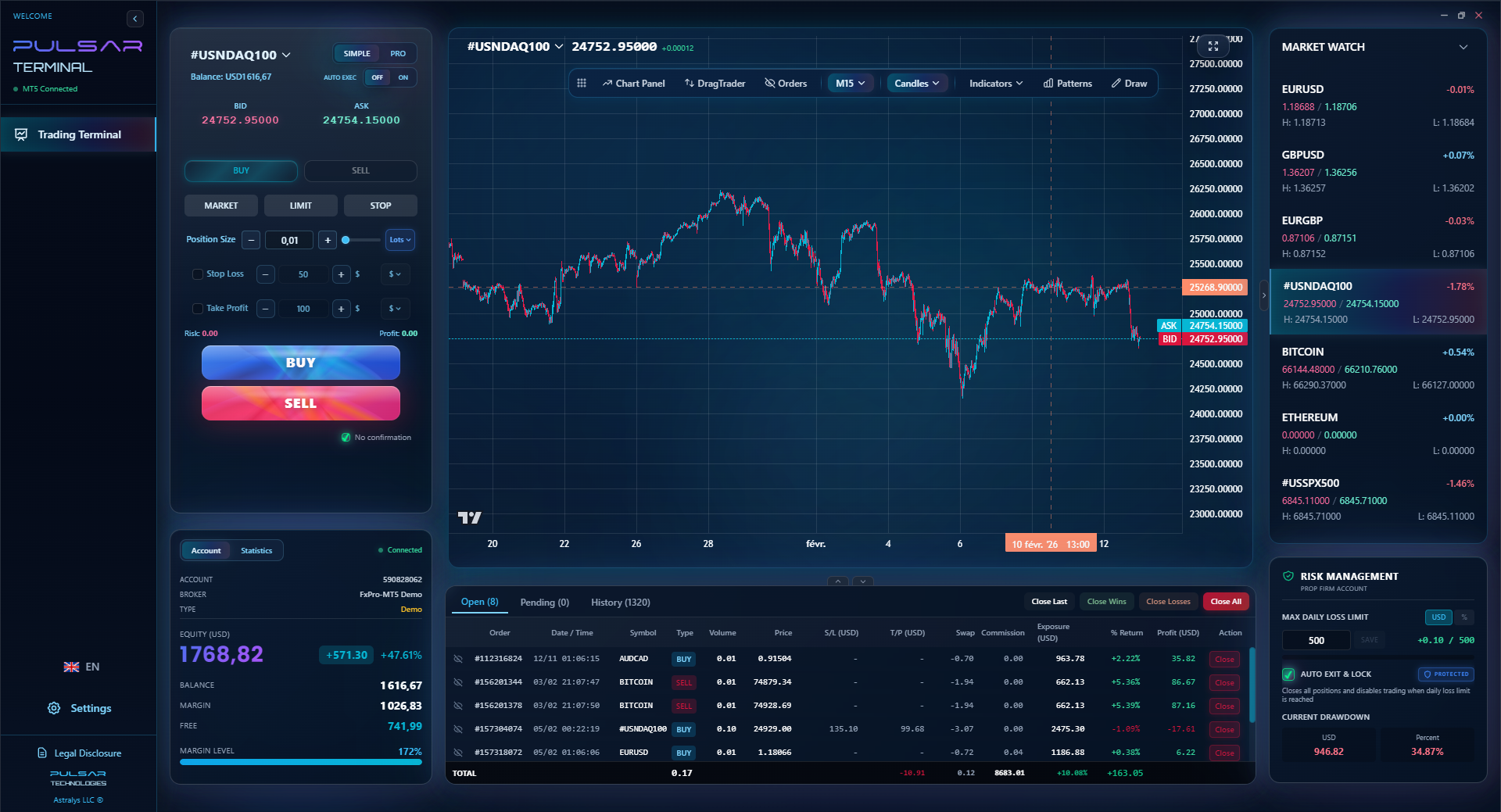
When you're testing a strategy on MT5, manually placing multiple take-profit and stop-loss levels for a single trade is tedious and error-prone.
Pulsar Terminal
เครื่องมือ MT5 ครบวงจร: ลากวางคำสั่ง, multi-TP/SL, trailing stop, grid trading, Volume Profile และการป้องกัน prop firm ใช้งานโดยเทรดเดอร์กว่า 1,000 คนทุกวัน
“Your edge won't come from a Telegram group. It comes from the quiet, solitary work you do away from the social media noise.”
You can’t do this completely alone. But the community you need isn’t the one selling you dreams.
Look for Learners, Not Gurus: Seek out groups or forums where people discuss losing trades and ask for chart analysis. The value is in the debate and shared learning, not in one person broadcasting ‘wisdom.’
Accountability Partners: Find one or two serious traders at a similar level. Share your journals weekly. Having to explain a bad trade to someone else is a powerful deterrent to making it in the first place.
Use Instagram Differently: Instead of following ‘gurus,’ follow reputable economic news pages, central bank updates, and a few analysts (not influencers) who post clear chart analysis without the glamour shot. Use the platform for information gathering, not aspiration.
The loneliness of trading is real. But filling that void with the noisy, sales-driven Instagram ‘community’ is often worse. A real community helps you stay disciplined, not excited.
💡 เคล็ดลับจาก Winston
The market doesn't care about your gender, your Instagram followers, or your motivational quotes. It only responds to price, volume, and economic reality. Trade the chart, not the persona.
“The loneliness of trading is real. But filling that void with the noisy, sales-driven Instagram 'community' is often worse.”
Let’s wrap this up with a blunt, step-by-step plan that ignores the Instagram algorithm.
- Education Budget: Allocate a maximum of ₦50,000 for initial education. Use it for a few reputable books and maybe one well-vetted course on the basics of price action and risk management. The rest of your learning is free: Babypips School, YouTube tutorials from established educators (not influencers).
- Capital: Save until you have at least ₦150,000 that you can afford to lose. This is your ‘tuition fee’ to the market.
- Demo Trade: Spend 3-6 months on a demo account. Not to ‘get rich on pretend money,’ but to test your strategy through different market conditions (trending, ranging, volatile). Document everything.
- Go Live Small: Start with a live account using only 10-20% of your saved capital. Trade micro lots (0.01). Your goal for the first 6 months is not profit. It’s to break even while maintaining perfect risk management and journaling.
- Ignore the Noise: Mute or unfollow every Instagram/TikTok trader whose primary content makes you feel FOMO, inadequate, or that you’re missing a ‘secret.’
- Embrace the Grind: Accept that 80% of trading is waiting, managing, and reviewing. The 20% of execution is the easy part. Your success depends on how well you handle the boring 80%.
Forex trading can be a legitimate way to build wealth, especially in an economy with a volatile Naira. But the path laid out by the ‘female forex trader on Instagram’ archetype is often a lucrative detour - for them. Your real journey is quieter, harder, and , far more empowering because the skills and discipline you build will be entirely your own.
FAQ
Q1Are all female forex traders on Instagram in Nigeria scams?
No, not all. But a significant portion are primarily content creators and salespeople, not full-time professional traders. The business model for many is selling courses, signals, and mentorship, not generating consistent income from the markets. It's crucial to differentiate between someone sharing their genuine trading journey (including losses) and someone selling a luxury lifestyle as the direct result of trading.
Q2How much does it really cost to start forex trading in Nigeria?
Realistically, you need at least ₦150,000 to trade with proper risk management on a standard account. While you can deposit as little as ₦1,500 with some brokers, trading with such a small amount forces you to use dangerous levels of use to see any meaningful profit, which almost guarantees you'll lose it all. Factor in monthly data costs (₦8,000-₦15,000) and the mandatory 10% capital gains tax on profits.
Q3What should I look for in a genuine forex mentor?
A genuine mentor should be transparent. Ask for a verifiable, long-term track record (like a MyFxBook link showing all trades over years, not months). They should teach solid risk management first, not 'secret indicators.' They should be willing to discuss their own losses and drawdowns. If their main pitch is about the money you'll make or the lifestyle they have, it's a red flag. Their fee should also be reasonable; a ₦350,000 'mastermind' is often marketing, not education.
Q4Is it illegal to trade forex in Nigeria?
No, it is legal for individuals to trade forex. However, the new Investments and Securities Act, 2025 (ISA 2025) makes it illegal for entities to operate online forex trading platforms or offer related services without registering with the SEC. For you as an individual retail trader, this means you should ensure you are using a reputable, internationally regulated broker that complies with local laws. You are also legally required to pay a 10% capital gains tax on your profits to the FIRS.
Q5How do I fund my forex trading account from Nigeria?
Direct deposits with Nigerian debit cards to international brokers are often blocked. The most reliable method is a local bank transfer. Most major brokers (like Exness, XM, HFM) have local Nigerian bank accounts. You transfer Naira to their designated bank, and they credit your trading account in USD. Withdrawals work the same way in reverse. Some brokers also offer P2P crypto deposits.
Q6Can I make a living from forex trading in Nigeria?
It is possible, but it is exceptionally difficult and should not be your initial goal. Most professional traders have years of experience and significant capital (often well over $10,000 or ₦18 million+). The vast majority of retail traders do not make consistent profits. Your first goal should be to learn, preserve capital, and achieve consistent risk management. Treat any profits in the first few years as a bonus, not an income.
บทเรียนจาก Prof. Winston
สรุปสาระสำคัญ:
- ✓Instagram profits are often from mentorship sales, not trading.
- ✓Start with at least ₦150k for sane risk management.
- ✓You owe FIRS 10% of gross profits as tax.
- ✓Local bank transfers are the most reliable funding method.
- ✓Your strategy must be backtested, not just believed.
บทความนี้มีประโยชน์แค่ไหน?
คลิกดาวเพื่อให้คะแนน
ข้อมูลเชิงลึกการเทรดรายสัปดาห์
การวิเคราะห์และกลยุทธ์รายสัปดาห์ฟรี ไม่มีสแปม
เกี่ยวกับผู้เขียน
Olumide Adeyemi
ผู้บุกเบิกการเทรดในแอฟริกาตะวันตก
หนึ่งในนักการศึกษาฟอเร็กซ์ที่กระตือรือร้นที่สุดของไนจีเรีย 8 ปีประสบการณ์เทรดจากลากอส เชี่ยวชาญกลยุทธ์ทุนต่ำและความท้าทาย prop firm สำหรับเทรดเดอร์ในแอฟริกา
ความคิดเห็น
คำเตือนความเสี่ยง
การซื้อขายตราสารทางการเงินมีความเสี่ยงสูงและอาจไม่เหมาะสำหรับนักลงทุนทุกคน ผลการดำเนินงานในอดีตไม่ได้รับประกันผลลัพธ์ในอนาคต เนื้อหานี้มีวัตถุประสงค์เพื่อการศึกษาเท่านั้นและไม่ควรถือเป็นคำแนะนำในการลงทุน โปรดทำการวิจัยของคุณเองก่อนการซื้อขาย
คุณอาจชอบสิ่งนี้

Cara Trading Forex Sukses: 7 Prinsip dari Trader Profesional
Cara trading forex sukses dengan 7 prinsip trader pro: manajemen modal, disiplin, journal trading, backtest. Data nyata, bukan janji profit palsu.
Jam Trading Forex Terbaik untuk Trader Indonesia: Panduan Lengkap dengan Tabel Waktu
Panduan jam trading forex untuk trader Indonesia. Tabel 4 sesi dunia, jam emas 20:00-00:00, sesi mana yang harus dihindari. Data akurat + tips dari trader berpengalaman.
Top 5 Sàn Forex Uy Tín Nhất 2026: Review Jujur dari Trader Indonesia
Top 5 sàn forex uy tín 2026 untuk trader Indonesia. Review jujur: spread, deposit, withdraw, dukungan lokal. Exness, XM, IC Markets & lebih.
รับ Pulsar Terminal
เครื่องคำนวณทั้งหมดนี้ถูกสร้างไว้ใน Pulsar Terminal พร้อมข้อมูลเรียลไทม์จากบัญชี MT5 ของคุณ
รับ Pulsar Terminal