


If you think FNB is your gateway to trading the EUR/USD with tight spreads, you're about to lose money.

David van der Merwe
เทรดเดอร์ตลาดเกิดใหม่ ·  South Africa
☕ 11 นาทีอ่าน
สิ่งที่คุณจะได้เรียนรู้:
If you think FNB is your gateway to trading the EUR/USD with tight spreads, you're about to lose money. I've seen too many South African traders confuse their bank's forex services with a live trading account, and it always ends the same way: confused and poorer. The real 'FNB forex address' isn't a physical location; it's a set of expensive, regulated money transfer services designed for travel and business, not for chasing pips. Let's set the record straight on what FNB actually offers, what it costs, and where you should really be putting your trading capital.
First, let's kill the biggest myth. FNB is not a forex broker. You can't download MetaTrader 5 from them, you won't get use to trade gold or indices, and you definitely shouldn't try scalping using their online banking platform. I made this mistake early on, thinking I could 'trade' the rate they quoted for a USD transfer. I lost about R800 on a R20,000 transfer just from the spread and fees before the market even moved.
FNB is an Authorised Dealer with the South African Reserve Bank (SARB). Their 'forex' service is for moving real money across borders: sending cash overseas, paying for imports, funding a child's studies abroad, or buying travel money. It's a utility, not a trading platform. The spreads they build into their exchange rates are massive compared to a real broker. Where a broker like IC Markets might have a 0.1 pip spread on the EUR/USD, FNB's effective spread can be 1-4% or more. That's the difference between a 0.00001 fee and a R400 fee on R10,000.

Warning: Using FNB for any form of speculative trading is a guaranteed way to erode your capital through fees. Their service is for settlement, not speculation.
Their system is built for compliance with SARB's Financial Surveillance Department, not for speed of execution. If you need to send money to a UK university, FNB is your guy. If you want to react to a US Non-Farm Payrolls report, you need a proper broker.

💡 เคล็ดลับจาก Winston
A bank's forex service is a toll road, not a race track. You pay the toll to get your cargo from A to B. Never try to race on it.
“The real 'FNB forex address' isn't a physical location; it's a set of expensive, regulated money transfer services designed for travel and business, not for chasing pips.”
This is where the rubber meets the road. FNB's fee structure is complex, and the total cost is often hidden in the exchange rate margin. Let's break down the numbers so you know exactly what you're giving up.
Transfer Fees: The Obvious Cost
Based on their latest schedules, sending money online costs you either a fixed fee or a percentage, whichever is higher. For amounts over R10,000, it's 0.55% with a minimum of R275. So, sending R50,000 to pay for a car overseas costs R275 just for the transaction fee. Do that via phone with a banker, and the minimum jumps to R550. Receiving money has its own fee schedule too. These are dead costs before we even talk about the exchange rate.
The Hidden Killer: The Exchange Rate Margin
This is the main profit center for banks. FNB doesn't give you the real mid-market rate. They add a margin of 1% to 4% on top. Let's do the math with a real example from last month.
I needed to convert ZAR to USD for a business expense. The interbank rate (the real rate) was 16.95 ZAR/USD. FNB's offered rate to me was 17.35. That's a margin of about 2.36%. On a R100,000 transfer, that margin cost me R2,360, on top of the R275 transaction fee. Total cost: R2,635, or 2.64% of my capital, gone in an instant.

Example:
- Your Money: R100,000
- Real Rate: 16.95 ZAR/USD = $5,899.70
- FNB's Rate: 17.35 ZAR/USD = $5,763.11
- Loss from Margin: $136.59 (R2,360)
- Plus Transaction Fee: R275
- Total Lost: R2,635
For pegged currencies like the Namibian Dollar, the margin is zero. But for the majors you care about - USD, EUR, GBP - you're paying. This combination of fees and margin can easily chew up 5-20% of the value you're transferring. Compare that to a typical broker's spread of a few pips, and you see why they're in different universes.
“Where a broker might have a 0.1 pip spread, FNB's effective spread can be 1-4%. That's the difference between a 0.00001 fee and a R400 fee on R10,000.”
You can't talk about forex in South Africa without understanding the rules. The SARB's exchange control regulations dictate everything FNB can and can't do for you. Ignoring these is a fast track to having your transaction flagged or rejected.
As a South African resident, you have two key allowances:
- Single Discretionary Allowance (SDA): R1 million per calendar year. You can use this for most things - travel, online shopping, gifts - without tax clearance from SARS. It's your 'no-questions-asked' bucket, but it's for actual spending, not for funding an offshore brokerage account (that's a grey area they don't like).
- Foreign Investment Allowance (FIA): R10 million per calendar year. This is for serious stuff: buying foreign stocks, bonds, or property. The catch? You must have a valid Tax Compliance Status PIN from SARS. No tax clearance, no allowance.

Pro Tip: Always apply for your FIA through your bank (like FNB) before you try to move the money. They handle the SARB approval. Trying to move R5 million without this pre-approval will get your funds frozen faster than you can say 'audit.'
For businesses, rules loosened in late 2024. Companies can now move up to R5 billion per year for foreign direct investment through their Authorised Dealer (like FNB) without needing prior SARB approval for each deal. This is a big deal for local businesses expanding into Africa.
Also, know this: a 2023 court ruling said cryptocurrencies aren't 'capital' under exchange control rules. This gives you more flexibility to move value via digital assets, though the FSCA is still figuring out its conduct rules. The point is, the landscape is shifting, but the core rules for moving physical Rand through FNB remain strict.
💡 เคล็ดลับจาก Winston
Your single biggest edge in using a bank for forex is doing it online. Phone banking fees are a lazy tax that doubles your cost for no reason.
“Where a broker might have a 0.1 pip spread, FNB's effective spread can be 1-4%. That's the difference between a 0.00001 fee and a R400 fee on R10,000.”
Let's be crystal clear. Choosing between FNB and a broker isn't a choice between two similar services. It's a choice between a money transfer office and a trading terminal. Here’s the side-by-side that matters.
| Feature | FNB (Authorised Dealer) | Real Forex Broker (e.g., Pepperstone) |
|---|---|---|
| Primary Purpose | Move physical currency for travel, business, investment. | Speculate on price movements of currency pairs, indices, commodities. |
| Regulator | SARB (Exchange Control), FSCA (Conduct). | FSCA (for SA-licensed brokers), often other top-tier regulators like ASIC, CySEC. |
| Costs | High: 1-4% margin + fixed transaction fees. | Low: Tight spreads (e.g., 0.0 pips on EUR/USD) + small commission. |
| use | None. You move your own money. | Available (capped at 1:30 for retail by FSCA, higher for pros). |
| Platform | Online Banking, FNB App. | MetaTrader 4/5, cTrader, proprietary platforms. |
| Instruments | Physical currency exchange. | 100+ instruments: FX pairs, CFDs on stocks, indices, crypto, commodities. |
| Execution Speed | Slow (hours to days for settlement). | Instant (milliseconds). |
| Suitable For | Settling invoices, travel money, legal offshore investments. | Active swing trading, day trading, hedging. |
I learned this the hard way. Early in my career, I used a bank's platform to try and 'position trade' based on fundamentals. The 3% hit I took just to get into the trade meant the market had to move 300 pips in my favor just to break even. With a proper broker, that same trade would have needed a 3-pip move. The math doesn't lie.
If your goal is to trade, you need a broker. Full stop. Look for one with an FSCA license for peace of mind, like XM or Exness (which also has a local presence). They provide the tools - real charts, the MACD indicator, manageable margin call levels - that a bank never will.
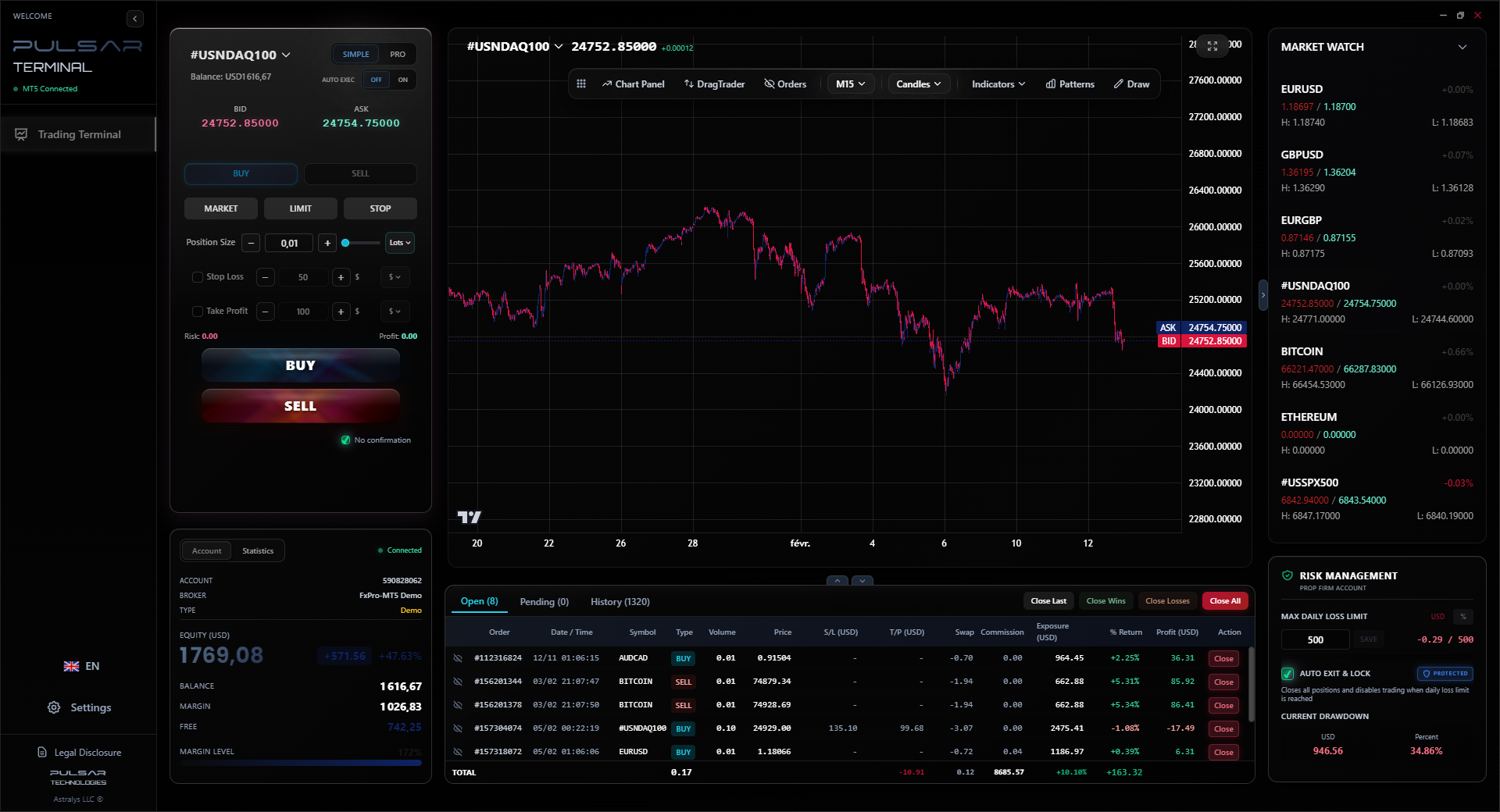
Once your capital is with a real broker, managing complex trades with multiple targets and stops is where a tool like Pulsar Terminal, which integrates directly with MT5, becomes indispensable.
Pulsar Terminal
เครื่องมือ MT5 ครบวงจร: ลากวางคำสั่ง, multi-TP/SL, trailing stop, grid trading, Volume Profile และการป้องกัน prop firm ใช้งานโดยเทรดเดอร์กว่า 1,000 คนทุกวัน
“Using FNB for any form of speculative trading is a guaranteed way to erode your capital through fees. Their service is for settlement, not speculation.”
So, when does it make sense to walk into that FNB branch or log into their app? When you need to move real, physical value for a specific, compliant purpose. Here are the legitimate use cases:
- Funding an International Brokerage Account: This is the big one for traders. Once you've set up an account with a broker like IC Markets, you'll need to get your Rand to them. You use FNB's international transfer service to send ZAR to the broker's nominated South African bank account (they almost all have one). The broker then converts it internally. You still pay FNB's fees, but only once to fund your account, not per trade.
- Taking Your Profits Out: When you win, you'll want to bring money back. Your broker sends USD to your FNB Foreign Currency Account (if you have one) or converts to ZAR and sends it to your local account. FNB handles the receipt.
- Travel Money: Loading a travel card or buying cash for a holiday. The fees are high, but it's convenient and secure.
- Paying for Imports/Exports: If you run a business that trades internationally, FNB's corporate forex services are essential for settling invoices.
- Using Your Foreign Investment Allowance: To buy Apple shares on the NYSE, you use FNB to formally channel your R10 million allowance through the SARB-approved process.
The key is intent. You're using FNB as the regulated pipeline that connects your ZAR world to the global financial system. You are not 'trading' on their platform. You are 'transferring' so you can go trade somewhere else.
“Using FNB for any form of speculative trading is a guaranteed way to erode your capital through fees. Their service is for settlement, not speculation.”
Alright, let's get practical. You need to move money. Here’s how to navigate FNB's system with the least pain and cost.
Step 1: Do Your Homework First. Log into your FNB Online Banking or app. Navigate to the 'Forex' or 'International' section. Use their rate calculator. See what rate they'll give you for your amount and compare it to the live market rate on Google or XE.com. That difference is your margin. Calculate the total cost: (Transfer Fee) + (Margin Loss). Decide if it's acceptable.
Step 2: Have Your Documents Ready. For amounts under R1 million (using your SDA), you usually just need your ID. For anything using the Foreign Investment Allowance, you must have your SARS Tax Compliance PIN ready. For business transactions, have the invoice, contract, or board resolution authorizing the transfer. FNB will ask for it.
Step 3: Initiate the Transfer Online. Always do it online or on the app. The fees are literally half the price of doing it over the phone with a banker. Input the beneficiary details carefully. A mistake here can cause weeks of delay and recall fees.
Step 4: Understand the Timeline. This isn't instant. A typical SWIFT transfer can take 2-5 business days. Don't panic if the money doesn't arrive in 24 hours. The funds will be 'out of your account' at FNB immediately, but in the banking system's pipeline.
Pro Tip: For funding a broker, always use the unique reference number they provide. This is the single most important piece of information. If you don't include it, your funds could sit in the broker's bank account unidentified for days, while your trading account stays empty.
The Physical 'FNB Forex Address'? It's not one place. You deal with them via your branch, the phone, or online. For complex corporate needs, FNB has dedicated Forex branches in major hubs like Sandton, Cape Town CBD, and Durban. But for 99% of individuals, the 'address' is https://www.fnb.co.za or the green FNB App on your phone.
💡 เคล็ดลับจาก Winston
The SARB's calendar year resets on 1 January. Schedule your large annual transfers for early January, not late December, when everyone is panicking.
“You're using FNB as the regulated pipeline that connects your ZAR world to the global system. You are not 'trading' on their platform.”
I've blown it. You'll probably blow it at least once. Here's how to minimize the damage.
Pitfall 1: Assuming the Quote is Locked In. When you check a rate on FNB's calculator, it's often an indicative rate. The final rate is determined at the time of processing, which could be hours later. If the Rand crashes in that time, your cost just went up. For large amounts, ask your relationship manager if they can 'book' a rate for you, usually for 24-48 hours.
Pitfall 2: Misusing the Allowance. Trying to send R1.5 million abroad in December, thinking R1m is for 'this year' and R500k is for 'next year' doesn't work. The SARB's calendar year is January to December. If you used R900k in November, you only have R100k left for December, not a fresh R1m. Plan your large transfers early in the year.
Pitfall 3: Not Accounting for All Fees. You see the 0.55% fee but forget the margin. You also might forget the receiving bank's fee overseas. That can be $15-$50, deducted from the amount that arrives. Always opt for 'SHA' (Shared) charges if possible, where you pay FNB's fees and the beneficiary pays theirs.
Pitfall 4: Trying to Beat the System. Structuring multiple small payments to stay under reporting thresholds is illegal. It's called 'cuckoo smurfing' and the banks' systems are designed to catch it. You'll get flagged, the transfers will be frozen, and you'll have a very uncomfortable conversation with the Financial Surveillance Department. Don't be clever. Be compliant.
The bottom line? FNB Forex is a necessary tool for South Africans operating in the world. Respect it for what it is: a costly, regulated utility. Use it for its intended purpose, and take your actual trading to a platform built for it, where your success depends on your skill, not on being eaten alive by fees before you even start.
FAQ
Q1Can I trade forex directly through my FNB account?
No, you cannot. FNB does not offer a speculative trading platform with charts, use, and live order execution. Their forex service is for transferring physical money for approved purposes like travel, education, or business payments. For active trading, you need a dedicated forex broker.
Q2What is the cheapest way to send money overseas with FNB?
Always initiate the transfer online or via the FNB App, not over the phone. For amounts over R10,000, the fee is 0.55% (min R275 online). For amounts under R10,000, a fixed fee applies, which can be proportionally higher. Also, sending to countries with currencies pegged to the Rand (like Namibia) has no exchange rate margin, making it significantly cheaper.
Q3How do I use my R10 million foreign investment allowance through FNB?
First, obtain a valid Tax Compliance Status PIN from SARS. Then, contact your FNB branch or forex specialist. You must apply for the allowance through FNB before making the transfer. They will guide you through the SARB approval process (Form FIA-001). You cannot simply transfer the money and claim the allowance afterwards.
Q4Why are FNB's exchange rates worse than the market rate?
FNB adds a margin (typically 1-4%) to the interbank market rate. This margin, plus their transaction fees, is how they make money on the service. It's not a trading spread; it's a built-in cost for the convenience, security, and regulatory compliance of moving physical currency. Always compare their offered rate to a live market rate to see the true cost.
Q5Can I use FNB to fund my international forex trading account?
Yes, but indirectly. You use FNB to send ZAR via an international transfer to your broker's designated South African bank account. You must use the unique reference number provided by your broker. The broker then converts the ZAR and credits your trading account. You pay FNB's transfer fees for this service.
Q6How long does an FNB international transfer take?
A standard SWIFT transfer can take 2 to 5 business days to reach the beneficiary's account. Delays can happen due to intermediary banks, public holidays in either country, or if beneficiary details are incorrect. Transfers to major global banks in the US or UK are often faster.
Q7Is my money safe when using FNB Forex?
From a regulatory and security standpoint, yes. FNB is a major systemic bank under SARB oversight. Your funds are protected up to certain limits by the SARB's prudential requirements. The primary risks are not fraud but cost (high fees/margins) and operational error (inputting wrong beneficiary details).
บทเรียนจาก Prof. Winston
สรุปสาระสำคัญ:
- ✓FNB is a money transfer utility, not a trading platform.
- ✓Total costs often hit 2-5% from fees + hidden margin.
- ✓Use your R1m SDA for spending, R10m FIA for investing.
- ✓Always initiate transfers online to halve your fees.
- ✓For active trading, use an FSCA-licensed broker instead.
บทความนี้มีประโยชน์แค่ไหน?
คลิกดาวเพื่อให้คะแนน
ข้อมูลเชิงลึกการเทรดรายสัปดาห์
การวิเคราะห์และกลยุทธ์รายสัปดาห์ฟรี ไม่มีสแปม
เกี่ยวกับผู้เขียน
David van der Merwe
เทรดเดอร์ตลาดเกิดใหม่
เทรดเดอร์ประจำโจฮันเนสเบิร์ก มีประสบการณ์ 11 ปีในสกุลเงินตลาดเกิดใหม่ เชี่ยวชาญคู่ ZAR การเทรดภายใต้กฎระเบียบ FSCA และการวิเคราะห์ตลาดแอฟริกาใต้
ความคิดเห็น
คำเตือนความเสี่ยง
การซื้อขายตราสารทางการเงินมีความเสี่ยงสูงและอาจไม่เหมาะสำหรับนักลงทุนทุกคน ผลการดำเนินงานในอดีตไม่ได้รับประกันผลลัพธ์ในอนาคต เนื้อหานี้มีวัตถุประสงค์เพื่อการศึกษาเท่านั้นและไม่ควรถือเป็นคำแนะนำในการลงทุน โปรดทำการวิจัยของคุณเองก่อนการซื้อขาย
คุณอาจชอบสิ่งนี้

Cara Trading Forex Sukses: 7 Prinsip dari Trader Profesional
Cara trading forex sukses dengan 7 prinsip trader pro: manajemen modal, disiplin, journal trading, backtest. Data nyata, bukan janji profit palsu.
Jam Trading Forex Terbaik untuk Trader Indonesia: Panduan Lengkap dengan Tabel Waktu
Panduan jam trading forex untuk trader Indonesia. Tabel 4 sesi dunia, jam emas 20:00-00:00, sesi mana yang harus dihindari. Data akurat + tips dari trader berpengalaman.
Top 5 Sàn Forex Uy Tín Nhất 2026: Review Jujur dari Trader Indonesia
Top 5 sàn forex uy tín 2026 untuk trader Indonesia. Review jujur: spread, deposit, withdraw, dukungan lokal. Exness, XM, IC Markets & lebih.
รับ Pulsar Terminal
เครื่องคำนวณทั้งหมดนี้ถูกสร้างไว้ใน Pulsar Terminal พร้อมข้อมูลเรียลไทม์จากบัญชี MT5 ของคุณ
รับ Pulsar Terminal