


You're probably wondering if walking into an FNB forex branch in Cape Town is the smart way to trade currencies.

David van der Merwe
เทรดเดอร์ตลาดเกิดใหม่ ·  South Africa
☕ 10 นาทีอ่าน
สิ่งที่คุณจะได้เรียนรู้:
- 1What FNB Forex Actually Offers (And What It Doesn't)
- 2The Real Costs: Fees, Spreads & The Hidden Tax
- 3FNB Forex Branches in Cape Town: Do You Even Need to Go?
- 4SARB's Rules: What Every SA Trader Must Know
- 5Banks vs. Real Forex Brokers: The Trader's Choice
- 6Common Mistakes & How to Avoid Them
- 7Final Verdict for SA Traders
You're probably wondering if walking into an FNB forex branch in Cape Town is the smart way to trade currencies. Maybe you want the safety of a big bank, or you think their rates are competitive. I get it. But as someone who's placed thousands of trades, I need to be blunt: using a retail bank for active forex trading is like trying to win a Formula 1 race in a family sedan. It's the wrong tool for the job. Let's break down exactly what FNB offers, what it costs you, and when you should (and definitely shouldn't) use it.
First, let's clear up the confusion. FNB is not a forex broker in the way you and I think of one. They are an Authorised Dealer, a title granted by the South African Reserve Bank (SARB). This means they're legally allowed to help currency exchange and international transfers under strict controls. Their services are built for life admin, not for trading.
Their main offerings you'll find at FNB forex branches in Cape Town or on their app are:
- International Transfers: Sending money overseas for tuition, property, or family.
- Foreign Currency Accounts (FCAs): Holding USD, GBP, or EUR in a South African bank account.
- Travel Money: Loading a Cash Passport card or buying foreign cash.
- A Basic Currency Exchange Facility: You can buy and sell major currencies through the FNB app.
Here's the critical part most people miss. That last point - buying and selling on the app - is not a trading platform. There's no use, no charts, no stop-loss orders, and no ability to short a currency. You're simply exchanging one lump sum for another at their rate. I made this mistake early on. I tried to "trade" the USD/ZAR move by buying dollars on my bank app, waiting a week, and selling back. After their spread and fees, I needed a 3% move just to break even. A proper broker would have given me 10:1 use on that same idea, with a tight spread and a guaranteed stop-loss. The difference is night and day.

Warning: Don't confuse FNB's currency exchange service with forex trading. One is for moving money, the other is for speculating on price movements with advanced tools. Using the former for the latter will bleed your account dry through costs.
This is where the rubber meets the road. Banks make money on forex through fees and the spread - the difference between the buy and sell price. FNB's pricing is structured for occasional, large transfers, not for frequent trading.
Let's look at the numbers from their 2023/2024 fee guide:
International Transfer Fees
| Transaction Value | Fee (Online/App) | Fee (Phone/Branch) |
|---|---|---|
| Under R10,000 | R100 - R200 flat | Higher |
| Over R10,000 | 0.55% (min R275, max R550) | 0.55% (min R550, max R875) |
That's just the commission. The real killer is the exchange rate margin. FNB (and all banks) don't give you the real interbank rate. They add a margin, typically between 2% and 4.5%. Let's say you're sending £10,000. The real rate might be 23.50 ZAR/GBP. FNB might give you 22.95. That 0.55 ZAR difference on £10,000 is a R5,500 hidden cost on top of the R550 fee.
For "Trading" on the App
There's no published commission for the buy/sell function, as it's baked into the spread. For a retail-sized transaction (say, converting R20,000 to USD), expect an effective spread of well over 1%. Compare that to a real broker like IC Markets or Pepperstone, where the spread on EUR/USD can be 0.0 pips with a small commission. On a R20,000 trade, that's the difference between a R200+ cost (FNB) and a R20 cost (broker).

Example: In 2021, I needed to convert a R150,000 profit from a US client. I got quotes from my bank (similar to FNB) and a forex broker. The bank's total cost (fee + margin) was about 2.8%. The broker's cost was 0.5%. I saved over R3,450 by using the broker. For active trading, these costs compound brutally.

💡 เคล็ดลับจาก Winston
A bank's forex service is designed to make the bank money from you. A broker's platform is designed to help you making money from the market. Know which tool you're holding.
“Using a retail bank for active forex trading is like trying to win a Formula 1 race in a family sedan.”
You might be looking for a physical FNB forex branch in Cape Town because it feels more secure. Here's the truth: for most services, you don't need to step foot in one.
FNB has designated Foreign Exchange Branches that handle more complex requirements, like large commercial transactions or documentary letters of credit. Regular branches in malls like Canal Walk or Tyger Valley might offer basic travel money services, but not all do.
The key takeaway? Everything is pushed online. Opening a Foreign Currency Account, initiating international transfers, even buying forex for travel - it's all designed for the FNB App or Online Banking. Going to a branch often results in higher fees (see the table above) and a less competitive rate.
The only times you might need to visit an FNB forex branch in Cape Town are:
- You need a large amount of foreign cash today.
- You're a business client with a complex trade finance need.
- You have a compliance issue that requires face-to-face verification.
For the everyday person or aspiring trader, the branch is mostly a relic. Your phone is your branch now. If your strategy relies on quick decisions, like scalping, waiting in a bank queue is a surefire way to miss your entry.
Whether you use FNB or an international broker, you live under SARB's Exchange Control Regulations. Ignorance isn't an excuse and can freeze your funds. Here’s the non-negotiable framework:
- Single Discretionary Allowance: You can move R1 million per calendar year offshore without SARS tax clearance. This covers travel, gifts, and online shopping. This is the allowance you'd use for funding an international broker account.
- Foreign Investment Allowance: You can move up to R10 million per year offshore, but you must have a Tax Compliance Status (TCS) PIN from SARS. This is for investments, including funded trading accounts larger than R1m.
- The New 2025 Rule (Big Deal): As of October 2025, SARB tightened the screws. If you're a non-resident (or your prop firm is) receiving South African-source income, the local bank (like FNB) must check your SARS compliance before sending funds offshore. This directly affects traders in prop firm challenges who get paid.
- Reporting is Everything: Every cross-border transaction you make through an Authorised Dealer like FNB gets reported to SARB with a Balance of Payments (BoP) code. "Sporadic income from online trading" has its own code. Keep your records pristine.
I learned the hard way about the TCS PIN. I tried to move a R2m trading profit back to South Africa through my local bank. It was held up for 6 weeks while I scrambled to get compliant with SARS. The lesson? Plan your money moves during the tax year, not in a panic at the end of it. Always use your position size calculator with these limits in mind - your maximum capital is capped by law.
💡 เคล็ดลับจาก Winston
Your R1m discretionary allowance is your annual ticket to the global markets. Don't waste it on a single, poorly-planned transfer. Fund your broker in stages, as your skill and strategy prove themselves.
“That 2-3% margin isn't a fee, it's a handicap. You start every trade thousands in the hole.”
Let's make this decision crystal clear. Here’s when to use FNB, and when to use a dedicated broker.
Use FNB (or any bank) for:
- Life Administration: Paying overseas invoices, sending money to family abroad, buying property offshore.
- Holding Currency: Parking USD earnings in an FCA until you decide what to do with them.
- Travel Cash: Getting physical euros or dollars for a holiday.
Use a Regulated International Broker (like Exness, XM, or IC Markets) for:
- Active Trading: Any strategy where you open and close positions based on market movements.
- Using use: You'll never get 10:1, 50:1, or 500:1 use from a South African bank.
- Advanced Orders: Stop-losses, take-profits, trailing stops. Essential for risk management.
- Real Trading Platforms: MT4, MT5, or cTrader with live charts, indicators like the RSI and MACD, and fast execution.
The Spread Comparison
This table says it all. Let's compare converting R100,000 into USD.
| Provider | Type | Approx. Spread/Cost | Effective Cost on R100k | Tools & use |
|---|---|---|---|---|
| FNB Bank | Authorised Dealer | 2% - 3% (embedded in rate) | R2,000 - R3,000 | None. Just exchange. |
| Int'l Broker | ECN/STP Broker | 0.1 - 0.5 pips + commission | R20 - R100 | Full MT5 platform, use, stops, charts. |
That cost difference isn't a fee, it's a handicap. You start every trade R2,000 in the hole. No serious swing trading or day trading strategy can overcome that consistently.

Pro Tip: A smart hybrid approach: Use FNB's FCA to hold your USD when you're not trading. Then, transfer chunks to your international broker (using your discretionary allowance) when you have a clear trade setup. This separates your banking from your trading.
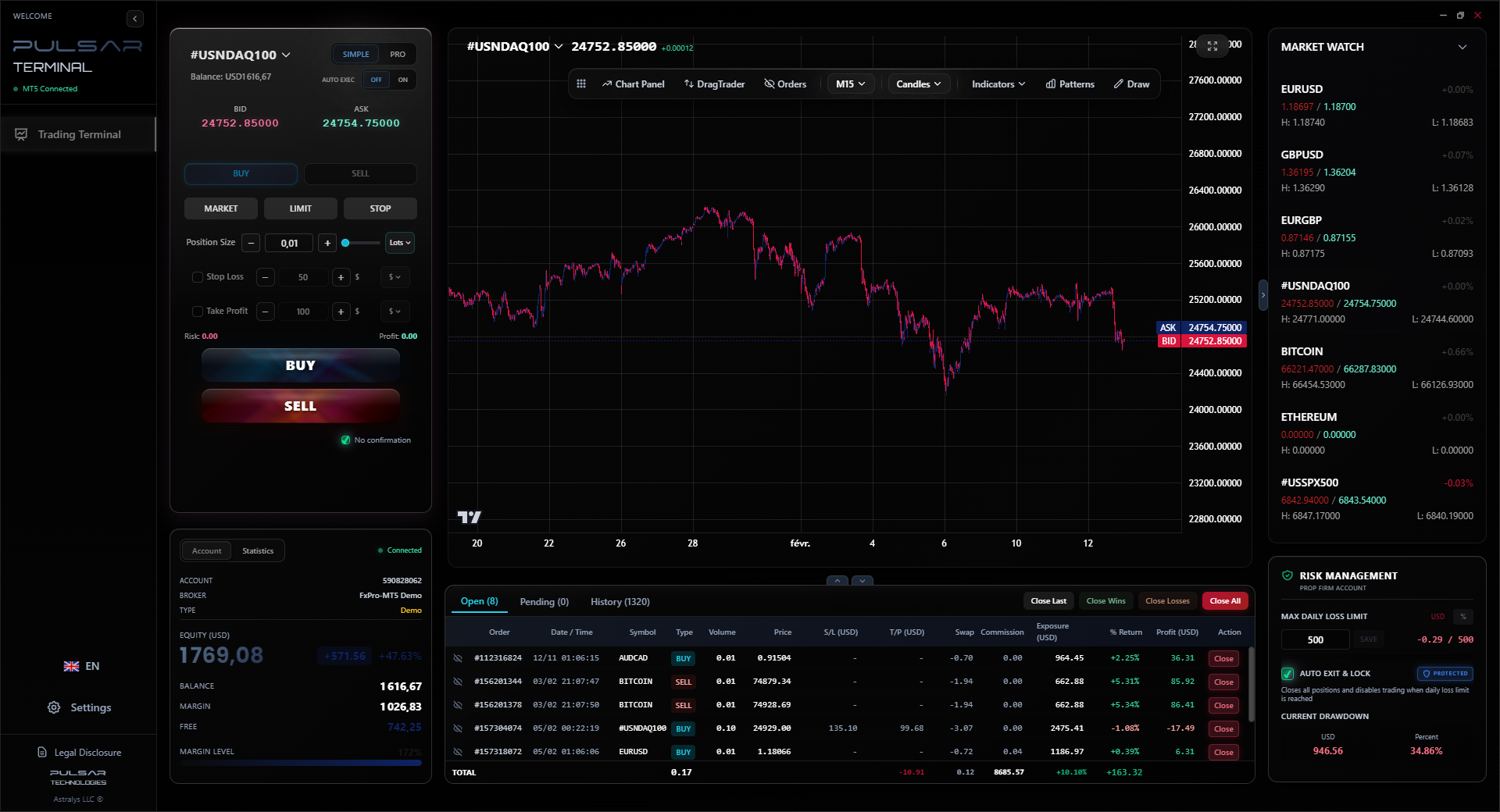
Managing multiple take-profit levels and a trailing stop on a fast-moving pair like USD/ZAR is stressful; Pulsar Terminal automates this directly on your MT5 chart with drag-and-drop ease.
Pulsar Terminal
เครื่องมือ MT5 ครบวงจร: ลากวางคำสั่ง, multi-TP/SL, trailing stop, grid trading, Volume Profile และการป้องกัน prop firm ใช้งานโดยเทรดเดอร์กว่า 1,000 คนทุกวัน
I've seen these errors cripple accounts. Don't be that person.
Mistake 1: Using a Bank's Rate as a Benchmark. You check the USD/ZAR rate on your FNB app and think, "That's the price." It's not. It's FNB's retail sell price to you. The real price is the interbank mid-rate, visible on any trading platform or financial site. Base your analysis on the real price, not the bank's marked-up version.
Mistake 2: Ignoring the Total Cost. People see a "R275 fee" and think it's cheap. They forget the 2.5% margin on the exchange rate, which is 90% of the cost. Always calculate the total cost: (Amount Received / Amount Paid) - 1.
Mistake 3: Thinking Bank = Safer for Trading. Your funds in a South African bank are safer in a bankruptcy, yes. But for trading, "safety" means tight spreads, fast execution, and reliable platforms to manage risk. A wide spread is an unsafe trading environment. I'd rather have my capital with a top-tier regulated broker with a 0.1 pip spread than a local bank with a 300-pip spread. The broker protects me from market risk better. Also, understand what a margin call is - it's a risk with brokers, not banks, because brokers offer use.
Mistake 4: Not Planning for SARB Allowances. You have a great year, make R1.5m, and now you can't bring it all back at once. Plan your withdrawals. If you're trading big, use your Foreign Investment Allowance (with tax clearance) from the start. Don't get trapped.
💡 เคล็ดลับจาก Winston
If you walk into a bank for trading advice, you're asking a plumber to perform brain surgery. They are experts in compliance and transfers, not in reading a chart or managing a trailing stop.
“Your first step isn't to find a branch. It's to educate yourself on the pip, understand the spread, and paper trade.”
So, should you use an FNB forex branch in Cape Town? For trading, absolutely not. It's a terrible, expensive choice that will guarantee your failure.
FNB is a fantastic South African bank. Their forex services are efficient for what they are: moving and holding money across borders in a compliant way. For that, use their app, maybe even an FCA, and appreciate the convenience.
But the moment you decide you want to trade the currency markets - to profit from the movement of the EUR/USD or the XAU/USD - you must step into the professional arena. That means a regulated international broker with competitive spreads, proper use, and a real platform. The difference in cost and capability isn't incremental, it's exponential.
Your first step isn't to find a branch. It's to educate yourself on the pip definition, understand the spread definition, paper trade on a demo account, and then fund a real broker account using your legal SARB allowances. That's the path of a serious trader. The bank teller can't help you with that.
FAQ
Q1Can I trade forex through the FNB app?
Technically, you can buy and sell currencies, but it's not forex trading as professionals understand it. There's no use, no stop-loss orders, no charts, and the spreads are very wide (often 2%+). It's a currency exchange service, not a trading platform.
Q2What is the difference between an FNB Foreign Currency Account (FCA) and a forex trading account?
An FCA is a bank account that holds foreign money (like USD or EUR). It's for saving or receiving funds. A forex trading account with a broker is for speculating on price movements. You use use, open/close positions rapidly, and manage risk with stops. They serve completely different purposes.
Q3Are FNB's forex rates competitive for large transfers?
For very large transfers (e.g., over $100,000), FNB can offer more competitive spreads, sometimes below 0.5%. However, you must negotiate, and there's still a commission (e.g., R550). For amounts under R100,000, their rates are generally less competitive than specialist forex transfer companies.
Q4Do all FNB branches in Cape Town offer forex services?
No. Only designated 'Foreign Exchange Branches' offer full services. Many standard branches only handle basic travel money. Always call ahead or use the FNB app/website to find a specific forex branch.
Q5How do I fund an international forex broker from South Africa?
You use your Single Discretionary Allowance (R1 million per year, no tax clearance needed) or Foreign Investment Allowance (up to R10 million, requires SARS tax clearance). You make an international payment from your South African bank (like FNB) to the broker's client trust account. Keep all your SARS and SARB documentation.
Q6What are the tax implications of trading forex in South Africa?
Profits from trading are generally considered capital gains or income, depending on your trading frequency and intent. You must declare this to SARS. It's crucial to keep detailed records of all trades, deposits, and withdrawals. Speak to a tax professional familiar with trading.
Q7Is it legal to use international forex brokers as a South African?
Yes, it is legal to use international brokers that are regulated in their respective jurisdictions (like the FCA, ASIC, or CySEC). You must still comply with SARB's exchange controls when moving money offshore to fund the account, using your legal allowances.
บทเรียนจาก Prof. Winston
สรุปสาระสำคัญ:
- ✓FNB's spread can cost you 2-3% per trade vs. 0.02% with a broker.
- ✓Use your R1m SARB allowance to fund a real broker, not for bank transfers.
- ✓Banks offer exchange; brokers offer leveraged trading with stops.
- ✓Always calculate total cost: fee + exchange rate margin.
บทความนี้มีประโยชน์แค่ไหน?
คลิกดาวเพื่อให้คะแนน
ข้อมูลเชิงลึกการเทรดรายสัปดาห์
การวิเคราะห์และกลยุทธ์รายสัปดาห์ฟรี ไม่มีสแปม
เกี่ยวกับผู้เขียน
David van der Merwe
เทรดเดอร์ตลาดเกิดใหม่
เทรดเดอร์ประจำโจฮันเนสเบิร์ก มีประสบการณ์ 11 ปีในสกุลเงินตลาดเกิดใหม่ เชี่ยวชาญคู่ ZAR การเทรดภายใต้กฎระเบียบ FSCA และการวิเคราะห์ตลาดแอฟริกาใต้
ความคิดเห็น
คำเตือนความเสี่ยง
การซื้อขายตราสารทางการเงินมีความเสี่ยงสูงและอาจไม่เหมาะสำหรับนักลงทุนทุกคน ผลการดำเนินงานในอดีตไม่ได้รับประกันผลลัพธ์ในอนาคต เนื้อหานี้มีวัตถุประสงค์เพื่อการศึกษาเท่านั้นและไม่ควรถือเป็นคำแนะนำในการลงทุน โปรดทำการวิจัยของคุณเองก่อนการซื้อขาย
คุณอาจชอบสิ่งนี้

Cara Trading Forex Sukses: 7 Prinsip dari Trader Profesional
Cara trading forex sukses dengan 7 prinsip trader pro: manajemen modal, disiplin, journal trading, backtest. Data nyata, bukan janji profit palsu.
Jam Trading Forex Terbaik untuk Trader Indonesia: Panduan Lengkap dengan Tabel Waktu
Panduan jam trading forex untuk trader Indonesia. Tabel 4 sesi dunia, jam emas 20:00-00:00, sesi mana yang harus dihindari. Data akurat + tips dari trader berpengalaman.
Top 5 Sàn Forex Uy Tín Nhất 2026: Review Jujur dari Trader Indonesia
Top 5 sàn forex uy tín 2026 untuk trader Indonesia. Review jujur: spread, deposit, withdraw, dukungan lokal. Exness, XM, IC Markets & lebih.
รับ Pulsar Terminal
เครื่องคำนวณทั้งหมดนี้ถูกสร้างไว้ใน Pulsar Terminal พร้อมข้อมูลเรียลไทม์จากบัญชี MT5 ของคุณ
รับ Pulsar Terminal