


I once tried to fund a new international broker account quickly.

David van der Merwe
เทรดเดอร์ตลาดเกิดใหม่ ·  South Africa
☕ 10 นาทีอ่าน
สิ่งที่คุณจะได้เรียนรู้:
- 1What Exactly is an "FNB Forex Card"? (It's Not One Thing)
- 2The Real Costs and Fees: What They Don't Always Highlight
- 3The SARB Rules You Absolutely Cannot Ignore
- 4FNB as a Forex Service (Not a Broker)
- 5How to Use an FNB Forex Card Correctly: A Step-by-Step
- 6Real Alternatives for South African Traders
- 7Common Mistakes (I've Made a Few)
I once tried to fund a new international broker account quickly. I was eyeing a setup on the EUR/USD and didn't want to miss the move. Thinking my FNB Global Account card was the perfect tool, I attempted a deposit of $500. The transaction was blocked immediately. A call to FNB revealed the hard truth: using a South African-issued card for direct forex trading deposits is a fast track to getting your account flagged under Exchange Control. That failed attempt cost me the trade and taught me a crucial lesson about the strict line between currency access for travel and currency access for speculation.
Let's clear this up first. When people say "FNB forex card," they're usually talking about one of two different products. Neither is a magic card for funding your MetaTrader account. They're tools for managing foreign currency for approved purposes under South African Reserve Bank (SARB) rules.
The first is the FNB Global Account. Think of it as a foreign currency wallet attached to your FNB profile. You can hold money in dollars, euros, pounds, and a few other major currencies. It comes with a physical (and virtual) debit card to spend that foreign currency abroad.
The second is the FNB Multi-currency Cash Passport. This is a prepaid Mastercard you load with specific currencies before you travel. It's like a modern, multi-currency version of traveler's cheques.
Both exist to help you legally use your Single Discretionary Allowance (that R1 million per year) for travel, online shopping, or studying overseas. They are not gateways to the forex market. I learned this the hard way when my broker deposit was rejected. The bank's systems are designed to spot and block transactions that look like they're going to trading platforms.

Warning: Don't confuse these with a trading account. Trying to use either card to deposit funds directly into an international forex or CFD broker will almost certainly fail and could raise red flags with Exchange Control.

💡 เคล็ดลับจาก Winston
A tool used for the wrong job becomes a liability. The FNB card is a travel spade, not a trading shovel.
The brochures say 'competitive rates,' but as traders, we need to see the numbers. The cost isn't just a fee, it's the spread - the difference between the rate you get and the real market rate.
FNB Global Account Fees
Opening and maintaining the account is free. The first card is free. That's the good news. The cost is in the exchange. When you convert your rands into dollars for your Global Account, FNB adds a margin to the interbank rate. This isn't a separate fee, it's baked into the rate you see. For large transfers (think over $100,000), this margin can be relatively tight, sometimes around 0.38% plus a commission of R550. But for the amounts a typical traveler or small-time international shopper moves? That margin is often between 2% and 4.5%.
Let's say you convert R20,000 to USD. If the real mid-rate is 18.50 ZAR/USD, you might get a rate of 18.87 (a ~2% margin). That's an extra R740 you're paying just to hold the dollars. If you then use the card to buy something in euros, and you only have dollars loaded, you'll get hit with another cross-currency conversion fee.
FNB Multi-currency Cash Passport Fees
This one has more upfront costs. You'll pay an initial card fee per currency (roughly R80-R130). Then, when you load it, there's a commission of about 2%. There are also ATM withdrawal fees (around $2.45 in the US, €2.05 in Europe) and even a small fee just to check your balance at an international ATM.

Example: Loading $1,000 onto a Cash Passport. With a 2% commission, you pay $20 upfront. If the embedded spread is another 2%, the real cost is closer to $40 before you've even spent a cent. That's a 4% haircut right off the bat.
The bottom line? These are convenient, not cheap. For moving money efficiently, a specialized international transfer service often beats bank rates. For trading, your broker's deposit methods (like EFTs to their local South African account) are the only compliant way. Using a position size calculator with accurate cost inputs is impossible here, as the 'spread' is hidden and variable.
“The FNB card is for spending foreign currency you own, not for acquiring currency to speculate on.”
This is the most important part of the guide. South Africa's Exchange Control Regulations aren't suggestions, they're law. FNB's cards are built within this cage.
- The Allowance is King: You're using your Single Discretionary Allowance (SDA) of R1 million per calendar year when you load these cards. You don't need tax clearance for this. There's a bigger Foreign Investment Allowance (FIA) of R10 million, but that requires a Tax Clearance Certificate and isn't for travel spending.
- No Trading Allowed: This is critical. The Currency and Exchanges Act and SARB regulations do not permit individuals to use local banking facilities for speculative forex trading. Authorised Dealers (like FNB) can trade currencies. You, as an individual using their card, cannot. The SARB has actively pursued people who used South African credit cards to fund overseas trading accounts. Your FNB forex card is in the same category.
- 30-Day Rule: Come back from holiday with leftover euros on your card? You have 30 days to convert them back to rands. Holding foreign currency indefinitely 'just in case' is not allowed.
- Geographic Block: You cannot use these cards within the Common Monetary Area (South Africa, Namibia, Lesotho, Eswatini). They are strictly for use outside this zone.
I made the mistake of thinking a digital transaction to a broker was a grey area. It's not. It's a bright red line. The proper way to fund a trading account is through an FNB electronic transfer to the broker's nominated South African account (if they have one) or via an approved international transfer for investment purposes, declaring it correctly. It's slower, but it's clean.

Pro Tip: If you're with a prop firm, their challenge rules are strict. Funding your account incorrectly could void everything. Always use the exact, approved deposit methods they list for South Africans to avoid a nasty margin call on your entire dream.
FNB does offer a forex trading platform for customers, but context is everything. It's designed for businesses and individuals to hedge currency risk for imports/exports or large planned expenses (like university fees), not for speculative scalping or swing trading the EUR/USD.
Their spreads are quoted from as low as 0.1 pips, but that's for massive, institutional-sized deals. For a retail customer, expect the typical spread to be more like 1-3 pips during active hours. Compare that to a dedicated international broker like IC Markets or Pepperstone, where sub-1 pip spreads on majors are standard for retail clients.
The selection is also limited. You'll get the major pairs, but don't expect exotic crosses or the ability to trade XAU/USD (gold) or indices. The platform itself is functional for placing a simple trade to lock in a rate, but it lacks the advanced charting, indicators like the RSI or MACD, and order types that active traders rely on.
Think of it this way: FNB sells you foreign currency as a commodity you need. A broker provides a venue to bet on that commodity's price movements. They are fundamentally different services under South African law.
💡 เคล็ดลับจาก Winston
The most expensive cost is often the one not listed on the statement. Always calculate the effective spread.
“That failed deposit attempt taught me the hard line between currency access for travel and access for speculation.”
So, if you shouldn't trade with it, what's it for? Here’s how to use it properly for its intended purpose.
- Open the Right Product: Log into your FNB App. For ongoing use and the best rates on larger amounts, apply for the Global Account. For a once-off trip, the Multi-currency Cash Passport might suffice (you can order it in-app).
- Fund It (Use Your SDA): Transfer rands from your cheque account. You'll see the exchange rate FNB is offering before you confirm. Remember, this uses part of your R1 million annual allowance. The transfer is instant and free.
- Spend Abroad: Use the card overseas for purchases and ATM withdrawals. Always choose to pay in the local currency (e.g., euros in France). If the machine asks to charge you in rands (Dynamic Currency Conversion), say NO. The rate is terrible.
- Track Your Balance: Keep an eye on your SDA usage in the app. Don't max it out in January if you have a big trip planned in December.
- Return the Leftovers: Within 30 days of returning, convert any unused foreign currency back to rands in the app. It takes two clicks.
The entire process is smooth for travel. I used my Global Account card in the UK last year. I loaded pounds, and contactless payments just worked. The peace of mind of a fixed travel budget was worth the small cost in the spread. But the moment I got home, I converted the leftover £23.45 back to rands. It's not worth the hassle of non-compliance.
You need to move money for trading. Here are the actual, compliant paths, from my own experience.
For Funding International Brokers:
- Local EFT: Many reputable brokers like XM or Exness have partnered with South African Authorised Dealers. You EFT rands to a local bank account (in South Africa), and they credit your trading account. This is 100% compliant, usually fee-free from your side, and takes a day or two.
- International Wire Transfer: For brokers without a local presence, you'll do a formal international transfer. This uses your Foreign Investment Allowance (FIA), so you need tax clearance. FNB's fees for this are a 0.55% commission (min R275, max R550) plus the exchange margin. It's a process, but it's the legal way.
For Moving Personal Funds Abroad (Not for Trading):
- Specialist FX Companies: Firms like CurrencyFair or Wise often offer better exchange rates and lower fees than traditional banks for sending money overseas for living expenses, property payments, or education.
- Cryptocurrency (With Caution): Some traders use crypto as a transfer medium, but this is a high-risk, unregulated path that comes with its own volatility and tax implications. I don't recommend it for the novice.
The key is separation. Use the right tool for the job. The FNB card is for spending. Your broker's designated deposit method is for trading capital. Mixing them is where you get into trouble.
“Compliance in trading isn't about slowing you down, it's about keeping you in the game long-term.”
Let me save you some headache and potential legal trouble.
- Trying to Fund a Broker: My biggest mistake, as mentioned. It blocks, it flags, it's not worth it.
- Not Accounting for the Full Spread: Seeing a '0% commission' ad and thinking it's free. The cost is in the rate. Always check the mid-market rate on Google or Reuters and compare it to the rate FNB gives you. The difference is your real cost.
- Letting Foreign Currency Sit: Forgetting about the 30-day repatriation rule. Set a calendar reminder when you get back.
- Using It in Namibia: It won't work. The card is geographically blocked in the CMA.
- Maxing Out Your SDA on a Card: If you use your entire R1 million allowance loading a forex card, you have nothing left for other approved international payments that year. Plan.
- Assuming It's a Backup for Trading Losses: Thinking, "If I blow my account, I can just top up with my Global Card." No, you can't. That mental safety net doesn't exist. Proper risk management, using a position size calculator, is your only real safety net.
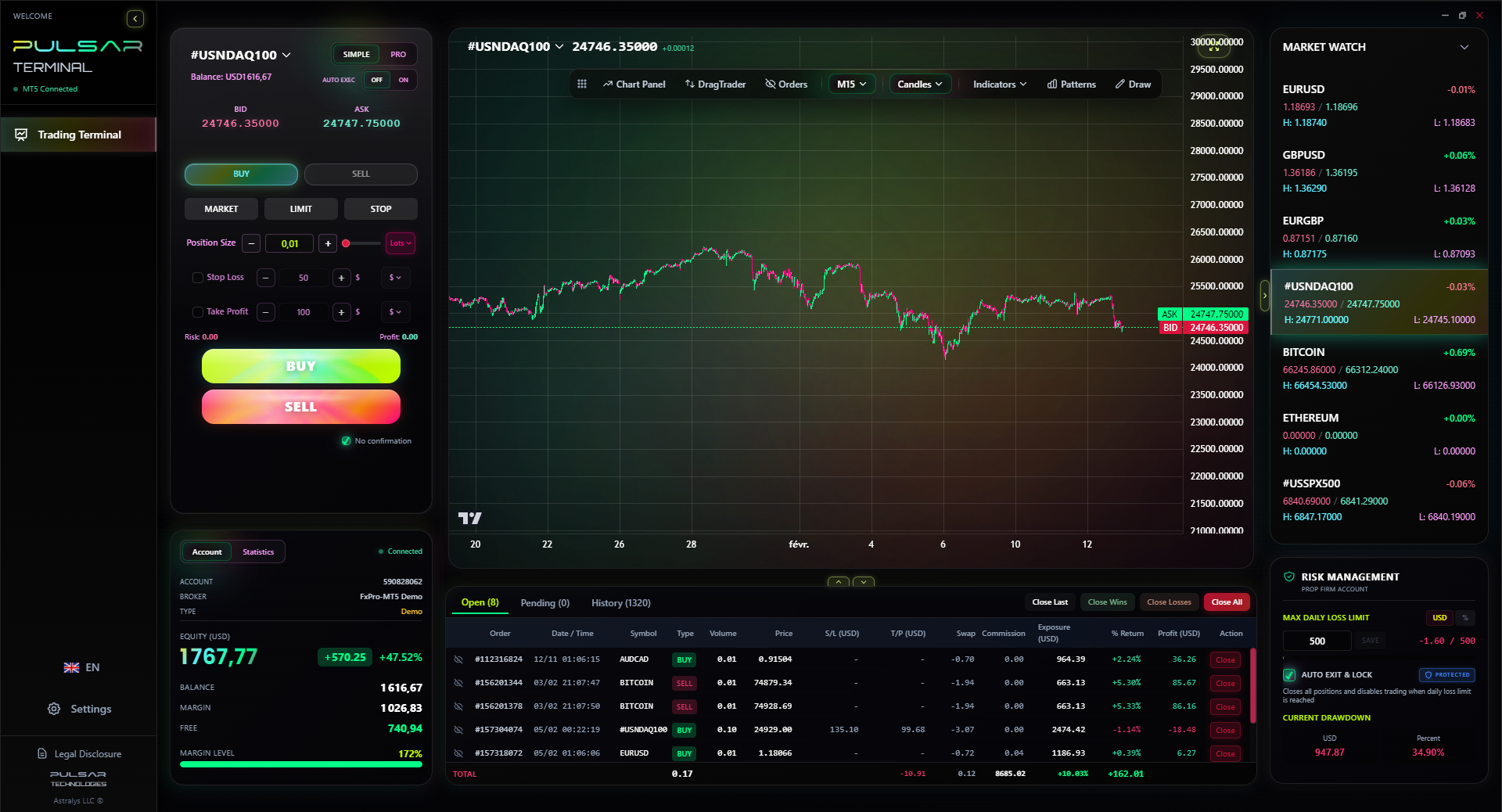
Managing complex trades and strict risk rules, like those needed for prop firms, is far easier with a tool that automates your strategy directly on your platform.
Pulsar Terminal
เครื่องมือ MT5 ครบวงจร: ลากวางคำสั่ง, multi-TP/SL, trailing stop, grid trading, Volume Profile และการป้องกัน prop firm ใช้งานโดยเทรดเดอร์กว่า 1,000 คนทุกวัน
FAQ
Q1Can I use my FNB Forex Card to deposit money into Forex.com, IG, or another international broker?
Almost certainly not. South African Exchange Control regulations prohibit using locally issued cards for speculative forex trading deposits. The transaction will likely be blocked by FNB, and repeatedly attempting it could lead to your account being scrutinized by the authorities.
Q2What is the difference between the FNB Global Account and the Multi-currency Cash Passport?
The Global Account is a digital foreign currency wallet linked to your FNB profile, with a debit card. It's better for ongoing needs and larger amounts. The Cash Passport is a separate prepaid travel card you load with specific currencies before a trip. It's more of a one-use travel product.
Q3How much does it really cost to load dollars onto an FNB card?
The advertised fee might be 0% commission, but the real cost is the 'spread' or margin FNB adds to the exchange rate. This is typically 2% to 4.5% for normal amounts. To load $1,000, a 2.5% margin means you pay an effective fee of $25, hidden in the rate you get.
Q4I'm a South African trader. What is the correct way to fund an international trading account?
The compliant method is to use the broker's specified deposit channel for South African clients. This is usually an EFT to a local South African bank account (if the broker has a local partner) or a formal international wire transfer using your Foreign Investment Allowance (which requires tax clearance). Never use a credit or debit card.
Q5What happens if I don't convert my leftover foreign currency back within 30 days?
You would be in breach of South African Exchange Control Regulations. While not everyone is caught, it introduces unnecessary risk. FNB may also automatically convert it at an unspecified time, potentially at an unfavorable rate. It's best to do it yourself within the deadline.
Q6Can I use the FNB Global Account card for online shopping in dollars?
Yes, that's one of its intended uses. If you have USD loaded in your Global Account, you can use the card details to shop on US websites. This is a legal use of your Single Discretionary Allowance.
Q7Are the funds on my FNB forex card protected?
Funds in your Global Account are part of your banking relationship with FNB. The Cash Passport is a prepaid product. Neither are designed for investment or trading, and they don't offer the same protections as a regulated brokerage account for speculative positions.
บทเรียนจาก Prof. Winston
สรุปสาระสำคัญ:
- ✓FNB Forex Cards are for travel, not trading deposits.
- ✓Real cost is the 2-4.5% hidden exchange margin.
- ✓SARB's 30-day rule: convert leftovers back.
- ✓Use broker-approved EFTs, never cards, to fund.
บทความนี้มีประโยชน์แค่ไหน?
คลิกดาวเพื่อให้คะแนน
ข้อมูลเชิงลึกการเทรดรายสัปดาห์
การวิเคราะห์และกลยุทธ์รายสัปดาห์ฟรี ไม่มีสแปม
เกี่ยวกับผู้เขียน
David van der Merwe
เทรดเดอร์ตลาดเกิดใหม่
เทรดเดอร์ประจำโจฮันเนสเบิร์ก มีประสบการณ์ 11 ปีในสกุลเงินตลาดเกิดใหม่ เชี่ยวชาญคู่ ZAR การเทรดภายใต้กฎระเบียบ FSCA และการวิเคราะห์ตลาดแอฟริกาใต้
ความคิดเห็น
คำเตือนความเสี่ยง
การซื้อขายตราสารทางการเงินมีความเสี่ยงสูงและอาจไม่เหมาะสำหรับนักลงทุนทุกคน ผลการดำเนินงานในอดีตไม่ได้รับประกันผลลัพธ์ในอนาคต เนื้อหานี้มีวัตถุประสงค์เพื่อการศึกษาเท่านั้นและไม่ควรถือเป็นคำแนะนำในการลงทุน โปรดทำการวิจัยของคุณเองก่อนการซื้อขาย
คุณอาจชอบสิ่งนี้

Cara Trading Forex Sukses: 7 Prinsip dari Trader Profesional
Cara trading forex sukses dengan 7 prinsip trader pro: manajemen modal, disiplin, journal trading, backtest. Data nyata, bukan janji profit palsu.
Jam Trading Forex Terbaik untuk Trader Indonesia: Panduan Lengkap dengan Tabel Waktu
Panduan jam trading forex untuk trader Indonesia. Tabel 4 sesi dunia, jam emas 20:00-00:00, sesi mana yang harus dihindari. Data akurat + tips dari trader berpengalaman.
Top 5 Sàn Forex Uy Tín Nhất 2026: Review Jujur dari Trader Indonesia
Top 5 sàn forex uy tín 2026 untuk trader Indonesia. Review jujur: spread, deposit, withdraw, dukungan lokal. Exness, XM, IC Markets & lebih.
รับ Pulsar Terminal
เครื่องคำนวณทั้งหมดนี้ถูกสร้างไว้ใน Pulsar Terminal พร้อมข้อมูลเรียลไทม์จากบัญชี MT5 ของคุณ
รับ Pulsar Terminal