


Let's be brutally honest: most people who try forex and CFD trading in South Africa get cleaned out.

David van der Merwe
เทรดเดอร์ตลาดเกิดใหม่ ·  South Africa
☕ 13 นาทีอ่าน
สิ่งที่คุณจะได้เรียนรู้:
Let's be brutally honest: most people who try forex and CFD trading in South Africa get cleaned out. The stats don't lie - 72% of new accounts are gone within six months. But here's the controversial part I'll prove: it's not the market's fault, and it's not just bad luck. It's a predictable outcome of poor education, chasing get-rich-quick dreams, and ignoring the local rules of the game. I've been there, I've blown accounts, and I've learned the hard way. This guide isn't about making you a millionaire overnight. It's about giving you the unvarnished truth about trading in SA, from FSCA regulations and tax man SARS to picking a real broker and not a scam. If you're serious about trading, this is your survival manual.
Before we get into the nitty-gritty of trading in SA, let's clear up what these things actually are. It's shocking how many people trade them without knowing.
Forex (FX) is simply trading one currency for another. You're betting on the exchange rate between, say, the US Dollar (USD) and the South African Rand (ZAR). If you think the Rand will strengthen against the Dollar, you buy ZAR/USD (or more commonly, you sell USD/ZAR). The price moves in pips, which is the smallest price move. For most pairs, that's 0.0001.
CFDs (Contracts for Difference) are different. You're not buying the actual asset - like a barrel of oil or a share in Naspers. You're entering a contract with your broker to exchange the difference in the asset's price from when you open the trade to when you close it. This is key: CFDs let you go long (buy) if you think the price will rise, or short (sell) if you think it will fall. This makes them incredibly flexible for trading everything from gold (XAU/USD) to the FTSE/JSE Top 40 index, all from one account.

Warning: Because you're trading on price difference and not owning the asset, CFDs come with extra costs. The big one is the overnight funding fee (swap). If you hold a position past the broker's daily cut-off time, you'll pay (or sometimes receive) a fee. This can eat into profits on longer-term trades.
Why does this matter for South Africans? Two reasons. First, our volatile Rand makes forex pairs like USD/ZAR and EUR/ZAR popular, but they can be wild. Second, CFDs give us access to global markets (like the S&P 500) without needing a foreign brokerage account, but you need to understand you're taking on the broker's credit risk, not just market risk.

💡 เคล็ดลับจาก Winston
The market doesn't care about your rent. Trade the chart in front of you, not the bill on your table. Emotional need is the enemy of logical execution.
Trading isn't a lawless frontier. In SA, there are referees, and ignoring them will cost you money or get you into serious trouble.
The FSCA is Your First Check
The Financial Sector Conduct Authority (FSCA) is the main watchdog. Any broker seriously offering services to South Africans should be FSCA licensed (look for a Category 1.13 or ODP license). This isn't just a nice-to-have. An FSCA license means:
- Client money is segregated. Your funds are held in separate bank accounts from the broker's operating money. If the broker goes bust (it happens), your money should be safer.
- There's a local entity you can complain to.
- They must adhere to certain conduct rules.
The FSCA has also set use limits. For retail traders, use on major forex pairs is capped at 30:1. That means for every R1,000 in your account, you can control a position worth R30,000. Some international brokers might offer you more (like 500:1), but using it is a fantastic way to blow up your account faster. I learned this the painful way early on. I put R5,000 into an account with 500:1 use, traded a full lot on EUR/USD, and a 10-pip move against me triggered a margin call. Account gone in under an hour. Stupid, but a cheap lesson.
Don't Forget Uncle SARS
Here's where many traders get a nasty surprise. The South African Revenue Service (SARS) views trading profits as income if you're trading frequently (like a business). It's not some secret tax-free side hustle.
- Income Tax: If trading is your primary activity, your net profit (profits minus losses, minus allowable expenses like data fees) is added to your other income and taxed at your marginal rate.
- Capital Gains Tax (CGT): If it's a more occasional, investment-like activity, profits may be subject to CGT. For individuals, 40% of the capital gain is included in your taxable income.
You need to keep careful records of every trade - entry, exit, profit/loss, fees. I use a simple spreadsheet, but a dedicated journal is better. When you withdraw profits to your FNB or Standard Bank account, that money has a paper trail straight back to SARS.
“72% of new forex accounts in SA are liquidated within six months. It's not bad luck, it's a predictable outcome of poor risk management.”
Brokers advertise 'low spreads' for a reason - it's the most visible cost. But the hidden fees are what quietly drain your account. Let's break down what you're really paying.
1. The Spread: This is the difference between the buy (ask) and sell (bid) price. It's how most 'commission-free' brokers make money. On EUR/USD, a good raw spread can be 0.0 to 0.3 pips, but on a standard account, you might see 0.9 to 1.5 pips. On volatile pairs like USD/ZAR, spreads can be 50-100 pips or more. You're in the red the moment you enter the trade.
2. Commissions: Some accounts, like Raw or ECN accounts, charge a commission per lot traded instead of widening the spread. For example, you might pay USD $3.50 per 100,000 currency units (a standard lot) traded, per side. This can actually be cheaper for high-volume traders.
3. Overnight Funding (Swap): This is the CFD killer for swing trading. Let's say you're long on Gold (XAU/USD). Every night you hold that position, you'll pay a fee based on the interbank lending rate plus the broker's markup (often around 2.5-3% annualized). I once held a long CFD position on Apple shares for two weeks. The profit was R1,200, but the overnight fees totaled R287. That's nearly a quarter of my profit gone.
4. Currency Conversion: If your account is in ZAR but you trade USD instruments (like most forex pairs), your broker will convert your profit/loss. They often add a 0.3-0.5% fee on top of the market rate. The fix? Use a broker that offers a true ZAR account, like some local providers or FxPro.
5. Inactivity Fees: Don't fund an account and forget it. Many brokers charge a monthly fee (e.g., R300) if you don't trade for a certain period.

Example: A R10,000 trade on USD/ZAR with a 80-pip spread.
- Spread Cost: 80 pips * R0.76 per pip (approx. value for a mini lot) = R60.80.
- You need the market to move 80 pips in your favor just to break even on the spread alone. This is why understanding position size is non-negotiable.
Instagram is flooded with 'gurus' pushing unlicensed bucket shops. Your first line of defence is picking a legitimate broker. Here’s my take on the landscape.
The FSCA-Licensed Crew: These are your safest bets for peace of mind. They have a physical presence and are answerable to the FSCA.
- AvaTrade & Plus500: Solid, well-established. Good for beginners with user-friendly platforms. AvaTrade's fixed spreads can be comforting in volatile markets.
- Local SA Brokers (e.g., some IFX Brokers offerings): Often offer great ZAR support, local payment methods like Ozow Instant EFT, and understand the SA context. Minimum deposits can be as low as R200.
The International Heavyweights (with FSCA presence): These are global giants that also hold FSCA licenses. They often have better pricing and technology.
- Exness: Notorious for ultra-low minimum deposits ($10) and high use offers. Be careful. Their Raw Spread accounts can be good for scalping.
- IC Markets & Pepperstone: My personal favourites for active trading. Their raw spreads from 0.0 pips and low commissions are unbeatable for strategy testing. Execution is lightning fast. I've run my scalping strategy on both and the fills are reliable.
- XM: Huge marketing presence in SA. Offers MT4/MT5, low minimum deposits, and lots of educational resources. Spreads can be a bit higher than IC or Pepperstone, but they're a reliable option.
What to AVOID:
- Any 'broker' or 'signal provider' that contacts you via WhatsApp, Telegram, or Instagram DM promising guaranteed returns.
- Platforms not regulated by a reputable authority (FSCA, ASIC, FCA, CySEC).
- Those offering 'managed accounts' where you send them money to trade for you. This is a classic scam.
Payment Methods You'll Use: Depositing and withdrawing should be easy. Look for brokers offering:
- Instant EFT (Ozow): Money is in your trading account in minutes.
- Credit/Debit Card (Visa/Mastercard): Instant.
- Bank Transfer (EFT): Takes 1-2 business days.
- Skrill/Neteller: E-wallets, also usually instant.
💡 เคล็ดลับจาก Winston
A 2% risk rule isn't a suggestion, it's the law. Survive 10 losing trades in a row and you still have 80% of your capital. That's how careers are built.
“Your first goal as a trader isn't to make profit. It's to not lose money. Master that, and the profits will follow.”
You have a broker, you understand the costs. Now, how do you not become part of the 72% statistic? You need a plan, not hope.
1. Start with a Demo, But Not Forever. Practice on a demo account for at least 2-3 months. Test your strategy through different market conditions (quiet ranges, high volatility). But don't get addicted. Demo trading lacks the psychological pressure of real money. Move to a live account with a small amount you can afford to lose (I started with R2,000) as soon as you're consistently profitable on demo.
2. Risk Management is Your Sacred Law. This is the only thing that will keep you in the game.
- Risk per Trade: Never risk more than 1-2% of your account balance on a single trade. On a R10,000 account, that's R100-R200 max. Use a position size calculator every single time.
- Stop-Loss Orders: ALWAYS use one. It's not a suggestion; it's an insurance policy. Decide where you're wrong before you enter the trade, and place the stop.
- use: Use the minimum needed. With FSCA's 30:1 cap, you're already protected from the worst excesses, but you can still use less. On that R10,000 account, controlling a R300,000 position (30:1) is extremely risky.
3. Have a Clear Strategy. Don't chase random signals. Pick a style that suits your personality and time.
- Swing Trading: Holding trades for days to weeks. Good if you have a day job. You'll need to account for swap fees. Focus on higher timeframes like the 4-hour or daily chart.
- Day Trading/Scalping: Opening and closing trades within the day. Requires focus, a fast internet connection, and a broker with tight spreads. You'll live on the 5-minute or 15-minute chart.
4. Keep a Trading Journal. Note every trade: reason for entry (e.g., "RSI indicator oversold on 4H chart"), entry/exit price, profit/loss, and most importantly, your emotional state. Review it weekly. My biggest losing streak happened when I ignored my journal telling me I was revenge trading after a big loss.
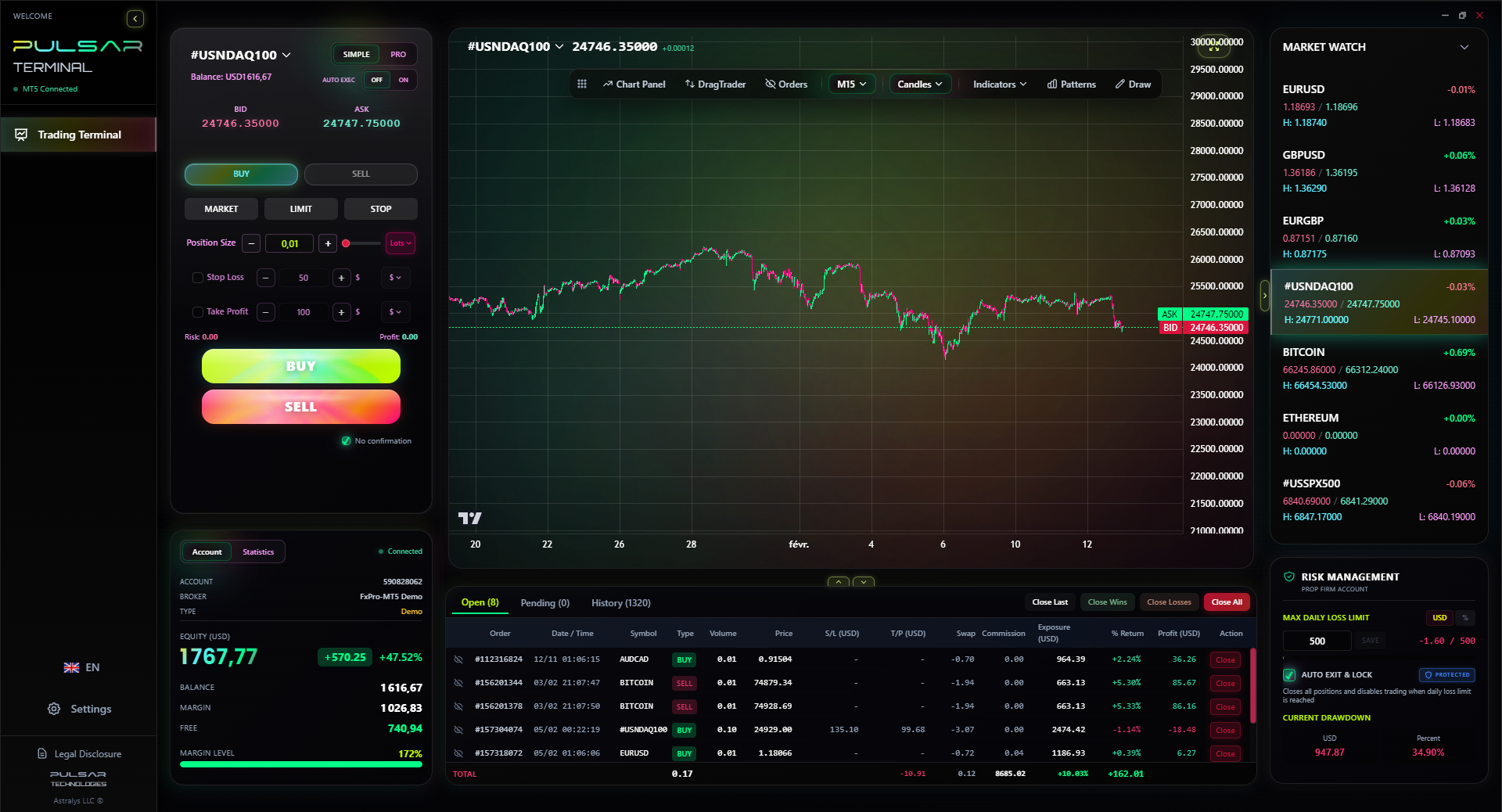
Manually moving stop-losses to breakeven is a chore; Pulsar Terminal automates it directly on your MT5 chart, locking in safety so you can focus on the next setup.
Pulsar Terminal
เครื่องมือ MT5 ครบวงจร: ลากวางคำสั่ง, multi-TP/SL, trailing stop, grid trading, Volume Profile และการป้องกัน prop firm ใช้งานโดยเทรดเดอร์กว่า 1,000 คนทุกวัน
We have unique cultural and economic pressures that lead to specific mistakes.
Pitfall 1: Trading to Solve Financial Problems. With unemployment high, many see trading as a quick income fix. This is a disaster. You'll take oversized risks, ignore your stop-loss, and blow up. Trading capital should be risk capital - money you can afford to lose without affecting your rent or groceries.
Pitfall 2: Chasing the 'ZAR Hedge'. We all want to protect ourselves from Rand weakness. So, we load up on long USD/ZAR trades when the Rand is already very weak. This is called 'chasing the market.' I did this in 2020, buying USD/ZAR at R18.50 after a huge run-up. It corrected to R17.80, and my stop-loss took me out for a loss. The trend is your friend, but you can't buy at the very end of the party.
Pitfall 3: Overcomplicating the Charts. New traders load their MT4 with 20 different indicators, all giving conflicting signals. Keep it simple. Price action, support/resistance, and maybe one or two key indicators like the MACD indicator or Moving Averages are all you need. More indicators just lead to paralysis.
Pitfall 4: Ignoring Global Market Hours. The JSE is quiet. The real moves in forex happen during the London (10am SAST) and New York (4pm SAST) overlaps. If you're trying to trade USD/ZAR at 2am SAST, you're trading in a illiquid, wide-spread environment perfect for getting stopped out.

Pro Tip: If you're trading global indices like the US30 or GER40, know their constituent companies' earnings calendar. A big move in Apple or Microsoft can drive the whole index. Economic news from SA (like SARB interest rate decisions) will cause massive volatility in ZAR pairs. Use an economic calendar.
“An FSCA license isn't just a logo on a website. It's your first and best defence against losing your deposit to a scam.”
You don't need a Bloomberg terminal, but you do need the right basic gear.
Essential Toolkit:
- A Reliable Laptop & Internet: A fibre line is ideal. Trading on mobile data during a load-shedding spike is asking for a disconnected trade.
- Trading Platform: MetaTrader 4 (MT4) or MetaTrader 5 (MT5) are the industry standards. Most brokers offer them. They're strong, have heaps of indicators, and support automated trading (Expert Advisors).
- Charting & Analysis: While MT4/MT5 have basic charts, many serious traders use TradingView for advanced charting and then execute on their broker's platform.
- A Risk Calculator: Don't do mental math. Use a calculator or a spreadsheet to determine your position size before every trade.
Your Action Plan:
- Educate Yourself for Free: Don't buy a R5,000 course. The broker education centres (XM, Pepperstone) and YouTube have vast amounts of free, quality material. Learn about candlestick patterns, support/resistance, and risk management.
- Open a Demo Account: With one of the brokers mentioned above. Practice for a minimum of two months.
- Develop & Test a Simple Strategy: Maybe it's buying when price bounces off a key moving average on the 1-hour chart. Test it on demo for at least 50 trades. Record the results.
- Go Live Small: Fund a live account with the smallest possible amount (e.g., R1,000). Your goal for the first six months is not to make profit, but to not lose money. Focus on executing your plan and managing risk perfectly. The profits will follow if you can do that.
Forex and CFD trading in South Africa is a tough but legitimate pursuit. It's a skill, like learning a craft. It takes time, patience, and a willingness to lose small amounts while you learn. Respect the FSCA rules, fear SARS, manage your risk like your financial life depends on it (because it does), and you might just survive long enough to become proficient. Good luck, and trade safe.
FAQ
Q1Is forex trading legal in South Africa?
Yes, absolutely. It's legal and regulated by the Financial Sector Conduct Authority (FSCA). The key is to use an FSCA-licensed broker to ensure your funds are protected and you have legal recourse.
Q2How much money do I need to start forex trading in SA?
You can start with very little. Some brokers like Exness allow deposits as low as $10 (roughly R180), and local brokers might accept R200. However, starting with such a small amount severely limits what you can do and learn. A more realistic starter amount to properly practice risk management is between R2,000 and R5,000.
Q3Do I pay tax on my forex trading profits?
Yes. The South African Revenue Service (SARS) will tax your trading profits. If you trade frequently, it's likely considered income and added to your annual income tax. If it's more occasional, it may fall under Capital Gains Tax (CGT). Keep detailed records of all your trades for your tax return.
Q4What is the best trading platform for beginners in South Africa?
MetaTrader 4 (MT4) is the most common and beginner-friendly. It's offered by almost every broker, has a simple interface, thousands of free indicators, and a huge community for support. Most local and international brokers like XM and AvaTrade offer it.
Q5Why do most forex traders lose money in South Africa?
The main reasons are poor risk management (using too much use, not using stop-losses), lack of a tested strategy, emotional trading, and treating trading as a get-rich-quick scheme instead of a skill that requires time and education to develop.
Q6Can I use use of 500:1 or 1000:1 in South Africa?
While some international brokers may offer this, the FSCA's retail client protection rules cap use at 30:1 for major forex pairs. Using higher use is extremely risky and is the fastest way to lose your entire deposit. It's not recommended for any serious trader.
Q7What is the most traded currency pair in South Africa?
Globally, it's EUR/USD, and South Africans trade it heavily. However, the USD/ZAR (US Dollar vs South African Rand) pair is uniquely popular here as traders look to hedge against or speculate on Rand volatility.
บทเรียนจาก Prof. Winston
สรุปสาระสำคัญ:
- ✓Risk a maximum of 2% per trade. Always.
- ✓Use an FSCA-regulated broker. No exceptions.
- ✓Keep a detailed journal for SARS and your sanity.
- ✓use is a tool, not a magic wand. Use it sparingly.
บทความนี้มีประโยชน์แค่ไหน?
คลิกดาวเพื่อให้คะแนน
ข้อมูลเชิงลึกการเทรดรายสัปดาห์
การวิเคราะห์และกลยุทธ์รายสัปดาห์ฟรี ไม่มีสแปม
เกี่ยวกับผู้เขียน
David van der Merwe
เทรดเดอร์ตลาดเกิดใหม่
เทรดเดอร์ประจำโจฮันเนสเบิร์ก มีประสบการณ์ 11 ปีในสกุลเงินตลาดเกิดใหม่ เชี่ยวชาญคู่ ZAR การเทรดภายใต้กฎระเบียบ FSCA และการวิเคราะห์ตลาดแอฟริกาใต้
ความคิดเห็น
คำเตือนความเสี่ยง
การซื้อขายตราสารทางการเงินมีความเสี่ยงสูงและอาจไม่เหมาะสำหรับนักลงทุนทุกคน ผลการดำเนินงานในอดีตไม่ได้รับประกันผลลัพธ์ในอนาคต เนื้อหานี้มีวัตถุประสงค์เพื่อการศึกษาเท่านั้นและไม่ควรถือเป็นคำแนะนำในการลงทุน โปรดทำการวิจัยของคุณเองก่อนการซื้อขาย
คุณอาจชอบสิ่งนี้

Cara Trading Forex Sukses: 7 Prinsip dari Trader Profesional
Cara trading forex sukses dengan 7 prinsip trader pro: manajemen modal, disiplin, journal trading, backtest. Data nyata, bukan janji profit palsu.
Jam Trading Forex Terbaik untuk Trader Indonesia: Panduan Lengkap dengan Tabel Waktu
Panduan jam trading forex untuk trader Indonesia. Tabel 4 sesi dunia, jam emas 20:00-00:00, sesi mana yang harus dihindari. Data akurat + tips dari trader berpengalaman.
Top 5 Sàn Forex Uy Tín Nhất 2026: Review Jujur dari Trader Indonesia
Top 5 sàn forex uy tín 2026 untuk trader Indonesia. Review jujur: spread, deposit, withdraw, dukungan lokal. Exness, XM, IC Markets & lebih.
รับ Pulsar Terminal
เครื่องคำนวณทั้งหมดนี้ถูกสร้างไว้ใน Pulsar Terminal พร้อมข้อมูลเรียลไทม์จากบัญชี MT5 ของคุณ
รับ Pulsar Terminal