


You're ready to trade, but how do you know if that shiny broker website is legit or a disaster waiting to happen? In South Africa, with over 200,000 active traders and daily volumes pushing $21 billion, the choice of broker isn't just about features, it's about survival.

David van der Merwe
เทรดเดอร์ตลาดเกิดใหม่ ·  South Africa
☕ 9 นาทีอ่าน
สิ่งที่คุณจะได้เรียนรู้:
You're ready to trade, but how do you know if that shiny broker website is legit or a disaster waiting to happen? In South Africa, with over 200,000 active traders and daily volumes pushing $21 billion, the choice of broker isn't just about features, it's about survival. A proper forex broker check is your first and most important trade. I've seen too many 'students' blow accounts because they skipped this step, lured in by promises of 1:1000 use or 'zero' spreads. Let's cut through the marketing and build your checklist.
Forget everything else for a second. If a broker isn't licensed by the Financial Sector Conduct Authority (FSCA), you should not be giving them your money. Full stop. This isn't me being overly cautious, it's the baseline for operating legally and safely in South Africa. The FSCA forces brokers to play by a set of rules designed to protect you, not them.
Here’s what that FSP number (Financial Service Provider number) actually means for you:
- Segregated Client Funds: Your trading capital must be held in separate bank accounts from the broker's own operating money. If the broker goes bankrupt, your money should, in theory, be safe from their creditors. I say 'should' because you still need to do the rest of this check.
- Dispute Resolution: You have a local regulatory body to complain to if things go sideways. Try getting help from some offshore regulator in Vanuatu. Good luck.
- Adherence to Local Laws: This includes South Africa's exchange control rules. Your bank might block a deposit to an unregulated offshore entity, causing you massive headaches.

Warning: An 'FSCA regulation' claim is worthless without a verifiable FSP number. I once reviewed a broker that had a tiny 'regulated' badge on their site. Digging into their FSP number showed it was for a completely different financial service, not for offering CFDs or forex. They were hoping you wouldn't check.
How to Verify an FSCA License
It takes two minutes. Go to the FSCA's Financial Service Provider Register. Pop in the broker's company name or their claimed FSP number. The search result must show that the license is ACTIVE and that the Authorised Financial Services include 'Category 1: Advisory and Intermediary Services' with the sub-category for 'Discretionary and Non-Discretionary Derivatives' (like CFDs and forex). If it doesn't, walk away.

💡 เคล็ดลับจาก Winston
A broker's withdrawal policy tells you everything about their integrity. Test it with a small amount first, before you commit serious capital.
“Your forex broker check is your first and most important trade.”
Brokers love to advertise 'tight spreads' or 'zero pips on majors!' It's the oldest trick in the book. Your job is to find out what they're not shouting about. The true cost of trading is a combination of the spread, commission, and swap fees. A 'zero' spread account will just slap on a hefty commission instead.
Let's use real numbers from our market. For a standard account (no commission), expect average spreads like these:
| Broker (Standard Account) | Avg. EUR/USD Spread | Min. Deposit |
|---|---|---|
| IG Markets | ~0.98 pips | £250 / ZAR equivalent |
| Plus500 | ~1.3 pips | €50 |
| Fusion Markets (Classic) | ~0.90 pips | $0 |
Now, for raw/ECN-style accounts (commission-based):
| Broker (Raw/ECN Account) | Avg. EUR/USD Spread + Commission | Min. Deposit |
|---|---|---|
| Tickmill (Raw) | 0.11 pips + $3 per lot per side | $100 |
| FP Markets (Raw) | ~0.1 pips + $3 per lot per side | $100 |

Example: Trade 1 standard lot (100,000 units) on EUR/USD. On a 'zero spread' account with a $6 round-turn commission, your cost is $6. On a standard account with a 1.2 pip spread, your cost is $12 (1.2 pips * $10 per pip). The 'zero spread' account is cheaper here. But on a micro lot (1,000 units), the commission is still a fixed $6, while the spread cost is only $0.12. Suddenly, the standard account is far cheaper. Know your typical position size.
Other hidden fees to interrogate:
- Inactivity Fees: $10-$15 per month after 3-12 months of no trading. Ask.
- Currency Conversion Fees: Up to 1.2% if your ZAR account funds are converted to USD to trade. This is why many local brokers like Khwezi Trade or iFX Brokers offering ZAR accounts are popular.
- Swap Fees (Overnight Funding): Check the broker's schedule. Holding a USD/ZAR buy position overnight costs a daily interest fee. These add up fast if you're swing trading.
- Withdrawal Fees: Some charge $20-$30 per bank withdrawal. Nonsense.
“If a broker isn't FSCA licensed, you should not be giving them your money. Full stop.”
This is where local knowledge saves you time and money. You want a broker that speaks ZAR, not just in currency pairs, but in payment processing.
Minimum Deposits: You'll see ads for '$1 minimum!' That's for a cent account, often with awful conditions. For a real, live standard account with a decent broker like Exness or XM, plan for $50-$200 (R1,000 - R4,000). My blunt advice? If you can't afford to risk at least R5,000, you're not ready to trade live. The psychology is different with real money, and tiny accounts get destroyed by fees and poor risk management.
Payment Methods That Actually Work:
- Instant EFT / Local Bank Transfer: The gold standard. Funds are in your trading account in minutes, directly from your SA bank. Brokers integrated with PayFast, Ozow, or similar offer this.
- Credit/Debit Cards: Visa/Mastercard are widely accepted. Just watch for your bank's forex conversion markup.
- E-Wallets: Skrill and Neteller are common. PayPal is less so in our forex space.
- Cryptocurrency: Bitcoin or USDT deposits are instant and avoid bank delays. Withdrawal times vary wildly by broker.
The Withdrawal Test: A broker's true colours show when you try to take money out. The process should be clear, and the timeframe published (e.g., 1-3 business days for EFT). If they bombard you with 'bonus offers' or make you jump through endless hoops to verify (again), it's a red flag. I once waited 11 business days for a withdrawal from a mid-tier broker; their 'efficient' deposit system took 10 minutes. I closed my account after that.
💡 เคล็ดลับจาก Winston
That '1:1000 use' offer is a siren song for the inexperienced. It's not a feature, it's a hazard. The FSCA's lower limits exist for a reason: to stop you from destroying yourself in minutes.
“High use isn't a tool for making more money, it's a tool for blowing up faster.”
Trading Platform: You'll likely use MetaTrader 4 or 5. It's the industry standard. Brokers like IC Markets and Pepperstone offer excellent MT4/5 integration. The question is: does their server provide stable, low-latency execution? Open a demo account and trade during volatile news (like US Non-Farm Payrolls). Does the platform freeze? Do spreads widen to 50 pips? That's your answer.
Execution Model:
- Market Maker: The broker is your counterparty. Can lead to conflicts of interest, but many reputable FSCA brokers operate this model smoothly.
- STP/ECN: Your order is routed to liquidity providers. Generally means faster execution and tighter spreads, but often comes with commissions.
The use Minefield: FSCA-regulated brokers for retail clients typically cap use at 1:30 on major forex pairs for professional clients, and lower for retail. Yet, you'll see offshore brokers offering 1:500, 1:1000. This is a trap for new traders.
Here's the brutal math I learned the hard way: Early in my career, I used 1:500 use. A $1,000 account gave me $500,000 in buying power. A mere 20-pip move against me (less than 0.2% on EUR/USD) wiped out my entire account. Poof. Gone. High use amplifies both gains AND losses. It's not a tool for making more money, it's a tool for blowing up faster. Stick to the FSCA limits or lower. Managing your margin call risk is your primary job.
“High use isn't a tool for making more money, it's a tool for blowing up faster.”
Don't get overwhelmed. Do this step-by-step.
Week 1: The Shortlist & Background Check
- Start with 3-5 brokers known to serve the SA market (IG, Tickmill, AvaTrade, a local like Khwezi).
- For each, verify the FSCA license. Bookmark the FSP register page for each.
- Scour independent review sites and forums. Look for consistent complaints about withdrawals or slippage.
Week 2: The Demo Dive
- Open a demo account with your top 2 contenders. Fund it with a realistic amount (e.g., R50,000 virtual).
- Test their platform. Place orders, set stops, use their charts. Try to replicate your planned scalping strategy.
- Crucially, contact their support. Ask a specific question like, "What are your EFT withdrawal fees and processing times for ZAR accounts?" Gauge their response time and clarity.
Week 3: The Live Test (Small)
- Pick one. Make the minimum deposit, not a cent more.
- Make a few small, real trades. The goal is not profit, but to test the entire cycle: deposit, execution, live spreads, and crucially, withdrawal.
- Withdraw a portion of your money (even just R500). If this process is smooth, you have a candidate. If it's a nightmare, you've lost only the minimum deposit and gained useful intel.

Pro Tip: Your broker is a utility, not a partner. Your loyalty should be to your own profitability. If their service degrades or a better option emerges, be ready to move. I've switched brokers three times in 12 years as my needs changed.
💡 เคล็ดลับจาก Winston
Your trading platform is your cockpit. If the demo feels clunky or unreliable during news events, the live version will be worse. Don't compromise on execution speed.
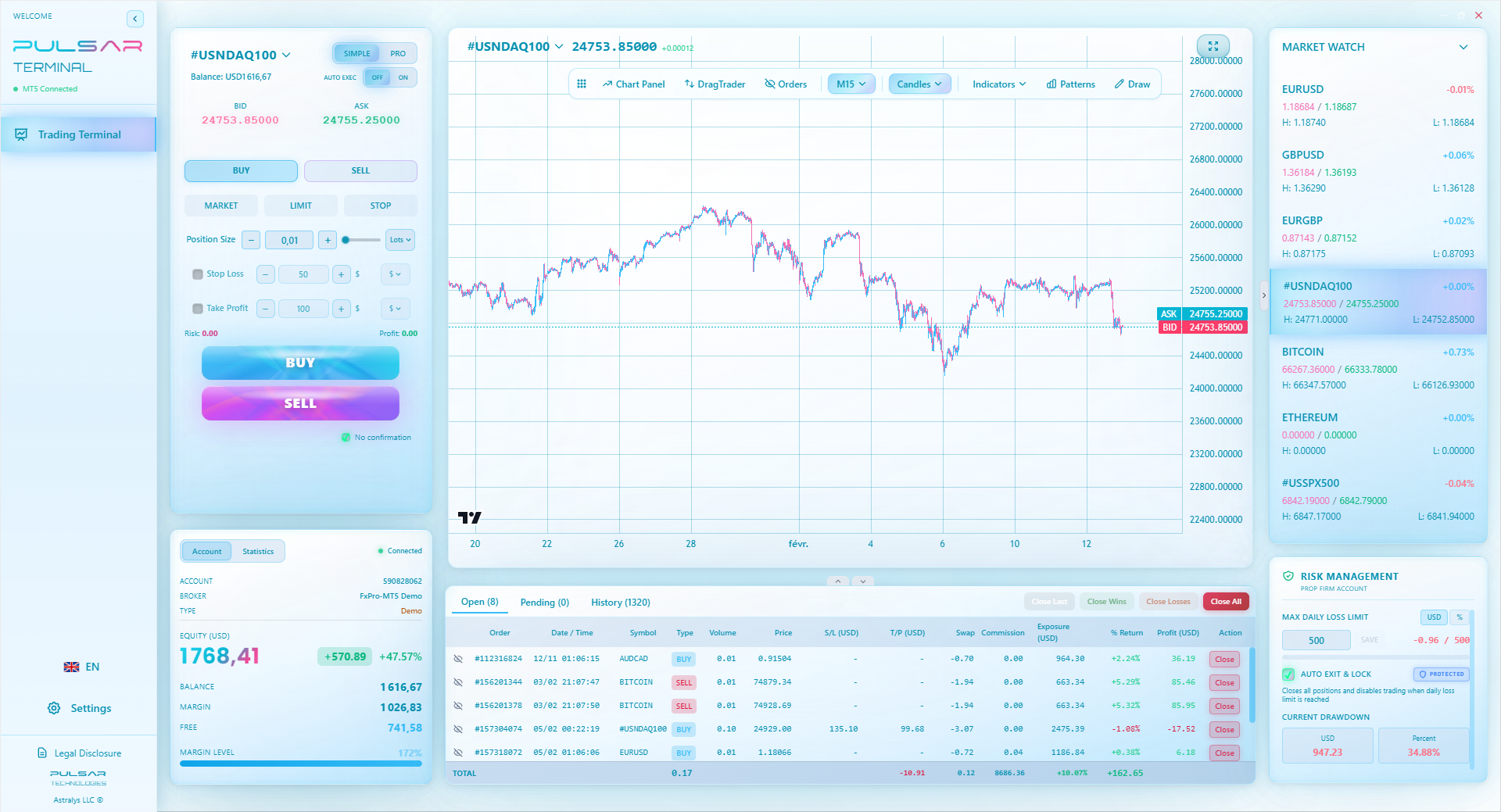
Once you've chosen a broker on MT5, a tool like Pulsar Terminal can supercharge your execution with one-click orders, advanced stop-loss management, and chart pattern recognition, turning a basic platform into a professional workstation.
Pulsar Terminal
เครื่องมือ MT5 ครบวงจร: ลากวางคำสั่ง, multi-TP/SL, trailing stop, grid trading, Volume Profile และการป้องกัน prop firm ใช้งานโดยเทรดเดอร์กว่า 1,000 คนทุกวัน
“If you have to ask 'Is this a scam?', it probably is. Trust that gut feeling.”
We have our own unique set of pitfalls. Here’s what to run from:
- The "FSCA Pending" Excuse: A broker claims they are "applying for" or "pending" FSCA regulation. This is meaningless. Regulate first, then take client money.
- The WhatsApp/Telegram "Guru" with a Broker Link: You're added to a group where a 'guru' posts insane winning screenshots and pushes a specific, often unknown, broker. This is usually a bucket shop scam. The trades aren't real, and your deposits go straight into their pocket.
- Too-Good-To-Be-True Bonuses: "Deposit R1000, get R5000 bonus!" These come with impossible withdrawal conditions (trade 50x the bonus volume). They're designed to make you lose everything.
- Pressure to Deposit More After a Loss: Legitimate brokers don't care if you win or lose on individual trades. If an 'account manager' calls you after a loss urging you to deposit more to 'recover,' hang up. They're incentivized on your deposit volume, not your success.
- Obscure, Expensive Payment Methods: If the only way to deposit is via some obscure international wire to a country with weak financial oversight, abort.
My rule: If you have to ask yourself, "Is this a scam?" it probably is. Trust that gut feeling. The legitimate brokers, the Exness and IC Markets of the world, don't need shady tactics. They have real offices, real licenses, and real reputations to uphold.
FAQ
Q1Is forex trading legal in South Africa?
Yes, absolutely. It's legal and regulated when you use a broker licensed by the Financial Sector Conduct Authority (FSCA). Trading with unregulated offshore brokers is risky and can run afoul of South Africa's exchange control laws.
Q2How much tax do I pay on forex trading profits in South Africa?
Profits are considered taxable income under capital gains tax (CGT). For individuals, the effective rate is up to 18% of the gain, depending on your income bracket. You must declare it to SARS. Keep careful records of all your trades, deposits, and withdrawals.
Q3What is a realistic minimum deposit to start trading forex in SA?
While some brokers accept as little as R70-R150 ($5-$10), that's for micro accounts. For serious trading with proper risk management, a minimum of R5,000 is a more realistic starting point. This allows you to withstand normal market fluctuations without being wiped out by a single bad trade.
Q4Can I use my South African bank account to fund an international broker?
Yes, but with caveats. Your bank may block transactions to unregulated entities. It's also subject to your annual Single Discretionary Allowance (R1 million) and Foreign Investment Allowance (R10 million) limits. Using an FSCA-regulated broker with local ZAR payment processing (like Instant EFT) is far simpler.
Q5What's more important, low spreads or FSCA regulation?
FSCA regulation, every single time. A low spread is useless if the broker disappears with your money or refuses your withdrawal. Regulation provides a fundamental layer of security and recourse. First find regulated brokers, then compare their costs.
Q6How do I check a broker's FSCA license?
Go to the official FSCA website and use their 'Search FSP' function. Enter the broker's company name or claimed FSP number. Verify the license is ACTIVE and includes authorisation for 'Discretionary and Non-Discretionary Derivatives' (Category 1).
Q7Are there any good South African-owned forex brokers?
Yes. Brokers like Khwezi Trade (FSCA licensed) and iFX Brokers are locally owned and regulated. They offer ZAR-based accounts, local support, and payment methods like Instant EFT, which can simplify the process for many traders.
บทเรียนจาก Prof. Winston
สรุปสาระสำคัญ:
- ✓Verify the FSCA FSP number on the official register. Every time.
- ✓True cost = Spread + Commission + Swap. Calculate it for your typical trade size.
- ✓Test the withdrawal process with a small sum before going live big.
- ✓use above 1:30 is a red flag, not a benefit.
- ✓Use a demo account to test execution speed during high volatility.
บทความนี้มีประโยชน์แค่ไหน?
คลิกดาวเพื่อให้คะแนน
ข้อมูลเชิงลึกการเทรดรายสัปดาห์
การวิเคราะห์และกลยุทธ์รายสัปดาห์ฟรี ไม่มีสแปม
เกี่ยวกับผู้เขียน
David van der Merwe
เทรดเดอร์ตลาดเกิดใหม่
เทรดเดอร์ประจำโจฮันเนสเบิร์ก มีประสบการณ์ 11 ปีในสกุลเงินตลาดเกิดใหม่ เชี่ยวชาญคู่ ZAR การเทรดภายใต้กฎระเบียบ FSCA และการวิเคราะห์ตลาดแอฟริกาใต้
ความคิดเห็น
คำเตือนความเสี่ยง
การซื้อขายตราสารทางการเงินมีความเสี่ยงสูงและอาจไม่เหมาะสำหรับนักลงทุนทุกคน ผลการดำเนินงานในอดีตไม่ได้รับประกันผลลัพธ์ในอนาคต เนื้อหานี้มีวัตถุประสงค์เพื่อการศึกษาเท่านั้นและไม่ควรถือเป็นคำแนะนำในการลงทุน โปรดทำการวิจัยของคุณเองก่อนการซื้อขาย
คุณอาจชอบสิ่งนี้

Cara Trading Forex Sukses: 7 Prinsip dari Trader Profesional
Cara trading forex sukses dengan 7 prinsip trader pro: manajemen modal, disiplin, journal trading, backtest. Data nyata, bukan janji profit palsu.
Jam Trading Forex Terbaik untuk Trader Indonesia: Panduan Lengkap dengan Tabel Waktu
Panduan jam trading forex untuk trader Indonesia. Tabel 4 sesi dunia, jam emas 20:00-00:00, sesi mana yang harus dihindari. Data akurat + tips dari trader berpengalaman.
Top 5 Sàn Forex Uy Tín Nhất 2026: Review Jujur dari Trader Indonesia
Top 5 sàn forex uy tín 2026 untuk trader Indonesia. Review jujur: spread, deposit, withdraw, dukungan lokal. Exness, XM, IC Markets & lebih.
รับ Pulsar Terminal
เครื่องคำนวณทั้งหมดนี้ถูกสร้างไว้ใน Pulsar Terminal พร้อมข้อมูลเรียลไทม์จากบัญชี MT5 ของคุณ
รับ Pulsar Terminal