


It was August 2022, and I was glued to my screen.

Olumide Adeyemi
ผู้บุกเบิกการเทรดในแอฟริกาตะวันตก ·  Nigeria
☕ 10 นาทีอ่าน
สิ่งที่คุณจะได้เรียนรู้:
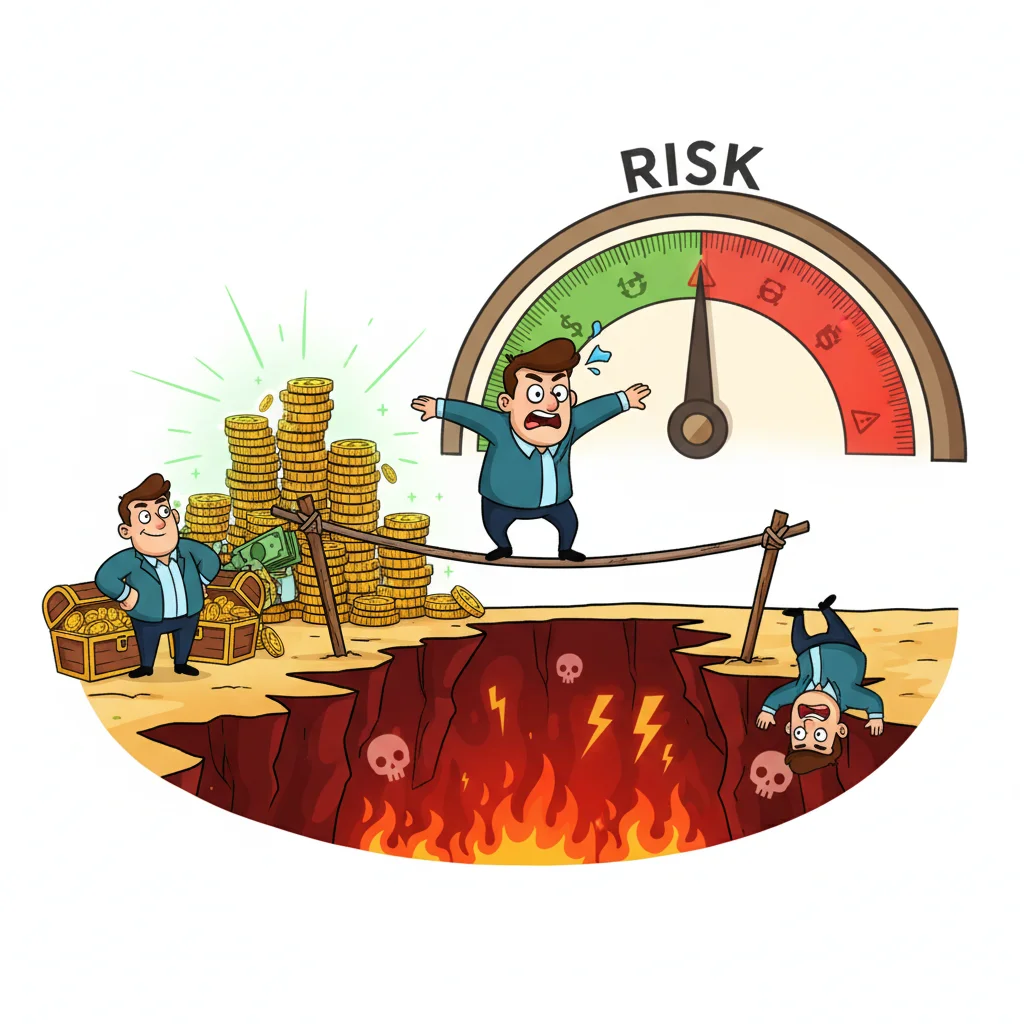
It was August 2022, and I was glued to my screen. I was in 3rd place in a 30-day forex contest run by a local broker, with a prize of ₦500,000 up for grabs. My account was up 187% in two weeks. Then, on a Tuesday morning, the US CPI data hit. I was over-leveraged on EUR/USD, trying to protect my leaderboard spot. In 90 seconds, I gave back a month's worth of gains. I didn't just lose the contest. I triggered a margin call on my main account trying to 'save' the trade. That's the real forex contest: you versus your own worst instincts.
A forex contest is a timed competition where traders compete for the highest percentage return, the highest profit in cash terms, or sometimes the most consistent wins. Brokers, especially the ones marketing hard in Nigeria like Exness or XM, love them. They're fantastic marketing tools. You see the ads: 'Win ₦2 Million in Our Demo Challenge!' or 'Top Trader Gets a BMW!'.
Here's the unspoken truth: the structure is designed to make you fail. The rules actively encourage the worst trading behaviors imaginable. They reward recklessness in the short term and punish the careful, patient strategies that actually build long-term wealth. Think about it. If you need to be in the top 0.1% of thousands of entrants to win a car, what's your strategy going to be? You're going to swing for the fences on every trade. You'll use insane use. You'll hold losing trades hoping for a miracle comeback. It's gambling, pure and simple, dressed up as skill.

Warning: The prize pool is funded by the losses of the 99.9% of contestants who don't win. You are not the customer in this scenario. You are the product.
Most contests use demo accounts, which removes the psychological pain of losing real money. This creates a dangerous feedback loop. You get used to taking wild risks with no consequence. When you switch back to your live account, that habit remains, and that's when you get cleaned out.

💡 เคล็ดลับจาก Winston
A contest is a sprint. Real trading is a marathon where you must preserve your stamina (capital) above all else. Never train for a sprint if your career is a marathon.
“The forex contest structure is designed to make you fail. It rewards recklessness and punishes patience.”
This is where contests do their real damage. They hijack your brain's reward system.
The Leaderboard Trap
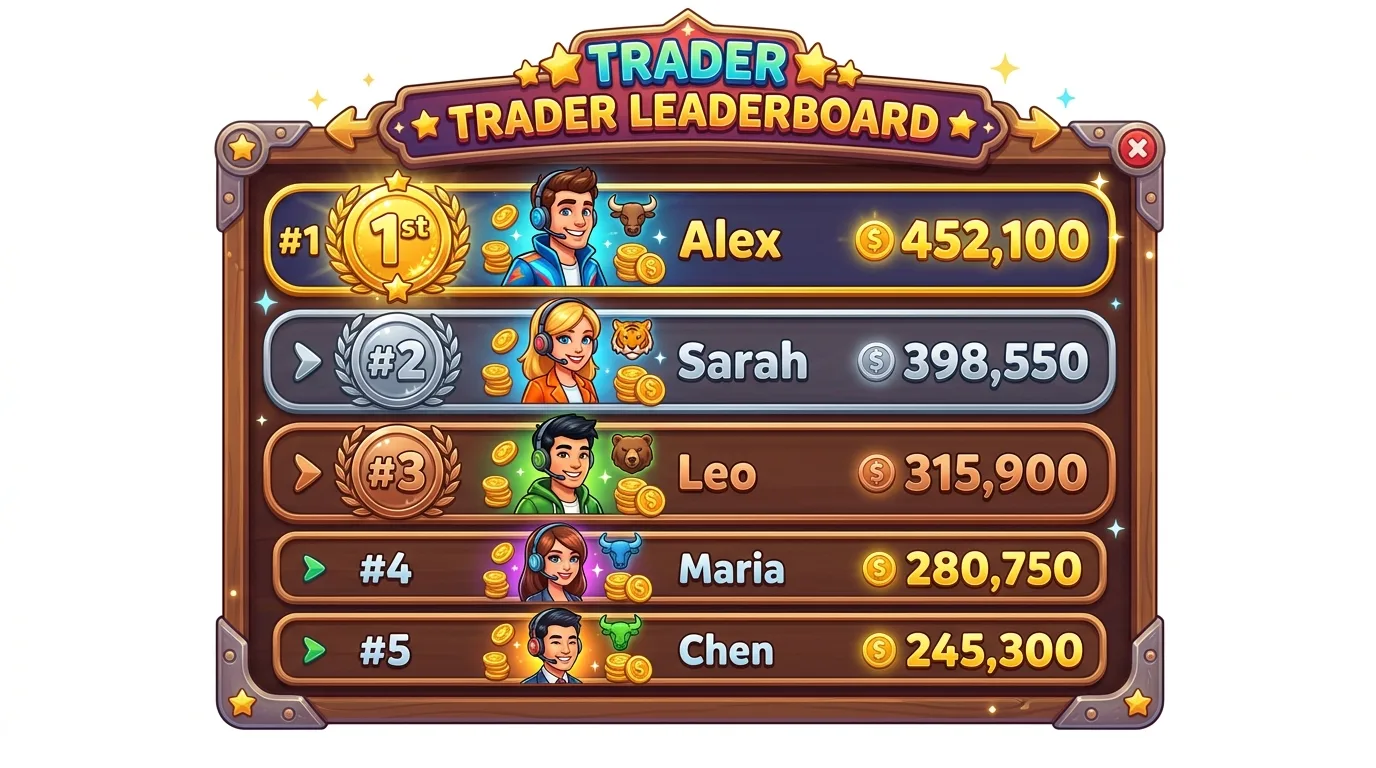
You're no longer trading the chart. You're trading your position on a list. I've seen traders take a 5% profit on a good trade, then immediately jump into another high-risk setup because the guy in 4th place just caught a lucky break and overtook them. Your focus shifts from 'Is this a good trade?' to 'What do I need to do to climb one more spot?' It's a guaranteed path to overtrading.
The Sunk Cost Fallacy
A week into a month-long contest, you're down 15%. The rational move is to stop, preserve what's left, and learn. But almost no one does that. You think, 'I've already put in all this time, I need a huge win to get back in the game.' So you triple your position size on a Hail Mary trade. I did this in 2019. I was down 22% in a contest, threw a massive trade on GBP/JPY (a notoriously volatile pair), and wiped the entire contest account to zero in under an hour.
Demo vs. Live Reality
Winning a demo contest feels great. It pumps your ego. But it teaches you nothing about the single most important factor in real trading: emotional control under real financial risk. That demo champion who won a brand new iPhone? I've met them. They often blow their first real account in weeks because they never learned to handle the fear of a drawdown or the greed of a winning streak. Real trading is about survival, not glory.

Pro Tip: If you must enter a contest, use a separate, small live account with money you can afford to lose completely. The psychological pressure, even with small amounts, is a better teacher than any demo.

“You're no longer trading the chart. You're trading your position on a list. That's a guaranteed path to overtrading.”
Let's break down a typical contest rulebook. You'll see the traps laid out in plain language.
1. The 'Maximum Drawdown' Killer: Many contests, especially those linked to prop firm evaluations, have a strict maximum daily or overall loss limit. Say it's 5%. In a normal trading week, a 3% drawdown is manageable. But in a contest, that 3% loss sends you into a panic. You're now only 2% away from disqualification. This forces you to either stop trading (and lose your chance to win) or trade tiny, meaningless sizes that can't possibly get you to the top. It's a psychological torture chamber.
2. The Profit Target Pressure: 'Achieve 10% profit in 30 days to win a funded account!' Sounds simple. That's less than 0.5% per day, right? Wrong. You don't have 30 calm, linear days. You have periods of chop and low volatility where making any profit is hard. This forces you to take trades during low-probability times just to 'stay on track.' It's the opposite of waiting for the right setup.
3. The use Illusion: Contests often provide crazy use, like 1:500 or even 1:1000. On a $10,000 demo account, that's $5 million in buying power. It makes small moves feel huge. You make 5% in a day and feel like a genius. What you're really doing is practicing how to handle a grenade with the pin pulled. When you go to a real broker like IC Markets or Pepperstone and use sensible use like 1:30, it feels boring and slow. So you're tempted to crank it up... and that's when it blows up.
A Real Numbers Example: Let's say a contest has 1,000 entrants. Prizes are for 1st, 2nd, and 3rd place only.
- Your odds of winning a prize: 0.3%
- The broker's benefit: 999 people are now hyper-engaged with their platform, most are now in a loss-making mindset, and are prime targets for depositing more to 'win back' their losses.
It's a brutal numbers game, and you are not the house.
💡 เคล็ดลับจาก Winston
The most valuable prize in any contest isn't the money. It's the cold, hard data on your own psychological breaking point. Study that data ruthlessly.

“The prize pool is funded by the losses of the 99.9% of contestants who don't win. You are not the customer; you are the product.”
I'm not saying never enter one. I'm saying have a bulletproof plan for why you're entering. Your goal should NEVER be 'to win the prize.' That's luck. Your goal should be to learn something specific.
1. Use It as a Strategy Stress-Tester. Pick ONE strategy you've been backtesting. Maybe it's a specific scalping strategy on EUR/USD during the London open. Enter the contest with one rule: you will ONLY take trades that fit this exact strategy. Ignore the leaderboard completely. Your metric for success is not your rank, but your consistency. Did you follow your rules 100% of the time under the pressure of a timer? That's a valuable lesson.
2. Practice Your Risk Management Under Fire. This is the most valuable use. Before the contest starts, decide your rules:
- Maximum risk per trade: 1% of contest equity.
- Daily loss limit: 3%.
- Will you use a trailing stop? (Tools that automate this, like Pulsar Terminal, are useful for removing emotion).
Then, stick to these rules religiously. If you hit your daily loss limit, you stop. No excuses. This practice in a simulated high-pressure environment is gold. It trains the discipline you need for your real swing trading account.
3. Analyze the Winners (Afterwards). When the contest ends, don't just look at the champion's 300% return. That's likely insanity. Look at the traders who came in 10th to 20th. Their 40-60% returns over a month are still huge, but they might have been achieved with more consistency. Download their public trade history if you can. Was it one lucky trade, or a series of solid ones? This post-mortem is more educational than the entire contest.

“The prize pool is funded by the losses of the 99.9% of contestants who don't win. You are not the customer; you are the product.”
These are a different beast. They're not contests for prizes, but auditions for a funded account. Firms like FTMO and The5%ers are huge globally, and their challenges are everywhere in Nigeria. The structure is a masterclass in psychological pressure.
You pay a fee (say, $500) to attempt a two-phase challenge.
- Phase 1: Make 10% profit in 30 days, but don't hit a 5% maximum daily loss or 10% maximum total loss.
- Phase 2: Make 5% profit in 60 days with similar drawdown rules.
Sounds achievable. Here's why it's so hard. The drawdown rules are usually based on your starting balance, not your current equity. This is critical.

Example: You start with a $100,000 demo account. Your max total loss is 10%, so $90,000 is your floor. You trade well and get to $110,000 (a 10% profit). Your floor is STILL $90,000. But now, from your peak of $110,000, you can actually lose $20,000 (or over 18% of your current equity) before you fail. Most people think the floor moves up. It doesn't. This 'hidden' volatility buffer is never explained well, and it causes massive miscalculations.
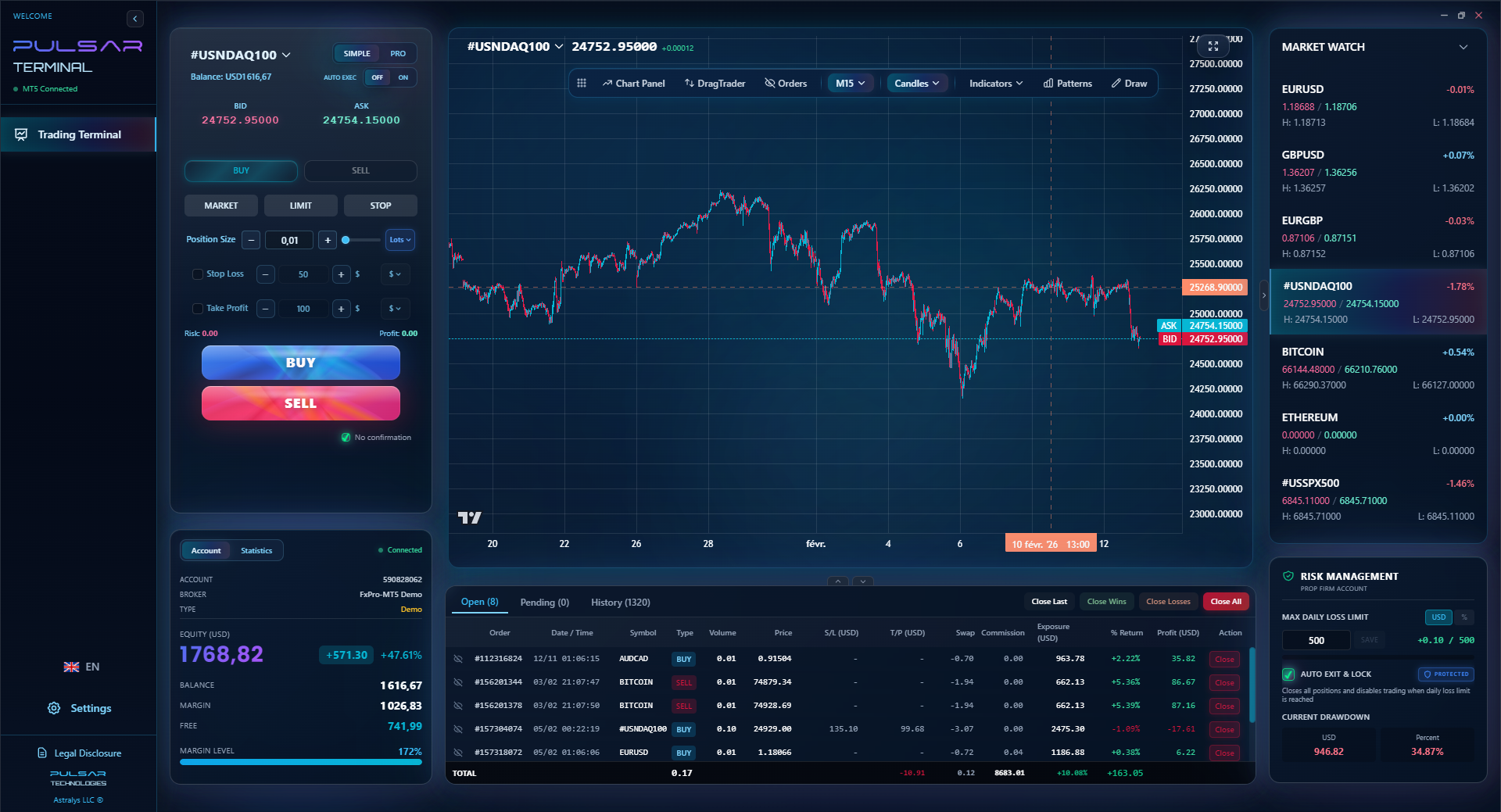
The entire process is designed to make you fearful of any loss, which causes hesitation and missed profits. It also makes you cut winners too early to 'lock in' progress. To pass, you need the discipline of a robot. This is where technology can be a true edge. Using a platform that can automatically enforce your daily loss limit and set breakeven stops is no longer a luxury. It's a necessity to pass these psychological gauntlets. Managing a prop firm's daily loss rule manually, while under pressure, is a recipe for a costly mistake.
💡 เคล็ดลับจาก Winston
If you wouldn't take the trade in your quiet, real account at 11 AM on a Tuesday, don't take it in a contest at 4 PM on a Friday just because you're 0.5% behind. You're lying to yourself.

Passing a prop firm challenge requires robot-like discipline on daily loss limits and breakeven stops, which is exactly the kind of rule-based automation Pulsar Terminal provides directly on your MT5 platform.
Pulsar Terminal
เครื่องมือ MT5 ครบวงจร: ลากวางคำสั่ง, multi-TP/SL, trailing stop, grid trading, Volume Profile และการป้องกัน prop firm ใช้งานโดยเทรดเดอร์กว่า 1,000 คนทุกวัน
“Real trading is about survival, not glory. The market is the only contest that matters.”
I see the ads on Instagram and Facebook. 'Brother, come and win big money.' I hear the stories in trading groups. Let me give it to you raw.
1. Your First Priority is Capital Preservation. In a country with economic volatility, the Naira in your trading account is precious. Throwing it into high-use contest-style trading is irresponsible. Use a position size calculator for every single trade, especially when emotions are high. Your goal is to be trading next year, not to be a flash in the pan this month.
2. Ignore the 'Guru' Who Brags About Contest Wins. Ask to see their verified, long-term live account statement. Not a screenshot, a downloadable report from their broker. I've never seen a consistent, profitable trader of 5+ years who brags about contest wins. They brag about their Sharpe ratio or their consistency. The contest braggarts are usually selling a course or a signal service.
3. If You're New, Spend Your Time Differently. The 100 hours you'd spend stressed over a month-long contest? Spend them like this:
- 30 hours: Truly understanding one instrument, like the EUR/USD guide or XAU/USD guide.
- 40 hours: Backtesting a simple strategy with the RSI indicator or MACD indicator on historical data.
- 30 hours: Trading a micro live account (like $50) with a focus on executing your plan, not making profit.
This path is boring. It doesn't get you likes or shoutouts. But it builds a foundation that won't collapse when the market gets rough.
, the forex market is the only contest that matters. It's open 24/5. The prize is a sustainable income. And the only opponent you need to beat is the person you were yesterday.
FAQ
Q1Can you actually make money from forex contests?
A tiny fraction of people win prize money, but it's statistically similar to a lottery. The vast majority lose their own capital trying to win. The real 'money' is in the lessons learned about your own psychology under pressure, but those lessons are often very expensive.
Q2Are prop firm challenges worth the fee?
They can be, but only if you treat them as a paid exam, not a get-rich-quick scheme. You need a proven, disciplined strategy first. The fee is the cost of seeing if you can execute that strategy under their specific, stressful rules. Never attempt one with a strategy you haven't thoroughly backtested.
Q3What's the biggest mistake in a trading contest?
Changing your strategy mid-contest to chase the leaderboard. You abandon your risk rules, increase use, and take trades you normally wouldn't. This destroys any discipline you've built and ingests bad habits that will hurt your real trading.
Q4Do brokers manipulate prices during contests?
Reputable, well-regulated brokers won't. But be wary of obscure, unregulated brokers running contests. Their goal is to get you to deposit. Always use contests from brokers you've vetted for safety, like those in our broker reviews.
Q5How can I control my emotions during a contest?
Automate everything you can. Pre-define your entry, stop-loss, and take-profit for every trade before you enter. Use tools that can set trailing stops or move to breakeven automatically. This removes emotional decisions in the heat of the moment. Also, set a strict daily time limit for checking the leaderboard - once at the end of the day is more than enough.
Q6Is a high contest rank a sign of a good trader?
Almost never. It's usually a sign of a very lucky or extremely reckless trader. A good trader is defined by consistency over years, not volatility over a month. Look for risk-adjusted returns, not just high percentage gains.
บทเรียนจาก Prof. Winston
สรุปสาระสำคัญ:
- ✓Contests promote 300% use habits; real trading needs 1:30.
- ✓Your odds of winning a prize are typically below 0.5%.
- ✓Drawdown rules in prop firms use starting balance, not equity.
- ✓Demo contest wins teach zero about real financial risk.
บทความนี้มีประโยชน์แค่ไหน?
คลิกดาวเพื่อให้คะแนน
ข้อมูลเชิงลึกการเทรดรายสัปดาห์
การวิเคราะห์และกลยุทธ์รายสัปดาห์ฟรี ไม่มีสแปม
เกี่ยวกับผู้เขียน
Olumide Adeyemi
ผู้บุกเบิกการเทรดในแอฟริกาตะวันตก
หนึ่งในนักการศึกษาฟอเร็กซ์ที่กระตือรือร้นที่สุดของไนจีเรีย 8 ปีประสบการณ์เทรดจากลากอส เชี่ยวชาญกลยุทธ์ทุนต่ำและความท้าทาย prop firm สำหรับเทรดเดอร์ในแอฟริกา
ความคิดเห็น
คำเตือนความเสี่ยง
การซื้อขายตราสารทางการเงินมีความเสี่ยงสูงและอาจไม่เหมาะสำหรับนักลงทุนทุกคน ผลการดำเนินงานในอดีตไม่ได้รับประกันผลลัพธ์ในอนาคต เนื้อหานี้มีวัตถุประสงค์เพื่อการศึกษาเท่านั้นและไม่ควรถือเป็นคำแนะนำในการลงทุน โปรดทำการวิจัยของคุณเองก่อนการซื้อขาย
คุณอาจชอบสิ่งนี้

Cara Trading Forex Sukses: 7 Prinsip dari Trader Profesional
Cara trading forex sukses dengan 7 prinsip trader pro: manajemen modal, disiplin, journal trading, backtest. Data nyata, bukan janji profit palsu.
Jam Trading Forex Terbaik untuk Trader Indonesia: Panduan Lengkap dengan Tabel Waktu
Panduan jam trading forex untuk trader Indonesia. Tabel 4 sesi dunia, jam emas 20:00-00:00, sesi mana yang harus dihindari. Data akurat + tips dari trader berpengalaman.
Top 5 Sàn Forex Uy Tín Nhất 2026: Review Jujur dari Trader Indonesia
Top 5 sàn forex uy tín 2026 untuk trader Indonesia. Review jujur: spread, deposit, withdraw, dukungan lokal. Exness, XM, IC Markets & lebih.
รับ Pulsar Terminal
เครื่องคำนวณทั้งหมดนี้ถูกสร้างไว้ใน Pulsar Terminal พร้อมข้อมูลเรียลไทม์จากบัญชี MT5 ของคุณ
รับ Pulsar Terminal