


Here's a fact that should make you pause: over 70% of Nigerian retail traders who blow up their first account do it because of a simple math error.

Olumide Adeyemi
ผู้บุกเบิกการเทรดในแอฟริกาตะวันตก ·  Nigeria
☕ 9 นาทีอ่าน
สิ่งที่คุณจะได้เรียนรู้:

Here's a fact that should make you pause: over 70% of Nigerian retail traders who blow up their first account do it because of a simple math error. Not a bad strategy, not a market crash - basic arithmetic. They miscalculate their position size, misunderstand the pip value, or completely lose track of what their profit in USD actually means for their life in Naira. That's where a proper forex converter mindset comes in. It's not just a website; it's the foundational skill of knowing exactly what you're risking and gaining in your own currency. Ignore this, and you're just gambling with fancy charts.
When you hear 'forex converter,' you probably think of those sites where you type in 100 USD and get 125,000 NGN. That's the basic version, and honestly, it's almost useless for trading. The real forex converter is a process - a mental and practical toolkit for translating every single market move into real, spendable Nigerian Naira.
Think about it. Your broker shows profits in USD or GBP. But you pay your rent, buy data, and handle family needs in Naira. That disconnect is where leaks happen. A true trading forex converter accounts for three things: the current exchange rate, the pip value of your trade, and your broker's spread. If you're not converting your potential loss into Naira before you hit 'buy,' you're flying blind.
I learned this the hard way early on. I took a nice 150-pip win on GBP/USD, felt like a genius looking at the $750 profit... until I converted it. The Naira had taken a hit that week. My $750 came out to just under 600,000 NGN instead of the 700,000+ I'd mentally budgeted for a project. The market gave, but the currency conversion took. Your trade isn't over until it's in your local currency.
“Your trade isn't over until it's in your local currency.”
You can't rely on feel. Here are the exact calculations you need to run, for every single trade.
Pip Value in Naira
This is the cornerstone. If you don't know what one pip movement is worth in your pocket, you're setting stops and targets based on fairy tales.
Formula: (Pip Value in USD) x (USD/NGN Rate) = Pip Value in NGN
Let's say you're trading the standard lot of EUR/USD. One pip is $10. If USD/NGN is 1250, then one pip is 10 * 1250 = 12,500 NGN. That's not chump change. A 20-pip stop-loss now has a real cost: 250,000 Naira. Seeing that number changes how you view the trade. Use our position size calculator to get this right every time.

Example: Trade: 0.5 lots on GBP/USD. Pip value for 1 lot = $10. So for 0.5 lots, it's $5. USD/NGN rate = 1275. Your Pip Value in Naira = 5 * 1275 = 6,375 NGN per pip. A 15-pip stop loss = 95,625 Naira at risk. Know that number before you enter.
Converting Profit & Loss
This seems obvious, but you must use the effective rate. When you withdraw, your broker converts at their rate, which often includes a fee or a less favorable spread. If you assume the perfect Google rate, you'll be disappointed. Always shave off 1-2% from the interbank rate for a realistic figure.
The Hidden Cost: Spread in Naira
You pay the spread in the trade's quote currency. For EUR/USD, you pay in USD. Convert that cost to Naira too. A 1.0 pip spread on a standard lot is $10. At NGN 1250/$, that's 12,500 Naira you lose the moment you enter the trade. It's a direct cost, just like a brokerage fee.

💡 เคล็ดลับจาก Winston
A pip isn't a point on a chart. It's a unit of your national currency. Start seeing it that way.

“If you're not converting your potential loss into Naira before you hit 'buy,' you're flying blind.”
Trading from Nigeria isn't like trading from the US or UK. Our economic context adds layers of complexity that your average YouTube guru from abroad will never mention.
Volatile Local Currency: The Naira's value against the dollar can swing significantly in a month. A trade you held for two weeks could see its Naira profit eroded by a central bank policy announcement, not a market move. You're effectively trading two pairs: the one on your screen, and the invisible USD/NGN pair.
Withdrawal Realities: You can't just withdraw USD to your local bank account easily. You'll be converting through your broker's or a fintech's platform. Their rate is king. I use Exness for some strategies, and I always check their conversion rate page before I plan a withdrawal. That rate, not the CBN's, is what funds your life.
Inflation Mindset: With inflation high, a 500,000 Naira profit isn't just a number. You have to ask: what will this buy in 6 months? Sometimes, taking a smaller, quicker profit in Naira and moving it into a tangible asset is smarter than holding for a larger USD target that inflation might eat. This isn't just trading, it's capital preservation in a tough environment.
“If you're not converting your potential loss into Naira before you hit 'buy,' you're flying blind.”
I've watched students make these errors for years. Don't be one of them.
Pitfall 1: Ignoring Conversion on Losses. This is the killer. You think, 'It's just a $50 loss.' But if you're over-leveraged, that $50 could be 70,000 NGN. Repeated small losses that you dismiss because the USD figure looks small will drain your Naira capital fast. Always, always convert your max loss per trade to Naira.
Pitfall 2: Using Static Rates. You calculated your trade plan with USD/NGN at 1200. Two days later, it's 1280. Your whole risk management is off. You need to have a rough idea of the trend of the Naira. If it's consistently weakening, your Naira risk is increasing even if your USD stop-loss stays the same.
Pitfall 3: Forgetting Withdrawal Fees. That beautiful $1000 profit? Minus a $30 withdrawal fee from your broker (which is common). That's another 37,500 NGN gone at 1250/$.

Warning: The most dangerous phrase is "I'll figure out the Naira value later." Later is when you're emotional, in a loss, or distracted. Do the math while you're cold and analytical, during your planning. A good forex converter discipline is the difference between a business and a hobby.
💡 เคล็ดลับจาก Winston
Your first calculation for any trade should be: 'If I'm wrong, how many Naira am I set to lose?' If that number makes you uncomfortable, walk away. The market will always be there tomorrow.
“A good forex converter discipline is the difference between a business and a hobby.”
Stop relying on memory. Build a system.
1. The Simple Spreadsheet: This is all you need to start. Columns for: Trade Date, Pair, Position Size, Entry Price, Stop Loss (pips), Stop Loss (USD), Current USD/NGN Rate, Stop Loss (NGN). Update the USD/NGN rate column daily. This visual is powerful.
2. use Broker Tools: Most decent brokers have advanced calculators on their platforms. Before you trade, input your lot size and it will show pip value. Do this. Then pull up a USD/NGN chart. The mental connection is key.
3. The 'Naira Check' Rule: Implement this as a hard rule in your trading plan: "Before any trade entry, I will state the maximum potential loss in Nigerian Naira out loud." If saying "I am risking 120,000 Naira on this trade" gives you pause, then your position size is too big. This one habit will save you more money than any indicator.
4. Withdrawal Planning: Don't withdraw reactively. Plan it. Look at the USD/NGN rate trend. If the Naira is temporarily strong, it might be a good time to convert and withdraw a portion of profits. This is active currency management, part of your job as a Nigerian trader.
“A good forex converter discipline is the difference between a business and a hobby.”
How you trade changes how you convert.
For Scalpers: You're in and out fast. The USD/NGN rate likely won't move much during your trade. Your primary conversion focus is on the aggregate. At the end of the day or week, convert your net P&L. But you must still know your per-trade Naira risk precisely because you take so many trades. A 5,000 NGN loss per trade, 10 times a day, is 50,000 NGN. Your scalping strategy needs a tight Naira-based daily loss limit.
For Swing Traders (This is where it gets critical): You hold for days or weeks. The USD/NGN rate will change. You now have currency exposure. I once held a XAU/USD (Gold) trade for 3 weeks for a $1200 gain. During that time, the Naira strengthened unexpectedly. My $1200, which I'd hoped would be over 1.5 million NGN, converted to just under 1.4 million. I still profited, but it was a lesson. For swings, you might even consider a small hedge or simply factor in a potential 2-5% conversion shift in your final profit calculation.
For Prop Firm Traders: This is crucial. If you're doing a challenge, your drawdown is in USD. But you need to know what that drawdown equates to in your Naira funding. A 5% drawdown on a $100,000 account is $5,000. That's over 6 million Naira at today's rates. That perspective keeps you disciplined. Tools that help automate risk, like those that manage daily loss limits, are useful here to protect that capital.
💡 เคล็ดลับจาก Winston
The most successful traders I know in Lagos have two screens: one for their charts, and one permanently on a USD/NGN price feed. They are always aware.

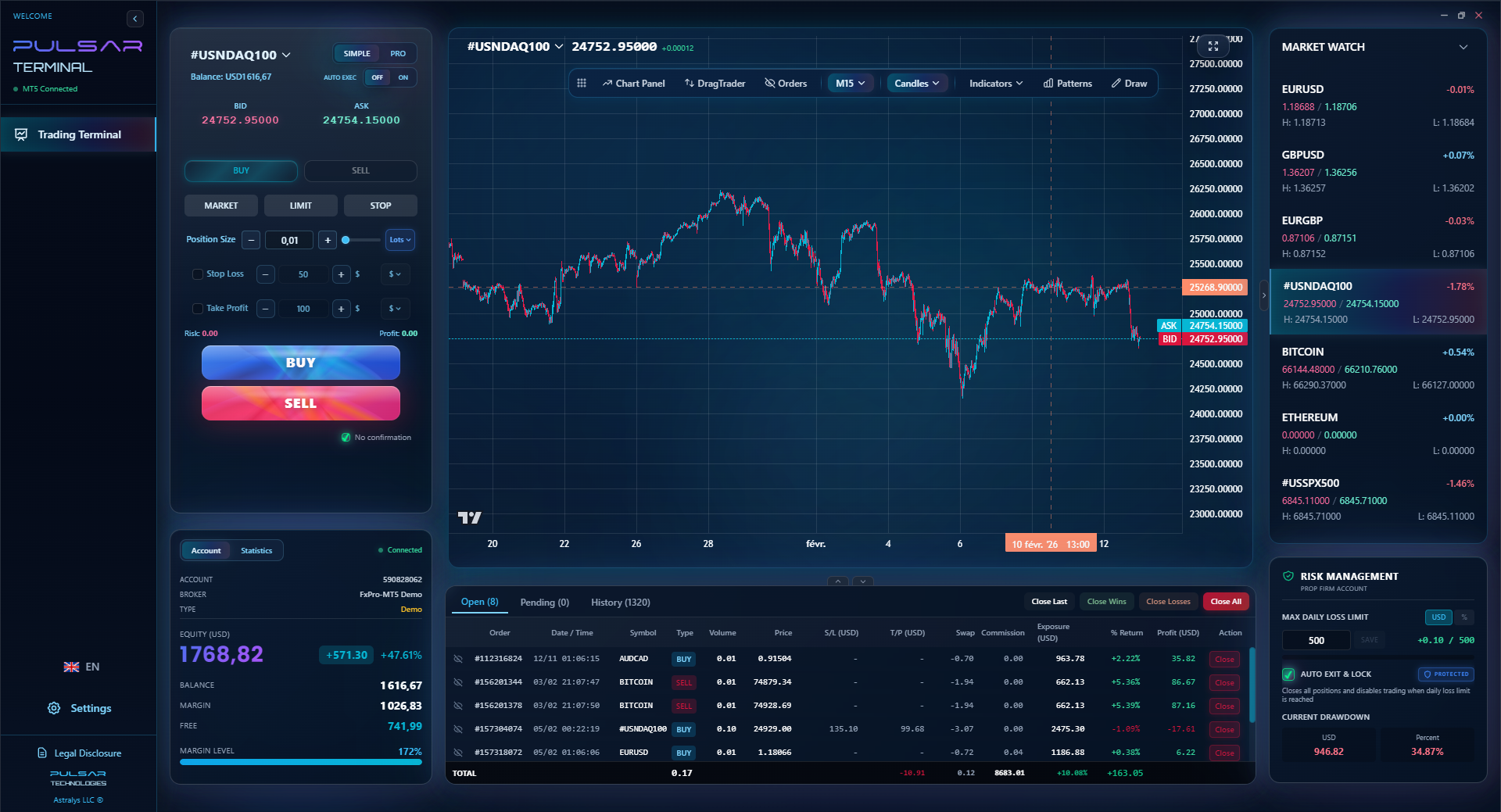
Managing the complex risk of multiple swing trades, especially for prop firm challenges, is far simpler when you can visualize and control your exposure with advanced trade management tools directly on your MT5 platform.
Pulsar Terminal
เครื่องมือ MT5 ครบวงจร: ลากวางคำสั่ง, multi-TP/SL, trailing stop, grid trading, Volume Profile และการป้องกัน prop firm ใช้งานโดยเทรดเดอร์กว่า 1,000 คนทุกวัน
“You're not a forex trader; you're a Naira profit generator using the forex market as your tool.”
Once you've mastered converting single trades, you look at the portfolio.
Correlation Risk in Naira: You might think you're diversified by trading EUR/USD, GBP/USD, and AUD/USD. But if all those pairs move in your favor, you're long the US Dollar Index (DXY). If your goal is to eventually have Naira, and the Naira weakens against the USD when the DXY is strong, your conversion rate gets worse. Your winning trades in USD terms could be offset by a worse conversion rate. It's a head-scratcher, but top-tier traders consider it.
Hedging Your Withdrawals (Conceptual): This is advanced. If you have a large USD profit you plan to withdraw in 30 days, you're effectively short USD/NGN (you need to sell USD for NGN). A sharp Naira strengthening would hurt you. Some traders will take a very small, opposing position on a Naira pair (if their broker offers it) or another asset correlated to emerging market currency strength, as a partial hedge. I don't do this often, but it's in the playbook for managing six-figure USD profits.
The Ultimate Goal: To detach emotionally from the USD P&L on your screen. The number that should make your heart race or bring you calm is the Naira equivalent in your spreadsheet. When you reach that point, you've truly internalized the forex converter. You're not a forex trader; you're a Naira profit generator using the forex market as your tool.


FAQ
Q1What's the best free forex converter for Nigerian traders?
The best tool is your own spreadsheet. For quick rates, Google Finance or XE.com are fine for mid-market rates, but remember they show the ideal rate. For the real rate you'll get, check the conversion page of your broker (like Exness or IC Markets) or your intended withdrawal channel (e.g., Payoneer, Wise). That's the rate that matters.
Q2How often should I update the USD/NGN rate in my calculations?
For trade planning, use the current rate at the time of analysis. For ongoing swing trades, update it daily when you do your market review. The rate can move 20-50 Naira in a day, which can significantly impact the Naira value of your open risk and profit.
Q3My broker shows profit in USD. Should I ask them to show it in Naira?
No. You want the raw, accurate data in the market's primary quote currency (usually USD). Broker conversions within the platform can be misleading or use poor rates. It's your job to do the conversion externally with the correct, real-world rate. Keep the source data pure.
Q4Does the CBN rate matter for my trading profits?
Almost never. The CBN official rate is not the rate you access as a retail individual withdrawing profits. You will get the parallel market rate or your broker's commercial rate. Always plan using the rate you can actually transact at.
Q5I'm scared of the math. Can I still trade?
No. And I mean that bluntly. If you're scared of basic multiplication that protects your capital, you are not ready to trade. This is the simplest, most fundamental part of the business. Use our position size calculator, build the spreadsheet I described, and practice with a demo account until converting pip value to Naira is second nature. There are no shortcuts here.
Q6How do I factor in inflation when converting profits?
You don't factor it into the trade math directly. Instead, you have a separate rule: a portion of Naira profits must be moved into inflation-resistant assets (like land, dollars, or commodities) within a specific timeframe. Your trading system generates Naira; your personal finance system defends its value.
บทเรียนจาก Prof. Winston
สรุปสาระสำคัญ:
- ✓Convert pip value to Naira for every single trade.
- ✓Use your broker's withdrawal rate, not Google's.
- ✓Update your USD/NGN rate daily for open swings.
- ✓State your max loss in Naira aloud before entering.
- ✓A $50 loss can be 70,000 NGN. Respect it.
บทความนี้มีประโยชน์แค่ไหน?
คลิกดาวเพื่อให้คะแนน
ข้อมูลเชิงลึกการเทรดรายสัปดาห์
การวิเคราะห์และกลยุทธ์รายสัปดาห์ฟรี ไม่มีสแปม
เกี่ยวกับผู้เขียน
Olumide Adeyemi
ผู้บุกเบิกการเทรดในแอฟริกาตะวันตก
หนึ่งในนักการศึกษาฟอเร็กซ์ที่กระตือรือร้นที่สุดของไนจีเรีย 8 ปีประสบการณ์เทรดจากลากอส เชี่ยวชาญกลยุทธ์ทุนต่ำและความท้าทาย prop firm สำหรับเทรดเดอร์ในแอฟริกา
ความคิดเห็น
คำเตือนความเสี่ยง
การซื้อขายตราสารทางการเงินมีความเสี่ยงสูงและอาจไม่เหมาะสำหรับนักลงทุนทุกคน ผลการดำเนินงานในอดีตไม่ได้รับประกันผลลัพธ์ในอนาคต เนื้อหานี้มีวัตถุประสงค์เพื่อการศึกษาเท่านั้นและไม่ควรถือเป็นคำแนะนำในการลงทุน โปรดทำการวิจัยของคุณเองก่อนการซื้อขาย
คุณอาจชอบสิ่งนี้

Cara Trading Forex Sukses: 7 Prinsip dari Trader Profesional
Cara trading forex sukses dengan 7 prinsip trader pro: manajemen modal, disiplin, journal trading, backtest. Data nyata, bukan janji profit palsu.
Jam Trading Forex Terbaik untuk Trader Indonesia: Panduan Lengkap dengan Tabel Waktu
Panduan jam trading forex untuk trader Indonesia. Tabel 4 sesi dunia, jam emas 20:00-00:00, sesi mana yang harus dihindari. Data akurat + tips dari trader berpengalaman.
Top 5 Sàn Forex Uy Tín Nhất 2026: Review Jujur dari Trader Indonesia
Top 5 sàn forex uy tín 2026 untuk trader Indonesia. Review jujur: spread, deposit, withdraw, dukungan lokal. Exness, XM, IC Markets & lebih.
รับ Pulsar Terminal
เครื่องคำนวณทั้งหมดนี้ถูกสร้างไว้ใน Pulsar Terminal พร้อมข้อมูลเรียลไทม์จากบัญชี MT5 ของคุณ
รับ Pulsar Terminal