


I remember staring at my screen in late 2023, watching the USD/NGN pair on my broker's platform.

Olumide Adeyemi
ผู้บุกเบิกการเทรดในแอฟริกาตะวันตก ·  Nigeria
☕ 11 นาทีอ่าน
สิ่งที่คุณจะได้เรียนรู้:
- 1What Exactly Is the "Forex Marketplace" in Nigeria?
- 2The Rules of the Game: Regulations You Can't Ignore
- 3Picking Your Platform: Brokers That Work for Naija Traders
- 4Trading the Naira: USD/NGN and Other Pairs
- 5Keeping Your Capital: Risk Management for the Naija Market
- 6Making Strategies Work for You
- 7Looking Ahead & Your Action Plan
I remember staring at my screen in late 2023, watching the USD/NGN pair on my broker's platform. The spread was widening like the Lagos lagoon during a storm, and my pending order just wouldn't fill. That moment, more than any textbook, taught me what the Nigerian forex marketplace really is: a vibrant, complex, and sometimes frustrating environment where global finance meets local reality. It's not just about charts and pips; it's about understanding the Central Bank's latest circular, finding a broker that actually accepts your Zenith Bank transfer, and knowing how much taxman wants when you finally make a profit. Let's break it down.
Forget the fancy definitions. In Nigeria, the forex marketplace is the entire environment where you, me, banks, the government, and international players all try to get the best deal on foreign currency. It's the official CBN windows, the black market (or parallel market, as we politely call it), the online platforms of international brokers like Exness or IC Markets, and the Bureau De Changes on your street corner.
The key thing to understand is that we operate in a tiered system. The rates you see on the news from the CBN are often different from what your broker quotes for USD/NGN, which is again different from what the BDC guy offers for cash. As a retail trader, your primary marketplace is the online brokerage platform. You're not directly trading the physical Naira with the CBN; you're trading CFD or spot contracts on the Naira's value against other currencies, priced by international liquidity providers.
This distinction is crucial. It means your trading is legal (you're using personal funds on an international platform), but it also means you're exposed to the volatility caused by shifts in the local economy. When the CBN makes a major policy announcement, the ripple effect hits your trading charts, often with exaggerated moves due to lower liquidity in forex pairs involving the Naira compared to majors like the EUR/USD.

💡 เคล็ดลับจาก Winston
The spread isn't just a cost, it's a signal. A suddenly widening spread on your Naira pair often means liquidity is vanishing. That's not the time to enter a new trade.
“In Nigeria, the forex marketplace is where global finance meets local reality.”
Here's where many new traders get tripped up. Yes, forex trading is legal for individuals in Nigeria. No, there isn't a strong, specific regulatory body for retail forex trading like the FCA in the UK. The Securities and Exchange Commission (SEC) and Central Bank of Nigeria (CBN) oversee the broader financial markets, but their direct oversight of you and me clicking buy/sell on MT5 is limited.
This creates a unique situation. The onus is on YOU to choose a reputable broker regulated elsewhere - think Australia's ASIC, Cyprus's CySEC, or the FCA. This is your first and most important line of defense. I learned this the hard way early on with a flashy "local" platform that promised the moon. Withdrawals were a nightmare. I lost about ₦80,000 before cutting my losses and moving to a properly regulated international broker.
The Taxman Cometh
This is non-negotiable and often overlooked. All gross profits from your forex trading are subject to a 10% Capital Gains Tax. It doesn't matter if your broker is in Cyprus or your money is in a USD account. If you're a Nigerian resident and you profit, the Federal Inland Revenue Service (FIRS) expects their share. Keep detailed records of all your trades. I set aside 10% of every profitable withdrawal immediately into a separate account, so I'm never caught short.

Warning: Don't assume because your broker is offshore you're invisible. Banks report large transactions. It's far better to be compliant from the start than to deal with penalties later.
The regulatory scene has been hectic. From the CBN revoking thousands of BDC licenses in 2024 to the massive recapitalization requirements (now ₦2 billion for a national BDC license!), the goal is to formalize and stabilize the broader forex marketplace. These changes filter down to us as reduced black-market influence and, hopefully, less extreme volatility in the long run.
“Risk management isn't a suggestion; it's the only reason I'm still trading today.”
Your broker is your gateway to the global forex marketplace. Choosing wrong can mean failed deposits, ridiculous spreads on Naira pairs, or worse, you can't get your money out. Based on my 12 years and testing more platforms than I care to admit, here’s what to look for specifically for Nigeria:
Payment Methods are King: The broker must support deposit and withdrawal methods that actually work here. Look for:
- Local bank transfers (NGN)
- Visa/Mastercard deposits (though sometimes cards get declined for international forex brokers)
- Popular e-wallets that have a footprint in Nigeria.
use and Costs: It's true, use offered to Nigerian clients can be very high - I've seen up to 1:1000. This is a double-edged sword. It can amplify tiny account gains, but it will vaporize your account just as fast. I never use more than 1:50 for my standard swing trading setups. Also, scrutinize the spreads and commissions. A "zero spread" account often has a commission that adds up. Always use a position size calculator to understand your true risk per trade.
Regulation is Your Safety Net: I stick to brokers with top-tier international regulation. Here’s a quick comparison of some that actively accept Nigerian clients:
| Broker | Strong Point for Nigerian Traders | Thing to Watch |
|---|---|---|
| Exness | Excellent history with local deposits/withdrawals, high use options. | Very high use can tempt new traders into extreme risk. |
| XM | Low minimum deposit ($5), good educational resources for beginners. | Spreads can be wider on exotic pairs. |
| IC Markets | Raw spreads, great for scalping strategies. | Minimum deposit is higher ($200). |
| Pepperstone | Top-tier regulation (ASIC, FCA), very reliable execution. | Might have fewer localized payment options than others. |
My personal go-to for the past 4 years has been a combination of IC Markets for my serious, lower-frequency trading and a smaller account with Exness for quick tests on Naira-related volatility. The key is to open a demo account first and test the deposit/withdrawal process with a small amount of real money before funding your main account.
“Risk management isn't a suggestion; it's the only reason I'm still trading today.”
Trading your home currency feels different. You have an innate sense of its value, which can be an advantage and a massive bias. The most direct pair is USD/NGN, but it's not always the easiest to trade.
The Liquidity Problem: USD/NGN is an exotic pair. It doesn't have the deep, constant liquidity of the Euro or Pound. This means spreads can be wide - I've seen 50 pips or more during off-hours or CBN announcement times. For context, the EUR/USD spread is often under 1 pip. This eats into profits, especially for short-term strategies.
How I Approach It: I treat Naira pairs more like a commodity than a major currency pair. I trade them less frequently, focusing on swing trades based on fundamental catalysts. A classic setup was in June 2025 after the CBN extended the BDC recapitalization deadline. There was a clear sentiment shift. I went long USD/NGN (betting the Naira would weaken slightly in the short-term confusion) at 1480.50 and took profit at 1522.00 over the next week. The move wasn't huge in pip terms, but the percentage gain was solid because I used sensible position sizing.
Alternative Routes: Sometimes, it's smarter to trade the Naira's story indirectly. If you believe the Naira will strengthen due to rising oil prices (a major source of USD inflow), consider going long on an oil-sensitive currency like the Canadian Dollar (USD/CAD) or even trading XAU/USD (Gold), which often moves on USD weakness and global uncertainty. This lets you capture the macro theme without dealing with the wild spreads of the direct Naira pair.

Pro Tip: Always check the swap rates (overnight financing charges) on USD/NGN before holding a position for more than a day. They can be significantly positive or negative depending on the direction, which can add to your cost or provide a small income.
💡 เคล็ดลับจาก Winston
Your first profitable withdrawal? Take 10% off the top and put it in a separate account labeled 'TAX'. Future you will be grateful.
“A Stop-Loss is not a failure. It's a pre-planned exit strategy.”
If I could give my younger self one piece of advice, it would be this: risk management isn't a suggestion; it's the only reason I'm still trading today. The Nigerian forex marketplace adds extra layers of risk - currency conversion risk on your profits, potential banking delays, and political/regulatory shocks.
The 1% Rule is Your Bible: Never, ever risk more than 1% of your trading capital on a single trade. On a ₦500,000 account, that's ₦5,000. This seems small, but it allows you to survive a losing streak. I once had 7 losses in a row (it happens to everyone). Because I was risking 1%, my total drawdown was under 8%. It hurt, but it wasn't a catastrophe. I've seen guys risk 10% per trade trying to "get back" their losses. They don't last the quarter.
Use Your Stops Religiously: A Stop-Loss (SL) is not a failure. It's a pre-planned exit strategy. With the volatility in our market, a news spike can wipe out weeks of gains if you're not protected. Place your SL at a logical technical level where your trade idea is proven wrong. And for the love of all that's holy, don't move it further away hoping the market will turn.
Beware of Margin Calls: High use makes a margin call come much faster. If you're using 1:500 use, a 0.2% move against you can wipe out your entire margin. Use use like a powerful spice - a little goes a long way. I keep mine dialed down, which lets me sleep at night when the market is closed.

Example: You have a ₦1,000,000 account. You want to buy USD/NGN at 1500.00 with a stop loss at 1490.00 (a 1000 pip risk). At 1% risk, you can lose ₦10,000 on this trade. With a 1000 pip risk, each pip is worth ₦10. To find your position size: (₦10,000) / (1000 pips) = ₦10 per pip. This is a manageable, disciplined size.
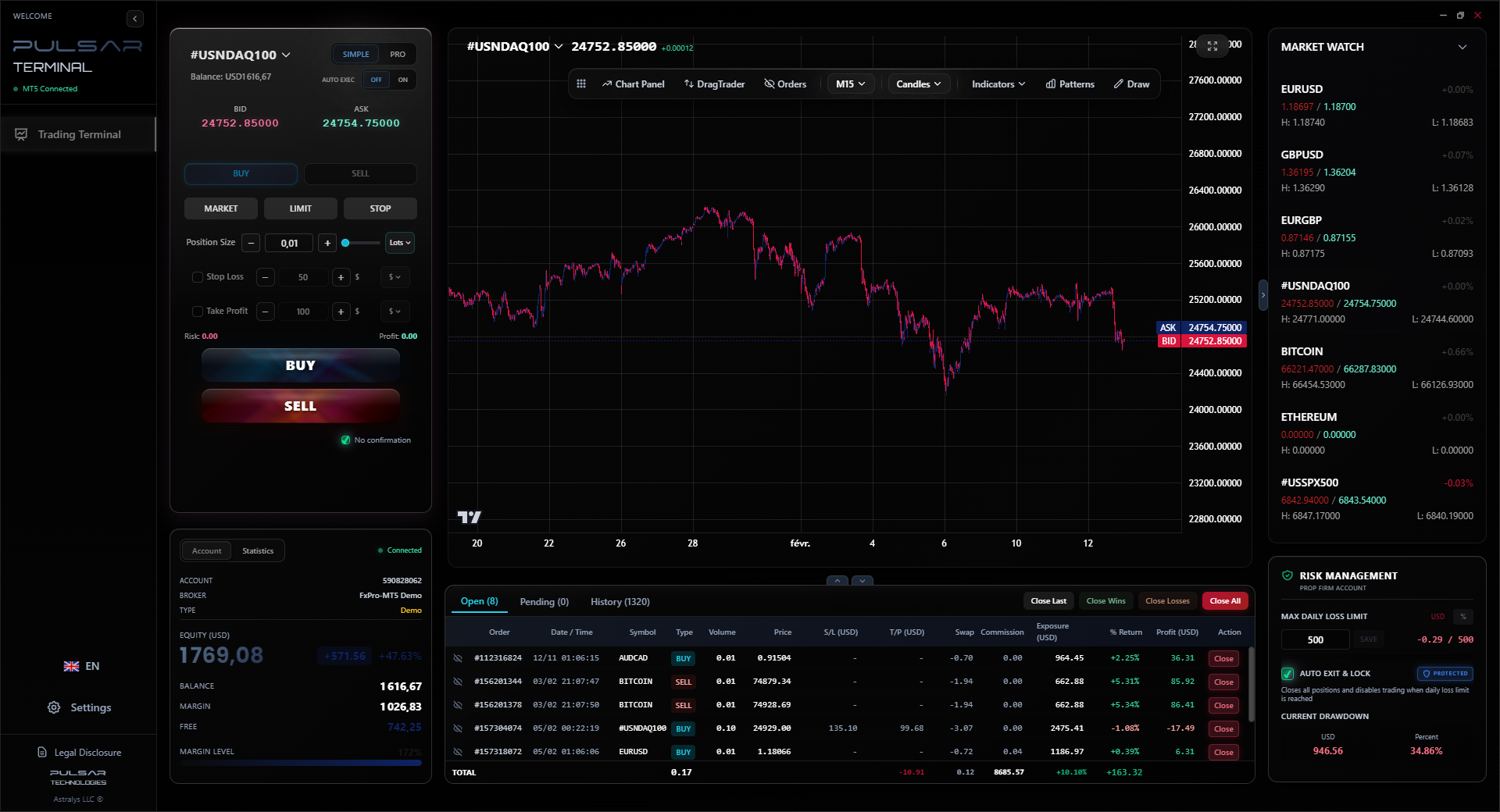
Managing multiple trades and strict stop-losses in a volatile market is easier with tools that automate risk management directly on your MT5 platform.
Pulsar Terminal
เครื่องมือ MT5 ครบวงจร: ลากวางคำสั่ง, multi-TP/SL, trailing stop, grid trading, Volume Profile และการป้องกัน prop firm ใช้งานโดยเทรดเดอร์กว่า 1,000 คนทุกวัน
“A Stop-Loss is not a failure. It's a pre-planned exit strategy.”
You can't just copy a strategy from a trader in London and expect it to work perfectly here. Our market conditions demand adaptation.
Time Your Trading: The most liquid and predictable moves for major pairs (EUR/USD, GBP/USD) often happen during the London and New York overlap (2pm - 5pm Nigerian time). This is when spreads are tightest and institutional volume is high. Trying to scalp the EUR/USD at 2am Nigerian time is a recipe for getting stopped out by random noise and wide spreads.
Indicator Sensitivity: Common indicators like the RSI or MACD can give false signals during low-volume periods or around major CBN news. I use longer timeframes to filter out the noise. A 4-hour or daily chart RSI reading is far more reliable than a 5-minute one in our market.
The News is Everything: In Nigeria, fundamental analysis often trumps technicals in the short term. A CBN governor's speech, a change in oil production quotas from OPEC, or even a major political announcement can override the cleanest head-and-shoulders pattern. Have an economic calendar open and know when major local data (inflation, external reserves) is due.
My most consistent strategy has been a simple trend-following approach on the 4-hour chart, but I only take signals that align with the broader fundamental picture. For example, if the CBN is in a tightening cycle to defend the Naira, I'll be more inclined to look for technical sell signals on USD/NGN (betting on Naira strength) than buy signals, giving the trend the benefit of the doubt.
💡 เคล็ดลับจาก Winston
If you wouldn't explain your trade setup to a skeptical friend over a bottle of Chapman, you're not ready to place it. Clarity prevents costly impulses.
“You can't copy a strategy from a trader in London and expect it to work perfectly here.”
The Nigerian forex marketplace is maturing fast. The reforms from 2024-2026 - unifying exchange rates, cleaning up the BDC sector, launching new frameworks like the Nigerian FX Code - are all aimed at creating a more stable, transparent, and attractive market. For us traders, this should mean reduced extreme volatility in the long run and a more predictable trading environment.
Your path forward is clear:
- Get Your House in Order: Choose a well-regulated international broker that supports Naira transactions. Start with a demo, then a very small live account.
- Education Before Execution: Learn one strategy thoroughly. Understand what a pip is, how margin works, and how to calculate your position size for every single trade.
- Specialize: You don't need to trade 50 pairs. Start with one major (like EUR/USD) to learn the ropes in a liquid market, and then perhaps one Naira pair when you understand the unique risks.
- Keep Records: Log every trade. Note your reasoning, your entry/exit, and your emotional state. This logbook is your best teacher. Review it weekly.
The opportunity is real. I've built a sustainable side income from this market over the years. But it didn't come from luck or one big win. It came from consistent, disciplined application of the basics, adapted to the unique rhythm of the Nigerian forex marketplace. You can do it too. Just respect the market, protect your capital, and never stop learning.
FAQ
Q1Is forex trading legal and safe in Nigeria?
Yes, it's legal to trade forex with your personal funds in Nigeria. The 'safety' part depends entirely on you. It's safe if you use a reputable, internationally regulated broker (like those regulated by ASIC or CySEC) and practice strict risk management. It's unsafe if you use unregulated platforms or trade with money you can't afford to lose.
Q2How much money do I need to start forex trading in Nigeria?
Technically, you can start with as little as $5 (about ₦7,500) with some brokers. However, I strongly advise starting with at least $100 (₦150,000) or more. This allows you to trade sensible position sizes without being wiped out by a single small loss or high spreads. It also gives you a real psychological stake in the game. Always start with a demo account first, no matter what.
Q3How do I pay the 10% tax on forex trading profits?
You are responsible for declaring your trading profits and paying the 10% Capital Gains Tax to the Federal Inland Revenue Service (FIRS). Keep detailed records of all your trades, deposits, and withdrawals. When you withdraw profits to your Nigerian bank account, set aside 10% for tax purposes. It's wise to consult with a local accountant familiar with forex trading to ensure proper filing.
Q4Why is the spread on USD/NGN so high sometimes?
USD/NGN is an exotic currency pair with lower trading volume and liquidity compared to majors like EUR/USD. During off-market hours, on weekends, or around major Nigerian economic news, liquidity dries up. Brokers widen the spread to protect themselves from the increased risk of not being able to hedge your trade easily. It's a cost of trading less liquid instruments.
Q5Can I use a Nigerian broker?
You can, but you must be extremely careful. Any local entity offering forex trading should be authorized by the CBN. The landscape for dedicated retail forex brokers is not as developed as internationally. Most Nigerian traders, myself included, prefer internationally regulated brokers for their stronger consumer protection, advanced platforms, and global liquidity. They also reliably accept Nigerian clients and Naira deposits.
Q6What's the best trading strategy for beginners in Nigeria?
Start with swing trading on higher timeframes (like the 4-hour or daily chart). It's less stressful than scalping, doesn't require you to stare at the screen all day, and is more forgiving of wider spreads. Focus on one or two major currency pairs first (EUR/USD is great) to learn price action before venturing into volatile pairs like USD/NGN.
Q7How do I know if a broker is legit?
Check their regulatory license on the regulator's official website (e.g., ASIC, FCA, CySEC). Read independent reviews from trusted sources. Avoid brokers that promise guaranteed profits or pressure you to deposit more. Test their customer support with questions. Finally, make a small deposit and more importantly, test a full withdrawal before committing significant capital.
บทเรียนจาก Prof. Winston
สรุปสาระสำคัญ:
- ✓Choose international regulation over local promises.
- ✓Never risk more than 1% of capital per trade.
- ✓The 10% capital gains tax applies to all gross profits.
- ✓Trade Naira pairs like commodities, not major currencies.
บทความนี้มีประโยชน์แค่ไหน?
คลิกดาวเพื่อให้คะแนน
ข้อมูลเชิงลึกการเทรดรายสัปดาห์
การวิเคราะห์และกลยุทธ์รายสัปดาห์ฟรี ไม่มีสแปม
เกี่ยวกับผู้เขียน
Olumide Adeyemi
ผู้บุกเบิกการเทรดในแอฟริกาตะวันตก
หนึ่งในนักการศึกษาฟอเร็กซ์ที่กระตือรือร้นที่สุดของไนจีเรีย 8 ปีประสบการณ์เทรดจากลากอส เชี่ยวชาญกลยุทธ์ทุนต่ำและความท้าทาย prop firm สำหรับเทรดเดอร์ในแอฟริกา
ความคิดเห็น
คำเตือนความเสี่ยง
การซื้อขายตราสารทางการเงินมีความเสี่ยงสูงและอาจไม่เหมาะสำหรับนักลงทุนทุกคน ผลการดำเนินงานในอดีตไม่ได้รับประกันผลลัพธ์ในอนาคต เนื้อหานี้มีวัตถุประสงค์เพื่อการศึกษาเท่านั้นและไม่ควรถือเป็นคำแนะนำในการลงทุน โปรดทำการวิจัยของคุณเองก่อนการซื้อขาย
คุณอาจชอบสิ่งนี้

Cara Trading Forex Sukses: 7 Prinsip dari Trader Profesional
Cara trading forex sukses dengan 7 prinsip trader pro: manajemen modal, disiplin, journal trading, backtest. Data nyata, bukan janji profit palsu.
Jam Trading Forex Terbaik untuk Trader Indonesia: Panduan Lengkap dengan Tabel Waktu
Panduan jam trading forex untuk trader Indonesia. Tabel 4 sesi dunia, jam emas 20:00-00:00, sesi mana yang harus dihindari. Data akurat + tips dari trader berpengalaman.
Top 5 Sàn Forex Uy Tín Nhất 2026: Review Jujur dari Trader Indonesia
Top 5 sàn forex uy tín 2026 untuk trader Indonesia. Review jujur: spread, deposit, withdraw, dukungan lokal. Exness, XM, IC Markets & lebih.
รับ Pulsar Terminal
เครื่องคำนวณทั้งหมดนี้ถูกสร้างไว้ใน Pulsar Terminal พร้อมข้อมูลเรียลไทม์จากบัญชี MT5 ของคุณ
รับ Pulsar Terminal