


Most new traders think forex names are just random letters.

David van der Merwe
เทรดเดอร์ตลาดเกิดใหม่ ·  South Africa
☕ 12 นาทีอ่าน
สิ่งที่คุณจะได้เรียนรู้:
- 1What Are Forex Names? It's Not Just Alphabet Soup
- 2Forex Names Every South African Trader Must Know
- 3The Real Cost of Trading These Names in South Africa
- 4How to Choose the Right Forex Name for Your Strategy
- 5Platforms, Tools, and Execution for South Africans
- 6Common Mistakes (And How I Made Them)
- 7Getting Started: A Safe Path for South African Traders
Most new traders think forex names are just random letters. They're wrong. The name of a currency pair tells you a story about risk, cost, and who's really in control of the price. In South Africa, trading USD/ZAR isn't the same as trading EUR/USD, and pretending they are is the fastest way to blow up an account. I learned this the hard way, losing real money before I understood what those three-letter codes actually meant. This guide will strip away the mystery and show you how to read forex names like a pro, with specific numbers and rules for the South African market.
Forex names, or currency pairs, are a price quote. It's that simple. EUR/USD = 1.0850 means one Euro costs 1.0850 US Dollars. The first currency (EUR) is the base currency. The second (USD) is the quote currency. You always buy or sell the base. If you buy EUR/USD, you're buying Euros and selling Dollars, betting the Euro will get stronger against the Dollar.
In South Africa, you'll see a mix. The majors all involve the USD (EUR/USD, GBP/USD). The crosses don't (EUR/GBP). Then you have the exotics, which include one major currency and one from a smaller or emerging economy, like USD/ZAR or EUR/TRY.
Here's the critical part most tutorials miss: the name tells you about liquidity and cost. EUR/USD? Huge volume, tight spreads. USD/ZAR? Less volume, wider spreads. That difference isn't just academic; it changes your entire risk calculation. I once treated USD/ZAR like it was just another pair, using the same tight stop-losses I used on the majors. The spread alone would often eat half my stop distance before the trade even had a chance to move. It was a rookie mistake born from not respecting what the name implied.

Warning: Trading exotics like ZAR pairs with the same tactics you use for majors is a classic error. The wider spreads and different volatility profile demand a different approach, often with wider stops and a smaller position size.
Understanding this hierarchy is your first step to smarter trading. It forces you to ask: why am I trading this pair? Is it for the volatility, the interest rate differential, or just because it's familiar? Your answer will shape your strategy.
“Trading USD/ZAR like it's EUR/USD is the fastest way to blow up an account.”
As a ZAR-based trader, your world revolves around a specific set of pairs. Knowing their personalities is key.
The Global Majors (Your Bread and Butter)
These are the most liquid pairs in the world. You should know them cold:
- EUR/USD (The Euro): The most traded pair globally. Tends to have clean, trending moves. Its average daily range is about 70-100 pips. It's my go-to for testing new strategies because the costs are low and the price action is relatively predictable. I've spent more hours staring at the EUR/USD chart than any other.
- GBP/USD (The Cable): More volatile than the Euro. Can make explosive moves, especially during UK news events. It's a pair that rewards patience and punishes impulsiveness.
- USD/JPY: Heavily influenced by the Bank of Japan and US Treasury yields. It has a reputation for long, sustained trends.
- USD/CHF & AUD/USD: The Swissy is often a "safe-haven" play. The Aussie is a proxy for global commodity demand, especially from China.
The ZAR Pairs (Your Home Turf)
This is where local knowledge can give you an edge, but also where costs are higher.
- USD/ZAR (The Big One): This is the most traded ZAR pair. Its price is a direct reflection of global sentiment towards emerging markets and local South African politics and economics. The spread can be massive. I've seen it as wide as 300 pips during volatile periods. You must factor this into your position size calculator. A 300-pip spread means your trade is already R3000 in the hole per standard lot the moment you enter.
- EUR/ZAR & GBP/ZAR: These are a combination of EUR/USD or GBP/USD and USD/ZAR. They're less liquid than USD/ZAR and can have even wider spreads. I trade these very sparingly.

Example: Let's say USD/ZAR is at 18.5000/18.5300. The spread is 300 points (or 30 pips). If you buy at 18.5300, the price needs to move to 18.5600 just for you to break even. That's a 0.16% move required before you even start making profit. On EUR/USD with a 0.6 pip spread, you only need a 0.006% move.
This table shows why pair selection isn't trivial:
| Pair | Typical Spread (Pips) | Key Driver | Risk Profile |
|---|---|---|---|
| EUR/USD | 0.6 - 1.2 | ECB/Fed Policy, EU Politics | Low Cost, High Liquidity |
| USD/ZAR | 25 - 50+ | SA Politics, Commodity Prices, EM Sentiment | High Cost, Volatile |
| GBP/USD | 1.2 - 2.0 | BoE Policy, UK Data | Volatile, News-Driven |
| AUD/USD | 1.0 - 1.8 | China Data, Iron Ore Prices | Commodity-Linked |
Choosing to trade USD/ZAR means accepting higher transaction costs for the potential of larger moves. It's a trade-off, not a free lunch.

💡 เคล็ดลับจาก Winston
A currency pair's name is its resume. EUR/USD has a PhD in liquidity. USD/ZAR has a certificate in volatility. Hire the right one for the job.
“The name of a currency pair tells you a story about risk, cost, and who's really in control.”
Let's talk numbers. The FSCA's 30:1 use cap is a big deal, but the real profit killers are the silent fees embedded in every trade.
Spreads: This is your main cost. On a good FSCA-regulated broker like Tickmill, you might get EUR/USD at 0.11 pips plus a $6 commission per lot. That's a true cost of about 0.71 pips. On the other hand, a standard account at a broker like XM might offer 0.8 pips with no commission. For USD/ZAR, don't expect anything near that. Spreads of 25-50 pips (250-500 points) are common. That's R250-R500 gone per standard lot before you start.
Commissions: If you're on a Raw/ECN account, you pay per lot. $5-$10 per 100,000 units (a standard lot) is standard. This makes scalping strategies very difficult unless you're catching big moves.
Swap Fees (Overnight Financing): This is critical for swing trading. If you're long USD/ZAR, you're borrowing ZAR to buy USD. The swap rate can be positive or negative depending on the interest rate differential. I once held a long USD/ZAR trade for two weeks during a quiet period. The price went nowhere, but the negative swap fees chipped away over R120 from my position. It was a lesson in hidden carrying costs.
The Inactivity Trap: Many brokers, even good ones, charge inactivity fees. R1500 per month after 30-60 days of no trading is not uncommon. If you're taking a break, close your account or make sure you know the policy.
My biggest mistake early on? I funded my account with ZAR but traded USD-denominated pairs. Every profit was converted back to ZAR at the broker's marked-up rate, silently skimming 1-2% off my gains. Always try to fund in your account's base currency, or use a broker that offers ZAR accounts with local EFT deposits, like some local FSCA providers.
“The name of a currency pair tells you a story about risk, cost, and who's really in control.”
Your strategy should dictate your pair, not the other way around. Here’s how I match them up.
For Beginners: Stick to EUR/USD. It's liquid, costs are low, and information is plentiful. It's the best classroom. Avoid ZAR pairs until you understand how spreads work. Use a demo account to practice on USD/ZAR and feel the difference in slippage and cost.
For Scalpers: You need tight spreads and high liquidity. EUR/USD, USD/JPY, and maybe GBP/USD during the London/New York overlap (3-7 PM SAST) are your playground. Exotics like USD/ZAR will eat you alive with spreads. A tool that helps you visualize liquidity, like the Volume Profile in Pulsar Terminal, is useful here to see where the real market activity is.
For Swing Traders: You can afford wider spreads because you're aiming for larger moves. This is where pairs like USD/ZAR, AUD/USD, or GBP/JPY can shine. Your stop-losses are wider, so the spread is a smaller percentage of your risk. Focus on the fundamental story. For USD/ZAR, are commodity prices rising? Is the political landscape stabilizing? This is a swing trading game.
For Carry Traders: You're hunting for positive swap. You want to buy the high-interest rate currency and sell the low-interest rate one. Historically, this meant pairs like long AUD/JPY or long ZAR/JPY. Warning: The carry trade can blow up spectacularly during risk-off events (like March 2020). The "carry" profits are small daily drips, but the losses can be a tsunami. Never use excessive use on a carry trade.
I learned this through failure. I tried to scalp GBP/JPY. It was volatile, sure, but the spreads were wide and the moves were jumpy. I was constantly stopped out. I switched to swing trading it on the 4-hour chart, using the MACD indicator for trend confirmation and giving trades 150-200 pips of room. My win rate and sanity improved immediately. The pair didn't change. My strategy for that pair did.
💡 เคล็ดลับจาก Winston
The spread isn't a fee you see on a statement; it's a toll bridge you cross on every trade. On some pairs, the toll is higher. Plan your route accordingly.
“Your strategy should dictate your pair, not the other way around.”
MetaTrader 4 and 5 are the undisputed kings in South Africa. They're reliable, and every broker supports them. But the vanilla MT4/5 experience is pretty basic. This is where add-ons become force multipliers.
Order Management: Manually moving stop-losses to breakeven or setting a trailing stop is a hassle. I can't tell you how many times I've watched a profit turn into a loss because I was slow to drag my stop. Now, I use tools that automate this. Setting a 50-pip trailing stop on a winning USD/ZAR trade lets me sleep while it runs.
Risk Management: The FSCA's 30:1 use is a hard cap, but you need your own softer caps. If you're trading a volatile pair, use less than the maximum allowed use. A position size calculator is non-negotiable. For prop firm traders, managing the daily loss limit is a huge stress. Having a tool that can automatically prevent you from trading after hitting a certain daily loss is a game-saver. It removes emotion at the worst possible time.
Charting: MT4's indicators are okay, but for serious analysis, I export data to TradingView or use advanced MT5 plugins. Understanding market structure through tools like Market Profile or having strong drawing tools for pattern recognition (head and shoulders, triangles) makes a tangible difference. It turns guesswork into a structured analysis.
The local advantage? Many South African brokers offer local support during SAST hours and ZAR-denominated accounts. This simplifies taxes and reduces bank fees. Before you sign up with an international broker like IC Markets or Pepperstone, check if they have a local FSCA entity and offer ZAR deposits. That convenience is worth a small premium in spread for many traders.
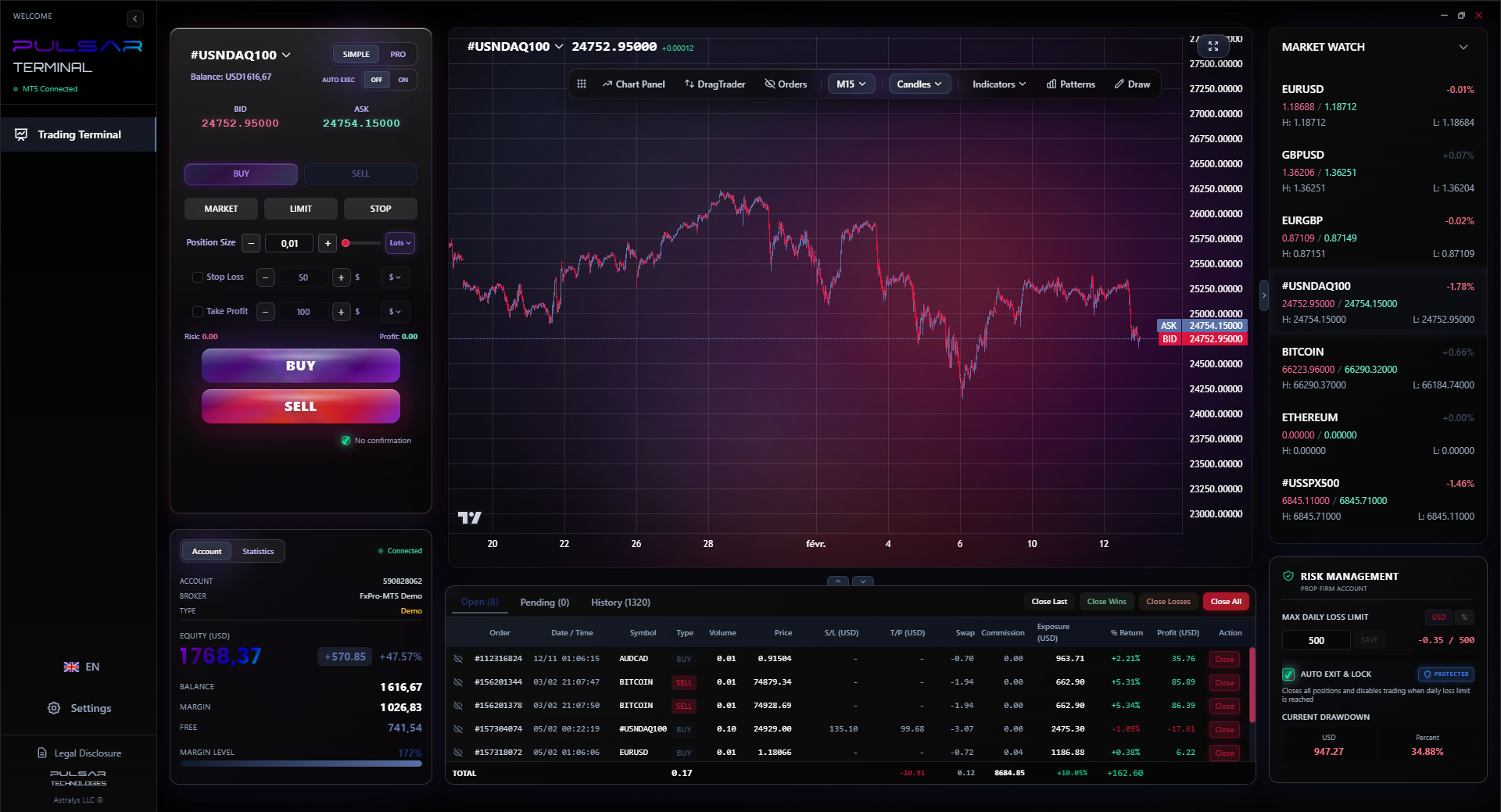
Managing multiple trades and complex risk rules on volatile pairs is stressful, but tools like Pulsar Terminal automate trailing stops, breakeven moves, and daily loss limits directly on your MT5 platform.
Pulsar Terminal
เครื่องมือ MT5 ครบวงจร: ลากวางคำสั่ง, multi-TP/SL, trailing stop, grid trading, Volume Profile และการป้องกัน prop firm ใช้งานโดยเทรดเดอร์กว่า 1,000 คนทุกวัน
“Your strategy should dictate your pair, not the other way around.”
Let me save you some money and frustration.
1. Trading Exotics Like Majors: My first foray into USD/ZAR was a disaster. I used a 50-pip stop-loss. The average spread was 35 pips. The price only needed to move 15 pips against me to hit my stop. It did, repeatedly. I was fighting the spread, not the market. Fix: On wide-spread pairs, use wider stops or trade smaller positions to account for the higher cost of doing business.
2. Chasing ZAR Pairs for 'Familiarity': Just because you read about Eskom in the news doesn't mean you can predict USD/ZAR. Local bias is real and dangerous. The market prices in everything faster than you can read the headline.
3. Ignoring Swap on Long-Term Trades: As mentioned, I've had trades become unprofitable purely from negative swap over time. Fix: Always check the swap rates (long and short) before entering a swing trade. Factor it into your potential profit/loss.
4. Over-Leveraging on Volatile Pairs: 30:1 on EUR/USD is one thing. 30:1 on GBP/JPY or USD/ZAR is a ticket to a margin call. Fix: Scale your use with volatility. If a pair typically moves 150 pips a day, using 1/10th of your available use might be prudent.
5. Not Understanding the Quote: I once confused myself on EUR/GBP. Was I buying Euros or Pounds? If you're ever unsure, just remember: you are always buying the first currency. If you buy EUR/GBP, you want the Euro to strengthen against the Pound. Write this on a sticky note.
💡 เคล็ดลับจาก Winston
Your first 100 trades should be on a demo account. Your next 100 should be with the smallest real money possible. Preserving capital is the first skill to master.
“Forex trading is a marathon of discipline, not a sprint to a Lamborghini.”
Here's your action plan, based on what I wish I'd done.
Step 1: Education, Not Deposit. Don't put in a cent yet. Learn what a pip definition is, how use works, and what the FSCA rules are. Understand the difference between a spread definition and a commission.
Step 2: Choose a Regulated Broker. This is non-negotiable. Start with an FSCA-licensed broker. Look at Exness or XM for low minimum deposits, or a local like Khwezi Trade for ZAR-focused service. Open a demo account first.
Step 3: Develop a Simple Strategy. Pick one pair: EUR/USD. Pick one time frame: the 1-hour chart. Pick one or two indicators, like the RSI indicator for overbought/oversold levels. Paper trade this single setup for a month. Track every trade in a journal.
Step 4: Fund Small, Trade Smaller. When you go live, deposit the absolute minimum. Then, trade with micro lots (0.01). Your goal is to preserve capital and learn the emotional rhythm of real trading, not to get rich. The market will be here tomorrow.
Step 5: Review and Scale. After 3-6 months of consistent, small-scale trading, review your journal. Are you profitable? Is your strategy sound? Only then should you consider increasing your capital or adding a second pair, like USD/ZAR or XAU/USD (gold).
Forex trading in South Africa is a legitimate opportunity, but it's a marathon of discipline, not a sprint to a Lamborghini. The names on your screen are the players on the field. Learn their strengths, weaknesses, and true costs before you bet the game.
FAQ
Q1Is forex trading legal in South Africa?
Yes, it's completely legal. It's regulated by the Financial Sector Conduct Authority (FSCA). You must use an FSCA-licensed broker to ensure your funds are protected under South African law, including client money segregation rules.
Q2What is the best forex pair to trade for beginners in South Africa?
Hands down, EUR/USD. It has the lowest spreads, highest liquidity, and the most predictable trading hours. Avoid South African Rand (ZAR) pairs as a beginner. The wide spreads and volatility will make learning much more difficult and expensive.
Q3What is the maximum use I can use in South Africa?
For retail traders, the FSCA caps use at 30:1. This has been in effect since 2021. Some offshore brokers may offer higher use, but using them means you lose FSCA protection, and your South African bank may block transactions to them.
Q4How are my forex trading profits taxed in South Africa?
Profits from forex trading are considered taxable income by SARS. You must declare them on your annual tax return. Keep detailed records of all your trades, including entries, exits, and fees. It's wise to consult with a tax professional who understands trading.
Q5Why is the spread on USD/ZAR so much wider than on EUR/USD?
Liquidity. EUR/USD is the most traded pair in the world, with billions traded every minute. USD/ZAR has far less trading volume. Lower liquidity means brokers and liquidity providers take on more risk to hold the asset, so they charge a wider spread (the difference between buy and sell price) to compensate.
Q6Can I fund my trading account in South African Rands (ZAR)?
Yes, many FSCA-regulated brokers, both international and local, offer ZAR-denominated accounts. This allows you to deposit and withdraw via local EFT, avoiding international bank fees and currency conversion charges on your deposit/withdrawal. Always check this feature before opening an account.
Q7What are the best trading hours for a South African trader?
The most active and liquid period is the overlap between the London and New York sessions, from about 3:00 PM to 7:00 PM South African Standard Time (SAST). This is when spreads are tightest and price movement is often strongest, ideal for day trading strategies.
บทเรียนจาก Prof. Winston
สรุปสาระสำคัญ:
- ✓Forex names indicate liquidity: EUR/USD tight, USD/ZAR wide.
- ✓Factor spread into stop-loss: 30-pip spread needs >30 pip stop.
- ✓Match pair to strategy: Scalpers need liquidity, swing traders can handle width.
- ✓FSCA use is 30:1, but volatile pairs demand self-imposed lower limits.
- ✓ZAR pairs cost more: A 300-point spread is R3000 per lot gone at entry.
บทความนี้มีประโยชน์แค่ไหน?
คลิกดาวเพื่อให้คะแนน
ข้อมูลเชิงลึกการเทรดรายสัปดาห์
การวิเคราะห์และกลยุทธ์รายสัปดาห์ฟรี ไม่มีสแปม
เกี่ยวกับผู้เขียน
David van der Merwe
เทรดเดอร์ตลาดเกิดใหม่
เทรดเดอร์ประจำโจฮันเนสเบิร์ก มีประสบการณ์ 11 ปีในสกุลเงินตลาดเกิดใหม่ เชี่ยวชาญคู่ ZAR การเทรดภายใต้กฎระเบียบ FSCA และการวิเคราะห์ตลาดแอฟริกาใต้
ความคิดเห็น
คำเตือนความเสี่ยง
การซื้อขายตราสารทางการเงินมีความเสี่ยงสูงและอาจไม่เหมาะสำหรับนักลงทุนทุกคน ผลการดำเนินงานในอดีตไม่ได้รับประกันผลลัพธ์ในอนาคต เนื้อหานี้มีวัตถุประสงค์เพื่อการศึกษาเท่านั้นและไม่ควรถือเป็นคำแนะนำในการลงทุน โปรดทำการวิจัยของคุณเองก่อนการซื้อขาย
คุณอาจชอบสิ่งนี้

Cara Trading Forex Sukses: 7 Prinsip dari Trader Profesional
Cara trading forex sukses dengan 7 prinsip trader pro: manajemen modal, disiplin, journal trading, backtest. Data nyata, bukan janji profit palsu.
Jam Trading Forex Terbaik untuk Trader Indonesia: Panduan Lengkap dengan Tabel Waktu
Panduan jam trading forex untuk trader Indonesia. Tabel 4 sesi dunia, jam emas 20:00-00:00, sesi mana yang harus dihindari. Data akurat + tips dari trader berpengalaman.
Top 5 Sàn Forex Uy Tín Nhất 2026: Review Jujur dari Trader Indonesia
Top 5 sàn forex uy tín 2026 untuk trader Indonesia. Review jujur: spread, deposit, withdraw, dukungan lokal. Exness, XM, IC Markets & lebih.
รับ Pulsar Terminal
เครื่องคำนวณทั้งหมดนี้ถูกสร้างไว้ใน Pulsar Terminal พร้อมข้อมูลเรียลไทม์จากบัญชี MT5 ของคุณ
รับ Pulsar Terminal