


I paid ₦150,000 for a 'forex signals pro' subscription in 2019.

Olumide Adeyemi
ผู้บุกเบิกการเทรดในแอฟริกาตะวันตก ·  Nigeria
☕ 11 นาทีอ่าน
สิ่งที่คุณจะได้เรียนรู้:
- 1What Are 'Forex Signals Pro' Really?
- 2The Nigerian Reality: Regulations, Scams, and Taxes
- 3How to Vet a Signal Provider (Without Getting Burned)
- 4Using Signals the Right Way: Integration, Not Dependency
- 5What It Really Costs & What Are the Alternatives?
- 6Broker Choice & Execution: The Make-or-Break Detail
- 7My Final Verdict & Advice for Nigerian Traders
I paid ₦150,000 for a 'forex signals pro' subscription in 2019. The first week, I followed a EUR/USD buy signal to the letter. Entry at 1.1250, stop loss at 1.1220. It hit my stop loss, then reversed and rocketed to 1.1350, exactly as the 'signal provider' said it would. I was furious. That's when I learned the first brutal lesson: a signal is useless if you don't understand the 'why' behind it, or if your risk management is weak. Let's talk about the real deal with forex signals in Nigeria, beyond the Instagram hype and flashy car pictures.
In simple terms, a forex signal is a suggestion to buy or sell a currency pair at a specific price and time. A 'pro' service implies it's more advanced, often with higher fees and promises of better accuracy. They usually come via Telegram, WhatsApp, SMS, or inside a member's area on a website.
A complete signal should have:
- Currency Pair: e.g., GBP/JPY
- Action: Buy (Go Long) or Sell (Go Short)
- Entry Price: The exact price to enter the trade
- Stop Loss (SL): The price to exit if the trade goes wrong
- Take Profit (TP): The target price to exit with a profit

Warning: Any signal provider that doesn't give you all five pieces of information is not professional. 'Buy GBP/USD now' is a gamble, not a signal. Run away.
The big sell is that they do the analysis so you don't have to. Sounds perfect, right? Just copy, paste, and profit. I wish it were that simple. The truth is, a signal is just someone else's opinion. If you don't have the skill to judge that opinion, you're blindly trusting a stranger with your money. I learned this the hard way after that ₦150,000 lesson. The market doesn't care who gave you the signal.
Many so-called 'pro' services are just repackaged free signals from trading forums or are generated by a basic algorithm with no human oversight. The real value, if there is any, comes from providers who explain the market context - the 'why' - like citing a key resistance break or a specific MACD indicator divergence on the 4-hour chart.

💡 เคล็ดลับจาก Winston
A signal is an idea, not an command. Your job is to court-martial that idea against your own chart and risk rules before you execute.
“A signal is useless if you don't understand the 'why' behind it.”
Here's the crucial bit most flashy ads won't tell you. Forex trading is legal in Nigeria, but the space for signal providers is the wild west. There's no SEC license for 'Forex Signal Guru Ltd.' The Central Bank of Nigeria (CBN) is focused on big-picture currency stability, not on regulating some guy in Lekki sending buy alerts on Telegram.
This lack of oversight is why scams thrive. The classic move? The 'proof trade'. A provider will run two parallel Telegram channels. In Channel A, they signal 'Buy EUR/USD'. In Channel B, they signal 'Sell EUR/USD'. Whichever one wins, they screenshot it and use it as 'proof' of their genius to sell subscriptions to new victims. The losing channel gets deleted.
And let's talk taxes. It doesn't matter if your broker is Exness or IC Markets based offshore. If you're a Nigerian resident making profit, you're liable for a 10% Capital Gains Tax on your gross profits. Yes, even on profits from following a signal. The FIRS won't accept 'my signal provider didn't mention it' as an excuse. Factor this into your profit calculations from day one.
Payment for these services is another headache. You might pay via bank transfer to a local account, with crypto, or with a card. Once that money is gone, there's virtually no consumer protection if the service is trash. I've seen guys pay $500 monthly subscriptions, only for the provider to ghost them after two weeks when a string of losing signals blows up their clients' accounts.
“The lack of oversight is why forex signal scams thrive in Nigeria.”
Don't just look at the win rate. A 90% win rate on tiny 5-pip profits is meaningless if one 50-pip loss wipes out all those gains. You need to dig deeper. Here's my checklist, forged from years of trial and error.
Check the Track Record Over Time
Ask for a verifiable, real-time track record for at least 3-6 months. Not just screenshots of MT4, but a link to a transparent myfxbook or FX Blue stats page. These platforms connect directly to a live trading account and can't be easily faked. Look for:
- Profit Factor: Above 1.5 is decent. Above 2.0 is solid. (Profit Factor = Gross Profit / Gross Loss).
- Maximum Drawdown: This is the biggest peak-to-trough drop in the account. If it's over 20%, it's extremely risky. I prefer providers who keep it under 15%. It shows discipline.
- Average Win vs. Average Loss: The average profitable trade should be significantly larger than the average losing trade. This is the core of a good strategy.
Understand Their Strategy
A good provider will tell you what they trade and how. Do they focus on EUR/USD during London session? Are they scalping the 5-minute chart or swing trading daily setups? If they say 'we use a secret algorithm', be very, very skeptical. Reputable analysts are proud of their method.

Pro Tip: Subscribe to their free signals or trial for a month. Don't trade them with real money. Just paper trade them. See how the signals feel. Are the stop losses reasonable? Is the communication clear? Do they send panic updates? This trial period saved me from another costly mistake just last year.
Community and Support
Are there real, active users? Or just bots in the Telegram group posting 'Thanks sir!'? A true pro service should have some form of support or education - explaining why a trade was taken or exited. If it's just a firehose of signals with no context, you're not learning, you're just a button-pusher.
“The lack of oversight is why forex signal scams thrive in Nigeria.”
This is the most important section. Signals should be a tool in your toolbox, not the entire workshop. Your job is to be the quality control manager.
1. Do Your Own Confirmation. Never blindly enter. When you get a 'Buy GBP/JPY' signal, open your own chart. Does it make sense to you? Is price at a key support level you recognize? Does your own quick analysis with the RSI indicator or price action agree? If not, skip the trade. No signal provider will reimburse your losses.
2. Manage Your Own Risk. The provider gives a stop loss, but you must decide your position size. This is non-negotiable. Using a position size calculator is essential. If their SL is 50 pips, you must calculate how much to trade so that a 50-pip loss is a small, acceptable percentage of your account (e.g., 1-2%). I once doubled down on a signal because I 'believed' in it, violating my own 2% rule. A £200 loss became £800 in minutes. That hurt more than the loss itself - it was a failure of my discipline.
3. Use Them for Education. The best way to use signals is to reverse-engineer them. When a signal hits, study the chart. Why here? Why now? Over time, you'll start to see patterns in their strategy. This is how you eventually wean yourself off and develop your own edge. I used signals from a respected swing trader for 6 months purely to study his entry logic around key weekly levels. It was better than any paid course.
4. Technology is Your Friend. Manually entering trades from a fast-moving Telegram group is stressful and error-prone. Some premium providers offer direct MetaTrader integration where signals are copied automatically. If you go this route, ensure you have rock-solid internet and understand the technology. The last thing you need is a lag causing a bad fill.
💡 เคล็ดลับจาก Winston
The subscription fee is the smallest cost. The real cost is the loss from a bad signal you followed blindly. Always price in that risk.
“Signals should be a tool in your toolbox, not the entire workshop.”
Let's get practical. What are you actually paying for?
| Service Type | Typical Cost (Monthly) | What You Usually Get |
|---|---|---|
| Free Telegram Groups | $0 | Crowded, chaotic, often late signals. High noise-to-signal ratio. |
| Basic 'Pro' Subscription | $50 - $150 | 2-5 signals per day, basic SL/TP, maybe an email summary. |
| Premium 'VIP' Service | $200 - $500+ | Faster signals, 1-on-1 'support', sometimes copy-trading access, webinars. |
| Prop Firm Signals | Varies | Signals tailored for passing prop firm challenges, often with strict risk parameters. |
Remember, a higher price doesn't guarantee better results. That ₦150,000 (about $300 at the time) service I bought was in the 'premium' bracket and was terrible.
Are there alternatives? Absolutely.
- Learn Technical Analysis Yourself: This is the long-term, most empowering path. Invest that monthly signal fee into books, a reputable course, or simply dedicate screen time. It's harder, but the skill is yours forever.
- Use Social/Copy Trading Platforms: Some brokers like XM or Pepperstone have built-in platforms where you can copy verified, real traders. You can see their full history, drawdown, and strategy. It's more transparent than a random signal group.
- Free Trading Ideas from Brokers: Many reputable brokers have daily market analysis from in-house experts. It's not a direct signal, but it's high-quality, free research to inform your own decisions.
Spending $100 a month on signals for a year is $1,200. That could buy a lot of charting books, a solid trading course, or pay for a few months of a powerful trading journal software. Think about the investment in you versus the rental of someone else's opinion.
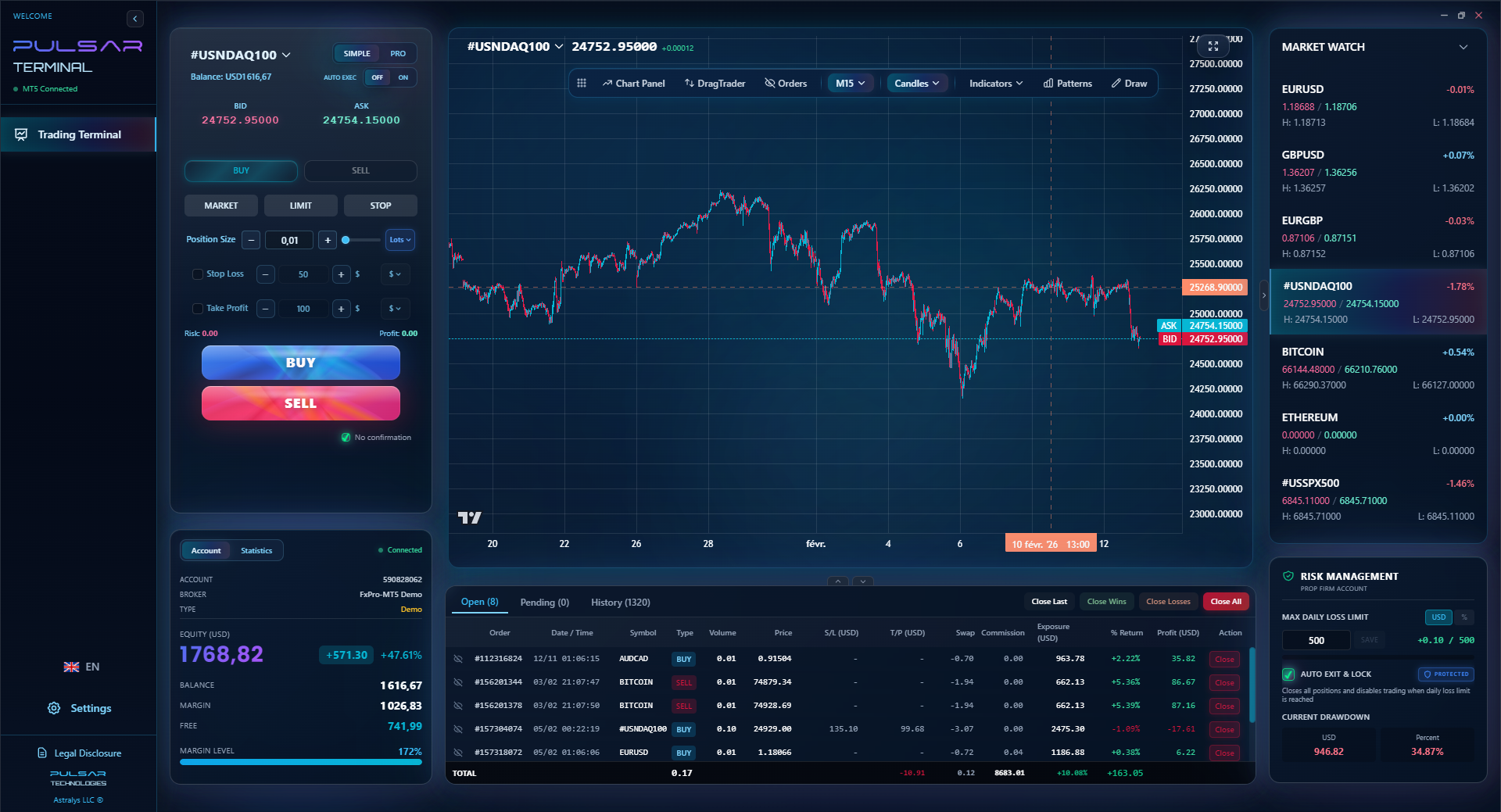
Managing multiple signal-based trades and their stop losses is complex, but tools like Pulsar Terminal let you set multi-level take profits and trailing stops directly on your MT5 charts, automating the exit strategy for any signal you take.
Pulsar Terminal
เครื่องมือ MT5 ครบวงจร: ลากวางคำสั่ง, multi-TP/SL, trailing stop, grid trading, Volume Profile และการป้องกัน prop firm ใช้งานโดยเทรดเดอร์กว่า 1,000 คนทุกวัน
“Signals should be a tool in your toolbox, not the entire workshop.”
A perfect signal can fail because of poor execution. This is especially critical for scalping signals where a 2-pip spread makes a huge difference.
You need a broker that offers:
- Low and Stable Spreads: Check the average spread on the pairs your signal provider trades. If they trade EUR/USD and your broker's spread is 3 pips, you're starting the trade 3 pips in the hole. Brokers like IC Markets or Pepperstone are known for tight raw spreads.
- Fast Execution with No Requotes: When a signal says 'Buy NOW at 1.0850', you need the order filled at that price, not rejected ('requoted') at 1.0852.
- Reliable Platform: MT4/MT5 is the standard. Ensure your broker's version is stable. There's nothing worse than your platform freezing when a signal to exit hits.
- Local Payment Methods: For funding your account in Naira, check if the broker supports local bank transfers or cards without crazy fees. It makes managing your trading capital much smoother.
I learned this execution lesson trading a gold (XAU/USD) signal during high volatility. The signal said sell at $1830.50. My old, clunky broker with high latency filled me at $1829.80. The price instantly reversed. That 0.7 difference was the entire planned profit for the trade. I ended up scratching it for a loss. The signal was right; my broker's execution was wrong.
Also, understand your broker's policy on margin call and stop outs. If you're following multiple signals and have several trades open, poor margin management can get you liquidated even if the individual signals are sound.
💡 เคล็ดลับจาก Winston
If you wouldn't take the trade on your own analysis, a signal is just permission to make a mistake you already saw coming.
“The confidence from executing your own plan is worth more than any subscription.”
So, are 'forex signals pro' worth it? They can be, but only under very specific conditions.
Consider a signal service IF:
- You treat it as a learning supplement, not a crutch.
- You have vetted the provider thoroughly with the checklist above.
- You have the discipline to always use your own risk management and position sizing.
- You have a broker with execution good enough to act on the signals properly.
Avoid them completely IF:
- You're a complete beginner looking for a 'get-rich-quick' button.
- You don't have the spare capital to absorb losses (signals will have losing streaks).
- You expect 100% accuracy and will emotionally blame the provider for every loss.
- You aren't willing to put in screen time to understand the market context.
My personal stance now? I don't use standalone signal services. I might subscribe to a research service from a trusted analyst to get their macro view, but I make my own entry and exit decisions. The confidence that comes from executing your own plan, win or lose, is worth more than any signal subscription.
Start small. If you're curious, allocate a tiny portion of your capital (money you can afford to lose) to test a provider you've vetted. Keep the rest of your account for your own trading education. The goal is to become your own 'forex signals pro'.

Example: Let's say you have a ₦500,000 account. You decide to test a ₦30,000/month signal service. That's 6% of your capital just on fees. A better approach? Put ₦50,000 in a separate account to paper trade the signals for 3 months (costing you nothing). Use the other ₦450,000 to practice your own trading. After 3 months, compare the paper results to your own progress. The data will tell you what's truly valuable.
FAQ
Q1Are forex signals legal in Nigeria?
Yes, but they are largely unregulated. There's no specific license for signal providers from the SEC or CBN. This means you have little to no legal recourse if you get scammed. The legality of trading itself isn't in question, but the signal service industry operates in a grey area with no consumer protection.
Q2What is the success rate of forex signals?
Beware of any provider boasting a 90%+ 'success rate'. It's often misleading. What matters more is the profit factor (aim for >1.5) and the average win size compared to the average loss. A service with a 50% win rate can be highly profitable if their winning trades are twice the size of their losers. Always ask for verified, long-term stats, not cherry-picked screenshots.
Q3How much do forex signal services cost in Nigeria?
Costs vary wildly. You'll find free groups, basic services from ₦20,000 to ₦75,000 per month, and 'VIP' services charging ₦150,000+ monthly. Payment is often in USD, Naira via bank transfer, or cryptocurrency. Remember, a higher price is not a guarantee of quality.
Q4Can I make a living from following forex signals?
It's extremely risky and unlikely. Signal delays, poor execution, emotional reactions to losses, and the inevitable losing streaks make it an unreliable income source. You lack control. Treating it as a side income supplement, at best, is more realistic. Building your own skill is the only path to sustainable trading income.
Q5What's the difference between forex signals and copy trading?
Signals are manual suggestions; you have to enter the trade yourself. Copy trading is automated; your account mirrors the trades of another trader in real-time. Copy trading on a broker's platform offers more transparency (you see the master trader's full history) but you still need to vet the trader carefully and understand the risks of automatic copying.
Q6Do I need a VPS to use forex signals?
If you're trading very short-term signals (scalps) or want 24/5 automated trade copying without worrying about your PC or internet going down, then a Virtual Private Server (VPS) is a good idea. For daily or swing trade signals, it's less critical, but still adds reliability for about $15-30 per month.
Q7How do I know if a forex signal provider is a scam?
Red flags: 1) No verifiable, real-time track record (only old screenshots). 2) Promises of guaranteed profits or extremely high win rates. 3) Pressure to pay large upfront fees for 'lifetime access'. 4) Vague or 'secret' strategies. 5) The 'proof trade' scam using multiple channels. 6) No clear information on stop loss and take profit levels.
บทเรียนจาก Prof. Winston
สรุปสาระสำคัญ:
- ✓Vet providers with verified stats, not promises.
- ✓Always apply your own 1-2% risk per trade rule.
- ✓Factor in the 10% Nigerian Capital Gains Tax.
- ✓A high win rate means nothing without a good profit factor.
บทความนี้มีประโยชน์แค่ไหน?
คลิกดาวเพื่อให้คะแนน
ข้อมูลเชิงลึกการเทรดรายสัปดาห์
การวิเคราะห์และกลยุทธ์รายสัปดาห์ฟรี ไม่มีสแปม
เกี่ยวกับผู้เขียน
Olumide Adeyemi
ผู้บุกเบิกการเทรดในแอฟริกาตะวันตก
หนึ่งในนักการศึกษาฟอเร็กซ์ที่กระตือรือร้นที่สุดของไนจีเรีย 8 ปีประสบการณ์เทรดจากลากอส เชี่ยวชาญกลยุทธ์ทุนต่ำและความท้าทาย prop firm สำหรับเทรดเดอร์ในแอฟริกา
ความคิดเห็น
คำเตือนความเสี่ยง
การซื้อขายตราสารทางการเงินมีความเสี่ยงสูงและอาจไม่เหมาะสำหรับนักลงทุนทุกคน ผลการดำเนินงานในอดีตไม่ได้รับประกันผลลัพธ์ในอนาคต เนื้อหานี้มีวัตถุประสงค์เพื่อการศึกษาเท่านั้นและไม่ควรถือเป็นคำแนะนำในการลงทุน โปรดทำการวิจัยของคุณเองก่อนการซื้อขาย
คุณอาจชอบสิ่งนี้

Cara Trading Forex Sukses: 7 Prinsip dari Trader Profesional
Cara trading forex sukses dengan 7 prinsip trader pro: manajemen modal, disiplin, journal trading, backtest. Data nyata, bukan janji profit palsu.
Jam Trading Forex Terbaik untuk Trader Indonesia: Panduan Lengkap dengan Tabel Waktu
Panduan jam trading forex untuk trader Indonesia. Tabel 4 sesi dunia, jam emas 20:00-00:00, sesi mana yang harus dihindari. Data akurat + tips dari trader berpengalaman.
Top 5 Sàn Forex Uy Tín Nhất 2026: Review Jujur dari Trader Indonesia
Top 5 sàn forex uy tín 2026 untuk trader Indonesia. Review jujur: spread, deposit, withdraw, dukungan lokal. Exness, XM, IC Markets & lebih.
รับ Pulsar Terminal
เครื่องคำนวณทั้งหมดนี้ถูกสร้างไว้ใน Pulsar Terminal พร้อมข้อมูลเรียลไทม์จากบัญชี MT5 ของคุณ
รับ Pulsar Terminal