


You've downloaded a forex trading app demo, you're watching the charts move, and you're thinking, 'This is easy money.' I get it.

Olumide Adeyemi
ผู้บุกเบิกการเทรดในแอฟริกาตะวันตก ·  Nigeria
☕ 9 นาทีอ่าน
สิ่งที่คุณจะได้เรียนรู้:
- 1What Exactly Are You Playing With?
- 2Stop Playing Games: How to Set Up Your Demo
- 3What You Should Actually Be Testing (Spoiler: It's Not Getting Rich)
- 4The Classic Nigerian Demo Mistakes (I Made #3 for Months)
- 5The Scary Question: When Do You Stop the Demo?
- 6Picking the Right Platform for Your Nigerian Reality
- 7Your Step-by-Step Transition Plan
You've downloaded a forex trading app demo, you're watching the charts move, and you're thinking, 'This is easy money.' I get it. I thought the same thing back in 2012. The demo account is the most misunderstood tool in trading. It's not a game. It's a simulator for financial combat, and most people treat it like a slot machine with fake money. If you're in Lagos, Abuja, or Port Harcourt and you're staring at that demo balance, wondering how to turn it into real Naira profits, you need to change your approach completely. Let's talk about what a demo account is really for and how to use it so you don't join the 90% who blow up their first real account.
A forex trading app demo is a simulation. Full stop. It gives you virtual money - often $10,000, $50,000, or even $100,000 - to trade with real-time market prices. Your broker's app (like MT4 or MT5) connects you to a demo server that mirrors the live market.
The critical thing most Nigerians miss? The psychology is fake. There's no adrenaline spike when you're down 50,000 Naira on a trade. Your heart doesn't race. That's the whole problem. The demo's primary job isn't to teach you how to win. It's to teach you how to not lose catastrophically when real money is on the line.

Warning: The biggest demo trap is the unrealistic starting balance. Trading a $100,000 demo when you plan to deposit 50,000 Naira ($~33) sets you up for failure. Your position sizing will be completely off. You'll take risks in the demo you'd never take with your actual savings.
I learned this the hard way. I practiced on a $50,000 demo, got cocky, and funded a live account with $200. My first trade? I sized it as if I still had $50,000. A normal 20-pip move wiped out 25% of my account. The position size calculator became my best friend after that disaster.
You need to use the demo to test three concrete things: the broker's execution speed (do your orders get filled at the price you see?), the reliability of their app during Lagos traffic hours, and the actual spreads on the pairs you care about, like EUR/USD or GBP/NGN crosses if your broker offers them.
If you want this practice to mean anything, you have to simulate reality. Here’s how.
Start with a Realistic Balance
Don't accept the default $100,000. Calculate how much you can realistically afford to risk in your first live account. Is it 100,000 Naira? 50,000? Open your demo with that equivalent in USD. This forces you to think about proper position sizing from day one. Trading 0.01 lots on a 50,000 Naira account feels very different than trading 1.0 lots on a fantasy balance.
Recreate Your Real-Life Obstacles
You're trading from Nigeria. Simulate it. Practice when you have poor internet connectivity. Can you still manage your trades? Test the app's functionality during your commute or in a busy area. Does the charting lag? This is more valuable than any theoretical strategy.
Track Everything Like It's Real
This is non-negotiable. Use a journal. For every demo trade, record:
- The currency pair (e.g., EUR/USD)
- Entry and exit price
- The reason for the trade (Was it an RSI indicator signal? A news play?)
- Your emotional state (Were you bored? FOMOing?)
I still have my demo journal from 2013. It shows me repeatedly breaking my own rules around news events. That pattern continued into live trading and cost me money. The demo showed me the flaw, but I ignored it.

💡 เคล็ดลับจาก Winston
A demo account is a flight simulator. You wouldn't let a pilot who only played arcade games fly your plane. Don't let your untested, demo-habituated self fly your life savings.
“The demo's primary job isn't to teach you how to win. It's to teach you how to not lose catastrophically.”
Your goal in a demo is to answer specific questions, not to see a big green number.
1. Test the Broker's Conditions. This is the most practical use. Are the spreads on the EUR/USD guide tight during the London session, or do they widen to 3 pips? How fast does a market order get filled? Try placing and closing a trade during a fast market (like at 2:30 PM Lagos time when US data drops). Does the app freeze? This research is crucial before you fund a live account with a broker like Exness or IC Markets.
2. Test Your Strategy's Mechanics. You want to try scalping? See if you can consistently capture 5-10 pips on the demo with the broker's minimum trade size and spread. You're interested in swing trading? Practice holding a trade for three days through drawdowns. Can you stomach the floating loss? The demo gives you the logistical rehearsal.
3. Test Your Risk Management. This is the main event. Set a hard daily loss limit (e.g., 2% of your demo balance) and a weekly limit (5%). Practice stopping when you hit it. Most people don't. They just reset the demo. That's a guaranteed future margin call.

Example: Your demo balance is $500 (simulating ~375,000 Naira). Your 2% daily loss limit is $10. If you lose $10, you close the platform for the day. No excuses. This discipline is the only thing that transfers to live trading.
Let's be blunt about the behaviors that will destroy your future real account.
Mistake 1: The Reset Button Addiction. You blow up your $10,000 demo. Instead of analyzing the failure, you click 'Reset Account.' You've just taught yourself that losses have no consequence. In the real world, you can't reset your Naira. The pain of loss is the best teacher, and you're disabling it.
Mistake 2: Strategy Hopping. You try a strategy for three trades, it doesn't work instantly, so you jump to another one. In a demo, this feels like exploration. In reality, it's how you go six months without developing any edge. Pick one approach - like using the MACD indicator for divergence - and execute 50-100 trades with it in the demo. Only then can you judge it.
Mistake 3: Ignoring Transaction Costs. This was my major blind spot. I'd see a 1-pip spread in the demo and think nothing of it. But when I moved to a live account with a different broker, the real spread was 2 pips plus a commission. My break-even point was suddenly further away. Every trade now had a higher hurdle. I didn't account for this, and my barely-profitable demo strategy became a losing live one. Always trade with the demo's 'ECN' or 'Raw' settings enabled to see the true cost, which you can compare later with brokers like Pepperstone or XM.
Mistake 4: No Life Simulation. You trade the demo all weekend and at night. But you have a 9-5 job in Victoria Island. When will you actually trade? Use the demo during your real available hours - maybe 7-8 AM before work or 8-9 PM after. Does your strategy work in those sessions?
💡 เคล็ดลับจาก Winston
The single most important metric to track in your demo isn't profit. It's your maximum consecutive losses. Knowing this number tells you how much capital you need to survive a drawdown.
“You're not ready if you haven't had at least one losing week where you stuck to your risk rules and stopped trading.”
There's no perfect time, but there are clear signals you're not ready. You're not ready if:
- You haven't had at least one losing week where you stuck to your risk rules and stopped trading.
- You don't know your average win rate and risk-to-reward ratio from your demo journal.
- The thought of losing 20,000 Naira on a single trade makes you feel sick (it should, and you need to be comfortable with the possibility within your risk plan).
You might be ready when:
- You've traded consistently for 2-3 months (minimum) through different market conditions (ranging, trending, volatile).
- You can look at your journal and explain why you lost, not just blame the market.
- You've successfully 'paid yourself a salary' from the demo. Set a rule: withdraw 3% of your demo balance every month. Can you grow the account despite this simulated 'withdrawal'? It adds pressure.
My rule of thumb? Double the time you think you need. If you think you're ready after one month, give it two. The market isn't going anywhere. That 100-pip move in XAU/USD will happen again next month, and the month after.
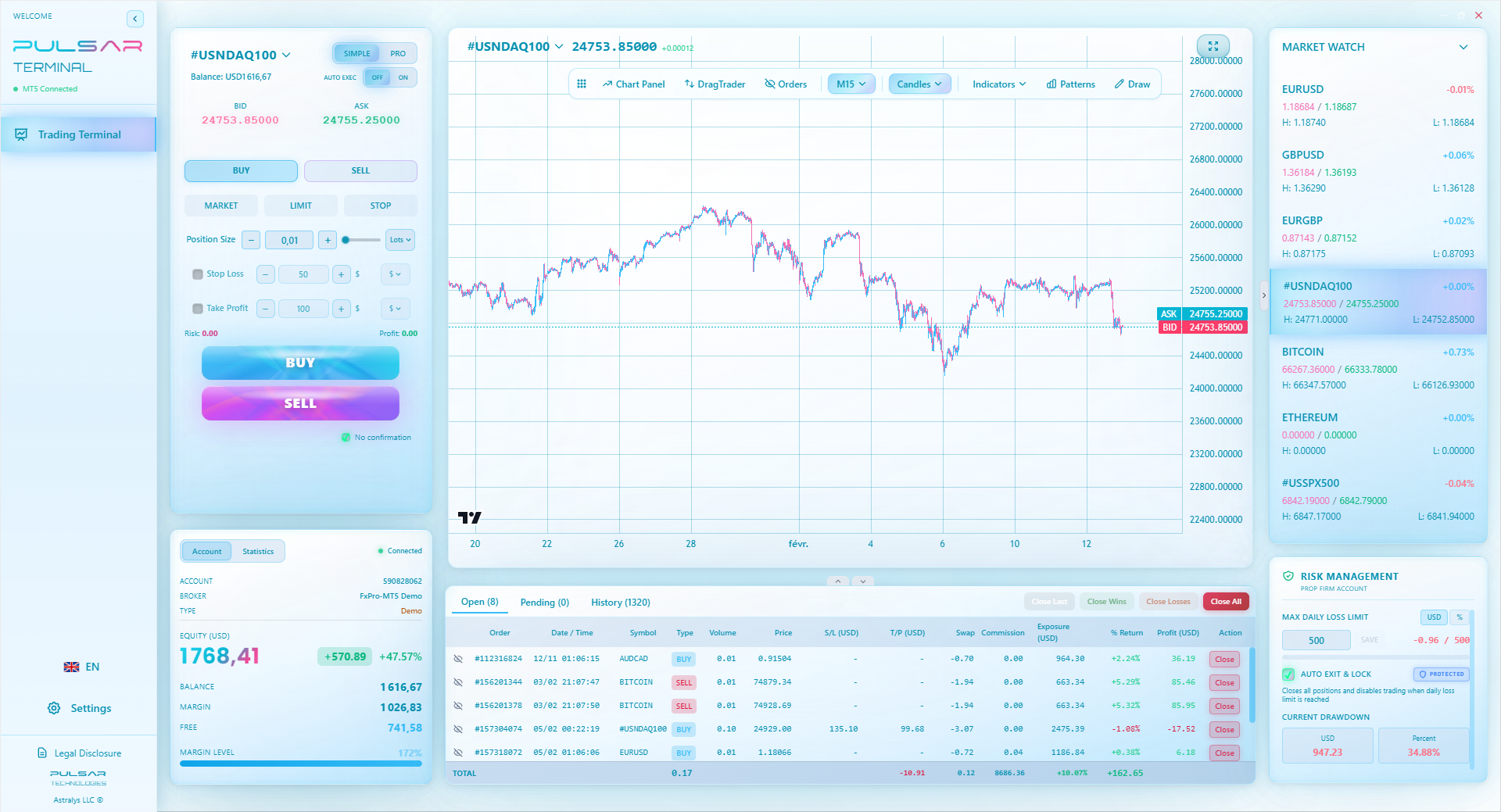
Managing the psychological jump from demo to live is easier when your trade management is automated, letting you focus on the strategy you practiced.
Pulsar Terminal
เครื่องมือ MT5 ครบวงจร: ลากวางคำสั่ง, multi-TP/SL, trailing stop, grid trading, Volume Profile และการป้องกัน prop firm ใช้งานโดยเทรดเดอร์กว่า 1,000 คนทุกวัน
Your forex trading app demo should be from the broker you'll actually use. Consider these factors for Nigeria:
1. Deposit and Withdrawal. This is king. Can you fund your account easily with your Nigerian bank card or a local transfer? How long do withdrawals take to hit your GTB or Zenith account? Test their customer service with a question during Nigerian business hours. The slickest trading app is useless if you can't get your money out.
2. App Stability on Nigerian Networks. Does the app work reliably on MTN or Airtel's data network? Does it have a light version for slower connections? You can't trade if you can't connect.
3. Regulatory Reality. Most international brokers aren't 'regulated' in Nigeria by the SEC. They're regulated offshore. Your protection is different. Understand this. Your demo should be with a broker that has a proven track record of serving African clients reliably. Check reviews from other Nigerian traders on forums like Nairaland.
4. Instruments You Care About. Do you want to trade USD/NGN pairs? Only a few brokers offer these. Does your demo include the commodities or indices you're interested in?

Pro Tip: Open demos with 2-3 shortlisted brokers. Trade the same strategy on all of them for a week. Compare the execution, spreads, and app responsiveness side-by-side. The difference can be the difference between a profitable and losing strategy.
💡 เคล็ดลับจาก Winston
When you switch to live, cut your demo position size in half for the first month. You will make emotional mistakes. This is your financial airbag.
“Be brutal with yourself in the demo, so the market isn't brutal with your Naira later.”
Going live is a shock. This plan softens the blow.
Week 1-2: The Micro Account Test. Don't fund your main account yet. Open a live micro or cent account with the absolute minimum deposit (maybe $10 or 5,000 Naira). The money should be an amount you can afford to lose without a second thought. Now, trade your strategy with real money, real emotion, and real spreads. The goal is not profit. The goal is to feel the psychological difference and not blow up. Keep your position sizes microscopic.
Week 3-4: The 'Real' Demo. Go back to your main demo account. But now, trade it with the emotional memory of that real-money fear. You'll be sharper. You'll respect your stop-losses more. This hybrid phase is where real learning happens.
Month 2: Live Launch. Now fund your actual trading account. Start by trading only 50% of the position size your risk management allows. If your math says you can risk 2,000 Naira per trade (0.02 lots), start by risking 1,000 Naira (0.01 lots). Give yourself a runway to adjust. Your first live goal is survival for 100 trades, not riches.
Remember, the demo is your training ground. The live account is the battlefield. No soldier succeeds by treating training like a game. Be brutal with yourself in the demo, so the market isn't brutal with your Naira later.
FAQ
Q1How long should I use a forex trading app demo before going live?
There's no fixed time, but 2-3 months of consistent, disciplined trading is a bare minimum. You need to experience different market phases - trends, ranges, high volatility. If you can't show a detailed journal of 100+ trades following a single plan, you're not ready. Rushing is the number one cause of early account blow-ups.
Q2Is demo trading a waste of time?
Only if you use it wrong. If you treat it like a video game to see how high you can run up a fake balance, it's worse than a waste of time - it builds bad habits. If you use it to test broker execution, practice strict risk management, and drill your strategy mechanics without emotion, it's useful. The difference is in your approach.
Q3Why are my demo profits so easy but I lose with real money?
Psychology. In a demo, a 50-pip loss is a number. With real money, it's school fees, data subscription, or fuel money. That fear and greed change your decisions. You hesitate on entries, you move stop-losses, you take profits too early. The demo didn't prepare you for the emotional weight. This is why transitioning with a micro account is critical.
Q4Can I use a demo account to pass a prop firm challenge?
Absolutely, it's the best way to practice. But you must replicate the challenge rules exactly on your demo: the same profit target, same maximum daily and overall loss limits. Most prop firms have strict rules, like no holding trades over the weekend. Practice this discipline in the demo first. It's a specific skill.
Q5Do all brokers offer the same demo conditions?
No, and this is a key thing to test. Some brokers have demo servers with perfect liquidity and instant execution. Their live servers might be slower with wider spreads. Use the demo to stress-test the platform: place orders during high volatility, check slippage, and see if the quoted spread is realistic compared to their advertised live spreads.
Q6My demo keeps expiring. What should I do?
Most demo accounts expire after 30 days. This is actually a good thing. It forces you to periodically start fresh, which can break the bad habit of relying on one big, lucky win. When it expires, reopen it with a realistic balance that matches your upcoming live account. Treat each new demo as a fresh live account simulation.
Q7Should I use a demo if I'm a complete beginner?
It's the only place you should start. Before you even think about candlestick patterns, learn how to place a buy and sell order, set a stop-loss and take-profit, and calculate what a 10-pip move means in Naira using a pip calculator. Master the mechanics of the app first. Then worry about strategy.
บทเรียนจาก Prof. Winston
สรุปสาระสำคัญ:
- ✓Simulate your real capital, not a fantasy balance.
- ✓Test the broker's execution, not just your luck.
- ✓Journal every demo trade with entry, exit, and emotion.
- ✓Transition using a micro account to feel real risk.
- ✓Master the app's mechanics before funding it.
บทความนี้มีประโยชน์แค่ไหน?
คลิกดาวเพื่อให้คะแนน
ข้อมูลเชิงลึกการเทรดรายสัปดาห์
การวิเคราะห์และกลยุทธ์รายสัปดาห์ฟรี ไม่มีสแปม
เกี่ยวกับผู้เขียน
Olumide Adeyemi
ผู้บุกเบิกการเทรดในแอฟริกาตะวันตก
หนึ่งในนักการศึกษาฟอเร็กซ์ที่กระตือรือร้นที่สุดของไนจีเรีย 8 ปีประสบการณ์เทรดจากลากอส เชี่ยวชาญกลยุทธ์ทุนต่ำและความท้าทาย prop firm สำหรับเทรดเดอร์ในแอฟริกา
ความคิดเห็น
คำเตือนความเสี่ยง
การซื้อขายตราสารทางการเงินมีความเสี่ยงสูงและอาจไม่เหมาะสำหรับนักลงทุนทุกคน ผลการดำเนินงานในอดีตไม่ได้รับประกันผลลัพธ์ในอนาคต เนื้อหานี้มีวัตถุประสงค์เพื่อการศึกษาเท่านั้นและไม่ควรถือเป็นคำแนะนำในการลงทุน โปรดทำการวิจัยของคุณเองก่อนการซื้อขาย
คุณอาจชอบสิ่งนี้

Cara Trading Forex Sukses: 7 Prinsip dari Trader Profesional
Cara trading forex sukses dengan 7 prinsip trader pro: manajemen modal, disiplin, journal trading, backtest. Data nyata, bukan janji profit palsu.
Jam Trading Forex Terbaik untuk Trader Indonesia: Panduan Lengkap dengan Tabel Waktu
Panduan jam trading forex untuk trader Indonesia. Tabel 4 sesi dunia, jam emas 20:00-00:00, sesi mana yang harus dihindari. Data akurat + tips dari trader berpengalaman.
Top 5 Sàn Forex Uy Tín Nhất 2026: Review Jujur dari Trader Indonesia
Top 5 sàn forex uy tín 2026 untuk trader Indonesia. Review jujur: spread, deposit, withdraw, dukungan lokal. Exness, XM, IC Markets & lebih.
รับ Pulsar Terminal
เครื่องคำนวณทั้งหมดนี้ถูกสร้างไว้ใน Pulsar Terminal พร้อมข้อมูลเรียลไทม์จากบัญชี MT5 ของคุณ
รับ Pulsar Terminal