


Let me guess.

David van der Merwe
เทรดเดอร์ตลาดเกิดใหม่ ·  South Africa
☕ 10 นาทีอ่าน
สิ่งที่คุณจะได้เรียนรู้:

Let me guess. You've seen the ads promising a 'free forex trading bot' that'll make you money while you sleep. It sounds like the ultimate hack, right? I fell for that same line back in 2018. Spent weeks testing a 'free' bot that ended up blowing a R5,000 demo account in three days. The hard truth is, in the trading world, 'free' is often the most expensive word you'll encounter. Let's cut through the hype and look at what a free forex trading bot really means for a South African trader, from FSCA rules to the hidden costs in ZAR.
When someone offers you a free trading bot, your first question should be: what's their angle? I've learned this the hard way. A truly free, profitable trading algorithm is like finding a winning Lotto ticket on the ground. It doesn't get given away.
Usually, 'free' comes with strings attached. Sometimes it's a limited demo version that stops working after a month. Other times, it's a 'signal service' in disguise, where the bot just tells you to trade through a specific broker who pays the developer a kickback. I once used a free EA that required me to trade minimum lot sizes, and the spread on those trades was suspiciously wide. The 'free' bot was making someone money, just not me.
The real cost isn't always upfront. It's in the poor execution, the hidden fees, or the outright scam that wipes your account. You still pay brokerage costs - spreads, commissions, swap fees. If you want it running 24/7, you'll need a VPS, which is another R200-R800 per month. That 'free' bot suddenly has a monthly subscription.

Warning: If a 'free' bot requires you to fund an account with a specific, obscure broker, run. This is a classic setup for a bucket shop scam, where your losses are their profit.
Think of it this way: if you had a money-printing machine, would you give it away for free? Neither would a legitimate developer. The most valuable thing you can get for free is knowledge. Learning to code a simple bot yourself, even if it's just for practice, teaches you more than any black-box system ever will.

💡 เคล็ดลับจาก Winston
The most expensive thing you can trade with is ignorance. A 'free' bot that you don't understand is just expensive ignorance with an on/off switch.
Here's a critical point many miss: the FSCA regulates brokers, not bots. They don't have a 'bot approval' department. Their job is to ensure financial service providers, like your broker, play fair. This means your protection starts and ends with using an FSCA-regulated broker like those we've reviewed, such as Exness or XM.
Broker Compatibility is Key
You can find the fanciest free bot online, but if your broker doesn't allow Expert Advisors (EAs) or has rules against certain types of automated orders, you're stuck. Always check a broker's policy on automated trading first. Most major platforms like MT4 and MT5 support EAs, but some brokers restrict hedging or scalping strategies that many bots rely on.
The Spread is Where They Get You
Let's talk numbers. Say you find a free scalping bot. It makes 10 trades a day on EUR/USD. On a standard account with a 1.5-pip spread, you're paying 15 pips in spread costs daily, before the trade even moves in your favor. Over a month, that's 300 pips just in fees. A bot needs to be incredibly accurate to overcome that drag. This is why ECN accounts with raw spreads (like 0.0 pips plus a commission) are often better for bots, but they're rarely the ones promoted with 'free' software.

Pro Tip: Before trusting a bot with real money, test it on a demo account with the EXACT same broker and account type you plan to use. Spreads and execution speeds on demo can be misleadingly good.
The FSCA's warnings list is full of unlicensed entities selling 'automated wealth' systems. If the bot seller isn't linked to a regulated broker, you have zero recourse if it steals your money or malfunctions. Your safety net is your broker's regulation, not the bot's promise.
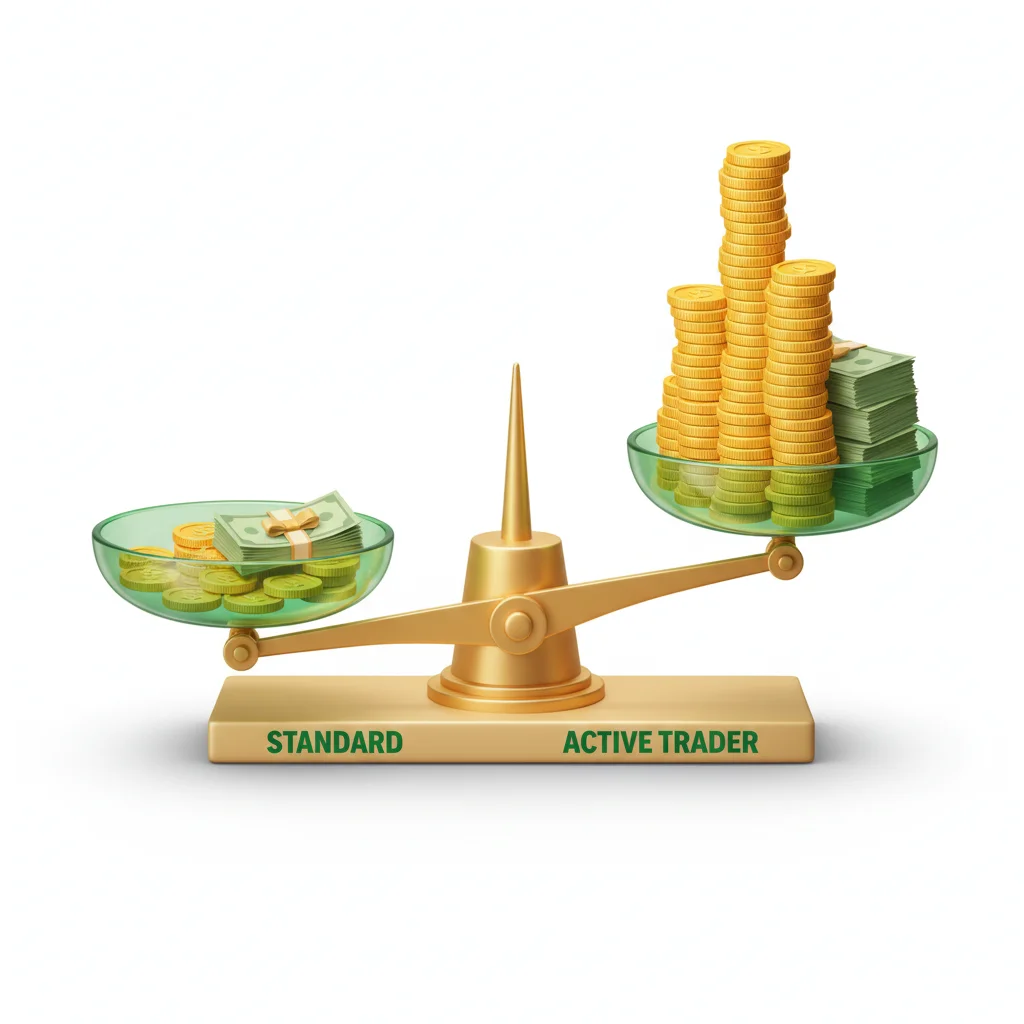
“Your safety net is your broker's regulation, not the bot's promise.”
Let's break down the actual rands and cents involved, even with a 'free' bot. I'll use my own past mistake as an example.
The Setup That Cost Me:
- 'Free' Grid Trading Bot: Downloaded online.
- Broker Account: Unregulated broker suggested by the bot website (my first big mistake).
- Deposit: R10,000.
- VPS for 24/5 operation: R240/month.
- Result in Month 1: The bot placed trades constantly during high volatility. The spreads widened, and it kept opening orders. I hit a margin call and lost R8,500 of my capital. The 'free' tool cost me 85% of my stake plus the VPS fee.
Here’s a realistic table of potential costs, free bot or not:
| Cost Item | Typical Price (ZAR) | Why It's Necessary |
|---|---|---|
| Broker Spreads/Commissions | Variable (R2 - R50 per trade) | How the broker makes money. |
| Virtual Private Server (VPS) | R200 - R800 / month | Keeps bot running if your PC/internet is off. |
| Potential Drawdown Losses | Your entire capital | Bots can fail spectacularly. |
| Your Time & Education | Priceless | Monitoring, adjusting, learning the strategy. |
A free bot ignores the most important cost: opportunity cost. The time you spend configuring, worrying about, and recovering from a bad bot could be spent learning a solid swing trading strategy you actually control. I learned more about market structure in one month of manual trading than I did in a year of fiddling with automated systems.
This is the biggest shift in mindset that saved my trading. Instead of searching for a free, ready-made 'robot', invest your time in learning to build your own simple automations. You don't need a computer science degree.
Platforms like MetaTrader's MT4 and MT5 have a built-in language called MQL4/MQL5. There are thousands of free tutorials online. Start by automating just one part of your process. Can you code a script that automatically closes all trades at Friday 5 PM? Or one that places a stop-loss and take-profit order as soon as your manual entry is filled?
I started by building a simple notification bot. It didn't trade for me, but it scanned for specific conditions on the XAU/USD chart and sent me a Telegram message. This took the emotion out of watching screens but kept me in control. The knowledge I gained let me look at any 'free' bot's code (if they provided it) and see if its logic was sound or complete nonsense.
When you build, you understand the strategy's weaknesses. You know exactly what conditions it needs to profit. If you just download a black-box free bot, you have no idea why it's losing. Is it the market? Or is the logic flawed? You're flying blind.

Example: A basic bot that places a trade when the RSI indicator goes below 30 and exits at 50 might look good in a trending market. But in a ranging market, it will get chopped up. If you coded it, you'd see this flaw immediately and adjust. If you downloaded it, you'd just blame the market.
This skill is liberating. It turns you from a consumer of magic solutions into a creator of your own tools. It’s the difference between hoping for a handout and building your own engine.
💡 เคล็ดลับจาก Winston
If you wouldn't hand a stranger R10,000 in cash to trade for you, why would you hand your trading logic to a stranger's code? Trust should be earned, not downloaded.
“The time spent recovering from a bad bot could be spent learning a strategy you actually control.”
Okay, I get it. You still want to try one. Maybe you found a promising free EA in a forum. If you're going to do it, do it smarter than I did. Here's a safety protocol.
Step 1: The Forensic Demo Test Don't use a R50,000 demo account. Use a realistic one, like R20,000. Run the bot for at least two months, through different market conditions (high volatility, low volatility). Record everything: win rate, average win/loss, largest drawdown. Use a position size calculator to ensure the bot's lot size settings aren't insane.
Step 2: Strategy Decryption Try to reverse-engineer what it's doing. Is it a martingale grid bot? (These average down on losses and can blow accounts fast). Is it a news trader? (Risky without ultra-fast execution). Look at its trades. Does it hold losses forever? Does it cut winners too short? Treat it like a new employee you're evaluating.
Step 3: The Micro-Live Test If it passes the demo, go live with the absolute minimum possible capital. With a broker like IC Markets, you could start with R500 or R1000 on a cent account (where 1 lot = 0.01). This lets you test real execution and psychology with literally 1% of your usual risk capital. The goal isn't to make money, it's to see if the bot behaves the same as in demo.
Step 4: The Walkaway Rule Set a hard loss limit before you start. For example: "If this bot loses 20% of the test capital, I uninstall it and move on." This prevents the sunk cost fallacy from making you throw good money after bad. I didn't have this rule in 2018, and I paid for it.
Remember, a bot that works in a backtest or on someone else's screenshot is meaningless. The only test that matters is forward performance, with your broker, on your terms.

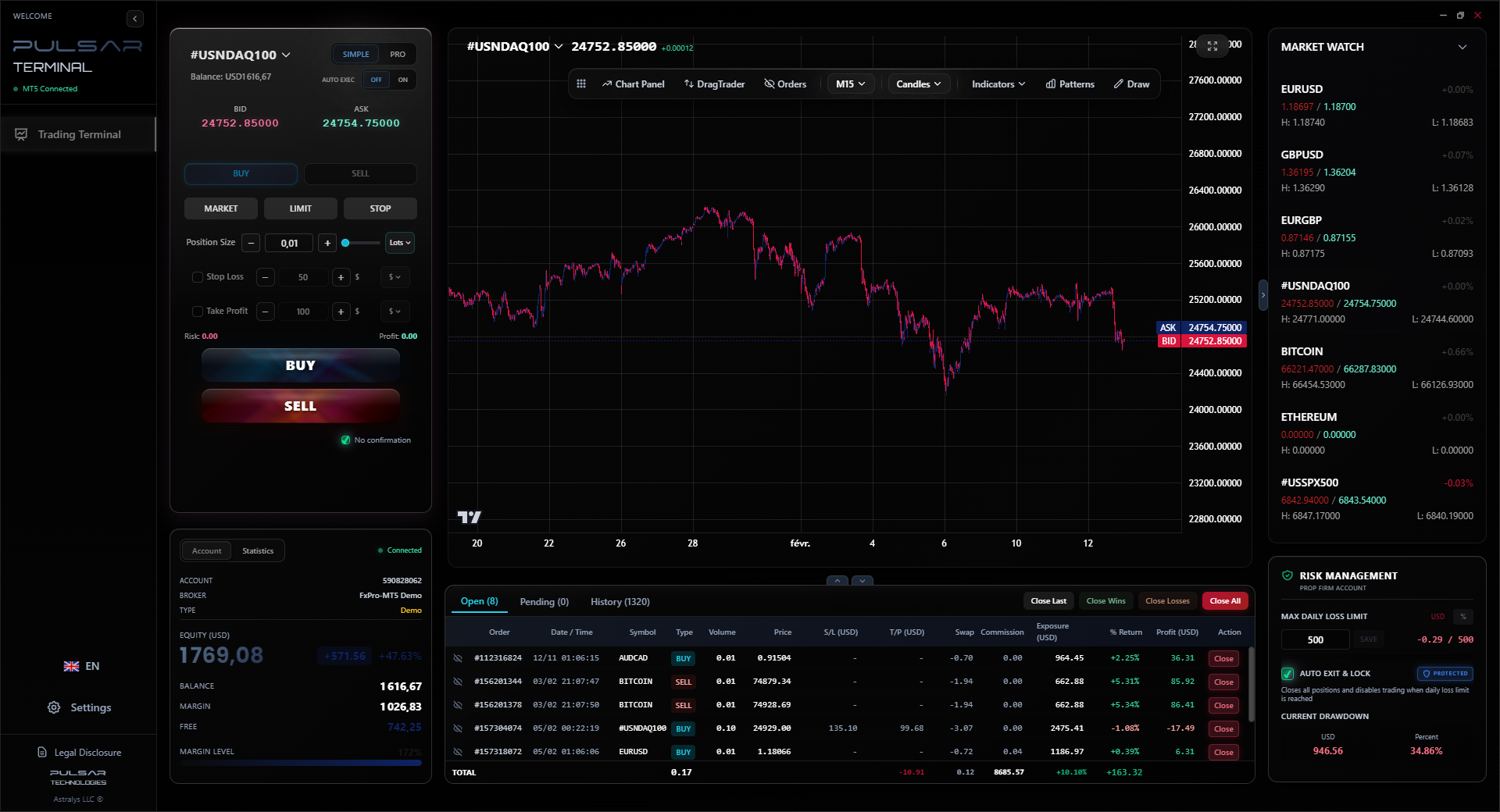
When testing strategies or managing risk, having precise control over your orders is key, which is exactly what tools like Pulsar Terminal offer for MT5 traders.
Pulsar Terminal
เครื่องมือ MT5 ครบวงจร: ลากวางคำสั่ง, multi-TP/SL, trailing stop, grid trading, Volume Profile และการป้องกัน prop firm ใช้งานโดยเทรดเดอร์กว่า 1,000 คนทุกวัน
Forget the bot for a second. What are you really trying to achieve? Consistent execution? Removing emotion? Saving time? There are better, more reliable ways to get there.
1. Use Your Platform's Built-In Automation. MT4/MT5 have fantastic built-in tools most traders ignore. You can set alerts based on indicators. You can use the 'Expert Advisor' feature to automatically trail your stop-loss. You can create templates for your chart setups. This is free, reliable automation provided by your platform, not some random download.
2. Semi-Automated Trading with Tools. This is where I've settled. I make the high-level decision (e.g., "I think EUR/USD is going up"), but I use tools to execute the details flawlessly. For instance, I might use a trade manager tool that automatically sets a risk-based stop-loss, scales out at multiple profit targets, and moves to breakeven at a specified point. This gives me discipline without handing over the keys to an algorithm I don't trust.
3. Focus on a Single, Repeatable Strategy. The allure of a bot is that it can trade 24/7 across 28 pairs. But is that actually good? More trades often mean more mistakes and more fees. I became profitable when I focused on just two setups on the EUR/USD, maybe taking 2-3 trades a week. I could plan and execute them manually with far greater care than any bot scanning the entire market.
4. Invest in Your Own System. If you are committed to full automation, save up and pay a reputable coder on a site like MQL5.com to code YOUR strategy. You provide the rules (the 'edge'), they provide the clean code. It might cost you R5,000-R15,000 once. That's cheaper than a 'free' bot that loses you R20,000. You own the code, you understand it, and you can modify it. This is the professional path.
The best tool for a South African trader isn't a mysterious bot. It's a regulated broker, a solid internet connection, a clear plan, and the discipline to follow it. Everything else is just a shortcut that usually leads off a cliff.
FAQ
Q1Are free forex trading bots legal in South Africa?
Yes, using them is legal. However, the bot itself isn't regulated by the FSCA. Your protection comes from using an FSCA-regulated broker. If the bot seller is also acting as a broker or managing your funds, they would need an FSP license, which most free bot providers absolutely do not have.
Q2What is the best free forex trading bot for MT4/MT5?
I'm hesitant to name a 'best' because there isn't one that's both truly free and reliably profitable long-term. The most valuable free bots are often educational tools or simple scripts from code-sharing communities like the MQL5 Market's 'Free' section. Look for ones with open-source code so you can see how they work, not mysterious .ex4 files.
Q3Can I make money with a free forex bot?
It's possible, but highly unlikely as a sustainable income. You might get lucky for a week or a month. The statistics showing most retail traders lose money include those using bots. A free bot typically has a fundamental flaw, a hidden cost, or is designed to benefit its creator, not you. Making consistent money requires an edge, and edges aren't given away for free.
Q4What's the biggest risk with a free trading bot?
Beyond losing money, the biggest risk is the 'black box' problem. You don't know its logic. It could be using a dangerous strategy like martingale (doubling down on losses) that can wipe your account in one bad move. Another huge risk is malware; downloading an .exe file from an untrusted site can compromise your banking details.
Q5Do I need a VPS for a free forex bot?
If you want it to run 24/7 without your computer being on, yes. A VPS adds a monthly cost (R200-R800), immediately making the bot 'not free.' For testing or running only when your PC is on, you don't need one. But for any serious, continuous operation, a VPS is non-negotiable for reliable execution.
Q6How can I tell if a free bot is a scam?
Red flags: 1) Promises of guaranteed profits or high daily returns. 2) Requires you to deposit money with a specific, unknown broker. 3) The seller is pushy or secretive. 4) No verified, long-term track record (not just screenshots). 5) The bot file is an .exe, not an .mq4/.mq5 file for MT4/MT5. If it sounds too good to be true in the forex market, it is.
บทเรียนจาก Prof. Winston
สรุปสาระสำคัญ:
- ✓'Free' bots have hidden costs: spreads, VPS, and potential total loss.
- ✓FSCA regulates brokers, not bots. Your protection starts there.
- ✓Building simple automations teaches more than any black-box system.
- ✓Test any bot with micro-capital first - 1% of your usual risk.
บทความนี้มีประโยชน์แค่ไหน?
คลิกดาวเพื่อให้คะแนน
ข้อมูลเชิงลึกการเทรดรายสัปดาห์
การวิเคราะห์และกลยุทธ์รายสัปดาห์ฟรี ไม่มีสแปม
เกี่ยวกับผู้เขียน
David van der Merwe
เทรดเดอร์ตลาดเกิดใหม่
เทรดเดอร์ประจำโจฮันเนสเบิร์ก มีประสบการณ์ 11 ปีในสกุลเงินตลาดเกิดใหม่ เชี่ยวชาญคู่ ZAR การเทรดภายใต้กฎระเบียบ FSCA และการวิเคราะห์ตลาดแอฟริกาใต้
ความคิดเห็น
คำเตือนความเสี่ยง
การซื้อขายตราสารทางการเงินมีความเสี่ยงสูงและอาจไม่เหมาะสำหรับนักลงทุนทุกคน ผลการดำเนินงานในอดีตไม่ได้รับประกันผลลัพธ์ในอนาคต เนื้อหานี้มีวัตถุประสงค์เพื่อการศึกษาเท่านั้นและไม่ควรถือเป็นคำแนะนำในการลงทุน โปรดทำการวิจัยของคุณเองก่อนการซื้อขาย
คุณอาจชอบสิ่งนี้

Cara Trading Forex Sukses: 7 Prinsip dari Trader Profesional
Cara trading forex sukses dengan 7 prinsip trader pro: manajemen modal, disiplin, journal trading, backtest. Data nyata, bukan janji profit palsu.
Jam Trading Forex Terbaik untuk Trader Indonesia: Panduan Lengkap dengan Tabel Waktu
Panduan jam trading forex untuk trader Indonesia. Tabel 4 sesi dunia, jam emas 20:00-00:00, sesi mana yang harus dihindari. Data akurat + tips dari trader berpengalaman.
Top 5 Sàn Forex Uy Tín Nhất 2026: Review Jujur dari Trader Indonesia
Top 5 sàn forex uy tín 2026 untuk trader Indonesia. Review jujur: spread, deposit, withdraw, dukungan lokal. Exness, XM, IC Markets & lebih.
รับ Pulsar Terminal
เครื่องคำนวณทั้งหมดนี้ถูกสร้างไว้ใน Pulsar Terminal พร้อมข้อมูลเรียลไทม์จากบัญชี MT5 ของคุณ
รับ Pulsar Terminal