


Ever placed a trade and watched it do absolutely nothing for hours? You're not alone.

Olumide Adeyemi
ผู้บุกเบิกการเทรดในแอฟริกาตะวันตก ·  Nigeria
☕ 12 นาทีอ่าน
สิ่งที่คุณจะได้เรียนรู้:
- 1Why Trading Times Aren't Just a Schedule
- 2The Four Major Sessions (Translated to WAT)
- 3The Golden Hours: Session Overlaps
- 4What to Trade and When: A Nigerian Trader's Cheat Sheet
- 5When to Step Away: The Risks of Quiet Periods
- 6Making It Work with Your Nigerian Life
- 7Tools and Strategies for Different Volatility
- 8Your Action Plan: From Theory to Practice

Ever placed a trade and watched it do absolutely nothing for hours? You're not alone. The truth is, the forex market has specific windows where the real money moves happen, and if you're trading at the wrong time, you're just wasting screen time and opportunity. For us trading from Nigeria, figuring out these global forex trading times in West Africa Time (WAT) is the difference between catching a big move and getting stuck in a dead market. Let's break down exactly when you should be at your charts, based on my 12 years of trading through Nigerian internet connections and power cuts.
Think of the forex market like a Lagos market. At 6 AM, it's quiet. By noon, it's packed, noisy, and prices are moving fast. That's liquidity and volatility in action. Trading during the busy hours means your orders get filled quickly at the price you want (tight spreads), and there's enough movement to actually make a profit.
I learned this the hard way early on. I used to trade USD/NGN crosses during our local afternoon, thinking it made sense. The spreads were huge - sometimes 50 pips or more - and the price would barely budge. I was paying a massive fee just to enter a stagnant trade. Once I shifted my focus to the major pairs during the London session, everything changed. The EUR/USD spread was often below 1 pip on my broker, and the moves were clean and decisive.

Warning: Trading during low-liquidity periods (like late Friday night WAT) is dangerous. A single large order can cause a massive spike or drop that triggers your stop-loss before reversing, a phenomenon known as a 'stop hunt.' I've been wiped out by this more than once.
The core concept is this: Price needs volume to move with purpose. You want to trade when the big banks and institutions in London, New York, and Tokyo are active. Your strategy also dictates your time. A scalping strategy needs the fast, liquid moves of the London-New York overlap. A swing trading approach can be more flexible, as you're targeting larger moves over days.
Nigeria operates on West Africa Time (WAT), which is GMT+1. This is actually a decent timezone for forex, as we can catch the tail end of Asia and the heart of Europe and America during reasonable hours. Here’s the daily cycle, starting from Sunday evening.
Sydney Session (The Quiet Opener)
- Opens: 10:00 PM WAT (Sunday)
- Closes: 7:00 AM WAT (Monday) This session kicks off the week. It's generally the quietest. The Australian and New Zealand dollars (AUD, NZD) see most action here, but volumes are low. I rarely trade this session unless I'm managing an existing position from the previous week.
Tokyo Session (The Asian Engine)
- Opens: 12:00 AM (Midnight) WAT
- Closes: 9:00 AM WAT This is when Japan, China, and Singapore come online. Pairs like USD/JPY, AUD/JPY, and GBP/JPY come alive. The moves can be sharp but often range-bound. It's a good session for methodical traders. If you're awake around 6-7 AM WAT, you're seeing the peak of this session.
London Session (The Main Event)
- Opens: 8:00 AM WAT
- Closes: 5:00 PM WAT This is it. The biggest financial center in the world opens. Liquidity floods the market. The Euro, British Pound, and Swiss Franc pairs (EUR/USD, GBP/USD, EUR/GBP) get their direction here. Most major economic data from Europe is released at 9:00 AM or 10:00 AM WAT. From 8 AM, my coffee is ready and I'm focused.
New York Session (The Volatility Spike)
- Opens: 1:00 PM WAT
- Closes: 10:00 PM WAT American banks and funds join the fray. This session often determines the daily close. The US Dollar pairs are in focus, and big US economic news (like Non-Farm Payrolls at 1:30 PM WAT) can cause market earthquakes. This is where a lot of the day's trends get confirmed or reversed.

Example: If you want to trade the EUR/USD guide, your prime hours are from 8:00 AM WAT (London open) through to about 5:00 PM WAT (when London closes and New York is still active). That's your 9-hour window of highest probability.

💡 เคล็ดลับจาก Winston
The market pays you for patience, not presence. If your set-up isn't there during the London open, wait for the New York join. Forcing a trade in the Tokyo lull is just paying spread for a seat in an empty cinema.

“For Nigerian traders, the London-New York overlap from 1 PM to 5 PM WAT isn't just a time slot; it's where the market decides the day's story.”
This is the secret sauce. When two major trading sessions are open simultaneously, trading volume doubles. More volume means tighter spreads, stronger trends, and better opportunities. For Nigerian traders, two overlaps are critical.
Tokyo-London Overlap (8:00 AM - 9:00 AM WAT) This is a short but sweet one-hour window. Asian traders are still active as London comes online. You often see a surge in activity in GBP/JPY and EUR/JPY pairs. It's a great time to look for breakout moves from the Asian range. I've caught some of my cleanest GBP/JPY trends right at 8:15 AM WAT.
London-New York Overlap (1:00 PM - 5:00 PM WAT) This is the absolute peak of the trading day. The two largest financial centers are both fully operational. This 4-hour window accounts for the majority of the day's volume and volatility.
- Liquidity is at its maximum. Spreads on majors like EUR/USD are often at their tightest.
- Trends accelerate. A move that started in London often gets a second wind from New York participation.
- News catalysts are frequent. US economic data is released at 1:30 PM and 3:00 PM WAT right in the middle of this overlap.
I structure my entire trading day around this overlap. If I'm taking new positions, 90% of them are initiated between 1:00 PM and 3:00 PM WAT. The market just has more conviction. Remember, with great volatility comes great risk. Always use a sensible position size calculator because moves can be fast.

You don't need to trade everything. Match your favorite pairs to their most active sessions. Here’s my personal schedule:
| Time (WAT) | Active Session | Best Currency Pairs to Watch | My Typical Action |
|---|---|---|---|
| 8:00 AM - 9:00 AM | London Open / Tokyo Overlap | GBP/JPY, EUR/JPY, EUR/GBP | Look for breakouts from Asia range. Set alerts. |
| 9:00 AM - 1:00 PM | Pure London Session | EUR/USD, GBP/USD, EUR/GBP | Core trading hours. Execute swing trade setups. |
| 1:00 PM - 5:00 PM | London-New York Overlap | EUR/USD, GBP/USD, USD/JPY, XAU/USD guide (Gold) | Most active time. Perfect for intraday trades and catching US news. |
| 5:00 PM - 10:00 PM | Pure New York Session | USD/CAD, USD/JPY, US Stock Indices (if your broker offers) | Manage existing trades. Be wary of false moves into the close. |
A specific trade example: On March 12th, I was watching EUR/USD. London had pushed it up, and at 1:30 PM WAT, weaker-than-expected US CPI data hit. The pair spiked 40 pips in minutes. Because I was already at my screen during the overlap, I could react instantly and rode 25 of those pips. If I'd been trading at 10 PM WAT, I'd have missed it entirely.

Pro Tip: Gold (XAU/USD) often gets very active during the New York session. If you're a night owl trading past 5 PM WAT, keep an eye on it, especially when there's US dollar news.
“Trading during low-liquidity periods is like trying to swim in a puddle - you'll just get muddy and go nowhere.”
Just as important as knowing when to trade is knowing when NOT to trade. Your discipline here will save you money.
Friday Evening (After 10 PM WAT): The New York session is closed, and the market is in weekend mode. Liquidity evaporates. This is when bizarre, thin-volume spikes can occur. I once had a stop-loss on GBP/USD taken out by a 25-pip spike at 11 PM WAT on a Friday, only for the price to snap back to where it was 30 seconds later. The trade was right, but the timing was disastrous.
Sunday Evening (10 PM - Midnight WAT): The Sydney session is opening. The initial 'Sunday gap' has usually been filled by this point, but volume is still very thin. It's best to wait for the Tokyo session to get going properly after midnight.
Major Holidays: If London or New York is on a bank holiday, volume will be drastically lower even during their usual session times. Check an economic calendar. Trading on a US Independence Day or UK Boxing Day is often a waste of time.
The psychological trap is feeling like you need to be in a trade. During these quiet times, the best trade is no trade. Go watch a movie. Your account will thank you. This is also where a good broker with reliable execution matters; during volatile news events in the overlap, you don't want requotes or slippage. I've found brokers like IC Markets review and Pepperstone review handle these high-volatility periods well due to their ECN models.
💡 เคล็ดลับจาก Winston
Your most dangerous trade is the one you take out of boredom after 10 PM. Low volume doesn't mean low risk; it means your stop-loss is a glowing target for the few players left on the field.

Not everyone can trade the 1 PM overlap. Maybe you have a 9-5 job. Here’s how to adapt.
For the Day Job Trader (9-5 WAT): Your sweet spot is the London open (8 AM - 9 AM WAT). Get up an hour earlier. Analyze the market, set your orders for the day, and use stop-loss and take-profit orders. You can also catch the very end of the New York session after work, but be cautious as volume tails off.
For the Night Owl: The Tokyo session (Midnight - 9 AM WAT) is yours. Focus on JPY pairs. You can also trade the New York close and the initial Sydney action, but remember the liquidity warnings.
For the Weekend Analyst: If you can only trade actively for a few hours, make it the London-New York overlap (1 PM - 3 PM WAT). This is your concentrated opportunity window. Do your analysis on Sunday night, then be ready to execute during this high-probability window.
Technology is your friend. Use pending orders (Buy Stop, Sell Limit) to enter trades at specified levels. Use mobile trading apps to monitor positions discreetly. The key is to plan your trade during your analysis time, then let the market come to you on your schedule. Don't chase.
I used to try trading around my erratic schedule, taking signals at all hours. It was exhausting and unprofitable. When I finally committed to just the London and overlap hours, my profitability concentrated and my stress levels dropped. I was trading less, but making more.

“Your discipline in knowing when NOT to trade will save more money than any indicator will ever make you.”
Your trading toolbox should change with the session.
High Volatility (London-New York Overlap):
- Indicators: Keep it simple. Price action and support/resistance levels are king. Volatility can distort oscillators. A simple MACD indicator on a higher timeframe (1H or 4H) for trend direction can be helpful.
- Strategy: Trend-following and breakout strategies work well. Be quick to take profits and use trailing stops. This is where managing a trade becomes as important as entering it.
Medium Volatility (Pure London/Tokyo Session):
- Indicators: This is where oscillators can shine. The RSI indicator can help identify overbought/oversold conditions within a range.
- Strategy: Range trading and mean reversion strategies can be effective. Look for bounces off clear support and resistance.
Managing Trades Across Sessions: This is a critical skill. If you enter a trade in London, what happens when New York opens? Your profit target might get hit faster, or the trend might reverse. You need a plan.
- Use Multiple Take-Profit Levels: Don't just have one target. Take partial profits at a first target to lock in gains, and let the rest run.
- Move Stop to Breakeven: Once the trade is in profit by a certain amount (e.g., 1.5x your risk), move your stop-loss to your entry price. This guarantees a risk-free trade.
- Use a Trailing Stop: This automatically follows the price as it moves in your favor, locking in profits on a retracement.
Manually doing this while watching multiple charts is tough. This is where trading tools can change the game. Having a platform that lets you set a multi-level take-profit and a trailing stop from the moment you place the trade removes emotion and error.
💡 เคล็ดลับจาก Winston
A strategy that works at 8 AM WAT will fail at 8 PM WAT. You wouldn't use a fishing net in a swimming pool. Match your tools - indicators, position size, profit targets - to the market's 'weather' (volatility).
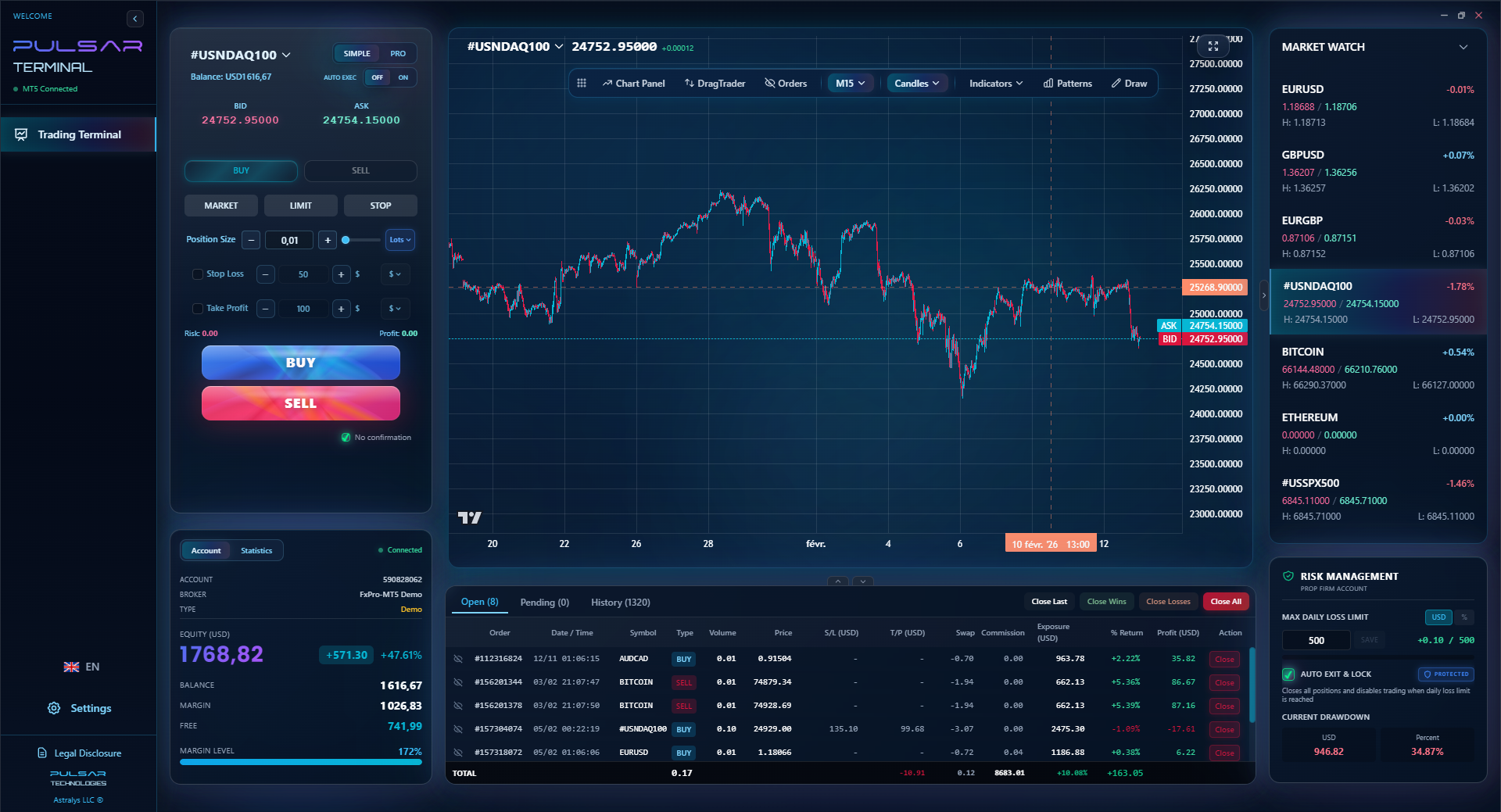
Managing multi-TP orders and trailing stops across volatile sessions is complex, but Pulsar Terminal automates it all directly on your MT5 platform, so you can trade the London overlap without the manual hassle.
Pulsar Terminal
เครื่องมือ MT5 ครบวงจร: ลากวางคำสั่ง, multi-TP/SL, trailing stop, grid trading, Volume Profile และการป้องกัน prop firm ใช้งานโดยเทรดเดอร์กว่า 1,000 คนทุกวัน
Knowledge is useless without action. Here’s your 7-day challenge to master forex trading times.
Week 1: Don't place a single trade. Just watch.
- Day 1-3: Open your chart at 8 AM, 1 PM, and 5 PM WAT. Just observe the EUR/USD for 30 minutes each time. Note the speed of the candles and the spread definition.
- Day 4-5: Pick one pair (start with EUR/USD). Using a demo account, pretend to place trades ONLY during the London-New York overlap (1-3 PM WAT). Practice setting stop-loss and take-profit orders.
- Day 6-7: Review your demo trades. Did the time of day help? Did you get better fills? How did the market behave after you left your trade running overnight?
Choosing a Broker: As a Nigerian, you need a broker that caters to your region. Look for:
- Local deposit options (bank transfer, maybe even Naira cards).
- Reliable customer support in your timezone.
- Tight spreads during the sessions you plan to trade. Check reviews for execution quality during news events. Brokers like XM review and Exness review have a strong presence in Africa and understand these needs.
Finally, sync your life to the market clock, not the other way around. Plan your analysis, your trading hours, and your leisure time. The market will be there tomorrow during the overlap. By focusing on the high-probability hours, you give yourself a massive edge over the trader who is glued to the screen 24/7, burning out and making rushed decisions. Now, go find your time.

FAQ
Q1What is the absolute best time to trade forex in Nigeria?
For most traders, the best time is the London-New York session overlap, from 1:00 PM to 5:00 PM West Africa Time (WAT). This 4-hour window has the highest liquidity and volatility, offering the best trading conditions for major pairs like EUR/USD and GBP/USD.
Q2Can I trade forex successfully in Nigeria if I have a full-time job?
Absolutely. Focus on the London open (8:00 AM - 9:00 AM WAT) before work. You can set orders based on pre-market analysis. Alternatively, use end-of-day analysis to set pending orders that will trigger during the active sessions while you're at work. The key is planning, not screen-staring all day.
Q3Is it safe to trade the Naira (NGN) pairs?
USD/NGN pairs offered by international brokers often have extremely wide spreads (50+ pips) and can be highly illiquid. They are also more susceptible to local Central Bank of Nigeria (CBN) policy shocks. For most retail traders, it's far more efficient and cheaper to trade major global pairs like EUR/USD where spreads are tight and liquidity is deep.
Q4Why did my stop-loss get hit late on a Friday night when the price was stable?
This is a classic 'stop hunt' in low liquidity. After the New York close (post-10 PM WAT), trading volume collapses. A single large order can cause a temporary, sharp spike that triggers stop-loss orders clustered at a certain level before the price snaps back. The solution is to avoid holding sensitive positions during these thin-volume periods.
Q5What is a swap fee, and how does it affect my trades in Nigeria?
A swap fee (or overnight financing charge) is interest paid or received for holding a position past the daily rollover time (usually 10 PM or 11 PM WAT on your broker's platform). It's based on the interest rate differential between the two currencies. For Nigerian traders, if you're consistently holding trades overnight, these fees can add up. Check your broker's swap rate table, as it directly affects the cost of your swing trading strategy.
Q6How do I know if my broker has good execution during busy trading times?
Look for reviews that mention 'slippage' and 'requotes' during high-impact news events like US Non-Farm Payrolls (1:30 PM WAT). A good ECN/STP broker should have minimal issues. Test it yourself on a demo account during the London-New York overlap. If you're getting frequent requotes or your orders are filled far from your requested price, it's a red flag.
บทเรียนจาก Prof. Winston
สรุปสาระสำคัญ:
- ✓Trade the London-New York overlap (1-5 PM WAT) for maximum liquidity.
- ✓Avoid holding sensitive positions post-10 PM WAT due to stop-hunt risk.
- ✓Match your strategy to session volatility: breakouts in overlaps, ranges in pure sessions.
- ✓Use multiple TPs and trailing stops to manage trades across sessions.
- ✓Sync your life to the market clock, not the other way around.
บทความนี้มีประโยชน์แค่ไหน?
คลิกดาวเพื่อให้คะแนน
ข้อมูลเชิงลึกการเทรดรายสัปดาห์
การวิเคราะห์และกลยุทธ์รายสัปดาห์ฟรี ไม่มีสแปม
เกี่ยวกับผู้เขียน
Olumide Adeyemi
ผู้บุกเบิกการเทรดในแอฟริกาตะวันตก
หนึ่งในนักการศึกษาฟอเร็กซ์ที่กระตือรือร้นที่สุดของไนจีเรีย 8 ปีประสบการณ์เทรดจากลากอส เชี่ยวชาญกลยุทธ์ทุนต่ำและความท้าทาย prop firm สำหรับเทรดเดอร์ในแอฟริกา
ความคิดเห็น
คำเตือนความเสี่ยง
การซื้อขายตราสารทางการเงินมีความเสี่ยงสูงและอาจไม่เหมาะสำหรับนักลงทุนทุกคน ผลการดำเนินงานในอดีตไม่ได้รับประกันผลลัพธ์ในอนาคต เนื้อหานี้มีวัตถุประสงค์เพื่อการศึกษาเท่านั้นและไม่ควรถือเป็นคำแนะนำในการลงทุน โปรดทำการวิจัยของคุณเองก่อนการซื้อขาย
คุณอาจชอบสิ่งนี้

Cara Trading Forex Sukses: 7 Prinsip dari Trader Profesional
Cara trading forex sukses dengan 7 prinsip trader pro: manajemen modal, disiplin, journal trading, backtest. Data nyata, bukan janji profit palsu.
Jam Trading Forex Terbaik untuk Trader Indonesia: Panduan Lengkap dengan Tabel Waktu
Panduan jam trading forex untuk trader Indonesia. Tabel 4 sesi dunia, jam emas 20:00-00:00, sesi mana yang harus dihindari. Data akurat + tips dari trader berpengalaman.
Top 5 Sàn Forex Uy Tín Nhất 2026: Review Jujur dari Trader Indonesia
Top 5 sàn forex uy tín 2026 untuk trader Indonesia. Review jujur: spread, deposit, withdraw, dukungan lokal. Exness, XM, IC Markets & lebih.
รับ Pulsar Terminal
เครื่องคำนวณทั้งหมดนี้ถูกสร้างไว้ใน Pulsar Terminal พร้อมข้อมูลเรียลไทม์จากบัญชี MT5 ของคุณ
รับ Pulsar Terminal