


Everyone in Lagos seems to have a hot take on forex vs cryptocurrency.

Olumide Adeyemi
ผู้บุกเบิกการเทรดในแอฟริกาตะวันตก ·  Nigeria
☕ 8 นาทีอ่าน
สิ่งที่คุณจะได้เรียนรู้:

Everyone in Lagos seems to have a hot take on forex vs cryptocurrency. The crypto guys call forex traders dinosaurs. The forex guys call crypto a casino. Both sides are mostly talking rubbish. Having traded both markets from my flat in Ikeja for over a decade, I can tell you the real differences aren't about hype, they're about structure, risk, and who's likely to take your money. Let's cut through the noise.
Forex is a centralized, regulated bazaar. It's the biggest financial market in the world, with over $7 trillion traded daily. When you trade EUR/USD, you're trading through a network of banks, brokers, and liquidity providers. There's a rulebook, even if some brokers like to bend the pages. Cryptocurrency is the digital Wild West. It's a 24/7 global market with no central authority. The 'rulebook' is written in code and can change if enough miners or validators agree. This isn't good or bad inherently, but it changes everything about how you trade.
Forex liquidity is deep. You can move millions in major pairs like GBP/USD or USD/JPY without causing a ripple. Try moving a million dollars worth of a mid-cap altcoin and watch the price chart have a seizure. This liquidity difference is why spreads in forex are often razor-thin, especially with a good ECN broker like IC Markets or Pepperstone. In crypto, the spread can be your first losing trade before you even get started.

Warning: That 24/7 crypto market is a trap for new traders. Just because you can trade at 3 a.m. doesn't mean you should. Forex gives you the weekend to breathe and review. Use it.
My own experience hammered this home. In 2018, I got caught in a classic 'crypto flash crash' on a smaller exchange. I entered a long position on LTC/USD at $58. Within 90 seconds, a series of large sell orders tanked it to $51 before it snapped back to $57. My stop-loss was obliterated in the spike down, and I was liquidated. The trade was gone. In forex, while 'slippage' happens during major news, a move that violent across a major pair is exceedingly rare due to the market depth. That event cost me $1,200 and a serious lesson in market structure.
New traders chase volatility like it's free money. It's not. It's just raw, undirected energy. Crypto volatility is legendary. A 10% daily move is a quiet Tuesday for many altcoins. Forex volatility is more measured. A 1% daily move in a major pair is a significant event, often driven by central bank news or economic data.
use: The Great Amplifier
This is where the rubber meets the road. Nigerian brokers, especially in the forex CFD space, offer insane use - I've seen up to 1:1000 advertised. That's a recipe for a margin call before you can say 'pips.' In crypto, use is also available on exchanges and via CFDs, but it's often lower (think 1:5 to 1:100) because the underlying asset is already so volatile.
Here’s the brutal truth: high use on high volatility is financial suicide. I learned this the hard way early on. I used 1:500 use on a USD/ZAR trade, thinking the rand was sure to weaken. A surprise political announcement sent it the other way. A 0.2% move against me wiped out 100% of my position's margin. Poof. Gone. That's why I now swear by a strict position size calculator for every single trade, no exceptions.

Example: Let's say you have a ₦500,000 account. A 2% risk per trade is ₦10,000. On a forex trade with a 50-pip stop-loss, that dictates your lot size. On a crypto trade with a 500-point (5%) stop-loss, the lot size is drastically smaller. Ignore this math, and you're not trading, you're gambling.

💡 เคล็ดลับจาก Winston
If you can't explain your trade's thesis in one sentence - 'The ECB will be dovish' or 'This crypto resistance level has been tested three times' - you don't have a trade, you have a hope.
“Forex taught me patience and discipline. Crypto taught me adaptability and to respect irrational momentum.”
This is the section that matters most for us sitting here in Naija. The regulatory landscape is a patchwork quilt with some big holes.
Forex trading via international brokers operates in a grey area. The CBN doesn't license them, but it also hasn't stopped Nigerians from using firms like Exness, XM, or IC Markets. Your funds are held offshore. The main headache is funding. Bank transfers are scrutinized, card payments are often declined, and you're forced to use crypto or fintech transfers. Withdrawals? Hope you kept the same method.
Cryptocurrency has been on a rollercoaster with the government. The CBN's 2021 ban on bank transactions for crypto exchanges was a gut punch. While it's been softened, the environment is still restrictive. You're largely using peer-to-peer (P2P) platforms, which introduces counterparty risk - the guy on the other end of your USDT trade might flake. The SEC Nigeria has made noises about regulating digital assets, but a clear framework is still cooking.
The bottom line? Neither market offers the clean, protected experience of a regulated stock market in the UK or US. You are, to a large degree, on your own. This makes broker choice critical. I always dig deep into reviews and withdrawal experiences on platforms like Exness review or XM review before depositing a kobo.

Stop asking which market is 'better.' Ask which market suits your personality, risk tolerance, and schedule.
You might lean towards FOREX if:
- You prefer structured trading sessions (London, New York overlap).
- Your analysis is based on economic fundamentals (interest rates, GDP, employment).
- You like technical analysis on cleaner charts with less insane noise.
- You want to trade with very tight spreads.
- You're interested in swing trading over days or weeks.
You might lean towards CRYPTO if:
- You're a night owl and want to trade 24/7.
- You're comfortable with fundamental analysis based on tech, adoption, and community sentiment (which is messy).
- You can handle extreme volatility without panicking.
- You're interested in very short-term moves, almost like a turbocharged form of scalping.
I trade both, but I allocate capital differently. 70% of my capital is in forex, trading majors and gold (XAU/USD). It's my 'steady' portfolio. The other 30% is in crypto, where I'm prepared to lose it all on higher-conviction, speculative plays. That separation keeps me sane.
💡 เคล็ดลับจาก Winston
Your first profit target should always be to get your initial risk off the table. Move to breakeven. A trade that can't give you your risk back isn't worth taking.

“You are, to a large degree, on your own. This makes broker choice critical.”
A strategy that prints money in forex can get shredded in crypto, and vice versa. You can't just transplant your plan.
Forex strategies often rely on well-established levels from previous days or weeks, because institutional order flow creates those memories in the market. Tools like the MACD indicator or RSI indicator work well for spotting divergences on these pairs. Economic calendars are your bible.
Crypto strategies have to account for the 'noise.' Support and resistance levels are more fluid because the market is dominated by retail sentiment and large whale wallets. A classic mistake is drawing a trendline on a 4-hour crypto chart and expecting it to hold like it would on EUR/USD. It won't. Momentum is king. I've had more success using volume profile tools to see where real congestion is, rather than relying on simple horizontal lines.

Pro Tip: In crypto, weekends (UTC) are often when retail traders are most active and prices can make irrational moves. In forex, the weekend is closed. Adjust your risk accordingly. Don't hold a highly leveraged crypto position into a Sunday if you're not watching it.
My worst crossover mistake was trying to use a low-volatility forex range-trading strategy on Bitcoin. I sold at a perceived resistance and bought at support. Bitcoin promptly broke resistance and didn't look back for a week, stopping me out for a 7% loss. The lesson? Crypto trends have more momentum; fighting them with a mean-reversion strategy is expensive.

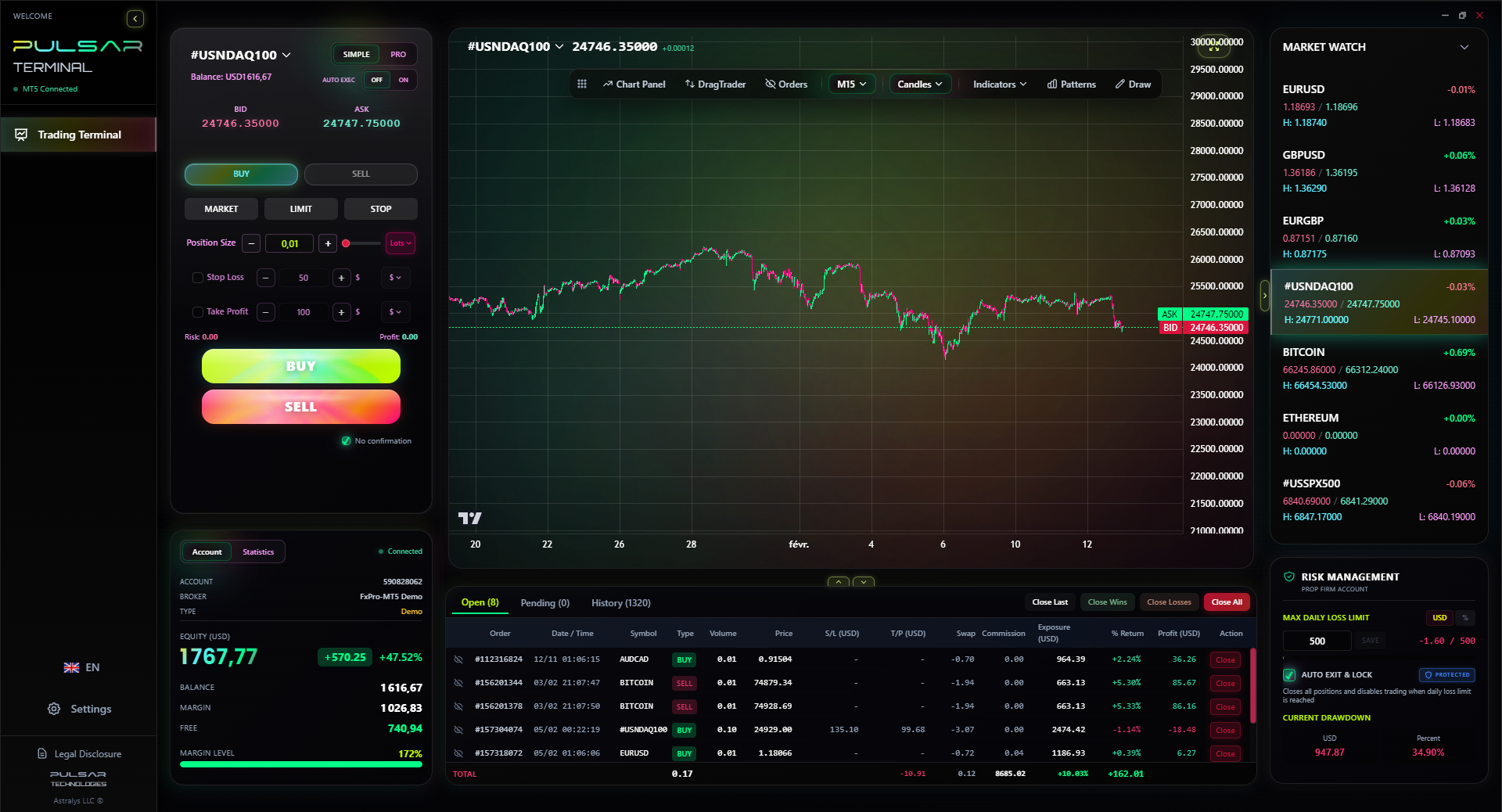
Managing multiple take-profit levels and moving stops to breakeven is tedious manually, but essential for locking in gains in both volatile forex and crypto trades.
Pulsar Terminal
เครื่องมือ MT5 ครบวงจร: ลากวางคำสั่ง, multi-TP/SL, trailing stop, grid trading, Volume Profile และการป้องกัน prop firm ใช้งานโดยเทรดเดอร์กว่า 1,000 คนทุกวัน
Look, you can make and lose money in both. The forex vs cryptocurrency debate is pointless without context. For a Nigerian trader starting out, I'd recommend forex first. Why? The learning materials are more standardized, the price action is slightly more predictable, and you can focus on learning risk management without a 20% swing wiping you out in an hour.
Once you have solid discipline - a proven strategy, strict stop-losses, and emotional control - then consider allocating a small portion to crypto for the higher potential returns (and risks).
Regardless of your choice, your toolkit is non-negotiable:
- A reliable broker with a proven track record for Nigerian clients (do your homework on those reviews).
- A solid trading platform. MT4/MT5 is the standard for forex. For crypto, the exchange's native platform plus maybe a charting package.
- A position size calculator. I don't care if you're trading ₦10,000 or ₦10 million.
- A trading journal. Your memory is a liar. Write everything down.
- An understanding of the tax implications (consult a professional).
Forex taught me patience and discipline. Crypto taught me adaptability and to respect irrational momentum. You need both skill sets to survive in modern markets. Start with the one that lets you learn without getting your head kicked in on day one.
💡 เคล็ดลับจาก Winston
The market doesn't care about your 'fair price.' It only cares about what the next person is willing to pay. This is ten times truer in crypto than in forex.

FAQ
Q1Which is more profitable, forex or crypto?
That's the wrong question. Profitability comes from your skill and risk management, not the market. Crypto has higher volatility, which means larger potential gains AND losses per unit of time. A skilled forex trader with good discipline can be consistently profitable. An undisciplined crypto trader can be a millionaire one month and bust the next.
Q2Is cryptocurrency trading banned in Nigeria?
No, it's not banned for individuals. The Central Bank of Nigeria (CBN) restricted regulated banks from dealing with crypto exchanges, but you can still trade using peer-to-peer (P2P) platforms. The SEC is working on a regulatory framework for digital assets. It's in a grey, evolving space.
Q3Can I use the same broker for forex and crypto?
Some international CFD brokers, like Pepperstone or Exness, offer both forex pairs and cryptocurrency CFDs. This can be convenient. However, for direct spot trading of cryptocurrencies (where you own the actual coin), you'll typically need a dedicated crypto exchange like Binance (via P2P) or a similar platform.
Q4Why are forex spreads lower than crypto spreads?
Forex markets have immense liquidity from banks, funds, and corporations. This high volume competition tightens the bid-ask spread. Crypto markets, especially for altcoins, have lower liquidity. Market makers charge a wider spread to compensate for the risk of not being able to quickly offset their position.
Q5As a beginner in Nigeria, which should I start with?
Start with forex. Focus on a major pair like EUR/USD. The moves are slower, the educational resources are tailored to it, and you can practice risk management without the 24/7 noise and extreme volatility of crypto. It's like learning to drive in a parking lot before hitting the Lagos-Ibadan Expressway at night.
Q6What's a bigger risk: forex use or crypto volatility?
They're a deadly combination. High forex use (like 1:500) can annihilate your account on a small move. High crypto volatility can do the same without any use. The biggest risk is using high use ON a highly volatile crypto asset. That's account suicide.
Q7Do technical indicators work the same in both markets?
Broadly, yes, but their reliability differs. Indicators like RSI or MACD can give more false signals in crypto due to the intense volatility and sentiment-driven moves. In forex, they work well within the context of economic fundamentals. Always backtest any indicator in the specific market you're trading.
บทเรียนจาก Prof. Winston
สรุปสาระสำคัญ:
- ✓Never risk more than 2% per trade, in any market.
- ✓Forex first, crypto later. Master volatility control.
- ✓Your funding method is part of your risk in Nigeria.
- ✓Liquidity difference is the silent trade killer.
บทความนี้มีประโยชน์แค่ไหน?
คลิกดาวเพื่อให้คะแนน
ข้อมูลเชิงลึกการเทรดรายสัปดาห์
การวิเคราะห์และกลยุทธ์รายสัปดาห์ฟรี ไม่มีสแปม
เกี่ยวกับผู้เขียน
Olumide Adeyemi
ผู้บุกเบิกการเทรดในแอฟริกาตะวันตก
หนึ่งในนักการศึกษาฟอเร็กซ์ที่กระตือรือร้นที่สุดของไนจีเรีย 8 ปีประสบการณ์เทรดจากลากอส เชี่ยวชาญกลยุทธ์ทุนต่ำและความท้าทาย prop firm สำหรับเทรดเดอร์ในแอฟริกา
ความคิดเห็น
คำเตือนความเสี่ยง
การซื้อขายตราสารทางการเงินมีความเสี่ยงสูงและอาจไม่เหมาะสำหรับนักลงทุนทุกคน ผลการดำเนินงานในอดีตไม่ได้รับประกันผลลัพธ์ในอนาคต เนื้อหานี้มีวัตถุประสงค์เพื่อการศึกษาเท่านั้นและไม่ควรถือเป็นคำแนะนำในการลงทุน โปรดทำการวิจัยของคุณเองก่อนการซื้อขาย
คุณอาจชอบสิ่งนี้

Cara Trading Forex Sukses: 7 Prinsip dari Trader Profesional
Cara trading forex sukses dengan 7 prinsip trader pro: manajemen modal, disiplin, journal trading, backtest. Data nyata, bukan janji profit palsu.
Jam Trading Forex Terbaik untuk Trader Indonesia: Panduan Lengkap dengan Tabel Waktu
Panduan jam trading forex untuk trader Indonesia. Tabel 4 sesi dunia, jam emas 20:00-00:00, sesi mana yang harus dihindari. Data akurat + tips dari trader berpengalaman.
Top 5 Sàn Forex Uy Tín Nhất 2026: Review Jujur dari Trader Indonesia
Top 5 sàn forex uy tín 2026 untuk trader Indonesia. Review jujur: spread, deposit, withdraw, dukungan lokal. Exness, XM, IC Markets & lebih.
รับ Pulsar Terminal
เครื่องคำนวณทั้งหมดนี้ถูกสร้างไว้ใน Pulsar Terminal พร้อมข้อมูลเรียลไทม์จากบัญชี MT5 ของคุณ
รับ Pulsar Terminal