


I blew up my first futures account in 2014.
James Mitchell
นักวิเคราะห์การเทรดอาวุโส
☕ 10 นาทีอ่าน
สิ่งที่คุณจะได้เรียนรู้:
I blew up my first futures account in 2014. I thought I had it figured out after trading forex for years. I shorted two contracts of the E-mini S&P 500 (ES) at 1980, convinced the market was topping. I was right for about 20 points. Then it ripped higher for 80 points straight. My $5,000 account was gone in two days. That loss taught me more about the real differences between forex and futures than any textbook ever could. The use, the contract sizes, the margin calls - they operate on a different level of consequence. Let's break down forex vs futures trading from the perspective of someone who's lost money in both, so you can make an informed choice without the expensive lessons.
This is the fundamental split that dictates everything else. Forex is an over-the-counter (OTC) market. There's no single physical exchange like the NYSE. Instead, you have a decentralized network of banks, brokers, and other participants. When you trade EUR/USD with your broker, you're making a deal with them or their liquidity provider. Your broker sets the price you see.
Futures trade on centralized exchanges like the CME Group (Chicago Mercantile Exchange). Every trade is matched in a central order book. This creates transparency. You can see the exact order depth (the market depth) for the E-mini S&P 500 contract. Everyone sees the same price. This structure leads to the first major practical difference: contract standardization.
In forex, you can trade any size you want. Want to buy 123,456 euros? Go for it. In futures, you trade in fixed contract sizes. One micro E-mini S&P 500 (MES) contract represents a $5 move per index point. One standard E-mini (ES) contract is $50 per point. You can't trade half a contract. This standardization is why futures margins and profits/losses are so precise and predictable.

Example: If the ES moves from 5200 to 5201, that's a $50 gain or loss per contract. If you're long 2 contracts, that's a $100 P&L swing for that single point. In forex, a 1 pip move in EUR/USD on a standard lot (100,000 units) is $10. But you control the unit size, so the risk is more flexible from the start.
“The use feels different in practice. Futures contracts react faster and more sharply - a 1% move can wipe out 50% of your margin.”
Here's where being a US trader really changes the game. Our regulators (the CFTC and NFA) treat these two markets very differently.
Forex use Limits
In the US, retail forex use is capped by law. It's 50:1 for major pairs (like EUR/USD, GBP/USD) and 20:1 for minors/exotics. This sounds high, but it's a fraction of what offshore brokers offer. To put 50:1 in perspective: on a $10,000 account, you can control a $500,000 position. That's huge risk. Your broker will require a specific amount of margin to hold that position open. If your losses eat into that margin, you'll get a margin call.
Futures Margin Rules
Futures margins work differently. There's no government-set use cap like in forex. Instead, the exchange (like the CME) sets an initial margin and a maintenance margin requirement for each contract. Your broker can then require more than the exchange minimum (they almost always do for retail).
The key difference? Futures margins are often lower in dollar terms for the equivalent notional exposure, but the consequences of a move are more violent. Let me give you a real example from last year.
I wanted exposure to a potential Nasdaq sell-off. Option A: Short USD/JPY (a major pair). With 50:1 use on a $10,000 account, I could short ~5 mini lots (50,000 units). Each pip would be worth $5. Option B: Short one Micro Nasdaq-100 (MNQ) futures contract. The day-trading margin at my broker was about $1,200. The notional value? Roughly $35,000 at the time. That's use of nearly 30:1 on that slice of capital. But here's the kicker: the MNQ moves $2 per index point. A 50-point move against me would be a $100 loss on the futures trade, but a 20-pip move against me on the forex trade would be the same $100 loss. The futures contract reacted faster and more sharply to news - I was stopped out on the MNQ while the forex trade was still hovering near my entry. The use feels different in practice.

Warning: Don't be fooled by lower dollar margins in futures. The standardized contract size means your profit and loss is amplified per price movement. A 1% move in the underlying index can wipe out 50% of your margin if you're on the wrong side. Always use a position size calculator and base your size on risk, not available margin.

💡 เคล็ดลับจาก Winston
Never choose an instrument based on supposed 'ease.' Choose the one whose price drivers you understand best. If you can't explain what moves gold futures in a sentence, you shouldn't be trading them.
“Don't be fooled by lower dollar margins in futures. The standardized contract size means your profit and loss is amplified per price movement.”
This is where most online comparisons get it wrong. They talk about spreads versus commissions, but miss the hidden fees that eat into your returns.
Forex Costs: Your main cost is the spread (the difference between the bid and ask). On a major pair like EUR/USD with a good US broker, you might see a 0.8 pip spread during New York hours. On a standard lot, that's an $8 cost to enter and exit (round turn). Some brokers offer "raw spread" accounts that charge a commission instead, like $5 per 100k round turn plus a 0.1 pip spread. There are usually no exchange or data fees for spot forex.
Futures Costs: You pay commissions, and they are per contract, per side. This adds up fast if you're scalping. Here's a breakdown from my own trading journal for a single day of scalping the MES (Micro E-mini S&P):
- Trade 1: Long 2 MES @ 5234.50, exited @ 5236.25. Profit: $17.50 (1.75 pts x $5 x 2 contracts).
- Commission: $2.25 per contract, round turn. That's $4.50 for the 2 contracts.
- Net Profit: $13.00. The commission ate over 25% of my gross profit.
And that's before data fees. To see real-time CME futures prices, most brokers charge a monthly data fee. For the CME real-time feed, it's typically $10-$15 per month. If you trade forex, you almost never pay for real-time data.

Pro Tip: When comparing forex brokers and futures brokers, calculate your cost per round turn for a typical trade size. For futures, ask: "What's your all-in rate per side, including all exchange and NFA fees?" Don't just look at the advertised commission.
“The fastest way to blow up a futures account is to trade standard contracts with under $20,000. The fastest way to blow up a forex account is to use maximum use on every trade.”
Forex Hours: The spot forex market is open 24 hours a day, 5 days a week, from 5pm EST Sunday to 5pm EST Friday. Liquidity ebbs and flows. The best volume (and tightest spreads) is during the London/New York overlap (8am-12pm EST). Trading the EUR/USD at 3am EST? The spread will widen, and your order might not fill at the price you want.
Futures Hours: Futures have specific trading sessions. The E-mini S&P 500 (ES) trades nearly 24/5, but there's a daily settlement and a brief pause. The official trading day for settlement purposes ends at 4:00pm EST, and reopens at 6:00pm EST. Liquidity is thinner during the overnight session (Asia hours). The vast majority of volume occurs during US cash equity hours (9:30am-4:00pm EST). If you're trying to exit a large position in the middle of the night, the bid-ask spread can widen significantly.
The liquidity difference is crucial. In forex, for the majors, you're trading the most liquid market in the world. You can move millions with minimal slippage. In futures, liquidity is concentrated in the front-month contract and during main hours. I learned this the hard way trying to scalp the MCL (Crude Oil) contract at 11pm. My limit order sat there unfilled for minutes as the price ticked away, and by the time I canceled and market sold, I had 3 ticks of slippage. That's $30 lost on one micro contract before the trade even started.
For most US retail traders, futures offer more than enough liquidity during the day. But if you're a night owl or want to trade 24/5 on constant volume, forex has the edge.
💡 เคล็ดลับจาก Winston
Your first $500 loss in futures will feel different than in forex. The standardized contract makes the loss feel more 'official' and concrete. Use that feeling. It's the market teaching you respect for size.
“The fastest way to blow up a futures account is to trade standard contracts with under $20,000. The fastest way to blow up a forex account is to use maximum use on every trade.”
This isn't about which is "better." It's about which one fits your personality, capital, and trading style. Let's make it simple with a table.
| Your Profile | Lean Towards Forex If... | Lean Towards Futures If... |
|---|---|---|
| Account Size | Under $5,000 | Over $10,000 (for standard contracts) |
| Trading Style | Swing trading over days/weeks, night trading | Day trading, precise technical breakout trading |
| What You Value | Flexibility in position size, 24/5 continuous market | Transparency of centralized exchange, direct market access |
| Your Focus | Macro economics, interest rate differentials | US indices (S&P, Nasdaq), commodities (Oil, Gold), Treasuries |
| You Hate | Paying for real-time data, opaque pricing | Wide spreads during off-hours, dealing with broker's quote |
My personal journey: I started with forex because the barrier to entry was lower. I could open a $500 account with OANDA and trade tiny sizes. I learned about risk management and the impact of news events. But I gravitated to futures as my account grew and my style became more discretionary day trading. I liked the clean, tax-advantaged (Section 1256) reporting, the pure exposure to the S&P 500, and the depth of market window.
If you're fascinated by currency dynamics and want to trade the reaction to a Fed or ECB announcement, forex is your arena. If you want to trade the direct pulse of the US stock market through the ES or NQ, futures are the tool. You can trade both, of course. Many platforms like Interactive Brokers offer access to both markets. But I strongly recommend mastering one market first. The mental shift between calculating pips and calculating points (and their dollar value) is a sure way to make a catastrophic sizing error.
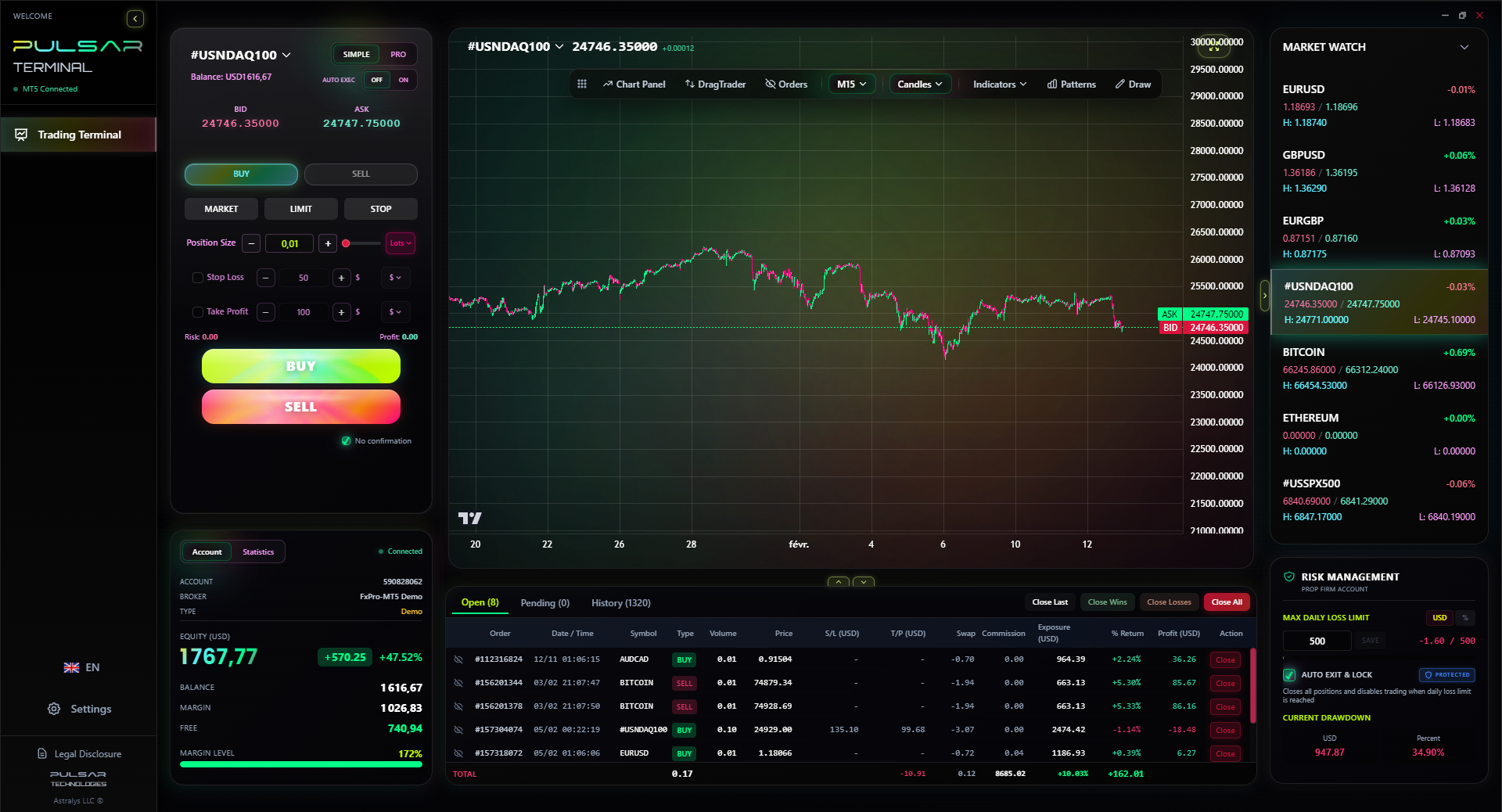
Managing multiple profit targets and stop-losses across different contract sizes in futures is complex, but tools like Pulsar Terminal allow you to set multi-TP/SL and partial closure orders with a single drag-and-drop directly on your MT5 chart.
Pulsar Terminal
เครื่องมือ MT5 ครบวงจร: ลากวางคำสั่ง, multi-TP/SL, trailing stop, grid trading, Volume Profile และการป้องกัน prop firm ใช้งานโดยเทรดเดอร์กว่า 1,000 คนทุกวัน
“Worrying about market manipulation is a distraction from managing your own risk and psychology. You are your own biggest threat.”
The market structure changes, but the fatal mistakes are eerily similar. After coaching hundreds of traders, I see the same patterns.
1. Misunderstanding use: In forex, with 50:1 use, a 2% move against you wipes out 100% of your margin. In futures, because the margin requirement is a small fraction of the contract's value, a 1% move in the S&P can represent a 50% loss on your margin. Traders see the low margin requirement and fill their entire account with one position. It's suicide.
2. Ignoring the Cost of Trading: The scalper who makes 10 futures trades a day paying $4 round turn is bleeding $40 daily. That's $1,000 a month. You have to overcome that just to break even. In forex, the scalper trading during low-liquidity hours gets eaten alive by widening spreads. You must trade your strategy around the cost structure.
3. No Defined Edge: This is the big one. People jump into trading XAU/USD or the ES because it's volatile and "moves." They have no statistical edge. They might use an RSI indicator or MACD indicator with no understanding of its win rate or average loss in different market conditions. Futures or forex, if you don't have a verifiable edge, you're just donating money.
My biggest pitfall? Overconfidence after a winning streak. In 2019, I had 12 winning days in a row trading the ES. On day 13, I tripled my normal size because I "couldn't lose." I revenge-traded after the first loss and gave back 80% of the streak's profits in one afternoon. The market doesn't care about your streak. Your risk parameters shouldn't either.
Warning: The fastest way to blow up a futures account is to trade standard contracts (ES, NQ) with under $20,000. The fastest way to blow up a forex account is to use maximum use on every trade. Both are guarantees of failure.
💡 เคล็ดลับจาก Winston
If you're calculating your potential profit before calculating your potential loss, you've already lost. This is true in every market, on every planet.
FAQ
Q1Can I trade forex and futures on the same platform?
Yes, some brokers offer both. Interactive Brokers and TradeStation are prime examples in the US. However, the platforms might treat them differently. You might use one software for futures charts and another for forex execution. It's common.
Q2Which market is more volatile, forex or futures?
It depends on the instrument. Major forex pairs like EUR/USD tend to have lower average daily volatility (around 0.7-1%) than equity index futures like the Nasdaq-100 (NQ), which can easily see 1.5-2.5% daily moves. However, exotic currency pairs or commodities like crude oil futures can be extremely volatile. Don't chase volatility; it amplifies both gains and losses.
Q3Are futures better for tax purposes in the US?
For many active traders, yes. Futures fall under IRS Section 1256 contracts, which have a major advantage: 60% of gains are taxed as long-term capital gains and 40% as short-term, regardless of your holding period. This can mean a significantly lower tax rate compared to forex trading, which is taxed under the less favorable "988 election" or mark-to-market accounting as ordinary income.
Q4I have a small account ($1,000-$2,000). Can I trade futures?
Technically, yes. You can trade micro futures (MES, MNQ, M2K, MYM) with some brokers. The day-trading margin might be as low as $40-$100 per contract. But practically, it's very hard. Commissions will eat a huge percentage of your small profits. One bad trade can be a 10-20% account loss. With that size, forex offers more flexibility to trade truly tiny, risk-managed sizes. Build your skills there first.
Q5Do I need a special license to trade futures?
No, retail traders do not need a license. Your broker is the one that must be licensed (as a Futures Commission Merchant with the CFTC and NFA). You just need to open an account and demonstrate an understanding of the risks (they'll make you read and sign a lot of disclosures).
Q6Which market is more manipulated?
This is a conspiracy theory trap. Both markets are huge and regulated. In forex, the "fix" scandals involved bank collusion on benchmark rates, not manipulating the spot price you trade. In futures, spoofing (placing fake large orders) does happen and is illegal. As a retail trader, you're a drop in the ocean. Worrying about manipulation is a distraction from managing your own risk and psychology.
Q7Is it easier to make money with forex or futures?
The honest answer is neither. The failure rate for retail traders is estimated above 80% in both markets. "Easier" isn't the right question. The right question is: which market's structure aligns with your analytical strengths, risk tolerance, and available time to trade? Success comes from discipline and edge, not the instrument.
บทเรียนจาก Prof. Winston
สรุปสาระสำคัญ:
- ✓Forex offers size flexibility; futures offer contract standardization.
- ✓US forex use is capped at 50:1; futures margins are set by exchanges.
- ✓Forex costs are mainly spreads; futures cost per contract commissions + data fees.
- ✓Trade futures for direct US index exposure; forex for macro currency plays.
- ✓Failure in both stems from poor use management, not the market itself.
บทความนี้มีประโยชน์แค่ไหน?
คลิกดาวเพื่อให้คะแนน
ข้อมูลเชิงลึกการเทรดรายสัปดาห์
การวิเคราะห์และกลยุทธ์รายสัปดาห์ฟรี ไม่มีสแปม
เกี่ยวกับผู้เขียน
James Mitchell
นักวิเคราะห์การเทรดอาวุโส
ประจำอยู่ที่นิวยอร์ก มีประสบการณ์การเทรดมากกว่า 9 ปี เน้นคู่ USD หลัก ความท้าทายของ prop firm และกฎระเบียบการเงินของสหรัฐฯ
ความคิดเห็น
คำเตือนความเสี่ยง
การซื้อขายตราสารทางการเงินมีความเสี่ยงสูงและอาจไม่เหมาะสำหรับนักลงทุนทุกคน ผลการดำเนินงานในอดีตไม่ได้รับประกันผลลัพธ์ในอนาคต เนื้อหานี้มีวัตถุประสงค์เพื่อการศึกษาเท่านั้นและไม่ควรถือเป็นคำแนะนำในการลงทุน โปรดทำการวิจัยของคุณเองก่อนการซื้อขาย
คุณอาจชอบสิ่งนี้

Cara Trading Forex Sukses: 7 Prinsip dari Trader Profesional
Cara trading forex sukses dengan 7 prinsip trader pro: manajemen modal, disiplin, journal trading, backtest. Data nyata, bukan janji profit palsu.
Jam Trading Forex Terbaik untuk Trader Indonesia: Panduan Lengkap dengan Tabel Waktu
Panduan jam trading forex untuk trader Indonesia. Tabel 4 sesi dunia, jam emas 20:00-00:00, sesi mana yang harus dihindari. Data akurat + tips dari trader berpengalaman.
Top 5 Sàn Forex Uy Tín Nhất 2026: Review Jujur dari Trader Indonesia
Top 5 sàn forex uy tín 2026 untuk trader Indonesia. Review jujur: spread, deposit, withdraw, dukungan lokal. Exness, XM, IC Markets & lebih.
รับ Pulsar Terminal
เครื่องคำนวณทั้งหมดนี้ถูกสร้างไว้ใน Pulsar Terminal พร้อมข้อมูลเรียลไทม์จากบัญชี MT5 ของคุณ
รับ Pulsar Terminal