


Staring at the gold chart, wondering why your trades keep getting stopped out right before the big move? You're not alone.

Rajesh Sharma
นักวิเคราะห์ฟอเร็กซ์อาวุโส ·  India
India
☕ 12 นาทีอ่าน
สิ่งที่คุณจะได้เรียนรู้:
- 1Why Gold Trading in India is a Different Animal
- 2Picking Your Battlefield: MCX, XAU/USD, or ETFs?
- 3The Core Gold Trading Strategy: Two Setups That Work
- 4Risk Management: The Only Thing That Saves You
- 5Brokers, Platforms, and Getting Filled
- 6Mistakes I've Made (So You Don't Have To)
- 7Your Weekly Gold Trading Routine

Staring at the gold chart, wondering why your trades keep getting stopped out right before the big move? You're not alone. Trading gold in India is a different beast compared to other markets. Between MCX's quirks, SEBI's latest rules, and the emotional weight of 'sona' in our culture, you need a specific game plan. I've blown up an account trading gold the wrong way, so let me save you the trouble and show you what actually works.
You can't just take a generic XAU/USD strategy and apply it to MCX Gold. The local market has its own personality, driven by factors global traders never think about.
First, there's the currency factor. MCX Gold is priced in Indian Rupees per 10 grams. When the USD/INR moves, it directly impacts your MCX chart, even if international gold prices are flat. I learned this the hard way in 2023. I was long on MCX Gold because my analysis showed a bullish setup on the international spot price. What I missed was a sharp rally in the USD/INR. International gold went up 1%, but the rupee strengthened, and my MCX position ended up in the red. The trade was right on the commodity, wrong on the currency pair.
Then there's local demand. Wedding seasons, festivals like Diwali and Akshaya Tritiya, and even rural harvest cycles create predictable liquidity flows. These aren't just cultural footnotes; they're trading signals. Volume often picks up in the lead-up to these events.

Warning: SEBI's big warning in late 2025 was crystal clear: most 'Digital Gold' platforms are unregulated. They told investors to stick to regulated products like Gold ETFs or Exchange Traded Commodity Derivatives (ETCDs) on proper exchanges. If a platform isn't SEBI-regulated or on an exchange like MCX/NSE, your money isn't safe. Full stop.
The regulatory shift in 2026 is huge. SEBI now says Gold ETFs must value their physical gold using polled spot prices from Indian exchanges (like MCX), not the London LBMA benchmark. This directly ties the ETF price you see on your Zerodha or Groww app closer to the MCX futures price, reducing weird arbitrage gaps. It's a move for transparency, and as traders, we love that.

💡 เคล็ดลับจาก Winston
Gold's true driver is the *real* interest rate (nominal yield minus expected inflation). When real rates fall, gold shines. Watch the 10-year TIPS yield for the clearest signal.
“Gold doesn't trade in a vacuum; it trades against real US Treasury yields.”
Your first decision isn't about entry points; it's about which version of gold you're even trading. Each has different rules, costs, and psychology.
Trading MCX Gold Futures
This is the main arena for Indian derivatives traders. You're trading contracts on the Multi Commodity Exchange. The standard contract is 1 kg, but they offer mini (100g), guinea (8g), and even a 1g 'petal' contract for smaller accounts. The margin requirement for the 1kg contract is typically around 8-10%. So, with gold near ₹1,51,500 per 10g, a 1kg contract is worth about ₹1.51 crore. Your margin to control that? Roughly ₹12-15 lakhs. That's serious use.
The Commodity Transaction Tax (CTT) is your enemy here. It's a direct tax on every sell transaction. When it was introduced, trading costs shot up by almost 300% and turnover fell by over 50%. You have to factor this into your scalping strategy profitability. If you're taking multiple quick trades, CTT will eat you alive.
Trading XAU/USD with International Brokers
This is trading the international spot price of gold in US Dollars per ounce. You do this via CFDs with brokers like Exness, IC Markets, or Pepperstone. The pros? No CTT. Often tighter spreads (I've seen as low as 0.0 pips on raw accounts with a small commission). You can trade 24/5, and the market is massively liquid.
The cons? You're dealing in USD. Your profit and loss are subject to forex risk on your deposit. Regulation is offshore (CySEC, FSCA), which some are comfortable with and others aren't. Also, the psychological disconnect is real. Seeing gold at $2,400 per ounce feels abstract compared to ₹1,51,500 per 10g.
Gold ETFs and New ETCD Rules
For a simpler, lower-stress approach, Gold ETFs on the NSE/BSE are great. You're buying a share that tracks physical gold. The big 2024 change was SEBI allowing Gold-Backed ETCDs (basically gold futures) to count towards an ETF's mandatory 95% allocation to gold. This gives fund managers more flexibility. For you, it means the ETF price might track the underlying even more efficiently. It's a buy-and-hold or very long-term swing trading play, not for day trading.
| Market | Best For | Biggest Cost | Key Regulation |
|---|---|---|---|
| MCX Futures | Active day/swing traders, hedging | Commodity Transaction Tax (CTT) | SEBI, MCX |
| XAU/USD (CFD) | Short-term, scalping, 24/5 access | Spread + Commission | Int'l (e.g., CySEC, ASIC) |
| Gold ETFs | Long-term investors, SIPs | Expense Ratio (TER) | SEBI |

“Your first decision isn't about entry points; it's about which version of gold you're even trading.”
After 12 years, I've found most profits come from two repeatable scenarios. This gold trading strategy combines price action with a key fundamental filter.
Setup 1: The 'Real Yield' Reversal
This is my bread and butter. Gold doesn't trade in a vacuum; it trades against real US Treasury yields (Yield minus Inflation Expectation). When real yields fall, gold usually rises, and vice versa. I don't need complex math. I just watch the US 10-Year Treasury Yield and have a rough sense of inflation expectations from news.
The Play: When the US 10-Year Yield makes a clear, sharp lower high on the daily chart (showing momentum loss), and the Fed is in a 'dovish' mood (hinting at rate cuts), I look for gold to break above a key consolidation. My best trade last year was on XAU/USD. Yield peaked near 4.35% in October, gold was coiling around $1,980. The break above $1,995 came with dovish Fed comments. I entered at $1,998, with a stop at $1,975. I used a trailing stop and rode it to $2,150. The key was patience waiting for the yield signal to confirm.

Pro Tip: Don't guess yields. Use a simple SMA crossover on the TLT ETF chart (which moves inverse to yields) as a visual proxy. When TLT crosses above its 20-day SMA, it often confirms downward pressure on yields, a tailwind for gold.
Setup 2: The MCX Support/Resistance with USDINR Check
This is pure technicals with a crucial currency overlay. On the MCX Gold continuous chart, I mark clear support and resistance levels from the past 3-6 months.
The Play: I only take a buy signal near support if the USD/INR is not screaming higher on the same timeframe. If USD/INR is also at a key resistance and looking heavy, that's a green light. It means a potential double boost: gold stability plus rupee strength. Conversely, I might short resistance if USD/INR is also looking weak, amplifying the downside.
I once ignored this and bought MCX support while USD/INR was in a powerful uptrend. Gold in dollars went up, but the rupee strengthened even more, and my trade went nowhere for weeks before I got bored and closed it. Wasted capital.
For both setups, I use the RSI indicator (set to 21 periods for more sensitivity) to spot divergences at extremes. A bearish divergence (price makes a higher high, RSI makes a lower high) at a key resistance zone is a powerful sell signal. I always, always use a position size calculator so my risk is never more than 1-2% of my account on any single trade. Gold is volatile; a ₹10,000 move per 10g on MCX is common news.
💡 เคล็ดลับจาก Winston
The USD/INR chart is your co-pilot for MCX Gold. A strong rupee can cap MCX rallies even if dollar-gold is rising. Always check the correlation before entering.
“Your first decision isn't about entry points; it's about which version of gold you're even trading.”
Gold will test your emotions. It's a 'safe haven' that can crash 5% in a day. Your plan must be robotic.
Position Sizing is Non-Negotiable: With MCX's use, a 1% move against you on a full 1kg contract can be over ₹15,000. If your account is ₹5 lakhs, that's a 3% loss on one trade. Too big. I size so that my initial stop loss, if hit, costs me 1% of my account. For the 1kg contract, that often means trading fewer contracts. Use the mini (100g) or guinea (8g) contracts to get your size right. Here's a quick mental check: (Account Risk in ₹) / (Stop Loss in ₹ per gram) = Maximum grams you should trade.
Where to Place Your Stop: Never use a fixed rupee stop. Place it beyond a technical level that invalidates your trade idea. If you're buying a breakout above ₹1,52,000, your stop goes below the recent consolidation low, say ₹1,50,500. That's a 1,500-point risk. Now you can calculate your contract size.
The Trailing Stop Mindset: Once you have a 1:1 risk-to-reward profit (e.g., you're up ₹1,500 if you risked ₹1,500), move your stop to breakeven. This turns a risky bet into a free ride. After that, trail your stop below recent swing lows on a lower timeframe. This is where discipline pays. I've given back six-figure profits by being greedy and not trailing.

Example: Account: ₹10,00,000. Risk per trade: 1% = ₹10,000. MCX Gold trade idea: Buy at ₹1,51,000, Stop Loss at ₹1,50,000 (risk = ₹1,000 per 10g or ₹100,000 per 1kg contract). Maximum position = ₹10,000 / ₹100,000 = 0.1 contracts. You can't trade 0.1 of a 1kg contract, so you use the 100g (mini) contract. 1 mini contract risk = ₹10,000 (₹1,000/10g * 100g). Perfect. You trade 1 mini contract.
The fear of a margin call is real. If your trade goes against you and your broker's margin requirement increases due to volatility, you could get a call to deposit more funds immediately. Always use less use than the maximum offered.

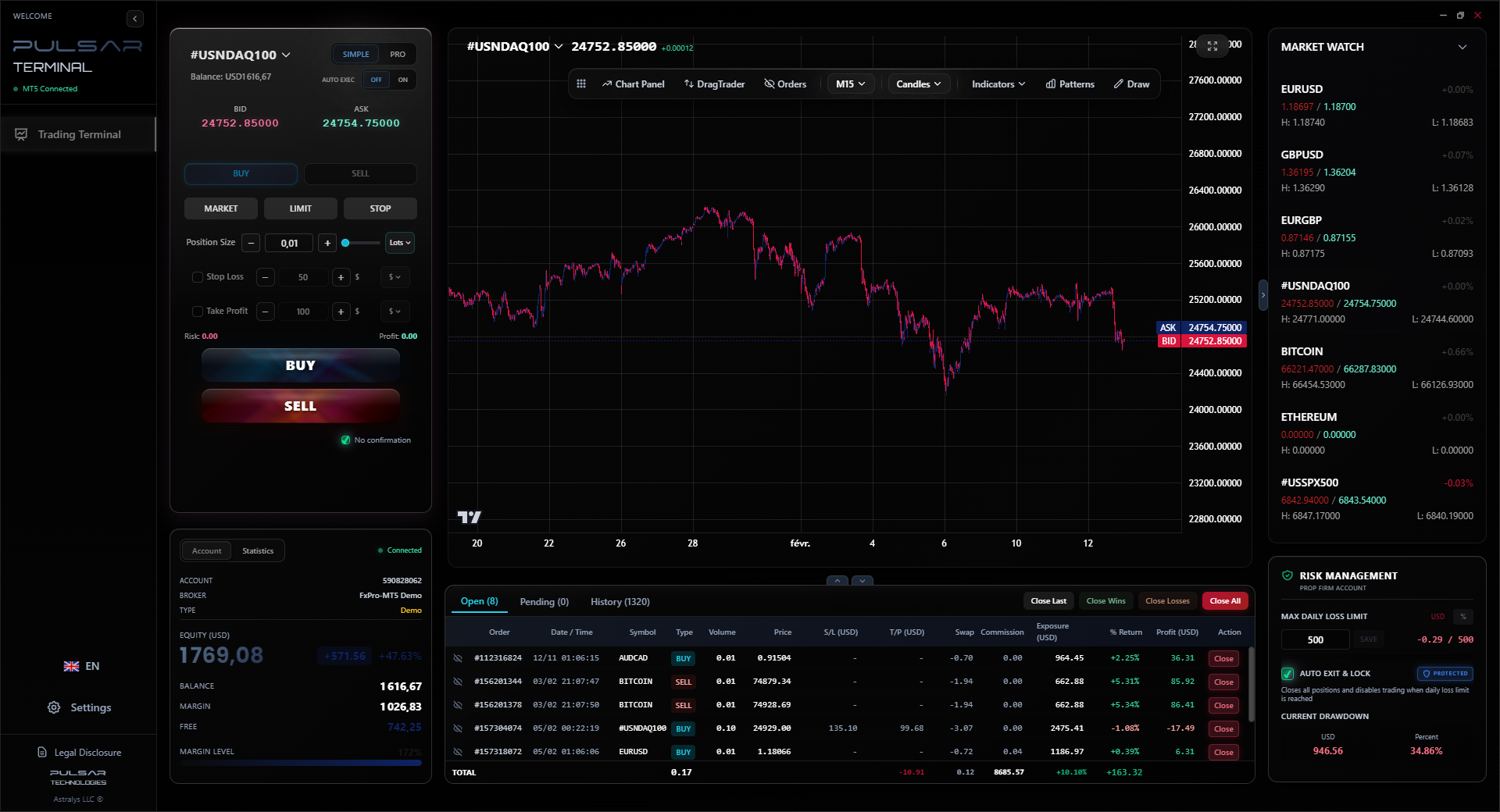
Managing multiple targets and trailing stops on volatile gold trades is complex, but Pulsar Terminal automates it all directly on your MT5 platform.
Pulsar Terminal
เครื่องมือ MT5 ครบวงจร: ลากวางคำสั่ง, multi-TP/SL, trailing stop, grid trading, Volume Profile และการป้องกัน prop firm ใช้งานโดยเทรดเดอร์กว่า 1,000 คนทุกวัน
“I've blown up an account trading gold the wrong way, so let me save you the trouble.”
Your broker is your gateway. Choose wrong, and your strategy is dead on arrival.
For MCX Trading: You need a SEBI-registered broker that offers commodity trading. Most big names like Zerodha, Angel One, and Groww do this. They provide their own platforms or integration with MCX's system. Check their margin requirements, CTT pass-through, and platform stability during high volatility (like during US NFP data releases at night). The MCX trading window is 9 AM to 11:30 PM, but the real action often aligns with London and New York opens.
For XAU/USD Trading: You're looking at international CFD brokers. Key metrics:
- Spread: This is your immediate cost. On XAU/USD, a good raw/ECN account might offer 0.0-0.5 pips spread plus a commission (e.g., $3.50 per side). A standard account might have a 1-2 pip fixed spread. I prefer the raw account for transparency.
- Execution: Does it slip badly during news? Check reviews.
- Deposit/Withdrawal in INR: How easy is it? Brokers like XM or Exness often have local bank transfer options or accept UPI, which is a lifesaver.
I used a broker once with 'tight spreads' that magically widened from 0.5 to 15 pips the second the US inflation data hit. My stop loss was executed at a horrific price. Now I only use brokers with a proven track record of stable execution during news, even if their commission is slightly higher.
24/7 Trading Apps: Newer FIU-registered apps like CoinSwitch Kuber or Delta Exchange offer 24/7 gold trading, even on weekends. This fills a gap, but understand you're likely trading on a different, less liquid marketplace. The price might deviate from MCX or spot.
💡 เคล็ดลับจาก Winston
The most reliable gold breakout often comes after a prolonged consolidation (at least 3 weeks) on the daily chart. Volatility compression precedes expansion. Wait for the squeeze.
“I've blown up an account trading gold the wrong way, so let me save you the trouble.”
Let's get vulnerable. Here's where I've lost money, so you can sidestep these traps.
- Trading Without a USD/INR Chart Open: This is the #1 mistake for MCX traders. As mentioned, I've had perfectly good gold calls ruined by forex moves. Now, the USD/INR chart is always on my second screen.
- Chasing 'Digital Gold' Yields: Before SEBI's warning, I parked some money in a fancy app promising 'gold savings' with bonus yields. It was opaque and unsettling. I pulled out. SEBI's 2025 warning confirmed the gut feeling. Stick to the regulated exchanges.
- Ignoring the 'Trump Trade': Gold has specific reactions to US political risk. Under certain administrations, fiscal spending fears can drive gold faster than anything else. It's not just about the Fed. Not factoring in this macro overlay left me on the sidelines during the 2024 late-year rally.
- Overcomplicating the Analysis. I spent years layering dozens of indicators on my gold chart. All it did was create confusion and conflicting signals. My edge now comes from: Price + Real Yield Trend + MACD indicator for momentum confirmation on the 4Hr chart. That's it. Clean charts lead to clear decisions.
- Not Accounting for CTT in Profit Targets. When scalping MCX, you need a wider profit target to overcome the CTT hit. A 10-point scalp might net you zero after costs. Calculate your break-even point including all charges before you enter.
“A 10-point scalp might be completely wiped out by Commodity Transaction Tax and brokerage.”
Consistency beats brilliance. Here’s a simple routine to follow.
Sunday Night: Review the weekly close for XAU/USD and MCX. Note the key weekly support and resistance levels. Glance at the US 10-year yield weekly chart for the broader trend.
Morning (Pre-MCX Open): Check overnight moves in XAU/USD and USD/INR. This sets the tone for MCX's open. Do you have a gap to fill? Note any major economic data due for the day (US CPI, Fed speeches).
Trade Execution: Wait for London Open (1:30 PM IST) or US Open (7:00 PM IST) for increased liquidity, especially for XAU/USD. These are when the big players move, and your orders get filled better. For MCX, the evening session (5:00 PM - 11:30 PM) often has the cleanest trends aligning with London/NY.
Trade Review: At the end of the day, journal your trades. Why did you enter? Did the setup match your plan? Where did you place the stop? This 10-minute habit improved my trading more than any book.
Finally, remember gold's role. It's not a hyper-growth asset; it's a preserver of wealth and a hedge against chaos. Trade it with patience, not greed. Start small on the mini contracts, master your gold trading strategy, and then scale up. The market isn't going anywhere.
FAQ
Q1What is the minimum amount needed to start trading gold in India?
It varies wildly. For MCX, the smallest 'Petal' contract is 1 gram. With gold at ~₹1,51,500/10g, that's about ₹15,150 worth of gold, with a margin requirement of maybe ₹1,200-₹1,500. For XAU/USD CFDs, some brokers like XM allow a $5 minimum deposit, and you can trade micro-lots. Realistically, start with at least ₹25,000-₹50,000 to properly manage risk and position size.
Q2Is it better to trade MCX Gold or international XAU/USD?
It depends. MCX is regulated by SEBI, trades in INR, and is great for aligning with local knowledge and hours. But it has CTT and is influenced by USD/INR. XAU/USD has no CTT, often lower spreads, 24/5 trading, and is a pure global market, but you deal with forex risk on your capital and offshore regulation. Many serious traders use both for different strategies.
Q3What time is best to trade gold in India?
The most volatile and liquid periods are during the London session (1:30 PM - 10:30 PM IST) and the US session (7:00 PM - 2:00 AM IST). The overlap (7:00 PM - 10:30 PM IST) is often the most active. MCX evening session (5:00 PM - 11:30 PM) captures most of this action.
Q4How does the Commodity Transaction Tax (CTT) affect my profits?
CTT is a direct tax of 0.01% on the sell value of your MCX futures trade. If you sell a 1kg contract valued at ₹1.51 crore, you pay ₹1,510 in CTT. This makes high-frequency scalping very difficult. You must factor this cost into your profit targets. A 10-point scalp might be completely wiped out by CTT and brokerage.
Q5What's the difference between Digital Gold, Gold ETFs, and Gold Futures?
Digital Gold (on apps) is an unregulated promise of physical gold ownership. Gold ETFs are SEBI-regulated funds listed on the stock exchange that track physical gold prices; you buy/sell units like a stock. Gold Futures (MCX) are standardized derivative contracts to buy/sell gold at a future date; they use use and are for trading, not investing. SEBI advises using regulated ETFs or futures over unregulated digital gold.
Q6Can I trade gold on weekends in India?
Not on traditional exchanges like MCX or NSE. However, some FIU-registered cryptocurrency and commodity apps (like CoinSwitch Kuber's commodity section) offer 24/7 gold trading. Be aware that the liquidity and pricing on these weekend markets may differ from the main weekday markets.
บทเรียนจาก Prof. Winston
สรุปสาระสำคัญ:
- ✓Always pair your MCX Gold chart with USD/INR.
- ✓Real yields, not just the Fed, dictate gold's major trend.
- ✓Size for a 1% account risk, not a fixed rupee amount.
- ✓SEBI says avoid unregulated Digital Gold platforms.
บทความนี้มีประโยชน์แค่ไหน?
คลิกดาวเพื่อให้คะแนน
ข้อมูลเชิงลึกการเทรดรายสัปดาห์
การวิเคราะห์และกลยุทธ์รายสัปดาห์ฟรี ไม่มีสแปม
เกี่ยวกับผู้เขียน
Rajesh Sharma
นักวิเคราะห์ฟอเร็กซ์อาวุโส
ซื้อขายในตลาดอินเดียและเอเชียใต้มากกว่า 10 ปี เริ่มต้นจากอนุพันธ์สกุลเงินของ NSE ก่อนเข้าสู่ตลาดฟอเร็กซ์สากล เชี่ยวชาญคู่ USD/INR และคู่สกุลเงินตลาดเกิดใหม่
ความคิดเห็น
คำเตือนความเสี่ยง
การซื้อขายตราสารทางการเงินมีความเสี่ยงสูงและอาจไม่เหมาะสำหรับนักลงทุนทุกคน ผลการดำเนินงานในอดีตไม่ได้รับประกันผลลัพธ์ในอนาคต เนื้อหานี้มีวัตถุประสงค์เพื่อการศึกษาเท่านั้นและไม่ควรถือเป็นคำแนะนำในการลงทุน โปรดทำการวิจัยของคุณเองก่อนการซื้อขาย
คุณอาจชอบสิ่งนี้

Cara Trading Forex Sukses: 7 Prinsip dari Trader Profesional
Cara trading forex sukses dengan 7 prinsip trader pro: manajemen modal, disiplin, journal trading, backtest. Data nyata, bukan janji profit palsu.
Jam Trading Forex Terbaik untuk Trader Indonesia: Panduan Lengkap dengan Tabel Waktu
Panduan jam trading forex untuk trader Indonesia. Tabel 4 sesi dunia, jam emas 20:00-00:00, sesi mana yang harus dihindari. Data akurat + tips dari trader berpengalaman.
Top 5 Sàn Forex Uy Tín Nhất 2026: Review Jujur dari Trader Indonesia
Top 5 sàn forex uy tín 2026 untuk trader Indonesia. Review jujur: spread, deposit, withdraw, dukungan lokal. Exness, XM, IC Markets & lebih.
รับ Pulsar Terminal
เครื่องคำนวณทั้งหมดนี้ถูกสร้างไว้ใน Pulsar Terminal พร้อมข้อมูลเรียลไทม์จากบัญชี MT5 ของคุณ
รับ Pulsar Terminal