


I remember staring at my screen in late 2024 as GBP/USD tanked 180 pips in under an hour during the BOE's surprise announcement.

Sarah Collins
นักกลยุทธ์การเทรด ·  United Kingdom
☕ 13 นาทีอ่าน
สิ่งที่คุณจะได้เรียนรู้:
I remember staring at my screen in late 2024 as GBP/USD tanked 180 pips in under an hour during the BOE's surprise announcement. I had a long position open with a 50-pip stop loss that got obliterated. My £2,000 account took a £450 hit in minutes because I was overexposed and had no protection. That painful lesson cost me real money, but it taught me why understanding how to hedge trade forex isn't just theory - it's survival insurance for your capital when London's markets go haywire.
Let's clear up the confusion right away. Hedging in forex isn't about making money - it's about not losing it. Think of it like insurance on your house. You pay a premium (the cost of the hedge) to protect against a catastrophic event (a massive market move against your main position).
In practical terms, a hedge trade forex strategy involves opening a second position that moves in the opposite direction to your original trade. If your main trade starts losing, the hedge should start gaining, offsetting some or all of those losses. The key word is 'should' - execution matters.
Here's where UK traders get tripped up: many confuse hedging with simply opening another trade in the opposite direction on the same account. That's just taking two opposing bets, which under FCA rules with 1:30 use on majors, can quickly eat through your margin. Real hedging is more strategic.

Warning: Don't use hedging as a substitute for a stop-loss. I made that mistake early on, thinking I could 'outsmart' the market by hedging instead of admitting a trade was wrong. It just doubled my losses and brokerage fees.
One thing I wish I'd understood sooner: hedging costs money. You're paying the spread twice, and if you're using CFDs (which most UK traders are), you might pay overnight financing on both positions. That adds up fast.
The Two Main Approaches
There are two ways UK traders typically hedge:
- Direct Hedge: Opening a sell position on GBP/USD when you already have a buy position open. Most FCA-regulated platforms allow this with a 'force open' setting, but check your broker's specific rules.
- Correlation Hedge: Using a different instrument that typically moves in the opposite direction to your main trade. For example, if you're long on GBP/USD, you might short FTSE 100, since UK stocks often fall when sterling strengthens.
I've found the correlation method works better for longer-term positions, while direct hedging is more for short-term protection during news events. Last quarter, I used a correlation hedge when holding EUR/USD long by taking a small short position on USD/CHF. It didn't perfectly offset losses, but it saved me about 40% of what I would have lost during that Fed announcement spike.
“Hedging isn't about making money - it's about not losing it. Think of it like insurance on your house.”
Here's the good news: hedging is completely legal with FCA-regulated brokers. The bad news? The rules make it more expensive and restrictive than you might hope.
First, those use limits change everything. At 1:30 on major pairs, you need £3,333 in margin to control a standard £100,000 (1 lot) position. If you open an opposing hedge of the same size, you've now tied up £6,666 in margin just to be flat. That's capital that's not working for you.

Example: On a £10,000 account with 1:30 use:
- Opening 1 lot GBP/USD requires ~£3,333 margin
- Hedging with another 1 lot requires another ~£3,333
- You've used £6,666 margin to be effectively neutral
- Only £3,334 remains for other trades
Professional client status changes the game. If you qualify (requires either €500,000 in trading capital, significant experience, or working in the financial sector), you can access 1:100 or even 1:200 use. That makes hedging cheaper margin-wise, but the risks are magnified.
Every UK trader should know these FCA protections work with hedging:
- Negative Balance Protection: You can't lose more than you deposit, even if a hedged position goes spectacularly wrong.
- 50% Margin Close-Out: If your used margin exceeds 50% of your equity, positions start closing. Hedged positions still use margin, so this can trigger unexpectedly.
- Segregated Accounts: Your money is safe if the broker goes under, which matters when you have complex positions open.
I learned the margin close-out lesson the hard way. During the 2025 Swiss franc flash event rerun, I had a hedged EUR/CHF position. Both sides moved against me temporarily due to spread widening, my margin ratio shot up, and my broker's system automatically closed part of my hedge. The result? I was left exposed on the wrong side. Always monitor your margin ratio closely when running multiple positions.
Most decent UK brokers like Pepperstone or IC Markets offer clear hedging functionality in their platforms. Just check their specific policies on whether they net hedged positions (combine them for margin purposes) or treat them separately - it makes a huge difference to your buying power.

💡 เคล็ดลับจาก Winston
The most expensive hedge is the one you open out of fear, not calculation. If your heart's pounding when you click 'sell' on your hedge, you're probably making a emotional decision, not a strategic one.
“I've found correlation hedging works better for longer-term positions, while direct hedging is for short-term protection during news events.”
Forget the theoretical stuff. Here are the three hedging approaches I've actually used with real money in London markets.
1. The News Event Hedge
This is my most frequent use. When trading major announcements like BOE rates or US Non-Farm Payrolls, I'll often enter with half my normal position size. If the trade moves against me immediately (which happens more than you'd think), I'll add the hedge at a predetermined level.
Example from last month: I bought GBP/USD at 1.2650 ahead of inflation data with 0.5 lots. My plan was to hedge with 0.5 lots if it broke below 1.2620. It did, I hedged at 1.2615, and when price bounced at 1.2590, I closed the hedge for +25 pips. That profit offset some loss on my original position when I eventually closed at 1.2630.
2. The Portfolio Hedge
If I'm running multiple GBP pairs (say long GBP/USD, long GBP/JPY, short EUR/GBP), I might use a single hedge against the US dollar index or buy gold as a general risk-off position. This is less precise but protects against broader market moves.
3. The Correlation Hedge
This requires knowing which pairs move together. The classic is EUR/USD and GBP/USD (they correlate about 80% of the time). If I'm long EUR/USD but worried about dollar strength, I might short AUD/USD instead of directly hedging EUR/USD. Why? Because if I'm wrong and the dollar weakens, both positions profit. If I'm right and the dollar strengthens, the AUD/USD hedge profits while EUR/USD loses.

Pro Tip: Always calculate your hedge ratio. If EUR/USD and AUD/USD have a 0.7 correlation, you need 1.4 lots of AUD/USD to hedge 1 lot of EUR/USD properly. Get this wrong and you're under- or over-hedged.
One strategy I've abandoned: permanent hedging. I used to run 'always hedged' positions, thinking I was being smart. All it did was guarantee I'd lose to spreads and commissions. Now I only hedge when volatility is high or I have a reason to protect profits.
Your position size calculator becomes crucial here. If you normally risk 2% per trade, and you're hedging, your effective risk changes. You need to adjust sizes so you don't accidentally double your exposure.
“I've found correlation hedging works better for longer-term positions, while direct hedging is for short-term protection during news events.”
Let's talk numbers, because hedging isn't free. On a typical major pair with a 1-pip spread:
- Opening a 1-lot trade: Costs you $10 immediately (1 pip × $10 per pip)
- Adding a 1-lot hedge: Another $10 gone
- You're down $20 before either position moves
Now add swap rates. If you're holding both positions overnight, you pay financing on both. On GBP/USD, that might be -$5 daily on the long side and +$2 on the short side (rates change daily). Net cost: -$3 per night.
Over a week, that's $20 in spreads + $21 in swaps = $41 just to be hedged. On a £10,000 account, that's 0.4% gone doing nothing.
Common mistakes I've made (so you don't have to):
- Hedging too early: I'd get nervous and hedge at the first sign of trouble, only to see the trade reverse and hit my target. Then I'm closing the hedge at a loss, eating into profits.
- Forgetting about correlations: I once hedged a long EUR/USD position with a short USD/CHF position during Swiss National Bank intervention. Both crashed together. That was expensive.
- Ignoring the economic calendar: Hedging before high-impact news often means wider spreads. Your hedge entry gets filled at a terrible price.
- Using hedging as an excuse for poor analysis: This was my biggest sin. Instead of admitting my trade thesis was wrong, I'd hedge and tell myself I was 'managing risk.' Really, I was avoiding a £200 loss that turned into a £500 loss with hedging costs.
The psychological trap is real. When you're hedged, you feel smart and protected. But you're often just delaying a decision while paying for the privilege. I now ask myself: 'Am I hedging because conditions changed, or because I'm scared?'
Also, watch your broker's policy on margin call levels with hedged positions. Some will net them, some won't. If they don't net, you can get a margin call even when your net position is flat.
💡 เคล็ดลับจาก Winston
Track your hedging P&L separately. I guarantee you'll be shocked at how much you're paying in spreads and swaps. One trader I mentored discovered 35% of his losses came from 'protective' hedges that cost more than the losses they prevented.
“If you find yourself hedging more than 20% of your trades, your entry strategy needs work, not more hedging.”
Through trial and error (mostly error), I've developed rules for when hedging makes sense.
Hedge when:
- You have large unrealized profits (50+ pips) and a news event is coming
- Market conditions have fundamentally changed since your entry
- You're in a trade for swing trading and want to protect against a weekly close against you
- Volatility spikes unexpectedly (VIX jumps, gaps appear)
Don't hedge when:
- You're in a losing trade from the start (just use a stop loss)
- Spreads are widening (you'll get terrible fills)
- You're trading lower timeframes (under 1-hour charts)
- You haven't calculated exact hedge ratios
Here's a real example from my journal. November 2025, I was long gold (XAU/USD guide) at $1,980 with +$3,200 profit. Fed minutes were due. Instead of closing, I hedged with a mini short at $2,015. Minutes were hawkish, gold dropped to $1,995. My hedge made $800, my main position lost $1,000. Net loss: $200 instead of $1,000. Worth the hedge cost? Absolutely.
Contrast that with a losing trade. This January, I was short EUR/USD at 1.0950, it went to 1.0980 (-30 pips). I hedged at 1.0985. It then dropped to 1.0930. My main trade was +20 pips, my hedge was -55 pips. Net loss: -35 pips plus spreads. Had I just taken the -30 pip loss, I'd be better off.
The difference? In the gold trade, I was protecting profits. In the EUR trade, I was avoiding admitting I was wrong.
Warning: If you find yourself hedging more than 20% of your trades, your entry strategy needs work, not more hedging.
One more consideration: tax implications. In the UK, spread betting is tax-free, but CFD profits are subject to Capital Gains Tax. If you're hedging CFDs, you're creating more taxable events. Keep records - HMRC will want them.
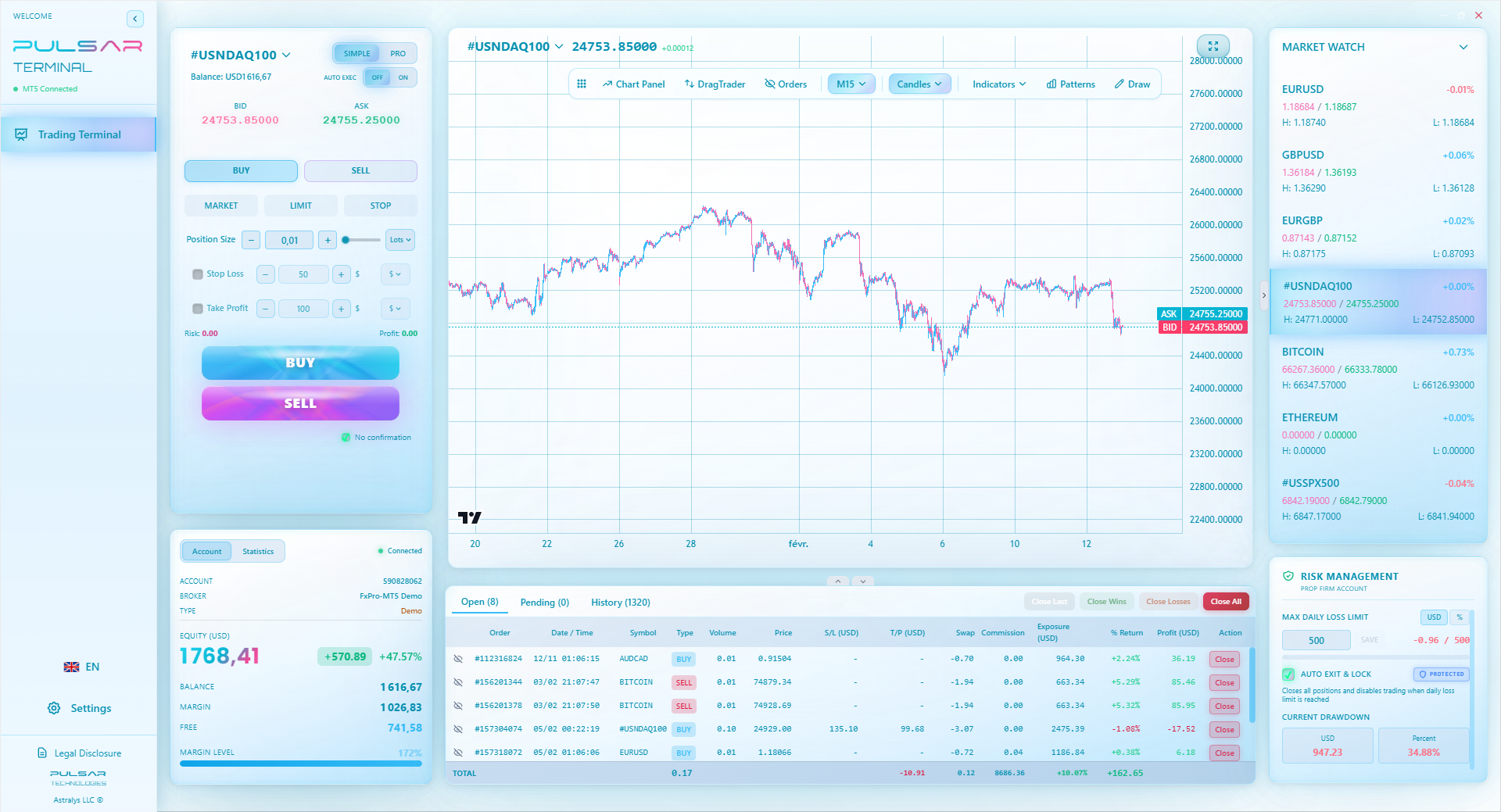
Managing multiple hedge positions with precise timing is complex, which is where tools like Pulsar Terminal's drag-and-drop orders and multi-TP/SL management on MT5 become invaluable for executing sophisticated strategies.
Pulsar Terminal
เครื่องมือ MT5 ครบวงจร: ลากวางคำสั่ง, multi-TP/SL, trailing stop, grid trading, Volume Profile และการป้องกัน prop firm ใช้งานโดยเทรดเดอร์กว่า 1,000 คนทุกวัน
“If you find yourself hedging more than 20% of your trades, your entry strategy needs work, not more hedging.”
Your trading platform can make or break your hedge trade forex strategy. Here's what to look for and set up.
MT4/MT5 Settings:
- Enable 'Allow hedging' in your account properties
- Set up one-click trading (you need fast execution)
- Use separate charts for your main pair and hedge pair
- Create templates with pre-set hedge position sizes
Most UK brokers offer decent hedging capabilities, but there are differences:
| Broker Feature | Exness | XM | IC Markets |
|---|---|---|---|
| Hedging Allowed | Yes | Yes | Yes |
| Netting or Gross | Gross | Gross | Gross |
| Margin on Hedges | Full margin both sides | Full margin both sides | Full margin both sides |
| Minimum Hedge Size | 0.01 lots | 0.01 lots | 0.01 lots |
Essential Tools:
- Correlation Matrix: Most platforms have one. Check it daily - correlations break when you least expect it.
- Economic Calendar: Know when high-impact news could widen spreads on your hedge entries.
- Margin Calculator: Before hedging, know exactly how much margin you'll tie up.
- Swap Rate Display: See what holding your hedge overnight will cost.
I use the MACD indicator divergence to time hedge entries sometimes. If my main position is going against me but MACD shows bullish divergence on the 15-minute, I might delay hedging. Not foolproof, but better than hedging at random.
For scalping strategy traders, hedging rarely makes sense. The timeframes are too short, costs too high. I learned this losing £500 trying to hedge 5-minute EUR/USD trades. The spreads ate me alive.
One platform feature that's saved me: partial close. Instead of closing my entire hedge, I can close half if the market starts turning. This lets me reduce protection gradually rather than all at once.
Remember, all these tools mean nothing without discipline. I've set perfect hedges with all the right tools, then messed them up by closing too early or too late. The tech helps, but you're still the one pulling the trigger.
💡 เคล็ดลับจาก Winston
Your first hedge should always be half the size of your main position. Full-size hedges turn you into a spread-paying spectator. Half-size lets you participate if the market turns while still cutting risk significantly.
“Sometimes the best hedge is being in cash. During volatile periods, I've closed all positions and waited. Lost $0 in spreads, $0 in swaps, $0 in losses.”
Once you've mastered basic hedging, these concepts can take your risk management further.
Options as Hedges: Some UK brokers offer forex options. Buying a put option on GBP/USD when you're long can be cheaper than a full CFD hedge. The premium is your maximum loss, and you're protected below the strike price. I used this during the 2026 election uncertainty - bought a 1.2500 put on GBP/USD for 0.5% of position value. When cable crashed to 1.2450, my CFD position lost but my option gained enough to offset 70% of losses.
Multi-Leg Hedges: Instead of one opposing position, use two. Example: Long EUR/USD, short USD/CHF and long AUD/USD. This creates a triangular hedge that's less binary. More complex, but can protect against specific scenarios (like dollar strength against Europe but not commodities).
Time-Based Hedging: Hedge only during specific sessions. If you're long Asian pairs but London session is opening (with different dynamics), hedge for the first 2 hours, then remove. I've done this with USD/JPY - hedge during London open, remove before US open.
Using the RSI indicator for Hedge Timing: When RSI on your main position hits extreme levels (below 20 or above 80) while moving against you, that's often when hedging is most expensive but also when reversals are likely. Sometimes better to wait for a pullback to hedge.
One advanced mistake I'll admit to: over-engineering. I once built a 5-position hedge structure for a single EUR/USD trade. Commission and spreads cost me £120, the market moved 10 pips, and my masterpiece netted £15. Keep it simple enough that you understand what each position is doing.
For prop firm traders (increasingly popular in the UK), hedging can help with daily loss limits. If you're down 1.5% on the day with a trade still open, a hedge can freeze the P&L while you figure out your next move. Just remember prop firms often have rules against 'hedging the account' - read their terms carefully.
Finally, the most advanced concept: knowing when not to trade at all. Sometimes the best hedge is being in cash. During the 2025 banking crisis scare, I closed all positions and waited. Lost $0 in spreads, $0 in swaps, $0 in losses. Felt boring at the time, but my account thanked me.
FAQ
Q1Is hedging forex legal with UK brokers?
Yes, completely legal with FCA-regulated brokers. Most allow direct hedging (opening opposite positions on the same pair) through a 'force open' or hedging setting in their platform. Just remember you're still subject to all normal FCA rules including 1:30 use limits on majors for retail clients.
Q2How much does it cost to hedge a forex trade?
You pay the spread twice (once to open your main trade, once to open the hedge), plus overnight financing on both positions if held past 10pm UK time. On a standard lot (100,000 units) of EUR/USD with a 1-pip spread, that's $20 in spreads immediately, plus roughly $2-10 daily in swap fees depending on interest rate differentials.
Q3Can I hedge with a different currency pair?
Absolutely, and often it's smarter. This is called correlation hedging. If you're long GBP/USD, you might short AUD/USD instead of directly hedging GBP/USD. The key is knowing the correlation strength - use a correlation matrix and adjust your position size accordingly. If GBP/USD and AUD/USD correlate at 0.8, you'd need 1.25 lots of AUD/USD to hedge 1 lot of GBP/USD properly.
Q4Does hedging guarantee I won't lose money?
No, and this is a dangerous misconception. Hedging reduces directional risk but introduces other risks: spread costs, swap costs, execution risk, and correlation breakdown risk. I've lost money on perfectly hedged positions when spreads widened dramatically during news events. Hedging is risk management, not risk elimination.
Q5Should I hedge all my trades?
Definitely not. Hedging should be strategic and occasional. If you're hedging more than 20% of your trades, your entry strategy needs work. I only hedge when: 1) Protecting substantial unrealized profits ahead of news, 2) Market conditions have fundamentally changed since my entry, or 3) I'm in a longer-term swing trade and want to protect against a weekly close against me.
Q6How does hedging affect my margin requirements?
With most UK brokers, hedged positions require full margin for both sides. So if 1 lot of GBP/USD requires £3,333 margin at 1:30 use, a 1-lot hedge requires another £3,333. You've tied up £6,666 to be effectively flat. This dramatically reduces your available margin for other trades - always calculate this before hedging.
Q7What's the difference between hedging and using a stop-loss?
A stop-loss closes your trade at a predetermined loss. A hedge opens a new opposing position while keeping your original trade open. Stops are cheaper (one spread) and definitive. Hedges are more expensive (two spreads plus swaps) but keep your original trade alive in case it recovers. Use stops for clear invalidation points, hedges for temporary protection during uncertainty.
บทเรียนจาก Prof. Winston
สรุปสาระสำคัญ:
- ✓Hedging costs minimum 2 spreads immediately
- ✓FCA use limits make hedging expensive margin-wise
- ✓Correlation hedges often work better than direct hedges
- ✓Track your hedge P&L separately - you'll be shocked
- ✓Hedge to protect profits, not avoid admitting losses
บทความนี้มีประโยชน์แค่ไหน?
คลิกดาวเพื่อให้คะแนน
ข้อมูลเชิงลึกการเทรดรายสัปดาห์
การวิเคราะห์และกลยุทธ์รายสัปดาห์ฟรี ไม่มีสแปม
เกี่ยวกับผู้เขียน
Sarah Collins
นักกลยุทธ์การเทรด
นักวางกลยุทธ์เทรดดิ้งประจำลอนดอน มีประสบการณ์ 12 ปีในตลาดการเงิน อดีตนักวิเคราะห์ที่บริษัทนายหน้าใน City of London ครอบคลุมคู่ GBP ตลาดยุโรป และการเทรดภายใต้กฎระเบียบ FCA
ความคิดเห็น
คำเตือนความเสี่ยง
การซื้อขายตราสารทางการเงินมีความเสี่ยงสูงและอาจไม่เหมาะสำหรับนักลงทุนทุกคน ผลการดำเนินงานในอดีตไม่ได้รับประกันผลลัพธ์ในอนาคต เนื้อหานี้มีวัตถุประสงค์เพื่อการศึกษาเท่านั้นและไม่ควรถือเป็นคำแนะนำในการลงทุน โปรดทำการวิจัยของคุณเองก่อนการซื้อขาย
คุณอาจชอบสิ่งนี้

Cara Trading Forex Sukses: 7 Prinsip dari Trader Profesional
Cara trading forex sukses dengan 7 prinsip trader pro: manajemen modal, disiplin, journal trading, backtest. Data nyata, bukan janji profit palsu.
Jam Trading Forex Terbaik untuk Trader Indonesia: Panduan Lengkap dengan Tabel Waktu
Panduan jam trading forex untuk trader Indonesia. Tabel 4 sesi dunia, jam emas 20:00-00:00, sesi mana yang harus dihindari. Data akurat + tips dari trader berpengalaman.
Top 5 Sàn Forex Uy Tín Nhất 2026: Review Jujur dari Trader Indonesia
Top 5 sàn forex uy tín 2026 untuk trader Indonesia. Review jujur: spread, deposit, withdraw, dukungan lokal. Exness, XM, IC Markets & lebih.
รับ Pulsar Terminal
เครื่องคำนวณทั้งหมดนี้ถูกสร้างไว้ใน Pulsar Terminal พร้อมข้อมูลเรียลไทม์จากบัญชี MT5 ของคุณ
รับ Pulsar Terminal