


Let's cut through the noise.

Rajesh Sharma
นักวิเคราะห์ฟอเร็กซ์อาวุโส ·  India
India
☕ 11 นาทีอ่าน
สิ่งที่คุณจะได้เรียนรู้:
- 1The Legal Minefield: What RBI & SEBI Actually Say
- 2use Limits: Regulated vs. Offshore (The Temptation)
- 3The Broker Landscape: Who Can You Actually Use?
- 4The Real Costs (Beyond the use Number)
- 5GIFT City: The (Mostly) Legal Loophole?
- 6Smart Alternatives to Chasing use
- 7Final Verdict: Is It Worth The Risk?
Let's cut through the noise. Every other YouTube ad screams about '1:1000 use' and 'turn ₹10,000 into ₹1 crore'. It's a fantasy, and a dangerous one. For Indian traders, the pursuit of high use isn't just a risky strategy, it's a legal minefield that can get your bank account frozen. I've seen too many guys blow up accounts chasing this dream. This guide isn't about finding the broker with the biggest use number. It's about understanding the harsh reality of the Indian regulatory landscape, the real costs of offshore trading, and how to trade forex here without getting yourself into serious trouble.
First things first. Forex trading in India is legal, but with chains attached. The Reserve Bank of India (RBI) and SEBI don't mess around with the Foreign Exchange Management Act (FEMA). They've drawn a very clear, very restrictive line in the sand.
You are only allowed to trade currency pairs that include the Indian Rupee (INR). Full stop. That means USD/INR, EUR/INR, GBP/INR, JPY/INR. Want to trade the classic EUR/USD or GBP/USD? That's a violation. You must trade through a SEBI-regulated broker on the NSE or BSE. Using an international platform for those major pairs is explicitly prohibited.
The RBI has issued countless warnings against these 'unauthorized Electronic Trading Platforms.' They're not bluffing. I know a trader in Mumbai who had his bank account temporarily flagged for repeated transfers to a known offshore broker. The hassle with his bank took months to sort out. It wasn't worth the supposed 'freedom.'
Then there's the Liberalised Remittance Scheme (LRS). A lot of guys think, 'Hey, I can send $250,000 abroad per year, I'll just use that for trading!' Wrong. The RBI has specifically stated you cannot use the LRS for speculative forex trading or to fund margin accounts overseas. They are watching this closely.

Warning: Using an offshore broker to trade non-INR pairs isn't just 'against the rules.' It's a violation of FEMA. The penalties can be severe, including hefty fines and legal action. You are operating in a regulatory grey area with zero protection.
This is where the siren song of offshore brokers gets loud. Let's look at the numbers, because they tell the whole story.
SEBI's Cap (The Safe, Boring Lane):
- For major INR pairs (USD/INR): 1:50 use.
- For other pairs: 1:20 use. So with ₹10,000 in your account, you can control a position worth ₹5,00,000 on USD/INR. That's it. It's designed to protect you from yourself.
Offshore Broker Offers (The Dangerous Fast Lane): This is what floods your social media feeds:
- 1:100, 1:200 (common)
- 1:500, 1:1000 ("professional" tiers)
- 1:2000, even 'unlimited' use (sheer madness)
Think about that 1:1000 use for a second. A 0.1% move against you wipes out your entire margin. That's 10 pips on most pairs. Price breathes wrong and you're done. I tried trading with 1:500 use early in my career, convinced I was smart enough to handle it. A news spike on GBP/USD took out my entire ₹50,000 position in under 30 seconds. I learned about margin call the hardest way possible.
These brokers aren't offering this out of generosity. High use is a customer acquisition tool and, frankly, a risk to your capital. It makes small accounts feel powerful while dramatically increasing the probability you'll lose everything quickly. Your first job as a trader is capital preservation, and high use is the enemy of that goal.

Example: You deposit $100 with a broker offering 1:500 use. You open a 0.5 lot position on EUR/USD (controlling $50,000). The spread is 1.2 pips. On a standard account, that spread costs you $6 immediately (1.2 pips * $10 per pip on a 0.1 lot * 5). You're down 6% on your $100 before the trade even starts moving. This is why you need a position size calculator.

💡 เคล็ดลับจาก Winston
A broker's use offer is a test. The truly professional traders I know treat maximum use like a car's top speed - a number you should never, ever need to use.
“High use is a customer acquisition tool and, frankly, a risk to your capital.”
You have two paths, and they lead to completely different worlds.
The Legal, Domestic Path (SEBI-Regulated)
These are your stockbrokers. They offer forex derivatives on INR pairs. This is 100% legal, safe, and above board. You get Indian customer support, UPI deposits, and SEBI's investor protection.
- Zerodha (Kite platform): The giant. Their platform is excellent for equities, and they offer currency derivatives.
- Upstox, Angel One, ICICI Direct, HDFC Securities: All major players. You're trading futures and options contracts on USD/INR, not spot forex.
The catch? You're limited to INR pairs and SEBI's use caps. For many traders, especially those focused on the Indian market, this is more than enough. The liquidity on USD/INR futures is massive.
The Offshore Grey Area (International Brokers)
This is where you go to access EUR/USD, Gold (XAU/USD), indices, and yes, sky-high use. I must stress: using these brokers for non-INR forex is against RBI rules. However, many Indian traders still do it. The brokers know this and cater to the market.
Based on who accepts clients from India and their offerings, here's a blunt comparison:
| Broker | Max use Offered | Notable Point |
|---|---|---|
| RoboForex, Ultima Markets | Up to 1:2000 | Pure insanity. Avoid unless you enjoy donating money. |
| Exness | 'Unlimited' (conditions apply) | Famous for this. Extremely high risk. |
| IC Markets, Pepperstone | Up to 1:500 | Respected raw spread/ECN brokers. Still very high use. |
| Vantage, FP Markets | Up to 1:500 | Similar to above, good platform choice. |
| XM, OctaFX | Up to 1:1000 | Frequently on RBI's alert list. Tread carefully. |
| FBS | Up to 1:3000 | The highest I've seen. A guaranteed way to blow up. |
I have accounts with both IC Markets and Pepperstone for my international trading (executed legally through a different structure). They are top-tier in terms of execution and raw spreads. But I keep my use dialed down to 1:30, mimicking SEBI's philosophy. The tool is there, but you don't have to use it on its most dangerous setting.
If you go this route, you're on your own. Do your own deep dive on our Exness review or XM review to understand the pros and cons. Your deposits will be in USD/EUR, you'll use Skrill/Neteller/crypto, and you'll have no recourse to Indian authorities if something goes wrong.
use is the headline, but the real profit killers are the silent fees. When comparing brokers, especially offshore ones, you need to look at the full picture.
Spreads & Commissions: This is your transaction cost. A broker offering 1:1000 use might have a huge spread, eating your profits.
- Raw/ECN Accounts: Brokers like IC Markets, Pepperstone, Vantage offer spreads from 0.0 pips but charge a commission (e.g., $3.50 per lot per side). This is often cheaper for active traders. A tight spread is crucial for a scalping strategy.
- Standard Accounts: Brokers like XM might offer 1.0 pips on EUR/USD with no commission. Simpler, but can be more expensive on larger volumes.
Swap/Rollover Rates: If you hold a position overnight, you pay or earn interest. These rates can be significant on certain pairs. A high-use position held for days can rack up huge swap charges.
Deposit/Withdrawal Fees: Funding an offshore account isn't free. Bank wire transfers can cost $25-$50. E-wallets like Skrill often have percentage fees. Some brokers offer one free withdrawal per month. Calculate this into your trading costs.
The Hidden Cost of Risk: This is the big one. With high use, your position size is enormous relative to your capital. A normal 20-pip stop-loss on a modest 1:100 leveraged trade can represent a 5% loss. With 1:500, that same 20-pip stop is a 25% loss. Your psychological pressure is multiplied, leading to bad decisions. You'll start moving stops, overtrading, and violating your plan. I've been there.

Pro Tip: Before you get dazzled by use, open a demo account and look at the actual, real-time spreads on the pairs you want to trade. Then, calculate your potential costs per trade including commission. You'll quickly see that low, consistent costs are far more valuable than hypothetical high use.
💡 เคล็ดลับจาก Winston
If you can't be profitable at 1:30 use, you're just a gambler. 1:500 use turns you into a bankrupt gambler. Focus on your edge, not your multiplier.
“Your first job as a trader is capital preservation, and high use is the enemy of that goal.”
Here's where it gets interesting for 2026. There is one semi-official path to trade global markets: GIFT City (Gujarat International Finance Tec-City). It's an International Financial Services Centre (IFSC) with different rules.
The RBI has specifically said that Indian retail individuals can use the LRS to invest in securities in GIFT City. This means you can legally send money to a broker registered with the IFSC authority and trade global products - stocks, commodities, and yes, forex pairs like EUR/USD.
How it works:
- You find a broker operating in GIFT IFSC (several international names have set up shop there).
- You use your LRS limit to fund that account.
- You trade on their platform, which is physically located in the IFSC zone.
The use offered here is still likely to be more conservative than pure offshore brokers (think 1:50 or 1:100), but it's regulated under the IFSC authority, not SEBI. This provides a layer of legal safety and oversight that sending money directly to Cyprus or the Seychelles does not.
It's not a free-for-all. The brokers are still regulated, and you must follow KYC norms. But it's the closest thing to a government-sanctioned method for Indians to access the global forex market. It's more paperwork, but it lets you sleep at night without worrying about an RBI notice.
This is a developing space. More brokers are establishing IFSC entities. If you're serious about trading global markets and want to stay on the right side of the law, this is the channel to research deeply.
Forget trying to game the system with 1:1000. Lasting success comes from skill, not borrowed size. Here's what to focus on instead.
1. Master Your Strategy with Low use. Use the SEBI-mandated 1:50 on a domestic account, or self-impose a 1:30 limit on an offshore account. Can you be consistently profitable? If not, 1:500 will only make you lose money faster. A solid swing trading strategy that catches 200-pip moves doesn't need high use to generate great returns.
2. Trade Larger Time Frames. The lower your use, the wider your stops need to be to avoid noise. This pushes you to trade the 4-hour or daily charts, where the market's true direction is clearer. You make fewer, higher-probability trades. I switched from 5-minute scalping to daily chart swing trades years ago, and it was the best decision I ever made. My stress dropped, and my returns smoothed out.
3. Focus on Risk Management, Not Reward Fantasy. This is non-negotiable. Risk 1-2% of your capital per trade. Use a stop-loss on every single position. A proper position size calculator is your most important tool. No amount of use can save a trader with poor risk management.
4. Use Technology to Trade Smarter. Instead of begging for more use, use tools that improve your precision. A platform with advanced order types lets you enter and exit with surgical accuracy. For instance, setting a multi-level take-profit or a trailing stop that locks in profits can do more for your bottom line than a bigger position ever could.
5. Build Your Capital the Old-Fashioned Way. Save and add to your trading account from your income. A ₹5,00,000 account trading at 1:50 use controls ₹2.5 crore. That's more than enough for any retail trader. The goal is to grow your capital through compounding profits, not by using dangerous use on a tiny account.
💡 เคล็ดลับจาก Winston
The only 'use' you need is patience and a proven strategy. Let your winners run with a trailing stop, and the compounding will do the heavy lifting.
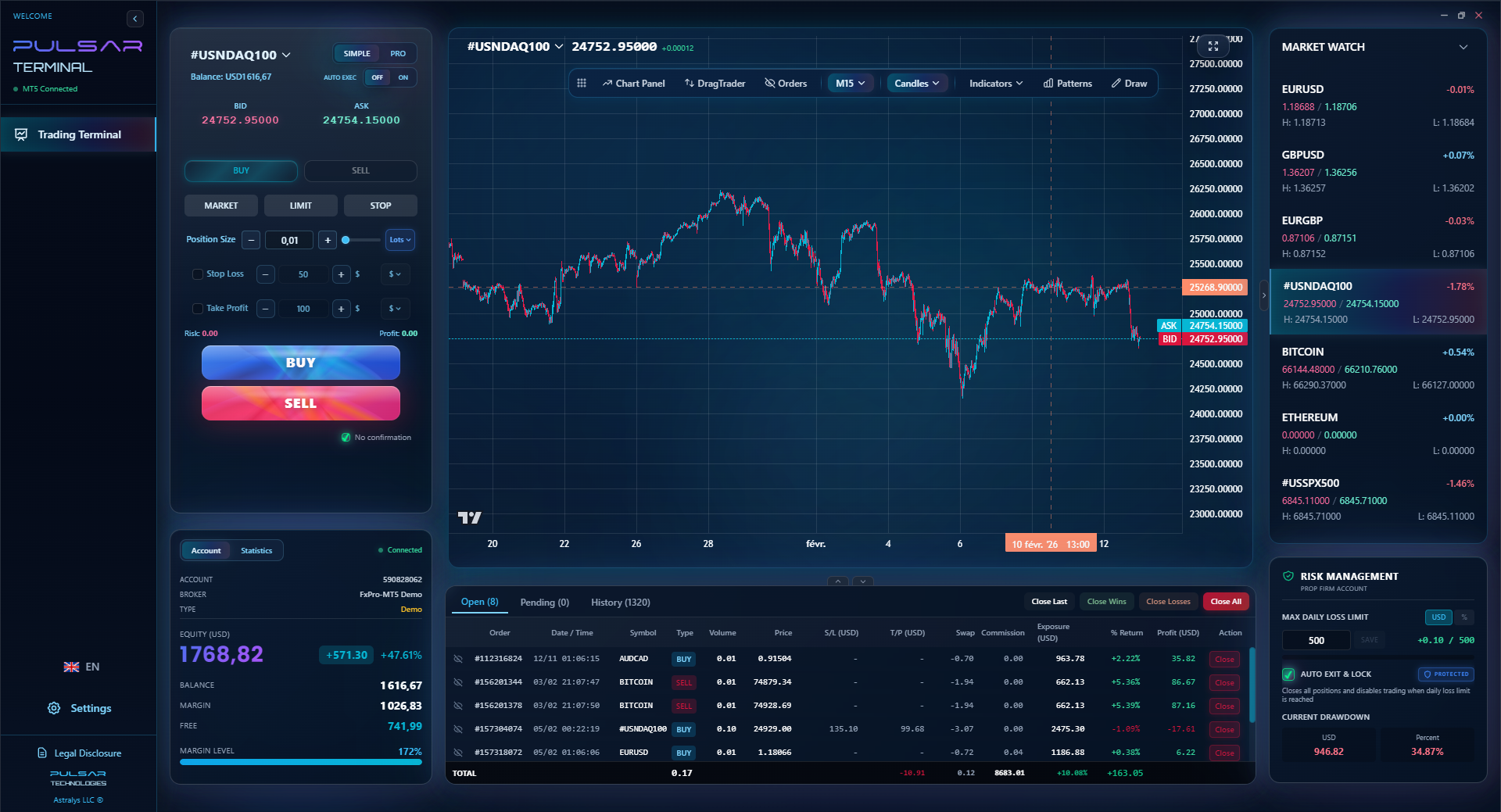
Managing multiple take-profit levels and trailing stops on high-leverage trades is stressful, which is why tools like Pulsar Terminal automate these advanced orders directly on your MT5 chart.
Pulsar Terminal
เครื่องมือ MT5 ครบวงจร: ลากวางคำสั่ง, multi-TP/SL, trailing stop, grid trading, Volume Profile และการป้องกัน prop firm ใช้งานโดยเทรดเดอร์กว่า 1,000 คนทุกวัน
“The broker's use offer is a test of your discipline. The smartest traders in the room are the ones who ignore it.”
So, should you hunt for high use forex brokers as an Indian trader?
For 99% of you, the answer is a resounding no.
The legal risks are real and growing. The RBI is tightening norms, not loosening them. The financial risk is even more real: high use is a shortcut to the poorhouse. It amplifies every mistake.
If you are a beginner, stick to SEBI-regulated brokers and trade USD/INR. Learn the game there. The volatility is plenty, and the rules protect you from your worst impulses.
If you are an experienced trader determined to trade global pairs, you have two less-bad options:
- The GIFT City Route: The most legally sound method. Do the paperwork, use your LRS limit, and trade with an IFSC-regulated broker.
- The Offshore Route (With Extreme Caution): If you must, choose a reputable, well-regulated international broker like Pepperstone or IC Markets. Then, immediately lower your use setting to 1:30 or 1:50 in your client portal. Fund the account with money you can afford to lose entirely, and be aware you have no legal shield.
I made my biggest losses chasing high use. My biggest gains came from patience, a clear strategy using the MACD indicator and RSI on higher timeframes, and strict risk management. The broker's use offer is a test of your discipline. The smartest traders in the room are the ones who ignore it.
FAQ
Q1What is the maximum legal use for forex trading in India?
For retail traders on SEBI-regulated platforms (trading INR pairs like USD/INR), the maximum use is 1:50 for major pairs and 1:20 for others. Any offer of higher use from an offshore broker is not compliant with Indian regulations for retail trading.
Q2Can I go to jail for using an offshore forex broker?
Jail is unlikely for a retail trader, but you are violating the Foreign Exchange Management Act (FEMA). The RBI can impose significant financial penalties, and your bank can freeze accounts involved in the transactions. It's a legal risk with serious financial consequences, not a criminal one for most small traders.
Q3Which offshore brokers are banned by the RBI?
The RBI maintains an 'Alert List' of unauthorized entities. Brokers like OctaFX and XM have appeared on this list. However, the list is not exhaustive. The core rule is that any platform offering you to trade non-INR pairs (like EUR/USD) is unauthorized for an Indian resident, regardless of whether it's on a specific list or not.
Q4Is trading in GIFT City really legal for individuals?
Yes. The RBI has explicitly permitted individuals to use the Liberalised Remittance Scheme (LRS) to invest in securities within GIFT City IFSC. This allows you to fund an account with an IFSC-regulated broker to trade global markets, including forex, in a much more compliant framework than sending money directly overseas.
Q5I have a small account (less than ₹50,000). Don't I need high use to make money?
This is the most dangerous myth. No, you don't. What you need is to protect that capital while you learn. High use on a small account guarantees you will lose it all quickly due to spreads, commissions, and normal market noise. Focus on growing your account through consistent, small gains at low use, or save more capital before trading seriously. Chasing big wins with high use is a guaranteed loss strategy.
Q6What's more important than high use when choosing a broker?
Execution speed, tight and consistent spreads (or low commissions), reliability of the trading platform (like MT5), and the safety of your funds (regulation). A broker with 1:50 use, 0.1 pip spreads, and instant execution is infinitely better than a broker with 1:1000 use and 3 pip spreads that requotes you on every entry.
บทเรียนจาก Prof. Winston
สรุปสาระสำคัญ:
- ✓SEBI caps legal use at 1:50 for INR pairs.
- ✓Using offshore brokers for non-INR pairs violates FEMA.
- ✓GIFT City offers a compliant path to global markets.
- ✓High use increases loss probability, not success.
- ✓Focus on spreads & execution, not use numbers.
บทความนี้มีประโยชน์แค่ไหน?
คลิกดาวเพื่อให้คะแนน
ข้อมูลเชิงลึกการเทรดรายสัปดาห์
การวิเคราะห์และกลยุทธ์รายสัปดาห์ฟรี ไม่มีสแปม
เกี่ยวกับผู้เขียน
Rajesh Sharma
นักวิเคราะห์ฟอเร็กซ์อาวุโส
ซื้อขายในตลาดอินเดียและเอเชียใต้มากกว่า 10 ปี เริ่มต้นจากอนุพันธ์สกุลเงินของ NSE ก่อนเข้าสู่ตลาดฟอเร็กซ์สากล เชี่ยวชาญคู่ USD/INR และคู่สกุลเงินตลาดเกิดใหม่
ความคิดเห็น
คำเตือนความเสี่ยง
การซื้อขายตราสารทางการเงินมีความเสี่ยงสูงและอาจไม่เหมาะสำหรับนักลงทุนทุกคน ผลการดำเนินงานในอดีตไม่ได้รับประกันผลลัพธ์ในอนาคต เนื้อหานี้มีวัตถุประสงค์เพื่อการศึกษาเท่านั้นและไม่ควรถือเป็นคำแนะนำในการลงทุน โปรดทำการวิจัยของคุณเองก่อนการซื้อขาย
คุณอาจชอบสิ่งนี้

Cara Trading Forex Sukses: 7 Prinsip dari Trader Profesional
Cara trading forex sukses dengan 7 prinsip trader pro: manajemen modal, disiplin, journal trading, backtest. Data nyata, bukan janji profit palsu.
Jam Trading Forex Terbaik untuk Trader Indonesia: Panduan Lengkap dengan Tabel Waktu
Panduan jam trading forex untuk trader Indonesia. Tabel 4 sesi dunia, jam emas 20:00-00:00, sesi mana yang harus dihindari. Data akurat + tips dari trader berpengalaman.
Top 5 Sàn Forex Uy Tín Nhất 2026: Review Jujur dari Trader Indonesia
Top 5 sàn forex uy tín 2026 untuk trader Indonesia. Review jujur: spread, deposit, withdraw, dukungan lokal. Exness, XM, IC Markets & lebih.
รับ Pulsar Terminal
เครื่องคำนวณทั้งหมดนี้ถูกสร้างไว้ใน Pulsar Terminal พร้อมข้อมูลเรียลไทม์จากบัญชี MT5 ของคุณ
รับ Pulsar Terminal