


It was March 2026, and the Naira was in freefall.

Olumide Adeyemi
ผู้บุกเบิกการเทรดในแอฟริกาตะวันตก ·  Nigeria
☕ 11 นาทีอ่าน
สิ่งที่คุณจะได้เรียนรู้:
It was March 2026, and the Naira was in freefall. On my screen, USD/NGN was screaming past ₦1,500. Retail traders were piling into shorts, convinced it would hit ₦2,000. I was one of them, and I was getting wrecked. Meanwhile, the big funds were quietly doing the opposite. They weren't gambling on a number; they were executing a plan built on data I couldn't see and discipline I didn't have. That week taught me more about how hedge funds trade forex than any textbook ever could. They don't just trade - they engineer outcomes. Let's break down how they really operate, and more importantly, what you can steal from their playbook.
Most traders imagine hedge fund managers as Gordon Gekko types, yelling orders and making gut calls on massive screens. The reality is far more boring, and that's why it works.
Their edge isn't a secret indicator. It's a systematic approach to three things: information, execution, and risk. While you're watching a 15-minute chart, they're analyzing order flow data from multiple liquidity pools, tracking the inventory of other large banks, and modeling correlations you've never heard of.
I learned this the hard way. In late 2024, I was swing trading GBP/USD based on a clean breakout. I entered at 1.2650 with a stop at 1.2600. The trade immediately went my way, hitting 1.2700. Then, out of nowhere, it reversed and took me out. I was confused. The news was quiet. Later, I saw a report that a single macro fund had executed a £2 billion hedge on a related derivatives position, causing a temporary liquidity squeeze that flushed out every retail stop loss in the zone. My "technical" trade was just noise in their structural move.

Warning: Your chart is a postcard of a battlefield. Hedge funds see the satellite imagery, troop movements, and supply lines. Trading without understanding the larger context is like bringing a knife to a drone strike.
For you, this means accepting that some moves are inexplicable at our level. The goal isn't to know everything but to structure your trades so you survive the stuff you can't see. This starts with a brutal focus on risk, which brings us to their real secret weapon.
“Hedge funds don't have feelings. They have protocols.”
Ask any fund manager their number one job, and they won't say "making money." They'll say "preserving capital." For them, risk management isn't a tool you use sometimes; it's the operating system everything else runs on.
Position Sizing is Everything
You might risk 2% or 5% per trade. A hedge fund's risk parameters are surgical. They often risk a tiny fraction of 1% of their portfolio on a single idea. They define their maximum loss before they define their potential profit. They use a position size calculator religiously, but theirs is fed with volatility forecasts, portfolio correlations, and Value-at-Risk (VaR) models.
Let me give you a real number. A fund with $100 million under management might have a maximum daily loss limit of 0.5% ($500,000). Each trading desk then gets a slice of that. A single EUR/USD trade might only be allowed to risk 0.05% ($50,000). This forces them to be incredibly selective. They can't afford ten "let's see what happens" trades a day.
The Tools They Actually Use
- Correlation Matrices: They don't just look at EUR/USD in isolation. They know how it moves against USD/JPY, XAU/USD, and the S&P 500. Opening a long EUR/USD and a short DAX position might be one consolidated bet, not two separate trades.
- Scenario Analysis: "What if the CBN intervenes when USD/NGN hits ₦1,450? What if it doesn't?" They pre-plan their response for multiple outcomes, so they're not making emotional decisions in the heat of the moment.
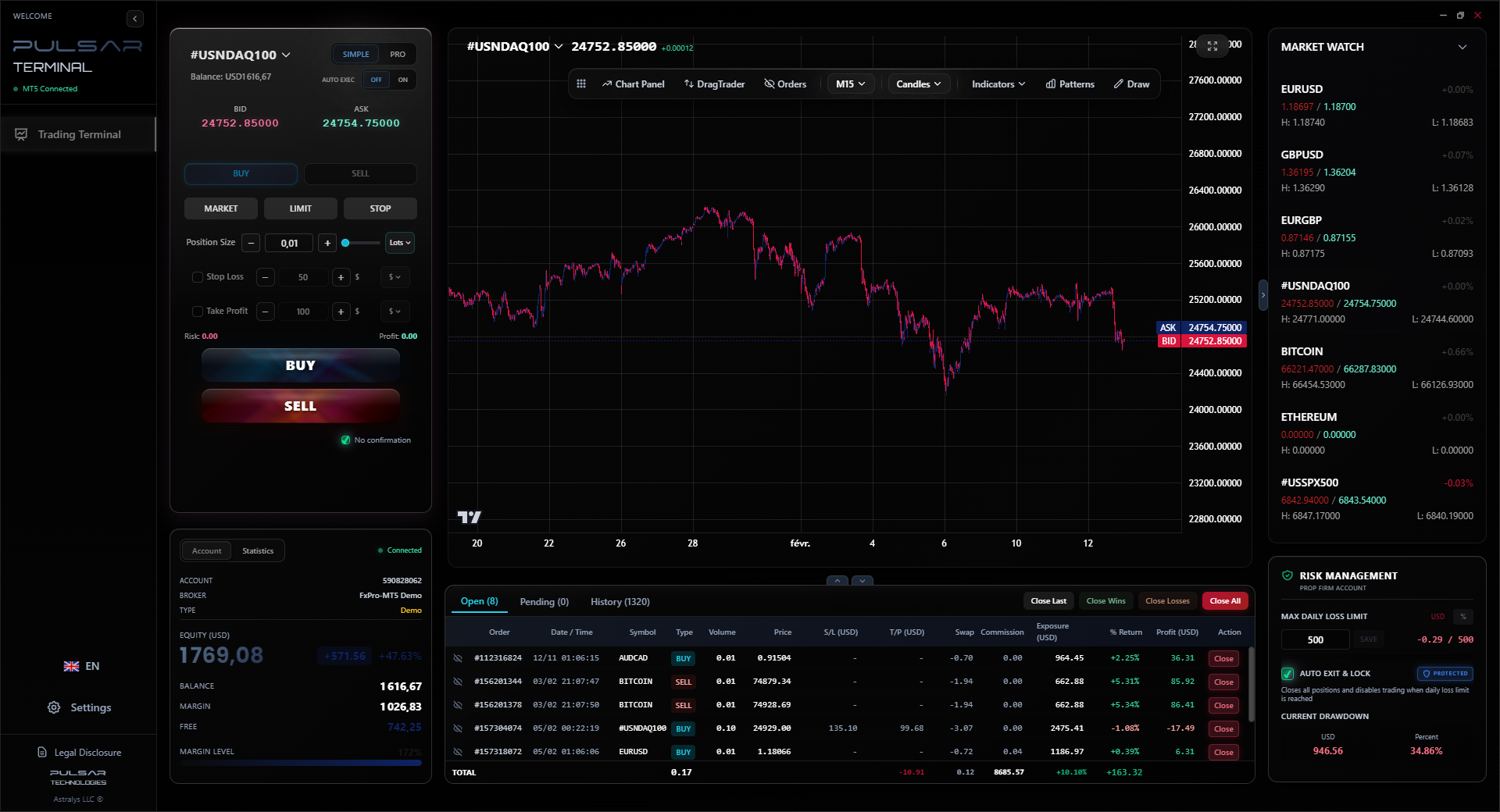
- Advanced Orders: They rely heavily on OCO (One-Cancels-the-Other) orders, trailing stops that adjust with volatility, and take-profit scales. This isn't discretionary; it's automated. This level of order management is where tools like Pulsar Terminal, which allow multi-TP/SL and partial closures directly on MT5, mimic an institutional workflow.

Pro Tip: Before you enter any trade, write down your exact exit plan for three scenarios: 1) You're wrong (stop loss). 2) You're right (take profit). 3) You're right, but then it reverses (trailing stop or breakeven trigger). This simple habit forces institutional discipline.
The biggest mistake I see Nigerian traders make is letting a winning trade turn into a loser because they "have a feeling." Funds don't have feelings. They have protocols.

💡 เคล็ดลับจาก Winston
A hedge fund's risk manager sleeps well not because they're always right, but because they've pre-calculated the cost of being wrong. You should know the price of every trade before you enter it.
Managing complex exits with multiple take-profit levels and trailing stops is a core institutional practice, and Pulsar Terminal brings this automated precision directly to your MT5 platform.
Pulsar Terminal
เครื่องมือ MT5 ครบวงจร: ลากวางคำสั่ง, multi-TP/SL, trailing stop, grid trading, Volume Profile และการป้องกัน prop firm ใช้งานโดยเทรดเดอร์กว่า 1,000 คนทุกวัน
“Your chart is a postcard of a battlefield. Hedge funds see the satellite imagery.”
This is where the playing field is most uneven. Your broker's chart shows you the price. Their systems show them the mechanics behind it.
Execution: You click "buy," and your order goes to your broker's internal system. They might fill it internally (becoming your counterparty) or pass it to a single liquidity provider. When a hedge fund clicks "buy," their order is routed through a Smart Order Router (SOR) that scans dozens of liquidity providers, banks, and dark pools in milliseconds to get the absolute best available price. The difference might be 0.2 pips. On a $10 million trade, that's $200 saved instantly. Over thousands of trades, it's millions.
Data: You're looking at lagging indicators like RSI or MACD. They're analyzing:
- Volume Profile: Seeing exactly where most trading activity occurred, identifying true support/resistance. This is a core feature of advanced platforms.
- Order Flow: Seeing if a price move is driven by large institutional buy/sell orders or just retail noise.
- FX Swap Points: For them, holding a currency pair overnight isn't just about a small swap fee; it's a strategic calculation based on interest rate differentials.

Example: In June 2025, I tried copying a "carry trade" by buying a high-yield currency. I got crushed when the pair moved against me. I focused only on the interest rate. The funds were also modeling political risk, upcoming central bank meetings, and global liquidity conditions. My one-dimensional trade was a loser in their multi-dimensional model.
You can't access their data feeds. But you can change your mindset. Stop looking for the "right" price. Start looking for the price where the story makes sense, the risk is minimal, and the execution is clean. Sometimes, the best trade is the one you don't take because the data is too murky.
“Your chart is a postcard of a battlefield. Hedge funds see the satellite imagery.”
Hedge funds aren't a monolith. Their forex approaches generally fall into three camps, and understanding them helps you see why the market moves.
- Global Macro Funds: These are the giants. They trade based on top-down analysis of entire economies. They're asking: "Is the CBN's policy sustainable? What's the real inflation picture in Nigeria? How will the 2027 elections affect capital flows?" Their trades are huge, long-term, and fundamental. When they move into or out of the Naira, it's a tidal wave. Their swing trading horizon is months or years, not days.
- Discretionary Currency Funds: These managers combine fundamentals with technicals. They might see the macro story for a weaker dollar but wait for a specific chart pattern or liquidity zone to enter. They're more agile than macro funds. This is the style most accessible for a serious retail trader to study.
- Systematic/Quant Funds: This is all math, no opinion. They build algorithms that trade based on statistical patterns, arbitrage, or momentum signals. They don't care about the "story" of the Naira. They care if their model detects a predictable inefficiency between the spot price and a futures contract. They can execute thousands of trades a day, a pure scalping strategy on steroids.
As a Nigerian trader, the macro story is your lifeline. You live the CBN's policies, feel the parallel market rates, and see dollar scarcity firsthand. That's a genuine insight. Pair that local knowledge with clean risk management, and you have the seed of a discretionary approach. Don't try to be a quant; you don't have the PhDs or the server farm. Play to your unique information advantage.
💡 เคล็ดลับจาก Winston
In Lagos, you feel the Naira's strength in the market. That's alpha. But if you don't pair that local insight with a global risk framework, you're just a well-informed gambler.
“Survival isn't sexy, but it's the only thing that matters in the long run.”
You won't get their execution speeds or data. But you can adopt their frameworks. Here’s your actionable checklist.
1. Treat Trading Like a Business. You are the CEO, risk manager, and analyst. Have a written trading plan. Track every trade in a journal - not just P&L, but why you entered, what you felt, and what you learned. I didn't start making consistent money until I reviewed 100 of my past trades and saw my stupid patterns in cold, hard Excel.
2. Redefine Your Relationship with Your Broker. Don't just chase low spreads. Ask questions. How do they execute orders? Are they an ECN/STP broker passing trades through, or a market maker trading against you? Read reviews of brokers like IC Markets or Pepperstone with a focus on their institutional services. Your broker is your infrastructure partner.
3. Master One Thing. Hedge funds have teams. You have you. Don't jump from forex to crypto to commodities. Master one major pair like EUR/USD or XAU/USD. Understand its average daily range, its typical reaction to US data, and its correlation to other assets. Depth beats breadth every time.
4. Implement Mechanical Rules. Automate what you can. Use hard stop-losses every single time. Decide your profit-taking rules in advance (e.g., take 50% off at 1:1 risk-reward, trail the rest). This removes emotion. The number one reason traders blow up is moving their stop loss, hoping a losing trade will come back. A fund trader who does that gets fired.
5. Focus on Survival First. Your goal for the first year isn't a Lamborghini. It's to not blow up your account. Aim for consistent, small gains. A 2% gain per month compounds to over 26% a year. That destroys any bank savings rate. The funds think in quarters and years. You should too.
“Survival isn't sexy, but it's the only thing that matters in the long run.”
Trading USD/NGN is a unique beast. It's less about pure forex speculation and more about navigating policy, liquidity, and local sentiment. Here’s how the institutional mindset applies here.
Understanding the Layers: The official CBN rate, the NAFEX (I&E Window) rate, and the parallel market rate can all be different. Hedge funds with local presence arbitrage these differences legally through authorized channels. As a retail trader, you're likely trading a CFD based on the interbank rate. Know which price your broker is quoting.
Policy is King: Every CBN circular, MPC meeting, and FAAC announcement is a potential market mover. Funds have economists parsing every word. You need to do the same. The 2023 forex unification and the expected FTSE Russell reclassification in 2026 are perfect examples of structural events that create long-term trends, not just one-day spikes.
Liquidity and Gaps: The Naira market can be illiquid, especially during off-hours. This leads to large gaps. Institutional players size way down or avoid trading during these thin periods. You should too. Trying to scalp USD/NGN during low liquidity is a great way to get caught in a margin call from a sudden, unpredictable move.
The Emotional Cycle: Naira volatility triggers deep national emotion - hope, fear, anger. Hedge funds exploit this sentiment extreme. When everyone is panicking about a crash, they might be looking for value. When everyone is celebrating a rally, they might be preparing to sell. Your job is to recognize your own emotional state and know it's probably wrong.
My most painful Naira trade was in November 2024, buying USD/NGN at ₦1,650 because "it had to go higher." I ignored all my rules, used excessive use, and watched it reverse to ₦1,400. I was a sentiment-driven retail trader. The funds were taking the other side of my panic. Don't be me.
💡 เคล็ดลับจาก Winston
Your goal isn't to make a killing. Your goal is to make a living. The killing comes later, as a byproduct of not being killed first.
“The funds think in quarters and years. You should too.”
So, how do hedge funds trade forex? They trade with a process that minimizes luck and maximizes statistical edges. The gap between you and them isn't just about money; it's about method.
You start closing that gap today, not by finding a better indicator, but by installing better processes.
- Audit Your Last 20 Trades. Be brutally honest. How many had a predefined stop loss and take profit? How many did you move your stop loss further away? This data is your truth.
- Simulate Being a Fund. For one month, trade your live account but with fund-like rules. Maximum risk of 0.5% per trade. No more than 3 open trades at once. A mandatory 1:2 risk-reward ratio. Journal the psychological difference.
- Build Your Intelligence Network. Follow the CBN on Twitter. Read financial reports from local banks like UBA and GTB. Understand the flows. Your edge as a Nigerian is your proximity to the Naira's reality.
I'll leave you with this. The first time I truly applied a hedge fund-style risk rule - cutting my position size by 80% - I was bored. The profits were small. But six months later, my account was at an all-time high and had survived two periods of extreme volatility that wiped out my previous accounts. That's the whole point. Survival isn't sexy, but it's the only thing that matters in the long run. The funds know this. Now you do too.
FAQ
Q1Do hedge funds in Nigeria trade the Naira like retail traders do?
Not really. Retail traders often speculate on Naira CFDs through international brokers. Hedge funds with local licenses engage in the actual physical and derivatives markets - entering swaps, forwards, and arbitraging between the official and parallel markets through legal channels. Their access, size, and instruments are completely different.
Q2What's the single biggest difference between a hedge fund trader and a retail trader?
The separation of analysis and execution. A fund analyst decides the why and where. A risk manager decides the how much. A separate execution trader then finds the best price to fill the order. Retail traders combine all three roles, which is why emotion so often wrecks the plan. They fall in love with their own analysis and ignore risk.
Q3Can I use the same strategies as hedge funds with a small account?
You can use the same principles, but not the same strategies. You can't engage in complex arbitrage or move markets. But you can absolutely adopt their core tenets: rigorous risk management (tiny position size), trade based on a logical thesis, use hard stops, and focus on preserving capital above all else. The mindset scales down.
Q4How important are algorithms in forex hedge funds?
Extremely. A large portion of forex volume is algorithmic. These algos range from high-frequency trading (HFT) that holds positions for seconds, to systematic trend-following models. For a retail trader, this means the market can move violently with no clear news - it's just machines talking to each other. It's another reason to use stop-losses; you can't out-react a server in London.
Q5Do hedge funds care about technical analysis?
Yes, but not in the way you might think. They don't look for "head and shoulders" on a 1-hour chart. They use technicals to understand liquidity - where large clusters of stop-loss orders might be (which they can target), or where key institutional support/resistance lies based on Volume Profile. It's a tool for mapping market structure, not predicting the future.
Q6Is it true hedge funds always win?
No. Plenty of hedge funds shut down every year. They have losing months and quarters. The difference is that their risk controls prevent a bad run from becoming a fatal blow. A retail trader might lose 50% in a week chasing losses. A fund's rules would have halted trading after a 2% drawdown to reassess. They're better at losing gracefully.
Q7What broker features should I look for to trade more like an institution?
Prioritize brokers with true ECN/STP models (like IC Markets or Pepperstone) for clearer execution. Look for advanced order types (OCO, trailing stop). Most importantly, use a platform that allows precise, automated trade management. Managing multiple take-profit levels and moving stops to breakeven manually is error-prone and emotional.
บทเรียนจาก Prof. Winston
สรุปสาระสำคัญ:
- ✓Risk 0.5-1% max per trade, not 2-5%.
- ✓Define your exit before your entry. Always.
- ✓Master one pair, not ten.
- ✓Your local knowledge is an edge; your emotions are a liability.
บทความนี้มีประโยชน์แค่ไหน?
คลิกดาวเพื่อให้คะแนน
ข้อมูลเชิงลึกการเทรดรายสัปดาห์
การวิเคราะห์และกลยุทธ์รายสัปดาห์ฟรี ไม่มีสแปม
เกี่ยวกับผู้เขียน
Olumide Adeyemi
ผู้บุกเบิกการเทรดในแอฟริกาตะวันตก
หนึ่งในนักการศึกษาฟอเร็กซ์ที่กระตือรือร้นที่สุดของไนจีเรีย 8 ปีประสบการณ์เทรดจากลากอส เชี่ยวชาญกลยุทธ์ทุนต่ำและความท้าทาย prop firm สำหรับเทรดเดอร์ในแอฟริกา
ความคิดเห็น
คำเตือนความเสี่ยง
การซื้อขายตราสารทางการเงินมีความเสี่ยงสูงและอาจไม่เหมาะสำหรับนักลงทุนทุกคน ผลการดำเนินงานในอดีตไม่ได้รับประกันผลลัพธ์ในอนาคต เนื้อหานี้มีวัตถุประสงค์เพื่อการศึกษาเท่านั้นและไม่ควรถือเป็นคำแนะนำในการลงทุน โปรดทำการวิจัยของคุณเองก่อนการซื้อขาย
คุณอาจชอบสิ่งนี้

Cara Trading Forex Sukses: 7 Prinsip dari Trader Profesional
Cara trading forex sukses dengan 7 prinsip trader pro: manajemen modal, disiplin, journal trading, backtest. Data nyata, bukan janji profit palsu.
Jam Trading Forex Terbaik untuk Trader Indonesia: Panduan Lengkap dengan Tabel Waktu
Panduan jam trading forex untuk trader Indonesia. Tabel 4 sesi dunia, jam emas 20:00-00:00, sesi mana yang harus dihindari. Data akurat + tips dari trader berpengalaman.
Top 5 Sàn Forex Uy Tín Nhất 2026: Review Jujur dari Trader Indonesia
Top 5 sàn forex uy tín 2026 untuk trader Indonesia. Review jujur: spread, deposit, withdraw, dukungan lokal. Exness, XM, IC Markets & lebih.
รับ Pulsar Terminal
เครื่องคำนวณทั้งหมดนี้ถูกสร้างไว้ใน Pulsar Terminal พร้อมข้อมูลเรียลไทม์จากบัญชี MT5 ของคุณ
รับ Pulsar Terminal