


Most traders think prop firms are just generous benefactors handing out cash.

James Mitchell
นักวิเคราะห์การเทรดอาวุโส
☕ 9 นาทีอ่าน
สิ่งที่คุณจะได้เรียนรู้:
- 1The Two-Pillar Business Model: Fees First, Profits Second
- 2The Brutal Math of Failure Rates
- 3Other Revenue Streams You Might Not See
- 4Risk Management: How They Protect Their Actual Cash
- 5US Regulations: The Gray Area is Getting Less Gray
- 6Choosing a Firm is a Business Decision
- 7The Bottom Line for Traders
Most traders think prop firms are just generous benefactors handing out cash. They see the ads promising 'up to $4 million in funding' and assume the firm's profit comes solely from a cut of their future winnings. That's a dangerous fantasy. The real answer to 'how do prop firms make money' is far more pragmatic, and it's built on a foundation of fees paid by traders who never see a dime of profit. Let's pull back the curtain on the actual business model, using hard numbers from the US market.
Prop firms aren't charities. Their revenue comes from two distinct, interconnected streams, and the first one is far more predictable.
The first pillar is evaluation fees. This is the upfront money you pay to take a challenge. Think of it as buying a ticket to try out for the team. This isn't a deposit; it's a non-refundable service fee. For the firm, this is guaranteed, recurring income. A trader might fail a $200 challenge, buy a reset for $100, fail again, and then try a different firm's $500 challenge. That's $800 in pure revenue for the industry before a single profitable trade is made.
The second pillar is profit splits. Once you pass and get a funded account, you share your profits with the firm. A typical split is 80/20 in your favor, though some go to 90/10 or even 100% after certain milestones. This is where the alignment happens - if you make money, they make money. But crucially, this pillar is funded by the first. The fees from the thousands who don't pass subsidize the capital allocated to the few who do.

Warning: Don't view the challenge fee as an 'investment' in your future capital. View it as the cost of a very expensive, high-stakes skills test. Most people fail the test.
I learned this the hard way early on. I was so focused on the 'free' $100k account I was chasing that I blew through nearly $1,200 in combined challenge and reset fees across three different firms. I was their perfect customer: consistently paying, consistently failing. I wasn't funding my account; I was funding their payroll.
This is where the model gets its engine. The sustainability of a prop firm relies on a high percentage of traders failing their challenges or blowing their first funded account. Let's talk real stats.
Industry data suggests only about 5% to 10% of traders pass their evaluation on the first try. Some firms with more generous reset policies might see that climb to 15-20%. But here's the kicker: of all the traders who buy a challenge, only about 7% ever receive a payout. The long-term, consistently profitable traders? That's maybe 1% to 3% of everyone who signs up.
What This Means for Revenue
Let's run a simple, hypothetical model for a small firm:
- 1,000 traders sign up for a challenge at an average fee of $250.
- That's $250,000 in immediate revenue.
- If only 7% (70 traders) ever get a payout, the firm's profit-split risk is isolated to just those 70 accounts.
- The fees from the 930 who failed cover the operational costs and the capital risk for the 70.
The firms design the challenge rules - daily loss limits, trailing drawdowns, minimum trading days - specifically to identify statistical edges and filter out those without disciplined risk management. It's a filter, not a training program.

Example: A popular two-phase challenge might have a 10% max loss rule. For a $100,000 account, that's a $10,000 buffer. If hundreds of traders hit that loss and fail, the firm never actually lost that $10,000 per account. It was virtual capital. The only real money that changed hands was the challenge fee they paid upfront.

💡 เคล็ดลับจาก Winston
Never risk more than 1% of your challenge account's *drawdown limit* on a single trade. If your max loss is $1,000, your max trade risk is $10. This is the only way to survive the statistics.
“The firm's business is selling evaluations and managing risk. Your business is generating consistent, rule-compliant returns.”
While fees and splits are the main event, there are a few auxiliary income sources.
Commission Mark-ups or Wider Spreads: Some firms partner with specific brokers and may receive a rebate on the commissions or spreads you pay. If the broker charges $5 per lot round turn, the prop firm might charge you $6, pocketing the difference. This is why checking the trading conditions (like raw spreads plus commission) is so important. It directly affects your scalping strategy viability.
Subscription Fees & Resets: The monthly or quarterly fee to keep your funded account active is pure revenue. So are reset fees. If you breach a rule but want to continue, paying $80 to reset your challenge is a high-margin transaction for them.
Interest on Capital: For the actual capital sitting in the firm's master accounts (the real money behind your simulated or funded account), they may earn interest. This is a minor factor compared to the fee engine.
My personal red flag? Firms that are vague about their broker partnerships and fees. I once traded with a firm that promised 'tight spreads' but I was consistently getting 2.5 pips on EUR/USD during London sessions. When I asked for a breakdown, I got crickets. I later realized they were almost certainly widening the spread for extra profit. I moved to a firm using a transparent broker like IC Markets with published raw spreads.
You're not trading with 'their money' in the challenge phase. You're trading in a simulated environment. Their real capital is only at risk once you're funded and have a proven track record within their system. The rules are their firewall.
Maximum Daily Loss: Often 3-5%. Hit it, your challenge is over. This stops emotional, revenge-trading blowouts in one session. Maximum Trailing Drawdown: Usually 6-10%. This is the big one. It's a moving ceiling on your losses. If you start at $100,000 and your peak balance hits $102,000, your loss limit might trail up to $92,000 (a 10% drawdown from the peak). It forces consistency and prevents you from giving back all your profits.
These rules aren't arbitrary. They're calibrated based on volatility and statistical probability to ensure that the traders who do pass are extremely likely to follow a disciplined, low-risk approach. The firm's entire goal is to find traders who treat the firm's future capital with more care than they treated their own challenge fee.
This is where tech comes in. Managing these rules manually is a nightmare. I use a tool that automates my daily loss calculation and trailing stop logic, which is a lifesaver. Passing a prop firm challenge requires strict loss management, which tools like Pulsar Terminal handle automatically, letting you focus on the trade, not the rulebook.
💡 เคล็ดลับจาก Winston
Pick one firm and one challenge size. Master its specific rulebook. Jumping between firms after each failure is just paying tuition to multiple universities for the same degree.
“Only about 7% of all traders who purchase a challenge ever receive a payout. The fees from the 93% fund everything.”
Here's a critical piece for US traders. Many retail prop firms have operated in a regulatory gray area. They argue they're not brokers or investment advisors; they're selling an 'evaluation service.' This has let them sidestep direct SEC or CFTC oversight.
That's changing. Fast.
In early 2024, the SEC adopted new rules that broaden the definition of a 'dealer.' If a prop firm is trading actively and providing liquidity as part of its business, it may now have to register with the SEC and FINRA, meet strict capital requirements, and face regular exams. The compliance clock is ticking.
Also,, the CFTC is looking closely at whether these firms should be classified as Commodity Trading Advisors (CTAs). That would mean registration, disclosure documents, and a whole new level of scrutiny.
What this means for you:
- More Scrutiny: Firms will be forced to be more transparent about their operations, pass rates, and payout practices.
- Potential Shakeout: Smaller, less strong firms might close shop, as we saw in 2024 when over 80 firms shut down. Your challenge fee could be at risk if a firm folds.
- Legitimacy: For the strong firms that survive, it adds a layer of legitimacy. Always check if a firm is registered with the NFA or if its executing broker is (like many Pepperstone or Exness entities are).

Pro Tip: Before paying any firm, search for it on the NFA's BASIC database. If they or their executing broker are listed, it's a good sign. If there's no trace, that's a major red flag.
Managing prop firm rules like daily loss and trailing drawdown manually is a huge distraction; Pulsar Terminal automates these protections directly on your MT5 chart.
Pulsar Terminal
เครื่องมือ MT5 ครบวงจร: ลากวางคำสั่ง, multi-TP/SL, trailing stop, grid trading, Volume Profile และการป้องกัน prop firm ใช้งานโดยเทรดเดอร์กว่า 1,000 คนทุกวัน
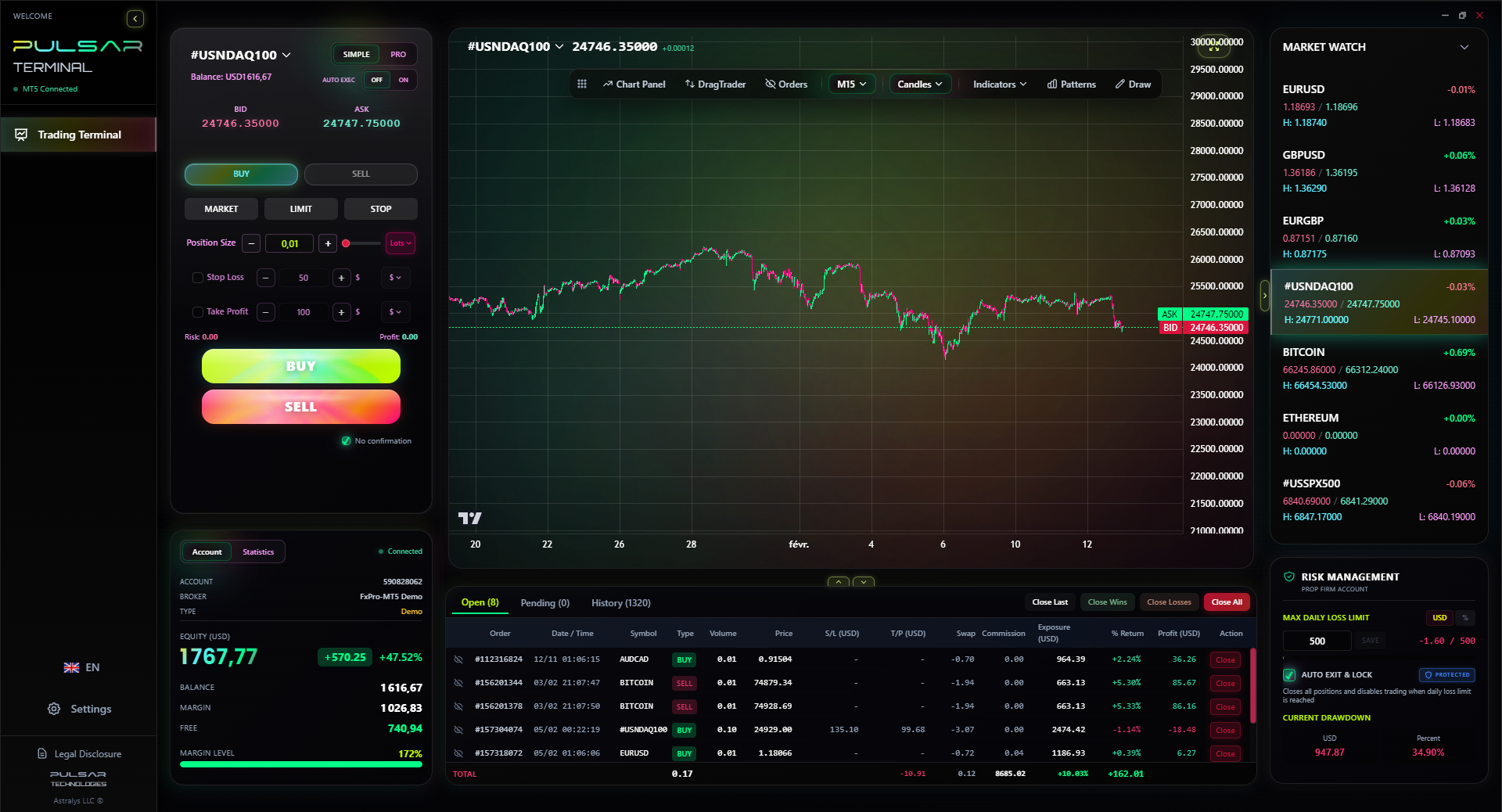
Now that you know how they make money, you can choose a partner intelligently. Don't just look at the biggest headline account size.
Compare the real cost structure:
| Factor | What to Look For | Why It Matters |
|---|---|---|
| Challenge Fee | Cost relative to account size. A $500 fee for a $50k account is 1%. A $500 fee for a $10k account is 5%. | Lower fee % means better value and less sunk cost if you fail. |
| Profit Split | The real split after any thresholds. Is it 80/20 from dollar one? Or 50/50 until you hit a target? | This directly determines your take-home pay. |
| Payout Threshold | Minimum profit needed to request a withdrawal. $50 is better than $1,000. | Affects your cash flow and motivation. |
| Trading Conditions | Spreads (are they raw?), commissions, platform (MT5 vs. cTrader), allowed strategies. | Impacts your actual trading edge and position size calculations. |
| Rule Clarity | Are the drawdown rules static or trailing? Is the daily loss based on initial or current balance? | Ambiguity here is where accounts get blown unexpectedly. |
Start small. The dream of a $200k account is seductive, but the $10k or $25k challenge is often cheaper and has identical rules. Prove you can beat their model on a small scale before you invest more in fees. I made my first consistent profits with a firm offering a $25k account, precisely because the psychological pressure was lower than the giant accounts I'd failed before.
“You're not trading with 'their money' in the challenge phase. You're trading in a simulated environment. Their real capital is only at risk once you're funded.”
Understanding how prop firms make money flips the script. You're not a student applying for a scholarship. You're a service provider auditioning for a capital allocation partner. The firm's business is selling evaluations and managing risk. Your business is generating consistent, rule-compliant returns.
Your goal isn't to 'beat the challenge' with one lucky trade. It's to demonstrate a process that can be scaled sustainably. They want to see boring, disciplined trading. The kind that uses indicators like the RSI or MACD as part of a plan, not as crystal balls. The kind that excels at swing trading within defined boundaries.
So, approach it like a pro. Budget for challenge fees as a business expense. Read the rules like a contract. And remember, the only way you truly cost them money is by becoming so consistently profitable that your profit share checks become a significant line item on their expenses. Strive to be that cost.
FAQ
Q1Is the challenge fee just free money for the prop firm?
, yes. It's non-refundable revenue used to cover their operations and the capital risk of funding the small percentage of traders who pass. It's the cornerstone of their business model.
Q2Do prop firms want me to fail?
They don't have to 'want' you to fail. Their rules are statistically designed so that most traders will fail. They profit from the many who fail (via fees) and the few who succeed (via profit splits). The model is profitable either way.
Q3What happens to the 'virtual' money I lose in a challenge?
Nothing. It disappears. The firm never had that money at risk. Only the fee you paid was real. This is why they can offer '$100,000' challenges for a few hundred dollars.
Q4Are prop firms regulated in the USA?
It's complex. Traditional prop desks in banks are heavily regulated. Many retail prop firms operate as unregulated evaluation services. However, new SEC and CFTC rules in 2024/2025 are actively bringing more of them under regulatory oversight, which is a good thing for trader protection.
Q5What's the single biggest mistake traders make with prop firms?
Treating the challenge like their personal account. They ignore the specific drawdown and daily loss rules, trade too large, and blow up. You must trade the firm's rulebook first, the market second.
Q6Can I make a living from prop firm trading?
A very small percentage do. It requires passing the challenge, then consistently performing under their rules, and scaling up over time. It's a career path, but an extremely difficult one with high upfront attrition. Don't quit your day job for a challenge.
บทเรียนจาก Prof. Winston
สรุปสาระสำคัญ:
- ✓Prop firm revenue is 80%+ from evaluation fees, not your profits.
- ✓A 5-10% first-time pass rate is the engine of the model.
- ✓Rules like trailing drawdowns are statistical filters, not advice.
- ✓New 2024 SEC rules are forcing prop firms into regulatory light.
- ✓Always calculate your risk as a % of the drawdown buffer, not the balance.
บทความนี้มีประโยชน์แค่ไหน?
คลิกดาวเพื่อให้คะแนน
ข้อมูลเชิงลึกการเทรดรายสัปดาห์
การวิเคราะห์และกลยุทธ์รายสัปดาห์ฟรี ไม่มีสแปม
เกี่ยวกับผู้เขียน
James Mitchell
นักวิเคราะห์การเทรดอาวุโส
ประจำอยู่ที่นิวยอร์ก มีประสบการณ์การเทรดมากกว่า 9 ปี เน้นคู่ USD หลัก ความท้าทายของ prop firm และกฎระเบียบการเงินของสหรัฐฯ
ความคิดเห็น
คำเตือนความเสี่ยง
การซื้อขายตราสารทางการเงินมีความเสี่ยงสูงและอาจไม่เหมาะสำหรับนักลงทุนทุกคน ผลการดำเนินงานในอดีตไม่ได้รับประกันผลลัพธ์ในอนาคต เนื้อหานี้มีวัตถุประสงค์เพื่อการศึกษาเท่านั้นและไม่ควรถือเป็นคำแนะนำในการลงทุน โปรดทำการวิจัยของคุณเองก่อนการซื้อขาย
คุณอาจชอบสิ่งนี้

Cara Trading Forex Sukses: 7 Prinsip dari Trader Profesional
Cara trading forex sukses dengan 7 prinsip trader pro: manajemen modal, disiplin, journal trading, backtest. Data nyata, bukan janji profit palsu.
Jam Trading Forex Terbaik untuk Trader Indonesia: Panduan Lengkap dengan Tabel Waktu
Panduan jam trading forex untuk trader Indonesia. Tabel 4 sesi dunia, jam emas 20:00-00:00, sesi mana yang harus dihindari. Data akurat + tips dari trader berpengalaman.
Top 5 Sàn Forex Uy Tín Nhất 2026: Review Jujur dari Trader Indonesia
Top 5 sàn forex uy tín 2026 untuk trader Indonesia. Review jujur: spread, deposit, withdraw, dukungan lokal. Exness, XM, IC Markets & lebih.
รับ Pulsar Terminal
เครื่องคำนวณทั้งหมดนี้ถูกสร้างไว้ใน Pulsar Terminal พร้อมข้อมูลเรียลไทม์จากบัญชี MT5 ของคุณ
รับ Pulsar Terminal