


I lost over ₦450,000 in my first year trading because I was just staring at charts, not analysing them.

Olumide Adeyemi
ผู้บุกเบิกการเทรดในแอฟริกาตะวันตก ·  Nigeria
☕ 10 นาทีอ่าน
สิ่งที่คุณจะได้เรียนรู้:
I lost over ₦450,000 in my first year trading because I was just staring at charts, not analysing them. There's a difference. Most Nigerian traders jump in looking for the 'magic line' that tells them when to buy or sell, but that's not how this works. Real chart analysis is a structured conversation with the market. It's about asking the right questions in the right order. Let me walk you through the exact process I use now, the one that finally turned my P&L green.
The first mistake? I treated every chart like a Rorschach test, seeing patterns I wanted to see. You have to impose a logical structure on your analysis, or your emotions will do it for you.
My process now is a top-down filter. I don't even look at indicators until I've answered three bigger questions. What's the overall trend? Where are the key price levels? What's the current market context? This simple shift stopped me from trying to scalp against the daily trend, a surefire way to get run over.

Warning: Starting your analysis with an indicator like the RSI indicator is like trying to read a book by starting on page 50. You'll have no context for the story.
For Nigerian traders, context is king. Is the CBN MPC meeting this week? What's the price of Bonny Light crude doing? These aren't afterthoughts. They're the headline news that sets the stage for every candle on your GBP/NGN or USD/NGN chart. I learned this the hard way in 2023, getting caught in a huge Naira move because I was only looking at my moving averages.

💡 เคล็ดลับจาก Winston
A clean chart is a thinking chart. If you can't explain what every line on your screen is for in 5 seconds, you have too many. Start with price and two horizontal levels.
“Real chart analysis is a structured conversation with the market.”
Technical analysis gets a bad rap sometimes, but done right, it's just reading the story price is telling. Forget predicting the future. Focus on understanding the present.
Start with Timeframes
I always start on the higher timeframe. For a swing trade, that's the daily chart. I need to know if I'm trying to swim with the current or against it. If the daily chart is in a clear downtrend (making lower highs and lower lows), my bias on the 4-hour and 1-hour charts is to look for selling opportunities, not buying ones. This one rule saved me more money than any indicator ever made me.
Map the Battlefield: Support & Resistance
These are the most important lines on your chart. Support is where buyers have historically stepped in. Resistance is where sellers have emerged. I draw these at obvious swing highs and lows, and at areas where price has reacted multiple times.
Here’s a real example from a USD/NGN trade I took through an international broker like Exness:
- Observation: Price rallied to 1,480 Naira per dollar three times and got rejected each time. That's a strong resistance zone.
- Plan: Wait for price to approach 1,480 again. Look for signs of seller pressure (like a bearish pin bar or rejection candle).
- Trade: Price hit 1,479.50, formed a clear bearish engulfing candle on the 4-hour chart. I entered a sell.
- Result: Took 65% of the position off at a support level of 1,460 for a 195 pip gain, let the rest run. This structured approach came from simply analysing the chart's history.
Understand the Trend
A trend is simply the path of least resistance. An uptrend is a series of higher highs and higher lows. A downtrend is lower highs and lower lows. If you can't easily identify which one you're in, you're probably in a range. That's valuable information too. It tells you to fade the moves at the edges, not chase breakouts.

Pro Tip: When you draw a trendline, it doesn't have to be perfect. It's a visual guide, not a law of physics. The more times price touches it and reacts, the more valid it becomes.
“A perfect technical buy signal on USD/NGN is worthless if the CBN is about to hike rates.”
This was my biggest time-waster early on. I had 12 indicators on my screen, all saying different things. Now I use two, maybe three, and they have specific jobs.
Moving Averages: They smooth out the noise. I use a simple 50-period and 200-period Exponential Moving Average (EMA) on the daily chart. The 200 EMA is a major trend filter. If price is above it, the long-term trend is up. The 50 EMA often acts as dynamic support in an uptrend or resistance in a downtrend. A crossover of the 50 above the 200 (a Golden Cross) can signal a major trend change, but it's a lagging signal. Don't jump in the moment it crosses.
The RSI: I use the RSI indicator for one main thing: spotting potential exhaustion. If the market is in a strong uptrend and the RSI goes above 70, it doesn't mean "sell now." It means the move is getting stretched. I might look to take partial profits or tighten my stop-loss. In a range-bound market, an RSI reading above 70 near resistance can be a good fade signal. The same logic applies below 30.
The MACD: The MACD indicator is great for spotting shifts in momentum. I watch for divergences. If price makes a new high but the MACD histogram makes a lower high, that's a bearish divergence and a warning the uptrend is losing steam. I got a great short signal on EUR/USD this way last month, catching a 90-pip move.
The key? These tools confirm what price action and support/resistance are already suggesting. They are the supporting actors, not the star of the show.
“A perfect technical buy signal on USD/NGN is worthless if the CBN is about to hike rates.”
You can be the best technical analyst in the world, but if you ignore fundamentals in Nigeria, you'll get blindsided. Our market moves on news and policy.
Your chart analysis for any pair involving the Naira (or even pairs like GBP/USD that affect import costs) must start with the economic calendar. I have a checklist:
- CBN MPC Meeting Dates: This is non-negotiable. Volatility spikes. I often close positions or widen my stops ahead of these. A surprise rate hike to defend the Naira can wipe out a technically perfect trade in minutes.
- Oil Price (Brent Crude): Up 10%? That's potential dollar inflow for Nigeria, which could strengthen the Naira. I'm immediately less bullish on USD/NGN. I overlay a crude oil chart next to my USD/NGN chart. The correlation isn't perfect every day, but the long-term relationship is undeniable.
- US Non-Farm Payrolls & Fed Decisions: The dollar is half of most major pairs. A strong US economy means a strong dollar, which pressures the Naira. When the Fed is hawkish, I have a inherent bearish bias on EUR/USD and GBP/USD.
I once had a beautiful bullish setup on GBP/NGN. The chart was perfect. But it was the day before a CBN announcement where they unexpectedly tightened forex restrictions for BDCs. The Naira spiked. My stop-loss was vaporised. That ₦120,000 lesson taught me that fundamental analysis isn't separate. It's the first layer of your how to analyse a forex chart process.
💡 เคล็ดลับจาก Winston
Your first profit target should always be based on a logical chart level - the next resistance in an uptrend, or a previous support area. Never use a random pip number.
“Analysis is useless without a plan.”
Analysis is useless without a plan. Here’s my exact checklist for analysing a potential trade, using a recent Gold (XAU/USD) trade as an example. You can apply this to any instrument, like those covered in our XAU/USD guide.
Step 1: The Big Picture (Daily Chart)
- Trend: XAU/USD is in a strong weekly uptrend (above 200 EMA). Daily chart is consolidating after a pullback. Bias: Look for buys.
- Key Level: Major support at $2,150 (previous resistance turned support).
- Fundamentals: Fed rate cut expectations are supporting gold.
Step 2: The Entry Zone (4-Hour Chart)
- Price Action: Price is approaching the $2,150 support zone.
- Confirmation: I want to see a bullish reversal pattern at the support. A hammer candle, a bullish engulfing, or a double bottom.
- Indicator Check: Is the RSI oversold (<30) as price hits support? That's a convergence.
Step 3: The Trigger & Risk (1-Hour Chart)
- Trigger: Price hits $2,152. A bullish engulfing candle forms on the 1-hour chart. That's my entry signal.
- Entry: $2,153.
- Stop-Loss: Below the support zone at $2,144. That's a 9-point risk.
- Take-Profit 1: First target at recent swing high of $2,180.
- Take-Profit 2: Let a runner go with a trailing stop if the trend resumes.
The Math: If I risk 1% of my account ($100 on a $10,000 account), my position size is $100 / 9 points = 11.11 units. I use a position size calculator to get this exact every time.
This structured approach turns vague hope into calculated execution. The chart told a story: uptrend pause, test of key level, buyer reaction. My job was just to listen and plan my move.
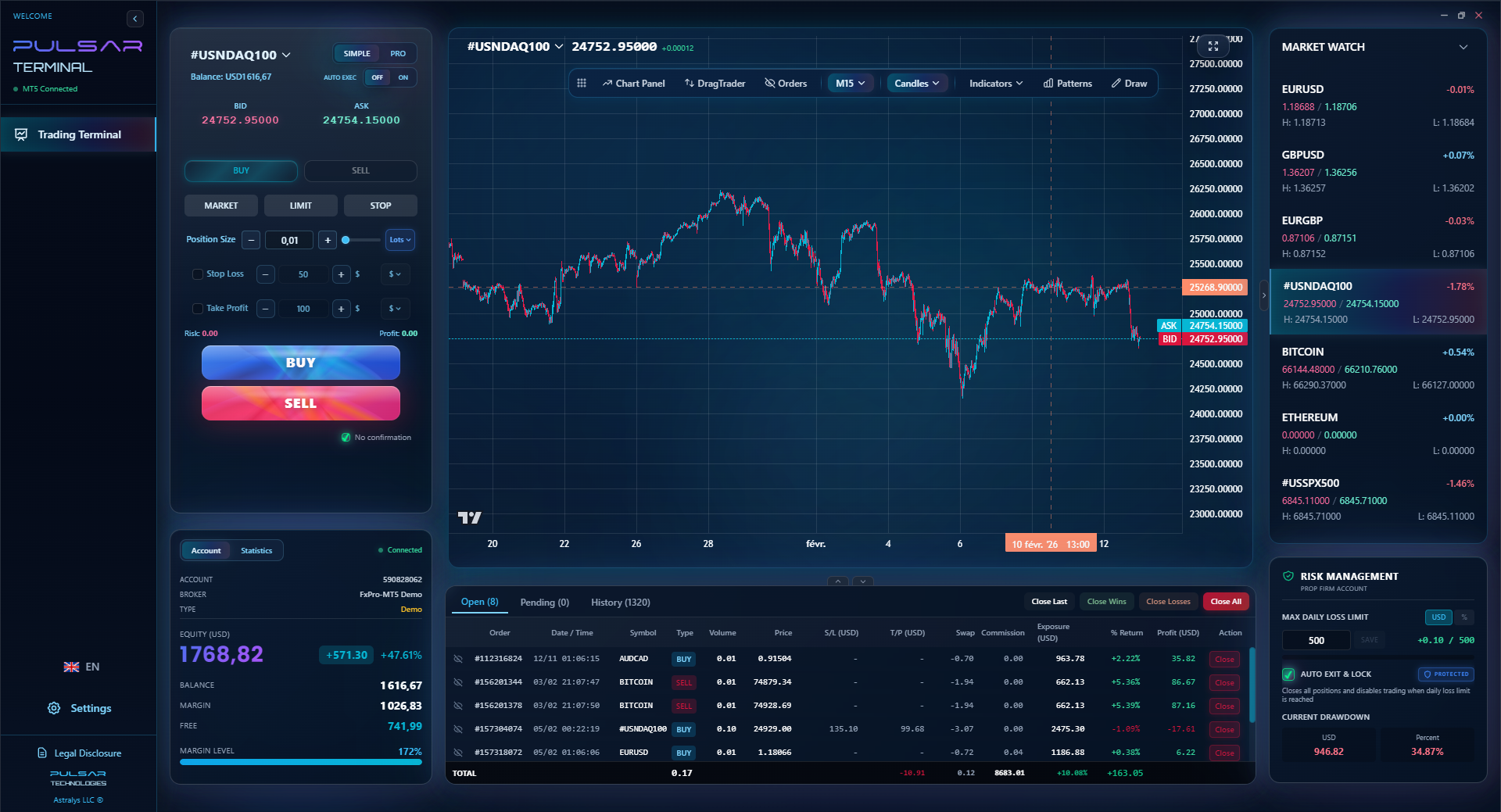
Executing a multi-target trade plan from your chart analysis is seamless with tools like Pulsar Terminal, which lets you drag and drop orders with partial closures directly on your MT5 chart.
Pulsar Terminal
เครื่องมือ MT5 ครบวงจร: ลากวางคำสั่ง, multi-TP/SL, trailing stop, grid trading, Volume Profile และการป้องกัน prop firm ใช้งานโดยเทรดเดอร์กว่า 1,000 คนทุกวัน
“Analysis is useless without a plan.”
Let's be brutally honest. My learning curve was funded by losses. Here’s where I went wrong analysing charts.
Overcomplicating Everything: I used to think more lines and indicators meant I was working harder. It just meant I was confused. Now, a clean chart is a productive chart. Price, two EMAs, horizontal lines at key levels. That's often it.
Ignoring the Spread: Analysing a 5-minute chart for a 5-pip scalp is pointless if the spread is 3 pips. Your analysis must account for transaction costs. This is why I prefer brokers with tight spreads like IC Markets or Pepperstone for short-term work.
Analysis Paralysis: I'd find a good setup, then switch to a lower timeframe looking for a "better" entry, then miss the move entirely. Decide on your entry timeframe and stick to it. If the signal is there, take it. If not, wait.
Not Knowing My Style: I was analysing daily charts but trying to execute a scalping strategy. The timeframes were in conflict. My analysis now matches my personality: I'm a swing trader. I analyse on the daily and 4-hour, and execute on the 1-hour. It’s consistent. Find your rhythm.
The worst mistake? Not having a stop-loss. A perfect analysis can still be wrong. A stop-loss is your admission fee to the trade. Without it, you're not trading, you're gambling. I’ve seen too many guys get a margin call on a single trade because they "believed" in their analysis too much.
“Your stop-loss is your admission fee to the trade. Without it, you're not trading, you're gambling.”
You can't just copy my lines. You have to learn to see the market for yourself. Here's how to practice.
Chart Review, Not Chart Prediction: Spend 30 minutes each day with a blank chart. Go bar by bar, left to right. At each point, ask: "What would my bias be here? Where is support? Resistance? What's the trend?" Then see what happened next. This builds pattern recognition without risking a kobo.
Keep a Trading Journal: This is non-negotiable. For every trade, screenshot your chart analysis before you enter. Write down your reasoning: "Selling at resistance 1.0850, bearish divergence on MACD, 4-hour trend down." Later, review what happened. Was your analysis correct? Did price respect your levels? This feedback loop is how you improve.
Start with the Majors: Don't jump into exotic pairs. Start with EUR/USD. It's liquid, the spreads are tight, and there's a mountain of analysis available. Get good at analysing a EUR/USD chart first. The principles apply everywhere.
Finally, be patient. You won't see everything at once. I've been doing this for over a decade, and I still see new things. The market is a living thing. Your analysis is just your way of trying to understand its mood. Some days it's clear. Some days it's chaotic. Your job is to know the difference and act, or not act, accordingly.
💡 เคล็ดลับจาก Winston
Spend twice as much time analysing your losing trades as your winners. The losses teach you where your chart reading is flawed. The wins often just teach you luck.
FAQ
Q1What's the single most important thing to look at on a forex chart?
Price and its history. Before any indicator, identify the recent highs and lows (support/resistance) and the sequence of those highs and lows (the trend). Everything else is commentary on that basic story.
Q2How many indicators should a beginner Nigerian trader use?
Start with one, maybe two. A moving average (like the 50 EMA) to define trend and dynamic support/resistance, and the RSI to gauge momentum. More than that creates confusion and conflicting signals. Master reading price action first.
Q3How do I analyse a forex chart when trading Naira pairs like USD/NGN?
You must layer fundamental analysis on top. First, check the calendar for CBN events and note the oil price. Then do your technical analysis. A perfect technical buy signal on USD/NGN is worthless if the CBN is about to hike rates to defend the Naira. Context is everything.
Q4What's a good timeframe to start analysing for a beginner?
Start with the 4-hour and daily charts. They have less noise than 1-minute or 5-minute charts, and the trends are more reliable. It forces you to think about swing trading moves of 50-200 pips instead of stressful 5-pip scalps.
Q5How do I know if my chart analysis is wrong?
The market tells you. If price decisively breaks through a key support or resistance level you identified, and closes beyond it on your chosen timeframe, your analysis for that level is invalid. Don't argue. Accept it, exit if necessary, and re-assess.
Q6Is technical analysis enough for forex trading in Nigeria?
No, not for pairs involving the Naira, and not fully for majors either. Nigerian markets are heavily influenced by policy and external shocks (oil). Use technicals to find your entry and exit points, but use fundamentals to determine your overall bias and to know when to stay out of the market entirely.
บทเรียนจาก Prof. Winston
สรุปสาระสำคัญ:
- ✓Always define trend & key levels before looking at indicators.
- ✓For Naira pairs, check CBN & oil news before your chart.
- ✓Risk a fixed % per trade (I use 1%). No exceptions.
- ✓A clean chart with 3-4 tools beats a messy one with 12.
บทความนี้มีประโยชน์แค่ไหน?
คลิกดาวเพื่อให้คะแนน
ข้อมูลเชิงลึกการเทรดรายสัปดาห์
การวิเคราะห์และกลยุทธ์รายสัปดาห์ฟรี ไม่มีสแปม
เกี่ยวกับผู้เขียน
Olumide Adeyemi
ผู้บุกเบิกการเทรดในแอฟริกาตะวันตก
หนึ่งในนักการศึกษาฟอเร็กซ์ที่กระตือรือร้นที่สุดของไนจีเรีย 8 ปีประสบการณ์เทรดจากลากอส เชี่ยวชาญกลยุทธ์ทุนต่ำและความท้าทาย prop firm สำหรับเทรดเดอร์ในแอฟริกา
ความคิดเห็น
คำเตือนความเสี่ยง
การซื้อขายตราสารทางการเงินมีความเสี่ยงสูงและอาจไม่เหมาะสำหรับนักลงทุนทุกคน ผลการดำเนินงานในอดีตไม่ได้รับประกันผลลัพธ์ในอนาคต เนื้อหานี้มีวัตถุประสงค์เพื่อการศึกษาเท่านั้นและไม่ควรถือเป็นคำแนะนำในการลงทุน โปรดทำการวิจัยของคุณเองก่อนการซื้อขาย
คุณอาจชอบสิ่งนี้

Cara Trading Forex Sukses: 7 Prinsip dari Trader Profesional
Cara trading forex sukses dengan 7 prinsip trader pro: manajemen modal, disiplin, journal trading, backtest. Data nyata, bukan janji profit palsu.
Jam Trading Forex Terbaik untuk Trader Indonesia: Panduan Lengkap dengan Tabel Waktu
Panduan jam trading forex untuk trader Indonesia. Tabel 4 sesi dunia, jam emas 20:00-00:00, sesi mana yang harus dihindari. Data akurat + tips dari trader berpengalaman.
Top 5 Sàn Forex Uy Tín Nhất 2026: Review Jujur dari Trader Indonesia
Top 5 sàn forex uy tín 2026 untuk trader Indonesia. Review jujur: spread, deposit, withdraw, dukungan lokal. Exness, XM, IC Markets & lebih.
รับ Pulsar Terminal
เครื่องคำนวณทั้งหมดนี้ถูกสร้างไว้ใน Pulsar Terminal พร้อมข้อมูลเรียลไทม์จากบัญชี MT5 ของคุณ
รับ Pulsar Terminal