


You've probably seen those clean diagonal lines on trading charts and wondered, 'How do I actually draw a trend line in forex without messing it up?' I get it.

Olumide Adeyemi
ผู้บุกเบิกการเทรดในแอฟริกาตะวันตก ·  Nigeria
☕ 10 นาทีอ่าน
สิ่งที่คุณจะได้เรียนรู้:
- 1What Is a Trend Line (And Why It's Your Best Friend)
- 2The Step-by-Step: How to Draw a Trend Line in Forex
- 3Mistakes I See Every Day (And Made Myself)
- 4Turning Lines Into Profits: Your Trading Plan
- 5The Nigerian Context: Brokers, Taxes, and Platforms
- 6Don't Go It Alone: Combining With Other Tools
- 7Next Level: Channels and the Fan Principle
You've probably seen those clean diagonal lines on trading charts and wondered, 'How do I actually draw a trend line in forex without messing it up?' I get it. When I started trading back in 2014 from Lagos, I'd connect any two random points and call it a trend line. Spoiler: that cost me money. The truth is, drawing a proper trend line is less about art and more about a few simple, repeatable rules. Let me walk you through exactly how to do it, what mistakes to avoid, and how this one skill can seriously improve your trading here in Nigeria.
Think of a trend line as a visual representation of the market's current mood. It's a straight line you draw on your chart that connects important price points - either the highs in a downtrend or the lows in an uptrend. Its main job is to show you where the price is likely to find support (a floor) or resistance (a ceiling) as it moves.
For us trading in Nigeria, with all the market volatility we see, a good trend line acts like a guardrail. It helps you answer the most basic question: should I be looking to buy or sell right now? If price is bouncing cleanly off an upward trend line, that's the market telling you buyers are still in control. If it keeps slamming into a downward line and falling back, sellers are running the show.
I learned this the hard way trading Gold (XAU/USD) during a particularly wild session. I was trying to pick tops and bottoms without any reference. Once I started properly drawing the main trend line on the 4-hour chart, my entries got way cleaner. It didn't make me right every time, but it gave my trades a logical place to start. You can learn more about trading Gold specifically in our XAU/USD guide.

Pro Tip: Don't overcomplicate it. A trend line's strength comes from its simplicity. The more times price respects it, the more important it becomes to other traders watching the same chart. That collective attention is what makes it work.

💡 เคล็ดลับจาก Winston
A trend line is a hypothesis, not a prophecy. Trade the break of the line with the same conviction you trade the bounce off it.
Let's get practical. Here’s the exact process I use on my MT5 charts every day.
1. Spot the Swing Points
First, you need to identify at least two significant swing lows (for an uptrend) or swing highs (for a downtrend). A 'swing' is a clear point where the price reversed direction. Don't use tiny little wiggles on a 1-minute chart. Zoom out to the 1-hour or 4-hour timeframe to find the obvious peaks and troughs.
2. Connect the Dots (The Right Way)
For an Uptrend: Take your drawing tool and connect the lowest points of two consecutive swing lows. The line should be below the current price action, acting as a dynamic support. For a Downtrend: Connect the highest points of two consecutive swing highs. The line should be above the price, acting as dynamic resistance.
The key is to have the line touch as many of these extreme points as possible. Should you use the wicks or the bodies of the candles? Honestly, I go with the wicks (the high and low shadows) because they represent the absolute extremes of buying and selling pressure. Just be consistent.
3. Wait for the Third Touch
Two points make a line, but three points make a valid trend line. That third touch, where price approaches the line and reverses again, is your confirmation. It tells you other traders are seeing the same level and acting on it. This is where you start paying real attention for a potential trade setup.

Warning: Never force a trend line. If you're bending and twisting it to make it fit three random points, it's wrong. The market isn't wrong - your line is. A true trend line will look obvious once it's drawn.
“Two points make a line, but three points make a valid trend line.”
We all mess this up at the beginning. Here are the big ones to avoid.
Drawing on Too Low a Timeframe: A trend line on a 5-minute chart is barely a trend. It's noise. The higher the timeframe, the stronger the signal. A daily chart trend line is respected by big banks and institutions. A 15-minute line is just for scalping and needs to be treated with less trust. I once lost about ₦40,000 trying to hold a long position because a trend line on the 30-minute chart broke, ignoring the fact the daily chart trend was still perfectly intact.
Ignoring the Angle: A trend line that's too steep (almost vertical) will break almost immediately. It's unsustainable. A line that's too flat isn't really showing a trend at all. The sweet spot is a moderate, consistent angle. If you have to redraw it every other day, it's not a useful trend line.
Treating It Like a Solid Wall: A trend line isn't a magic forcefield. Price will often pierce it slightly, especially on lower timeframes, before snapping back. This is called a 'false break' or 'wick through.' Don't panic and close your trade the millisecond a candle's wick pokes through. Wait for a full candle close beyond the line on your chosen timeframe. This patience alone saved me from several premature exits.
Forgetting About the Spread: When you're placing an order near a trend line, remember your broker's spread. If EUR/USD spread is 1.2 pips at Exness or IC Markets, and you place a buy order right on the trend line, your entry price is actually 1.2 pips above it. Give yourself a tiny buffer.
Okay, you've drawn a beautiful line. Now what? Here’s how to build a trade around it.
Entry: In an uptrend, look for price to pull back and touch your trend line. Watch for a bullish reversal candlestick pattern (like a hammer or engulfing bar) right at the line. That's your potential buy signal. For a downtrend, you're looking for price to rally up to the resistance line and show bearish signs.
Stop Loss: This is non-negotiable. Your stop loss goes just below an uptrend line (or just above a downtrend line). The logic is simple: if price breaks cleanly through your trend line, your trade idea is invalid. The exact distance depends on volatility, but it should be far enough away to avoid normal market noise.
Take Profit: You can use the trend line to trail your stop higher as the trend continues. Or, look for the next obvious horizontal resistance (in an uptrend) or support (in a downtrend) level to take profit. A classic method is to aim for a risk-to-reward ratio of at least 1:2. Always use a position size calculator to figure out your lot size based on where you place that stop.
The Breakout Trade: Sometimes, the play isn't to trade the bounce, but the break. When a strong, multi-touch trend line finally gives way with conviction, it can signal a trend reversal. Wait for a strong close beyond the line, then consider a trade in the new direction. Just be ready for false breaks - they happen all the time.

Example: Let's say you're trading GBP/USD. You buy at 1.2650 on a trend line touch. You place your stop loss at 1.2620 (30 pips risk). Your first take profit target could be at 1.2710 (60 pips reward), giving you a clean 1:2 risk-reward ratio. The remaining half of your position could run with a trailing stop.
💡 เคล็ดลับจาก Winston
The most profitable trend lines are often the ones everyone can see. Don't search for secret lines; trade the obvious ones on the higher timeframes.
“Never force a trend line. If you're bending it to fit, the market isn't wrong - your line is.”
Trading from Nigeria comes with its own specifics you can't ignore, especially with the new SEC rules.
Brokers & Platforms: You need a broker with reliable platforms for drawing tools. Most of us use MetaTrader 4 or 5. Brokers like XM, Pepperstone, and Exness are popular here for good reason - they offer MT4/5, accept Naira deposits, and have local payment methods. Their charting tools are where you'll be drawing all these lines. Check their spreads on the pairs you trade; a tight spread on EUR/USD means your trend line entries and exits are more precise.
The 10% Tax Question: Yes, profits from forex trading are subject to a 10% Capital Gains Tax by the FIRS. This isn't a broker fee; it's your responsibility to declare and pay. Keep a simple spreadsheet of your withdrawals from your trading account. When you win, factor this in. It affects your net profit.
use & Risk: High use (like 1:500 or 1:1000) can be tempting, but it's a double-edged sword when using trend lines. A small, normal pullback to your trend line can cause a bigger drawdown and potentially trigger a margin call if you're over-leveraged. Use use to control position size, not to amplify it recklessly.
Regulation Update: With the new Investments and Securities Act (ISA) 2025, the SEC is now empowered to regulate platforms. This is good for consumer protection long-term. For now, most Nigerian traders still use internationally regulated brokers, but it's wise to keep an eye on how this local regulation develops.
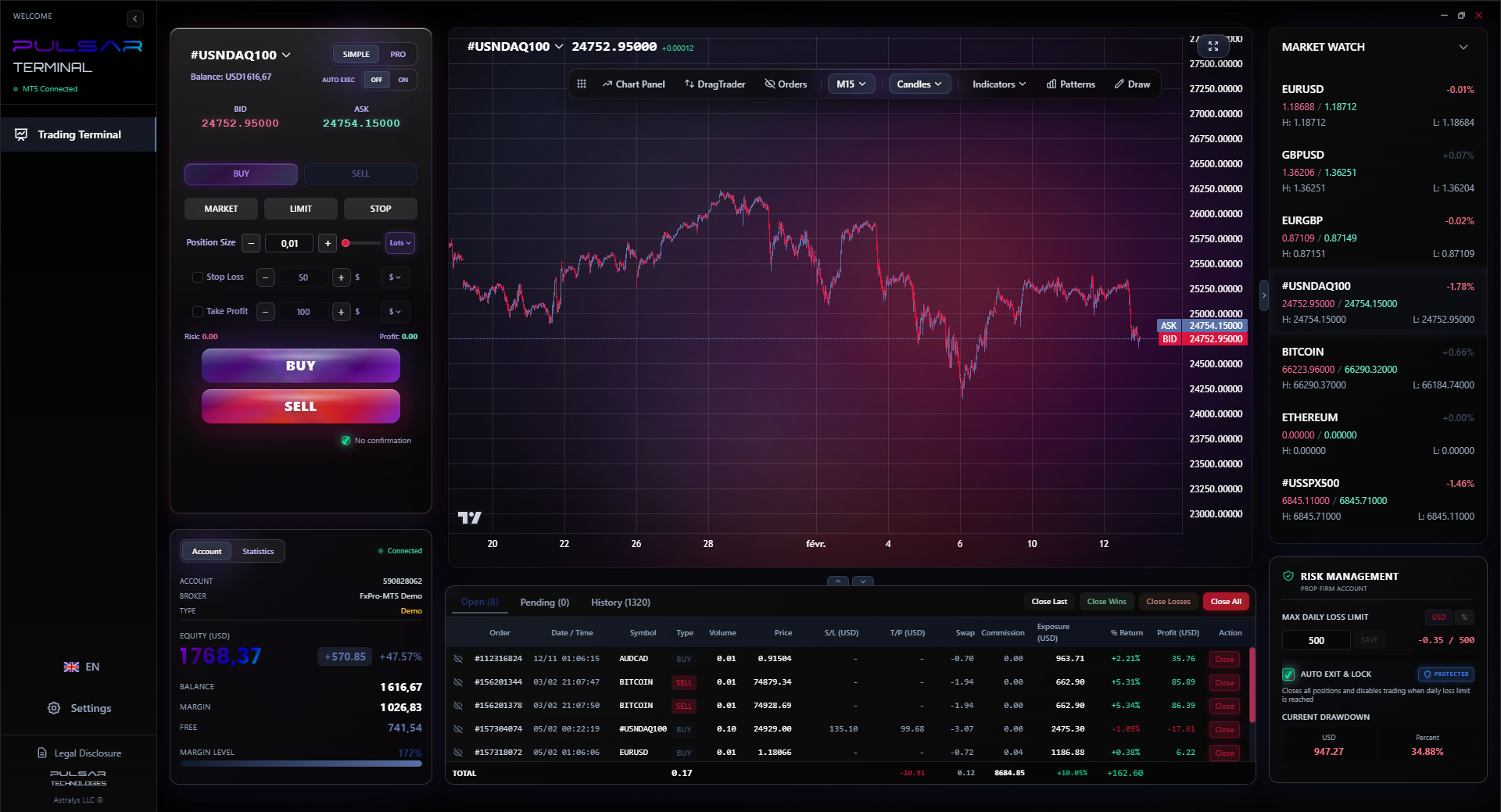
Drawing precise trend lines and managing trades around them is easier with tools that offer advanced charting and automated order management directly on your MT5 platform.
Pulsar Terminal
เครื่องมือ MT5 ครบวงจร: ลากวางคำสั่ง, multi-TP/SL, trailing stop, grid trading, Volume Profile และการป้องกัน prop firm ใช้งานโดยเทรดเดอร์กว่า 1,000 คนทุกวัน
A trend line in isolation is good. A trend line with confluence is powerful. Here’s what I pair it with.
Horizontal Support/Resistance: When a rising trend line intersects with a major horizontal price level, that zone becomes a super-strong area of interest. The market is more likely to react there.
The RSI Indicator: If price touches your uptrend line and the RSI is also dipping into oversold territory (near 30), that's a stronger buy signal than just the trend line alone. It shows momentum is aligning with structure.
The MACD Indicator: I like to see the MACD histogram losing bearish momentum as price approaches an uptrend line, or even starting to turn up. This can give you an early heads-up that the bounce might be coming.
Volume: On a breakout, I want to see higher-than-average volume. It shows the move has conviction. A breakout on low volume is suspect and often fails, pushing price back into the trend channel.
My biggest win last quarter came from this combo. On USD/JPY, price was in a clear daily uptrend. It pulled back right to the trend line, which also aligned with a previous swing high that had turned into support. The RSI was at 35. That was a triple-confluence buy signal. I entered, placed my stop below all of it, and rode it for over 200 pips. The trend line showed me the road, and the other tools gave me the green light.
💡 เคล็ดลับจาก Winston
If your trend line looks messy or confusing on a candle chart, switch to a line or bar chart. Sometimes simplicity reveals the true structure.
“A trend line on a 5-minute chart is noise. A trend line on a daily chart is an institution's roadmap.”
Once you're comfortable with a single line, you can expand the concept.
Drawing a Channel: A trend channel uses two parallel lines. You draw your main trend line, then draw a parallel line that connects the swing highs in an uptrend (or swing lows in a downtrend). This creates a channel where price oscillates between support and resistance. It’s fantastic for swing trading, as you can look for sells at the top of the channel and buys at the bottom - as long as the main trend is intact.
The Fan Principle: This is a great way to spot a slowing trend. After a strong trend line breaks, you can often draw a new, shallower trend line from the same origin point. If that second line breaks, you draw a third, even shallower one. These three radiating lines look like a fan. The breaking of each successive fan line indicates the trend is losing momentum and a larger correction or reversal is becoming more likely. It helped me avoid catching a falling knife in the Naira pairs more than once.
Remember, these are advanced concepts. Get rock-solid at drawing and trading off a single, clean trend line first. That foundation is 80% of the battle.
FAQ
Q1Should I draw trend lines on the candle wick or the candle body?
Most professional traders I know, including myself, use the wicks (the highs and lows). The wicks show the absolute extremes of price rejection, which is what a trend line is meant to capture. The key is to be consistent. Pick one method and stick with it for all your lines.
Q2What's the best timeframe to draw trend lines for a beginner in Nigeria?
Start with the 4-hour and daily charts. Trends on these timeframes are more reliable and less noisy than on the 5-minute or 1-hour charts. They're also less stressful to watch. You can use the daily chart to find the major trend, then the 4-hour to fine-tune your entry.
Q3How many times must price touch a trend line for it to be valid?
You need a minimum of two touches to draw the line, but it's not considered 'valid' or strong until you get a third clean touch and bounce. The more touches over a longer period, the more significant the trend line becomes.
Q4My broker's platform drawing tools are basic. What can I do?
Many Nigerian traders use the standard MT4/5 tools, which are sufficient. If you want more advanced features like automatic pattern recognition or more precise drawing tools, consider a premium charting software or a companion app that connects to your MT5. The core principles remain the same regardless of the tool.
Q5Do I need to pay tax on profits from trend line trading in Nigeria?
Yes. The Nigerian Federal Inland Revenue Service (FIRS) considers forex trading profits as capital gains, subject to a 10% tax. You are responsible for keeping records of your net profits (withdrawals minus deposits) and declaring this income.
Q6Can I use trend lines for crypto trading as well?
Absolutely. The principles of supply, demand, and market psychology are the same. Trend lines work on Bitcoin, Ethereum, and other crypto charts. Just be aware that crypto markets are often more volatile, so expect more frequent false breaks and steeper angles.
Q7What's the biggest mistake when using trend lines?
Redrawing the line every time price moves. If you're constantly adjusting your trend line to fit new price action, you're not following the market - you're chasing it. Draw it, confirm it with three touches, and then only redraw it if there's a clear, decisive break and a new trend establishes itself.
บทเรียนจาก Prof. Winston
สรุปสาระสำคัญ:
- ✓Always wait for the third touch for confirmation.
- ✓Place your stop loss just beyond the trend line, not at it.
- ✓Prioritize trend lines on the 4-hour and daily charts.
- ✓Combine with horizontal levels or RSI for stronger signals.
บทความนี้มีประโยชน์แค่ไหน?
คลิกดาวเพื่อให้คะแนน
ข้อมูลเชิงลึกการเทรดรายสัปดาห์
การวิเคราะห์และกลยุทธ์รายสัปดาห์ฟรี ไม่มีสแปม
เกี่ยวกับผู้เขียน
Olumide Adeyemi
ผู้บุกเบิกการเทรดในแอฟริกาตะวันตก
หนึ่งในนักการศึกษาฟอเร็กซ์ที่กระตือรือร้นที่สุดของไนจีเรีย 8 ปีประสบการณ์เทรดจากลากอส เชี่ยวชาญกลยุทธ์ทุนต่ำและความท้าทาย prop firm สำหรับเทรดเดอร์ในแอฟริกา
ความคิดเห็น
คำเตือนความเสี่ยง
การซื้อขายตราสารทางการเงินมีความเสี่ยงสูงและอาจไม่เหมาะสำหรับนักลงทุนทุกคน ผลการดำเนินงานในอดีตไม่ได้รับประกันผลลัพธ์ในอนาคต เนื้อหานี้มีวัตถุประสงค์เพื่อการศึกษาเท่านั้นและไม่ควรถือเป็นคำแนะนำในการลงทุน โปรดทำการวิจัยของคุณเองก่อนการซื้อขาย
คุณอาจชอบสิ่งนี้

Cara Trading Forex Sukses: 7 Prinsip dari Trader Profesional
Cara trading forex sukses dengan 7 prinsip trader pro: manajemen modal, disiplin, journal trading, backtest. Data nyata, bukan janji profit palsu.
Jam Trading Forex Terbaik untuk Trader Indonesia: Panduan Lengkap dengan Tabel Waktu
Panduan jam trading forex untuk trader Indonesia. Tabel 4 sesi dunia, jam emas 20:00-00:00, sesi mana yang harus dihindari. Data akurat + tips dari trader berpengalaman.
Top 5 Sàn Forex Uy Tín Nhất 2026: Review Jujur dari Trader Indonesia
Top 5 sàn forex uy tín 2026 untuk trader Indonesia. Review jujur: spread, deposit, withdraw, dukungan lokal. Exness, XM, IC Markets & lebih.
รับ Pulsar Terminal
เครื่องคำนวณทั้งหมดนี้ถูกสร้างไว้ใน Pulsar Terminal พร้อมข้อมูลเรียลไทม์จากบัญชี MT5 ของคุณ
รับ Pulsar Terminal