


Most Indian traders I meet think tax is something you figure out after you're profitable.

Rajesh Sharma
นักวิเคราะห์ฟอเร็กซ์อาวุโส ·  India
India
☕ 11 นาทีอ่าน
สิ่งที่คุณจะได้เรียนรู้:
Most Indian traders I meet think tax is something you figure out after you're profitable. That's a ₹50,000 mistake I made myself. The truth is, the rules around income tax for forex trading in India are a minefield of legal grey areas, sudden audits, and classifications that can wipe out your gains. This isn't about theory; it's about keeping the money you make. I'll walk you through exactly how to classify your trades, what you can deduct, and the very real risks of pretending the RBI doesn't exist.
Let's get this out of the way first, because it changes everything about your tax situation. You've probably seen ads for platforms offering EUR/USD or GBP/JPY with huge use. Here's the brutal truth: for an Indian resident, trading those pairs with an unregulated offshore broker is prohibited under FEMA. The RBI's rules are clear. The only fully legal path is trading INR-based pairs (USD/INR, EUR/INR) or specific cross-currency futures (like EUR-USD) on SEBI-regulated exchanges like the NSE.
I learned this the hard way early on. Back in 2018, I was using a popular international broker (similar to IC Markets or Pepperstone) to trade GBP/USD. I was making money, and I felt clever 'circumventing' the system. Then I tried to withdraw a larger sum. The bank asked for source of funds. Explaining 'forex profits from an offshore broker' to a bank manager is a special kind of stress. The transaction was held up for weeks. That's when I realized the legal risk wasn't just theoretical - it was a blocker to accessing my own capital.

Warning: Trading non-INR pairs offshore doesn't make your profits tax-free. It makes them illegal income, which is still fully taxable. The taxman doesn't care if you broke RBI rules; he still wants his share.
So, you have two paths: 1) The legal, SEBI-regulated path for INR pairs. 2) The grey-area, offshore path for global majors. Your choice here fundamentally dictates your risk profile, banking relationships, and how you approach your income tax forex trading India filings. Most traders, including me for a long time, choose door number two and just hope they don't get noticed.
This is the core of your tax liability. The Indian tax department looks at your activity to decide if you're running a business or making an investment. Guess which one they almost always pick for active traders?
Business Income (The Most Common Scenario)
If you trade frequently, use use, and it looks like a professional operation, your profits will be taxed as Business Income. This means your net profit (after deducting expenses) gets added to your total income and is taxed at your slab rate. For the 2024-25 financial year, under the new regime, that means:
- 0% up to ₹3 lakh
- 5% for ₹3-6 lakh
- 10% for ₹6-9 lakh
- 15% for ₹9-12 lakh
- 20% for ₹12-15 lakh
- 30% above ₹15 lakh
Plus a 4% Health and Education Cess on the tax amount.
Let me give you a real example. In FY 2023-24, my net trading profit from all activities (including some scalping on indices) was ₹8.2 lakh. After deducting allowable expenses (brokerage, data feeds, a portion of home office costs), my taxable business income was ₹7.4 lakh. Under my slab, that put me in the 20% bracket for a portion of it. The tax bill was substantial - a stark reminder that profits on screen aren't profits in your pocket.
Capital Gains (The Rare Exception)
This only applies if you trade very occasionally, like buying a USD/INR futures contract and holding it for months as a pure currency hedge. Short-term gains (held less than 36 months) are taxed at 15%. Long-term gains (over 36 months) are taxed at 10% above ₹1 lakh. I've never met a retail trader who legitimately qualified for this. The tax officer will see your trading frequency and immediately classify it as business.

Pro Tip: Keep a detailed trading journal. Note your strategy, time spent, and frequency. If you ever get audited, you need to prove your trading is systematic, not a hobby. This documentation is your first line of defense in justifying your expense claims.

💡 เคล็ดลับจาก Winston
Your first profitable year? Set aside 30% of those profits immediately in a separate account. The tax bill always comes, and it's always bigger than you think.
“The legality of your trading affects your banking access and regulatory risk, not your tax liability. The taxman always wants his share.”
Here's the silver lining if you're classified as a business: you can deduct expenses. This is how you legally reduce your taxable income. Most traders miss out on this.
You CAN deduct:
- Brokerage commissions and fees (the 18% GST on these fees is also deductible as input tax credit if you're registered, but that's complex).
- Data subscription costs (Bloomberg Terminal, TradingView pro, etc.).
- Internet and phone bills (a reasonable percentage used for trading).
- Cost of trading software, charting tools, or educational courses directly related to your activity.
- A portion of rent and electricity if you have a dedicated home office.
- Interest paid on funds borrowed for trading.
You CANNOT deduct:
- Personal living expenses.
- Losses from other speculative activities (unless they're also speculative business losses).
- Fines or penalties paid to brokers or exchanges.
I use a simple rule: I allocate 40% of my internet bill and 20% of my electricity/rent to trading, as my office is a spare room. For a ₹15,000 monthly rent, that's ₹3,000 per month or ₹36,000 per year I can deduct. It adds up. Keep every receipt, every invoice. A spreadsheet isn't enough; have scanned copies in a cloud folder.
Remember the tax audit threshold? If your turnover exceeds ₹1 crore, an audit is mandatory. 'Turnover' here is the absolute sum of all your trades - every win and every loss added together as positive numbers. A high-frequency trader can hit this limit faster than they think. My advice? Work with a CA who understands trading from day one.
Forget just income tax. The government gets its cut long before you see a profit, especially on the exchanges. The most significant change hitting traders from April 1, 2026, is the hike in Securities Transaction Tax (STT). This is a direct cost on every trade you make on Indian exchanges like NSE.
Here’s the damage (Futures & Options on Currency Derivatives):
| Transaction Type | Old STT Rate (Pre-April 2026) | New STT Rate (From April 2026) |
|---|---|---|
| Futures (Sell-side) | 0.02% of turnover | 0.05% of turnover |
| Options (Premium) | 0.10% of premium | 0.15% of premium |
| Options (Exercise) | 0.125% of settlement price | 0.15% of settlement price |
Let's make this real. Suppose you sell one lot of USD/INR futures worth ₹75 lakh (turnover).
- Before 2026: STT = 0.02% of ₹75,00,000 = ₹1,500
- From 2026: STT = 0.05% of ₹75,00,000 = ₹3,750
That's an extra ₹2,250 gone, per trade, before you've even covered the spread or brokerage. For active traders, this will murder your edge. It forces you to either trade larger timeframes (like swing trading) to absorb the cost, or become exponentially more precise with entries. My old scalping strategies on Nifty became unviable overnight with similar hikes years ago. I had to completely adapt.
Then there's GST. An 18% GST is levied on the brokerage fee you pay. So if your broker charges ₹100 per order, you actually pay ₹118. This GST you pay (on input services) can sometimes be claimed as a credit if you're registered under GST, but for most individual traders, it's just a sunk cost.
These transaction taxes are why your position size calculator needs to include more than just stop-loss distance. Your break-even point just moved significantly higher.
💡 เคล็ดลับจาก Winston
Treat your tax CA's fee as your most important trading cost. A good one saves you multiples of their charge in avoided penalties and optimized deductions.
“A losing year isn't just a financial hit; it's a tax asset for the future. But only if you file your return on time.”
This is the million-rupee question no one wants to answer clearly. You're using an international broker like XM or Exness to trade EUR/USD. You make a profit. How do you handle income tax forex trading India rules?
Myth: "The money is offshore, so it's tax-free." Reality: Indian tax law taxes you on your global income, regardless of where it's earned or where the bank account is. If you're a resident in India, that profit from your offshore MT5 account is 100% taxable in India.
The practical problem is proof and repatriation. You need to convert your trading statements into INR values for each trade. Use the RBI's FEDAI rate for the date of each transaction - it's a pain. When you bring the money back, your bank will ask for the source. You'll need to show your contract notes, bank statements from the offshore account, and your tax returns where you've already declared and paid tax on that income.
I got audited for the 2021-22 year. The officer saw foreign remittances under the LRS (Liberalised Remittance Scheme) category for 'investment'. He asked for proof of the source. I had to provide two years of trading statements from my offshore broker, all my tax filings showing the declared income, and a written explanation of my activity. It was invasive and stressful. They eventually accepted it, but it took three months of back-and-forth.
Warning: If you trade crypto pairs (like getting paid out in USDT) on some offshore platforms, that falls under the 30% flat tax for Virtual Digital Assets (VDAs). No deductions, no set-off of losses. It's the harshest tax regime of all.
The cleanest, safest way is to declare the income as 'Income from Other Sources' or 'Speculative Business Income' and pay the slab rate. Keep immaculate, chronologically ordered records. Assume you will have to explain every rupee.
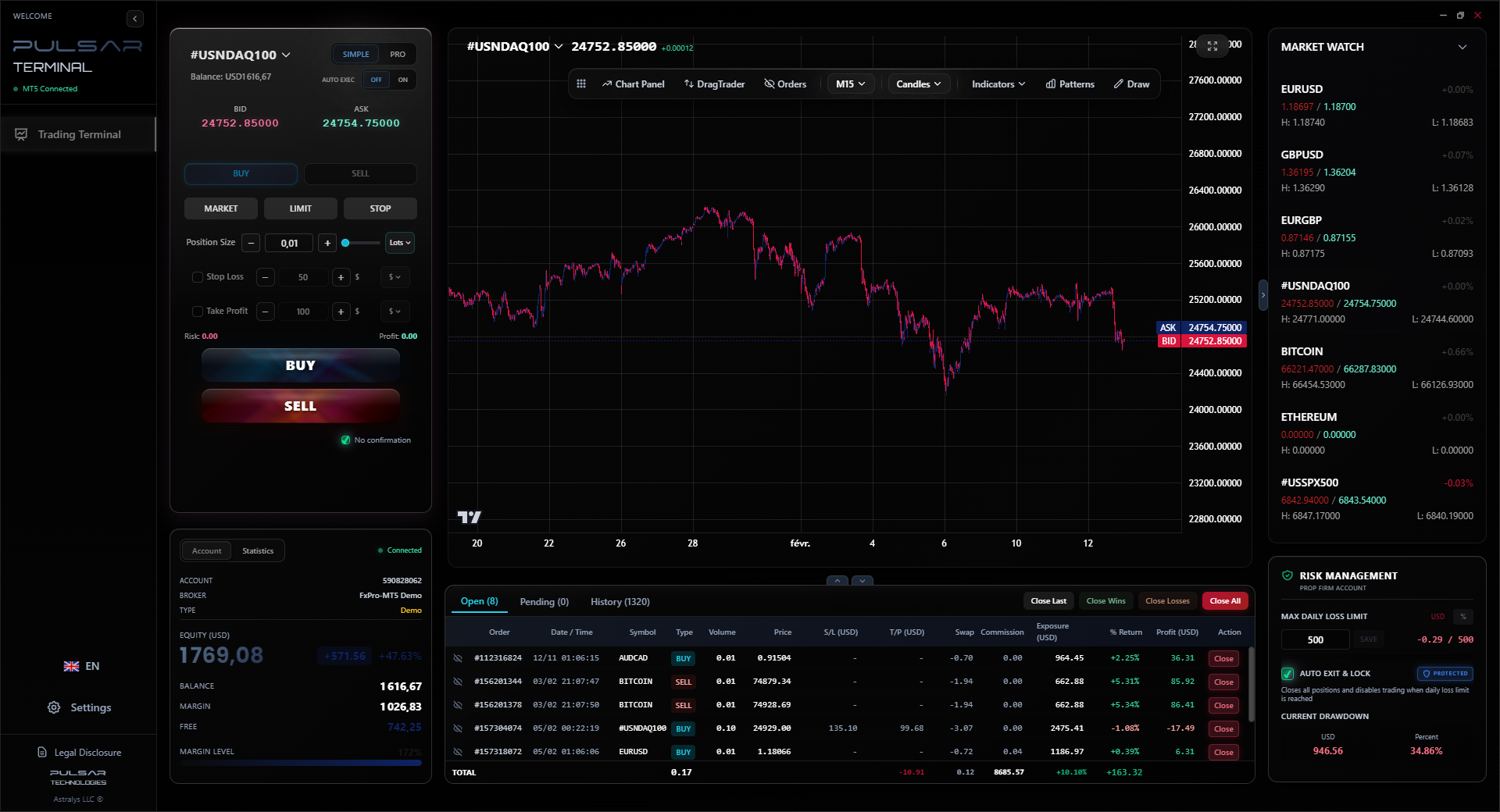
Managing dozens of trades across offshore and domestic accounts for tax reporting is chaos. Pulsar Terminal's unified trade journal and reporting tools can automatically log every entry, exit, and P&L in your base currency, creating the clean audit trail you desperately need.
Pulsar Terminal
เครื่องมือ MT5 ครบวงจร: ลากวางคำสั่ง, multi-TP/SL, trailing stop, grid trading, Volume Profile และการป้องกัน prop firm ใช้งานโดยเทรดเดอร์กว่า 1,000 คนทุกวัน
Losing years are part of the game. The tax treatment of losses is one of the few bits of good news.
If your trading is classified as a non-speculative business (this is a technical distinction, but trading equity derivatives is often deemed non-speculative, while forex can be speculative), you can carry forward losses for 8 years. You can set them off against any business income in those future years.
If it's classified as a speculative business (which pure forex trading often is), the rules are tighter. Speculative losses can only be set off against speculative profits in the same year. Any remaining loss can be carried forward for 4 years, but again, only to be set off against future speculative profits.
Here's a practical scenario from my books:
- FY 2022-23: Net speculative loss from forex = ₹2,00,000. I had no other speculative income that year. I couldn't set it off against my salary. I carried forward the entire ₹2 lakh.
- FY 2023-24: Net speculative profit from forex = ₹4,50,000. I set off the ₹2 lakh brought-forward loss against this. My taxable speculative business income became ₹2,50,000.
This is a powerful tool. It means a bad year isn't just a financial hit; it's a tax asset for the future. You must file your return on time to be eligible to carry forward losses. Missing the deadline (usually July 31st) burns this benefit. I set a calendar reminder for July 1st every year: 'Gather P&L. Contact CA.'
💡 เคล็ดลับจาก Winston
If you trade offshore, keep a separate, simple spreadsheet logging every withdrawal you make to India. Date, amount in FX, INR equivalent, and the RBI reference rate for that day. This log is your audit shield.
“The STT hike from April 2026 isn't a tweak; it's a direct attack on the edge of retail futures traders.”
Feeling overwhelmed? Don't be. Systemize this like you would a trading strategy.
- Choose Your Path: Decide if you'll trade legally on Indian exchanges or accept the risks of offshore trading. This is your foundational tax and legal decision.
- Open a Separate Bank Account: Use one dedicated account for all trading inflows and outflows. No mixing with grocery money. This makes reconciliation trivial.
- Record Every Trade: Use a journal. I use a simple Google Sheet with columns for Date, Pair, Buy/Sell, Lot Size, Entry, Exit, P&L (in INR), and Broker. At the end of the month, I have my turnover and net profit ready.
- Track Every Expense: That ₹5000 paid for a trading course? Receipt in the folder. Monthly brokerage invoice? Saved as PDF. I even track the percentage of my laptop's depreciation used for trading.
- Hire a Specialized CA: Not your family CA who does salaried returns. Find someone who has other traders as clients. Their fee is a deductible business expense. They'll know about tax audit triggers and how to present your case.
- File On Time, Every Time: Even if you have a loss. Filing the return is the only way to carry those losses forward and prove your income if questioned later.
- Repatriate Profits Cleanly: When bringing money from offshore, be prepared with your documents. Declare it as 'Repatriation of funds sent for investment abroad under LRS' and have your tax-paid proofs.
This isn't about being paranoid. It's about being professional. Trading is a business. Treat your compliance like your most important trade setup. The peace of mind when you get that assessment notice and know you're rock-solid is worth every minute spent on the spreadsheet.
FAQ
Q1Is forex trading legal in India, and how does that affect my taxes?
Forex trading is legal only on SEBI-regulated exchanges using INR-based pairs (like USD/INR) or specific cross-currency futures. Trading global pairs (EUR/USD) via offshore brokers is prohibited under FEMA. However, for tax purposes, any profit you make - legal or from a grey-area offshore account - is fully taxable in India as part of your global income. The legality affects your banking access and regulatory risk, not your tax liability.
Q2What tax rate will I pay on my forex trading profits?
For most active traders, profits are taxed as business income at your applicable income tax slab rate (0% to 30% + cess). It's not a flat rate. Your net profit (after deducting allowable expenses) is added to your total income. So, if your total income pushes you into the 30% slab, your trading profits are taxed at 30%. Only in very rare, long-term investment cases might capital gains rates (10% or 15%) apply.
Q3Can I deduct losses from forex trading against my salary income?
Generally, no. If your forex trading is classified as speculative business (which it often is), losses can only be set off against other speculative profits in the same year. They cannot reduce your salary income. However, these speculative losses can be carried forward for 4 years to set off against future speculative profits. You must file your tax return on time to claim this carry-forward.
Q4What is a tax audit, and will I need one for forex trading?
A tax audit under Section 44AB is required if your annual trading turnover exceeds ₹1 crore (₹10 crore if 95%+ transactions are digital). 'Turnover' is the absolute sum of all your trades (all profits + all losses as positive numbers). If you're a high-frequency trader, you can hit this limit. An audit involves a Chartered Accountant examining and certifying your books. It's mandatory if you cross the threshold.
Q5Do I have to pay GST on my trading profits?
No, you do not pay GST on your trading profits. However, you do pay 18% GST on the brokerage fees and commissions charged by your broker. This GST is a cost to you. In some complex business setups, this GST paid can be claimed as an input tax credit, but for most individual traders, it's simply an additional cost of doing business.
Q6How do I calculate 'turnover' for forex trading for tax purposes?
Turnover is not your net profit. It's the sum of the absolute value of all your settled trades. For example, if you make 100 trades in a year: 60 wins totaling +₹8,00,000 and 40 losses totaling -₹4,00,000, your turnover is ₹8,00,000 + ₹4,00,000 = ₹12,00,000. This ₹12 lakh figure is what's tested against the ₹1 crore audit limit. It's why active traders can trigger an audit even with modest account sizes.
Q7I use an international broker. How do I convert my profits to INR for tax filing?
You must convert each individual trade's P&L from the foreign currency to INR using the RBI's FEDAI foreign exchange rate for the date of that specific transaction. Using a single year-end or average rate is incorrect and can be challenged in an audit. This is tedious and is one of the major administrative headaches of using offshore brokers. Proper trading software or a detailed journal is essential.
บทเรียนจาก Prof. Winston
สรุปสาระสำคัญ:
- ✓Trade legality ≠ tax liability. Offshore profits are fully taxable.
- ✓Classify as business income. Slab rates (0-30%) apply, not flat capital gains.
- ✓Deduct everything: brokerage, data, office costs. Lower your taxable base.
- ✓Carry forward losses for 4-8 years. File returns on time to preserve them.
- ✓The ₹1 crore turnover audit trigger is based on gross trade sums, not net profit.
บทความนี้มีประโยชน์แค่ไหน?
คลิกดาวเพื่อให้คะแนน
ข้อมูลเชิงลึกการเทรดรายสัปดาห์
การวิเคราะห์และกลยุทธ์รายสัปดาห์ฟรี ไม่มีสแปม
เกี่ยวกับผู้เขียน
Rajesh Sharma
นักวิเคราะห์ฟอเร็กซ์อาวุโส
ซื้อขายในตลาดอินเดียและเอเชียใต้มากกว่า 10 ปี เริ่มต้นจากอนุพันธ์สกุลเงินของ NSE ก่อนเข้าสู่ตลาดฟอเร็กซ์สากล เชี่ยวชาญคู่ USD/INR และคู่สกุลเงินตลาดเกิดใหม่
ความคิดเห็น
คำเตือนความเสี่ยง
การซื้อขายตราสารทางการเงินมีความเสี่ยงสูงและอาจไม่เหมาะสำหรับนักลงทุนทุกคน ผลการดำเนินงานในอดีตไม่ได้รับประกันผลลัพธ์ในอนาคต เนื้อหานี้มีวัตถุประสงค์เพื่อการศึกษาเท่านั้นและไม่ควรถือเป็นคำแนะนำในการลงทุน โปรดทำการวิจัยของคุณเองก่อนการซื้อขาย
คุณอาจชอบสิ่งนี้

Cara Trading Forex Sukses: 7 Prinsip dari Trader Profesional
Cara trading forex sukses dengan 7 prinsip trader pro: manajemen modal, disiplin, journal trading, backtest. Data nyata, bukan janji profit palsu.
Jam Trading Forex Terbaik untuk Trader Indonesia: Panduan Lengkap dengan Tabel Waktu
Panduan jam trading forex untuk trader Indonesia. Tabel 4 sesi dunia, jam emas 20:00-00:00, sesi mana yang harus dihindari. Data akurat + tips dari trader berpengalaman.
Top 5 Sàn Forex Uy Tín Nhất 2026: Review Jujur dari Trader Indonesia
Top 5 sàn forex uy tín 2026 untuk trader Indonesia. Review jujur: spread, deposit, withdraw, dukungan lokal. Exness, XM, IC Markets & lebih.
รับ Pulsar Terminal
เครื่องคำนวณทั้งหมดนี้ถูกสร้างไว้ใน Pulsar Terminal พร้อมข้อมูลเรียลไทม์จากบัญชี MT5 ของคุณ
รับ Pulsar Terminal