


I lost ₦450,000 in 48 hours.

Olumide Adeyemi
ผู้บุกเบิกการเทรดในแอฟริกาตะวันตก ·  Nigeria
☕ 9 นาทีอ่าน
สิ่งที่คุณจะได้เรียนรู้:
- 1The Legal Reality: It's Not Banned, But It's Not a Free-for-All
- 2The Mindset Gap: Trader vs. Better
- 3The Hidden Costs That Make It Feel Like a Casino
- 4use: Your Best Tool or Your Executioner
- 5From Gambling to Earning: How to Build a Real Edge
- 6Picking Your Arena: Broker Choice Matters
- 7The Final Verdict: Your Actions Define It
I lost ₦450,000 in 48 hours. It was 2021, and I was convinced EUR/USD was going to crash. I'd seen a YouTube video, ignored my own rules, and piled into a short position with 1:500 use. When it moved against me, I didn't cut the loss. I 'averaged down,' throwing good money after bad, praying for a reversal that never came. The margin call was brutal. That experience forced me to answer the real question: was I trading, or was I just betting with a fancy chart? For many Nigerians starting out, the line is dangerously blurry.
Let's clear this up first. Forex trading for individuals in Nigeria is legal. You can open an account, deposit your money, and trade. The Central Bank of Nigeria (CBN) hasn't banned it. The confusion, and the 'betting' label, often comes from two places: the wild risk people take with use, and the CBN's strict rules on where you get your foreign exchange.
You cannot use the official CBN window (where the rate might be around ₦1,386/$) to fund a trading account. That's considered economic sabotage. You're meant to use your own legitimately sourced foreign currency, often bought at the parallel market rate (closer to ₦1,410/$ as I write this). This immediately adds a cost layer many ignore.
The local regulatory scene for online retail forex is still young. While the SEC has a Capital Markets Operator search, most serious Nigerian traders I know use international brokers regulated abroad. This is perfectly legal, but it means your primary protection comes from that foreign regulator, not necessarily Nigerian law. You must report any profits for tax - that 10% capital gains tax is real. Choosing a broker with strong oversight, like those in our Exness review or IC Markets review, is your first line of defense against the casino-like operations.

Warning: Just because a broker offers you 1:1000 use doesn't mean you should use it. That's the financial equivalent of being handed a grenade with the pin already loose. High use is the single biggest reason new traders' accounts look like betting slips.
“High use is the single biggest reason new traders' accounts look like betting slips.”
This is where the rubber meets the road. Your psychology determines which side of the line you're on.
A better is driven by emotion: hope, fear, greed, and the thrill of the 'win.' A trader is driven by process: analysis, risk management, and cold, hard discipline. I learned this the expensive way. When I blew that ₦450k, I was a better. I had a 'feeling.' I was chasing the loss, trying to win back my money in one heroic trade. Sound familiar?
The Tell-Tale Signs You're Betting
- No Defined Risk: You enter a trade without knowing exactly where you'll get out if you're wrong. Your stop-loss is a vague idea, not a hard order in the market.
- Revenge Trading: After a loss, you immediately jump into another trade, usually larger, to 'make it back.' This is pure emotion.
- Over-leveraging: Using 1:500 on a $100 account means a 20-pip move can wipe you out. You're not trading price action; you're betting on a coin flip with your rent money.
- 'Prayer' as a Strategy: Holding a losing position and hoping the market turns around. This is the opposite of having an edge.
A real trading plan, like a structured scalping strategy or a swing trading framework, kills this mentality. It forces you to define everything before you click buy or sell.

💡 เคล็ดลับจาก Winston
If you can't articulate your edge in one sentence - what condition you wait for, where you enter, where you exit - you don't have one. You have a hope.
“The difference between forex trading and forex betting isn't found in the charts. It's found in your discipline.”
If you don't understand the costs, you're just guessing. Let's break down where your money really goes, in Naira terms.
First, the spread. This is the difference between the buy and sell price. On a standard account with a broker like AvaTrade, you might pay 0.9 pips on EUR/USD. On a ₦10,000,000 position (roughly $7,100 at ₦1,410/$), that's a ₦9,000 cost just to enter the trade. On a raw spread account, you might pay 0.0 pips but a commission - say $6 per lot. That's still a cost you must overcome before you make a kobo.
Then there's the Naira exchange risk itself. You fund your account in dollars bought at the parallel market. If you profit in dollars and withdraw when the Naira has strengthened, your Naira profit shrinks. It's a second, hidden market you're exposed to.
Here’s a brutal example from my logs:
- Trade: Short GBP/JPY, 0.5 lots.
- Entry: 183.50 | Stop Loss: 184.10 (60 pips risk)
- Account Size: $2,000 (approx. ₦2.82m)
- Risk per Trade (2% rule): $40 (₦56,400)
With my position size calculator, 60 pips risk meant I could only trade 0.5 lots. If I'd ignored that and traded 2 lots because I was 'sure,' my risk would have been $240 (₦338,400) - over 10% of my account on one bet. That's not trading. I use a position size calculator before every single trade now. It removes the emotion.

Example: You have a ₦500,000 account ($354 approx.). A 2% risk is ₦10,000. If your trade setup has a 50-pip stop loss, your maximum position size is tiny. Trying to force a big win from that is gambling, not calculating.
“The difference between forex trading and forex betting isn't found in the charts. It's found in your discipline.”
Brokers in Nigeria get away with offering insane use - 1:1000, 1:2000, even 'unlimited.' They market it as a benefit. For 99% of traders, it's a death sentence.
use is a loan. It amplifies everything: your gains AND your losses. At 1:500, a mere 0.2% move against you wipes out 100% of your margin. You're not even trading currencies at that point; you're making a binary bet on the next few minutes of price noise.
I used to think high use was my shortcut to riches. My first profitable month came when I forced myself to drop my use to 1:30, even though my broker offered 1:500. Suddenly, my stops could be placed at logical technical levels without immediately getting margin call warnings. My trades could breathe. I stopped looking at the screen every 30 seconds.
Consider this: Professional fund managers often use use below 1:10. The prop firms that pay out six-figure accounts? They have strict daily loss limits. They force discipline. If you're using 1:500 on a $100 account, you are, by definition, not behaving like a professional. You're a punter.
💡 เคล็ดลับจาก Winston
use is a magnifying glass. On a disciplined plan, it focuses sunlight into a tool. In an emotional hand, it just starts fires. Limit it before it limits you.
“Using 1:500 on a $100 account means you're not trading price action; you're betting on a coin flip with your rent money.”
An edge is what separates a profitable trader from a perpetual better. It's a statistical advantage over many trades. It's not about winning every time; it's about winning enough with good risk management.
Your edge comes from a repeatable process. Here’s a simplified version of mine:
- Market Selection: I don't trade everything. I focus on 2-3 pairs I understand, like EUR/USD and XAU/USD. Less noise, more familiarity.
- Signal & Confluence: I don't use one indicator. I look for confluence. For example, price hitting a key support level and the RSI indicator showing oversold and a bullish divergence on the MACD indicator. One signal is a guess. Three is a plan.
- Precise Entry/Exit: My entry, stop-loss, and take-profit are set in stone before the trade. I use tools to manage this mechanically.
- Journal Everything: Every trade goes in a log. Winner, loser, reason for entry, emotional state. This data over time shows you if you actually have an edge or are just lucky.
In 2023, my journal showed I was terrible at trading news events. My win rate was 38%. I stopped doing it. That decision, based on data, improved my overall profitability. A better never reviews their 'bets' with that level of honesty.

Pro Tip: Your first edge shouldn't be complicated. Master one simple setup on one pair. Trade it relentlessly with strict 1:2 risk-reward ratios. A 50% win rate with that ratio is profitable. That's math, not magic.
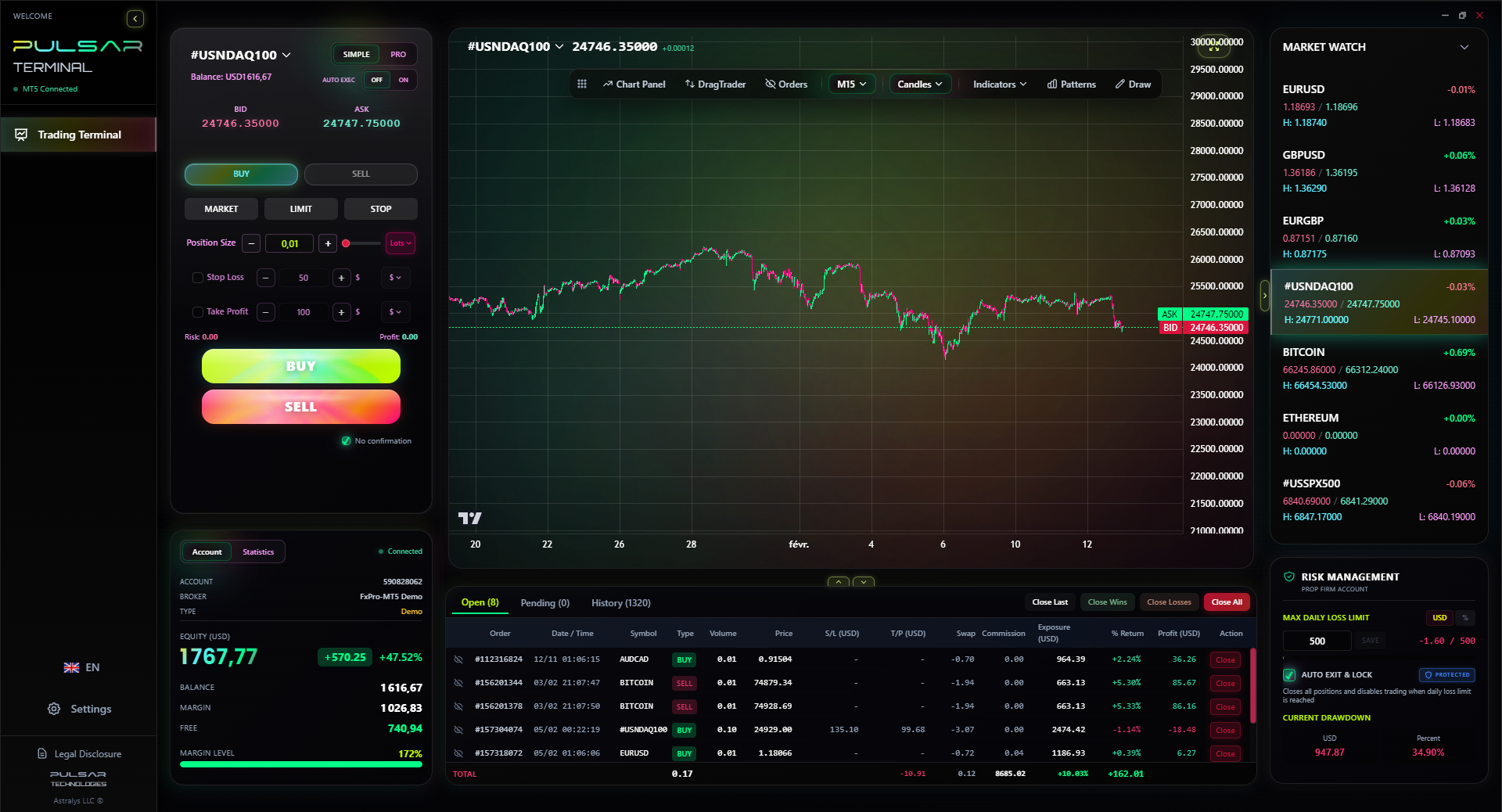
Building a real edge requires removing emotion from execution, which is exactly what Pulsar Terminal's drag-and-drop orders and automated trade management tools are designed to do on your MT5 platform.
Pulsar Terminal
เครื่องมือ MT5 ครบวงจร: ลากวางคำสั่ง, multi-TP/SL, trailing stop, grid trading, Volume Profile และการป้องกัน prop firm ใช้งานโดยเทรดเดอร์กว่า 1,000 คนทุกวัน
“Using 1:500 on a $100 account means you're not trading price action; you're betting on a coin flip with your rent money.”
Trading with an unregulated or shady broker is like betting in a dark alley. You might get lucky, but the odds are stacked against you in ways you can't see.
For Nigerian traders, I recommend brokers with strong international regulation (like ASIC, FCA, CySEC) that accept Nigerian clients. Why? Because their platforms are stable during volatility, their pricing is transparent, and your funds are segregated. You can compare specifics in our deep dives on XM review or Pepperstone review.
Look at the real numbers:
- Minimum Deposit: Can you start small to test your strategy without risking life-changing money? Some offer $5-$10 minimums.
- Spreads & Commissions: Are they transparent? Know your total cost per trade.
- Withdrawal Process: How easy is it to get your money back in Naira? What are the fees?
A good broker provides a fair playing field. A bad one has re-quotes, slippage on stops, and mysterious 'technical issues' when you're winning. If your broker feels like a betting shop, it probably is one.
💡 เคล็ดลับจาก Winston
Your trading journal is your truth serum. A losing trade with a good process is a win for your system. A winning trade with a bad process is a long-term loss.
“A stop-loss order is your admission ticket to the world of trading.”
So, is forex betting? The market itself is not. It's a global, liquid financial market. But the way most people approach it - especially with tiny accounts and massive use - is indistinguishable from high-stakes gambling.
The verdict depends entirely on you.
If you trade without a plan, risk 10% of your account per trade, chase losses, and rely on gut feelings, then yes, for you, it is betting. You will lose. It's a certainty.
If you treat it like a business - with a tested strategy, strict risk management (never more than 1-2% per trade), a trading journal, and continuous education - then it's a skilled profession. The potential is real, but the path is hard.
I'll leave you with this. The single most profitable change I ever made was automating my risk management. It took the emotion, the hesitation, and the gambling instinct right out of my hands. When a trade hits its stop, it's gone. I don't have to decide. That alone saved me from blowing up a second account.
The difference between forex trading and forex betting isn't found in the charts. It's found in your discipline, your spreadsheet, and your ability to follow your own rules when every emotion is telling you to break them.
FAQ
Q1Is forex trading illegal or considered betting in Nigeria?
No, it's not illegal. Forex trading for individuals is legal in Nigeria. The 'betting' perception comes from people using excessive use and trading without a plan, which mimics gambling behavior. The CBN prohibits using official forex windows to fund accounts, but trading with your own legitimately sourced foreign currency is allowed.
Q2What's a safe use for a beginner in Nigeria?
Forget what your broker offers. Start with no more than 1:10 or 1:20. Seriously. Even that is powerful. Using 1:100 or 1:500 as a beginner isn't trading; it's making a leveraged bet where a tiny move wipes you out. Professional traders use low use for a reason.
Q3Do I pay tax on forex profits in Nigeria?
Yes. You are required to pay a 10% capital gains tax on your gross trading profits. You must report this income to the Nigerian tax authorities. Trading with an international broker doesn't exempt you from local tax obligations.
Q4How much money do I need to start real trading, not betting?
It's less about the amount and more about what it represents. You need enough so that a 1-2% risk per trade is a meaningful amount to manage psychologically, but not so much that losing it would hurt. For many, starting with the equivalent of $200-500 (₦280k-₦700k) is sensible, provided you use proper position sizing. Starting with $10 and 1:1000 use is a guaranteed way to lose.
Q5What's the biggest sign I'm betting instead of trading?
You don't have a pre-defined stop loss for every trade. If you don't know exactly where you'll admit you're wrong before you enter, you're gambling. You're hoping, not managing risk. A stop-loss order is your admission ticket to the world of trading.
Q6Can I use the official CBN rate to fund my forex account?
Absolutely not. This is explicitly prohibited by the CBN and is considered economic sabotage. You must use your own personally sourced foreign exchange, typically acquired through the parallel market or other legal personal channels.
Q7Are international brokers safe for Nigerian traders?
They can be, but you must do your homework. Prioritize brokers regulated by top-tier authorities like the UK's FCA or Australia's ASIC. Check our broker reviews for details on which ones accept Nigerian clients and their specific terms. Your safety depends on the broker's regulation, not its marketing.
บทเรียนจาก Prof. Winston
สรุปสาระสำคัญ:
- ✓Legal doesn't mean safe; your discipline defines the risk.
- ✓use above 1:30 turns most retail accounts into casinos.
- ✓Your edge is a process, not a prediction.
- ✓A trade without a pre-set stop loss is a gamble, not an investment.
- ✓Tax on profits is 10%; factor it into your risk-reward math.
บทความนี้มีประโยชน์แค่ไหน?
คลิกดาวเพื่อให้คะแนน
ข้อมูลเชิงลึกการเทรดรายสัปดาห์
การวิเคราะห์และกลยุทธ์รายสัปดาห์ฟรี ไม่มีสแปม
เกี่ยวกับผู้เขียน
Olumide Adeyemi
ผู้บุกเบิกการเทรดในแอฟริกาตะวันตก
หนึ่งในนักการศึกษาฟอเร็กซ์ที่กระตือรือร้นที่สุดของไนจีเรีย 8 ปีประสบการณ์เทรดจากลากอส เชี่ยวชาญกลยุทธ์ทุนต่ำและความท้าทาย prop firm สำหรับเทรดเดอร์ในแอฟริกา
ความคิดเห็น
คำเตือนความเสี่ยง
การซื้อขายตราสารทางการเงินมีความเสี่ยงสูงและอาจไม่เหมาะสำหรับนักลงทุนทุกคน ผลการดำเนินงานในอดีตไม่ได้รับประกันผลลัพธ์ในอนาคต เนื้อหานี้มีวัตถุประสงค์เพื่อการศึกษาเท่านั้นและไม่ควรถือเป็นคำแนะนำในการลงทุน โปรดทำการวิจัยของคุณเองก่อนการซื้อขาย
คุณอาจชอบสิ่งนี้

Cara Trading Forex Sukses: 7 Prinsip dari Trader Profesional
Cara trading forex sukses dengan 7 prinsip trader pro: manajemen modal, disiplin, journal trading, backtest. Data nyata, bukan janji profit palsu.
Jam Trading Forex Terbaik untuk Trader Indonesia: Panduan Lengkap dengan Tabel Waktu
Panduan jam trading forex untuk trader Indonesia. Tabel 4 sesi dunia, jam emas 20:00-00:00, sesi mana yang harus dihindari. Data akurat + tips dari trader berpengalaman.
Top 5 Sàn Forex Uy Tín Nhất 2026: Review Jujur dari Trader Indonesia
Top 5 sàn forex uy tín 2026 untuk trader Indonesia. Review jujur: spread, deposit, withdraw, dukungan lokal. Exness, XM, IC Markets & lebih.
รับ Pulsar Terminal
เครื่องคำนวณทั้งหมดนี้ถูกสร้างไว้ใน Pulsar Terminal พร้อมข้อมูลเรียลไทม์จากบัญชี MT5 ของคุณ
รับ Pulsar Terminal