


You're sitting there, probably after watching some YouTube guru talk about making thousands from EUR/USD, wondering: 'Can I actually do this without getting in trouble?' Good.

Rajesh Sharma
นักวิเคราะห์ฟอเร็กซ์อาวุโส ·  India
India
☕ 11 นาทีอ่าน
สิ่งที่คุณจะได้เรียนรู้:
You're sitting there, probably after watching some YouTube guru talk about making thousands from EUR/USD, wondering: 'Can I actually do this without getting in trouble?' Good. You should be asking that. In India, the answer isn't a simple yes or no. It's a 'yes, but...' followed by a list of regulations that will make your head spin if you're not careful. I've seen too many traders, including a younger version of myself, jump in without understanding the legal minefield. Let's clear this up once and for all.
Forex trading in India doesn't operate in a free-for-all zone. It's governed by the Foreign Exchange Management Act (FEMA) of 1999, with the Reserve Bank of India (RBI) and the Securities and Exchange Board of India (SEBI) acting as the watchdogs. Think of them as the strict parents who set the house rules.
The core principle is this: you can trade currency derivatives involving the Indian Rupee (INR) on Indian exchanges. That's the legal path. Anything that smells like speculative trading of foreign currency pairs through an offshore entity? That's where you step into the grey area, which often tilts toward black.
SEBI regulates the brokers and exchanges where you can legally trade INR pairs. The RBI controls the flow of money out of the country through schemes like the Liberalised Remittance Scheme (LRS), which has a $250,000 annual limit. Here's the kicker: that LRS money explicitly cannot be used for margin trading or speculative forex on overseas platforms. They've spelled that out to close a loophole many were using.

Warning: Using your LRS limit to fund an international broker account for trading EUR/USD is a direct violation of RBI rules. You might get away with it for a while, but if it's flagged, the penalties and tax implications are severe. I know guys who've had their bank accounts frozen for less.

💡 เคล็ดลับจาก Winston
A legal trade on a narrow market is better than a profitable trade that keeps you awake fearing a notice from the ED. Security first, excitement second.
If you want to stay 100% within the law, your menu is short and specific. You are permitted to trade currency futures and options on recognized Indian exchanges like the NSE, BSE, or MSE. The key condition? The Indian Rupee must be one of the currencies in the pair.
The Approved Currency Pairs
Your legal trading options are limited to these four pairs:
- USD/INR
- EUR/INR
- GBP/INR
- JPY/INR
You'll execute these trades through a SEBI-registered domestic broker like Zerodha, Upstox, or ICICI Direct. The trading happens on the exchange, which provides transparency and regulatory oversight. This is the equivalent of trading stocks or indices, but with currencies.
How It Differs from International Forex
This isn't the 24/5 spot forex market you see advertised. These are exchange-traded derivatives with fixed lot sizes, expiry dates, and trading hours. The liquidity is massive - daily turnover hit $60 billion in 2024 - but the behavior can be different from the global EUR/USD market. You need to understand the local factors that move the INR, like RBI interventions, crude oil prices, and domestic political news.

Example: Let's say you buy one lot of USD/INR futures on the NSE. One standard lot is 1000 USD. If the rate moves from 83.50 to 83.70, that's a 20 paise move. Since each paise change is worth ₹100 per lot (1000 USD * 0.01), your profit would be 20 * ₹100 = ₹2,000, minus brokerage and taxes.
“The middle ground - where most retail forex activity happens - is a grey zone of unenforced prohibition. It's tolerated until it isn't.”
Let's be brutally honest. A huge portion of Indian retail traders are not trading USD/INR futures on the NSE. They're on MetaTrader 5 with IC Markets, Pepperstone, or Exness, trading EUR/USD, Gold, and indices. This is the elephant in the room.
These international brokers are not regulated by SEBI. They operate from offshore jurisdictions like Cyprus, Australia, or the Seychelles. They accept Indian clients, process deposits (often via UPI or Netbanking to local payment agents), and provide use up to 1:500 or more. Technically, this activity falls outside the permitted use of foreign exchange under FEMA for residents. The RBI has repeatedly clarified that remittances under LRS cannot be used for margin trading on such platforms.
So why is it so common? Enforcement is challenging. The broker is overseas, the transaction is digital, and many operate in a regulatory grey zone. But 'common' doesn't mean 'legal' or 'safe'. You have no recourse with SEBI if the broker vanishes with your money. Your bank could refuse the transaction or question the remittance. I had a withdrawal held up for three weeks once while my bank's compliance team asked for a dozen documents proving the source of funds. It was a nightmare.
The risk isn't just theoretical. In early 2026, the RBI tightened norms further, specifically banning banks from offering certain non-deliverable forward contracts involving the INR to curb speculation. The direction is clear: they're cracking down on speculative flows that can destabilize the rupee.
Whether you trade legally on an exchange or go the international route, the costs will eat into your profits. You need to account for all of them.
Trading on Indian Exchanges
- Brokerage: Usually a flat fee per trade or a percentage of turnover. Can be as low as ₹20 per executed order for discount brokers.
- Exchange & SEBI Charges: Small statutory fees added to each trade.
- Taxes: This is the big one. Every profitable trade in the derivatives segment (which includes currency futures) is subject to the Securities Transaction Tax (STT). Then, your net profit at the end of the year is added to your income and taxed according to your slab rate. There's no 'business income' classification benefit here for most retail traders.
Trading with International Brokers
- Spreads: This is your main cost. On major pairs like EUR/USD, raw spreads can start from 0.0 pips on ECN accounts, but you pay a commission (e.g., $7 per round lot). On standard accounts, expect 0.8-1.5 pips.
- Payment Gateway Fees: This hurts. Depositing via international card or e-wallet? You're looking at 3-5% in forex markup and transaction fees. Some brokers have local agents who accept UPI, which reduces cost but adds another layer of opacity.
- Taxes (The Complicated Part): Your profits from international trading are considered 'Income from Other Sources' or speculative business income. You must declare it in your ITR. The headache is calculating profit & loss in INR when your trades are in USD, accounting for currency fluctuations. I keep a separate spreadsheet just for this, and my CA charges extra every year to reconcile it.

Pro Tip: Before you even place a trade, use a position size calculator. Factor in all costs - spread, commission, potential payment fees. If your strategy needs a 10-pip move to break even because of wide spreads and fees, you're already at a huge disadvantage.
💡 เคล็ดลับจาก Winston
If you insist on the international route, pick a broker with a physical presence in a strong regulatory jurisdiction like Australia (ASIC). It's not a shield from Indian law, but it's better than a shell company on an island.
“Sometimes, the regulations that feel restrictive are actually saving you from yourself.”
Your choice of broker dictates your legal exposure and trading experience. Here's a blunt comparison.
| Aspect | SEBI-Regulated Domestic Broker (e.g., Zerodha) | International Broker (e.g., IC Markets, XM) |
|---|---|---|
| Legal Status | Fully legal for INR pairs. | Operates in a regulatory grey area for Indian residents. |
| Available Pairs | Only 4 INR pairs (USD/INR, EUR/INR, etc.). | 50+ pairs, including majors, minors, exotics, XAU/USD, indices, crypto. |
| use | Lower, as per SEBI norms (likely 1:10 or similar). | High, often 1:100 to 1:500+. |
| Platform | Proprietary platforms (Kite) or limited MT support. | Full MT4/MT5, cTrader, TradingView. |
| Deposit/Withdrawal | Seamless via UPI, Netbanking. Instant. | Can be tricky; may involve higher fees and agent networks. |
| Client Protection | You are protected by Indian law and SEBI's investor fund segregation. | Depends on the broker's offshore regulator (CySEC, ASIC, etc.). Harder to pursue legally. |
| Biggest Risk | Limited market opportunities. | Legal ambiguity, potential fund blockage, no SEBI recourse. |
I've used both. The domestic platforms are rock-solid for what they offer. The international brokers provide the real 'forex' experience with advanced tools. But with the latter, I sleep a little less soundly knowing my entire trading capital exists in a jurisdiction I can't easily visit. When XM had a server outage during a major news event a few years back, I was just a support ticket number. With a domestic broker, I have a physical office address and a SEBI registration number to complain to.
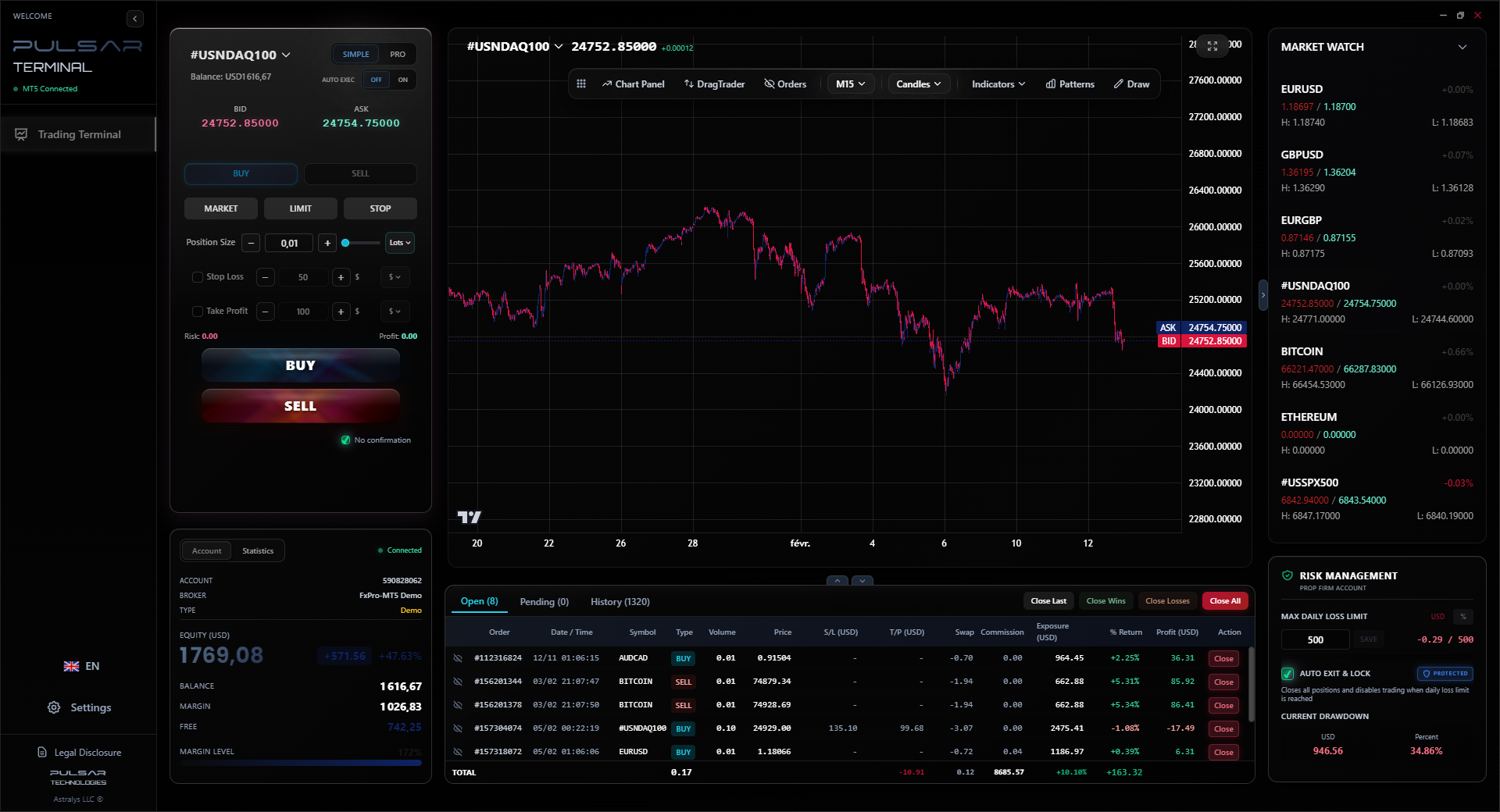
Managing complex trades and strict risk rules—essential for any market—is far easier with tools that automate partial closures and trailing stops directly on your MT5 platform.
Pulsar Terminal
เครื่องมือ MT5 ครบวงจร: ลากวางคำสั่ง, multi-TP/SL, trailing stop, grid trading, Volume Profile และการป้องกัน prop firm ใช้งานโดยเทรดเดอร์กว่า 1,000 คนทุกวัน
I learned about the legal nuances the hard way. Around 2015, I was all in on international brokers. The use, the pairs, the excitement. I ignored the legal whispers. Then, I hit a big winner - a £15,000 profit on a GBP/JPY swing trade. Getting the money back was the problem.
My bank flagged the incoming wire. They asked for contracts, proof of the income's nature, and tax paid at source. The broker provided generic documents. The bank wasn't satisfied. The money sat in a 'suspense account' for over a month while I scrambled. I eventually got it after paying a hefty fee and providing a sworn declaration. The tax consultant's bill that year was another shock. He had to convert every single trade from GBP and JPY to INR at the historical rate on the day of each trade. The accounting cost nearly 20% of the profit.
Another time, I got too aggressive with use on an international account, ignoring proper margin call warnings. A gap move wiped out the account. With a SEBI broker, there are stricter use limits that would have prevented that level of self-destruction. Sometimes, the regulations that feel restrictive are actually saving you from yourself.
The lesson? If you go the international route, start small. Treat it as risk capital you're prepared to lose, not just to the markets, but to operational and legal friction. And for god's sake, keep immaculate, trade-by-trade records in INR from day one.
“Your risk isn't just market risk; it's regulatory risk, banking risk, and tax complication risk.”
If you're new and want to stay clean, here's your action plan.
- Open a Demat & Trading Account with a SEBI-registered broker that offers currency derivatives. Zerodha, Upstox, Angel One are popular choices. Complete your KYC.
- Fund Your Account using UPI or Netbanking. It's instant and free.
- Learn the Product. Don't assume USD/INR behaves like EUR/USD. Study the contract specifications: lot size (1000 USD), expiry date (usually last Thursday of the month), tick size (0.25 paise). Paper trade first.
- Use the Platforms. Get familiar with the broker's platform or see if they offer MT5 for derivatives (some do). The tools might be different from what you see on YouTube.
- Develop a INR-Specific Strategy. Focus on economic events that impact the rupee: RBI monetary policy, US Fed decisions, crude oil prices, domestic inflation data. Use indicators like the MACD or RSI, but backtest them on the USD/INR chart, not EUR/USD.
This path is less glamorous. You won't be trading the Australian dollar during the Asian session. But you can build real skill, understand your home currency, and sleep at night without worrying about a regulatory notice. Once you're consistently profitable here, then you can consciously decide if you want to explore the grey area with a small portion of your capital, fully aware of the risks.
💡 เคล็ดลับจาก Winston
Your first ₹50,000 in profits will likely go to your chartered accountant if you trade internationally. Factor that into your risk-reward calculations from day one.
So, is forex trading legal in India? The answer is layered.
Yes, forex trading is legal if you are trading INR-based currency derivatives (USD/INR, EUR/INR, GBP/INR, JPY/INR) on Indian stock exchanges through a SEBI-regulated broker.
No, it is not legal to use overseas brokers/platforms to speculate on non-INR currency pairs (like EUR/USD) as a resident Indian, as it violates FEMA guidelines. This is the activity the RBI is increasingly scrutinizing.
The middle ground - where most retail forex activity happens - is a grey zone of unenforced prohibition. It's tolerated until it isn't. Your risk isn't just market risk; it's regulatory risk, banking risk, and tax complication risk.
My advice? Start legal. Master the 4 pairs you're allowed. Understand the spread, the pip value in paise, and the tax impact. Build a track record. If you later decide to venture out, do so with your eyes wide open, with money you can afford to lose in every sense. The market isn't going anywhere. Building a solid, legal foundation is slower, but it's the only one that won't potentially crumble beneath you.
FAQ
Q1Can I legally trade EUR/USD from India?
No, not through legal channels available to resident retail traders. Trading major pairs like EUR/USD requires using an international broker not regulated by SEBI, which falls outside the permitted uses of foreign exchange under FEMA and RBI's Liberalised Remittance Scheme (LRS).
Q2What is the penalty for illegal forex trading in India?
Violations of FEMA are civil offenses handled by the RBI's Enforcement Directorate. Penalties can be up to three times the amount involved in the contravention, or ₹2 lakh if the amount cannot be quantified. In severe cases, it can lead to prosecution and imprisonment. Your bank may also freeze accounts involved in such transactions.
Q3Can I use TradingView for legal forex trading in India?
Yes, but only for analysis. You can use TradingView to analyze USD/INR charts. However, to execute trades legally, you must connect TradingView to your SEBI-regulated broker's account (if supported) to trade on the NSE/BSE. You cannot use TradingView to place trades directly with an offshore broker for non-INR pairs from India.
Q4Do I have to pay tax on profits from international forex trading?
Yes, absolutely. All global income is taxable in India. Profits from international forex trading are considered 'Income from Other Sources' or speculative business income. You must convert each trade's P&L to INR using the exchange rate on the transaction date and declare it in your Income Tax Return (ITR). Failure to do so can lead to penalties and prosecution for tax evasion.
Q5Is the Liberalised Remittance Scheme (LRS) limit of $250,000 for forex trading?
No. The RBI explicitly states that the LRS cannot be used for margin trading, derivative trading, or speculative forex trading on overseas platforms. The LRS is for purposes like education, travel, medical treatment, and investments in overseas stocks (not CFDs/forex). Using it for forex trading is a violation.
Q6Are international brokers like IC Markets or Exness banned in India?
They are not officially 'banned' by name, but they are not authorized or regulated by SEBI to offer forex trading services to Indian residents. They operate from offshore jurisdictions. Indian banks and payment gateways are increasingly instructed not to help transactions for speculative forex trading, making deposits and withdrawals challenging.
บทเรียนจาก Prof. Winston
สรุปสาระสำคัญ:
- ✓Only 4 pairs are 100% legal: USD/INR, EUR/INR, GBP/INR, JPY/INR.
- ✓Using LRS $250k limit for forex is an explicit RBI violation.
- ✓International broker profits are taxable; accounting costs ~20%.
- ✓SEBI brokers offer safety but limited instruments.
- ✓Daily INR forex turnover hit $60 billion in 2024.
บทความนี้มีประโยชน์แค่ไหน?
คลิกดาวเพื่อให้คะแนน
ข้อมูลเชิงลึกการเทรดรายสัปดาห์
การวิเคราะห์และกลยุทธ์รายสัปดาห์ฟรี ไม่มีสแปม
เกี่ยวกับผู้เขียน
Rajesh Sharma
นักวิเคราะห์ฟอเร็กซ์อาวุโส
ซื้อขายในตลาดอินเดียและเอเชียใต้มากกว่า 10 ปี เริ่มต้นจากอนุพันธ์สกุลเงินของ NSE ก่อนเข้าสู่ตลาดฟอเร็กซ์สากล เชี่ยวชาญคู่ USD/INR และคู่สกุลเงินตลาดเกิดใหม่
ความคิดเห็น
คำเตือนความเสี่ยง
การซื้อขายตราสารทางการเงินมีความเสี่ยงสูงและอาจไม่เหมาะสำหรับนักลงทุนทุกคน ผลการดำเนินงานในอดีตไม่ได้รับประกันผลลัพธ์ในอนาคต เนื้อหานี้มีวัตถุประสงค์เพื่อการศึกษาเท่านั้นและไม่ควรถือเป็นคำแนะนำในการลงทุน โปรดทำการวิจัยของคุณเองก่อนการซื้อขาย
คุณอาจชอบสิ่งนี้

Cara Trading Forex Sukses: 7 Prinsip dari Trader Profesional
Cara trading forex sukses dengan 7 prinsip trader pro: manajemen modal, disiplin, journal trading, backtest. Data nyata, bukan janji profit palsu.
Jam Trading Forex Terbaik untuk Trader Indonesia: Panduan Lengkap dengan Tabel Waktu
Panduan jam trading forex untuk trader Indonesia. Tabel 4 sesi dunia, jam emas 20:00-00:00, sesi mana yang harus dihindari. Data akurat + tips dari trader berpengalaman.
Top 5 Sàn Forex Uy Tín Nhất 2026: Review Jujur dari Trader Indonesia
Top 5 sàn forex uy tín 2026 untuk trader Indonesia. Review jujur: spread, deposit, withdraw, dukungan lokal. Exness, XM, IC Markets & lebih.
รับ Pulsar Terminal
เครื่องคำนวณทั้งหมดนี้ถูกสร้างไว้ใน Pulsar Terminal พร้อมข้อมูลเรียลไทม์จากบัญชี MT5 ของคุณ
รับ Pulsar Terminal